



Press Release

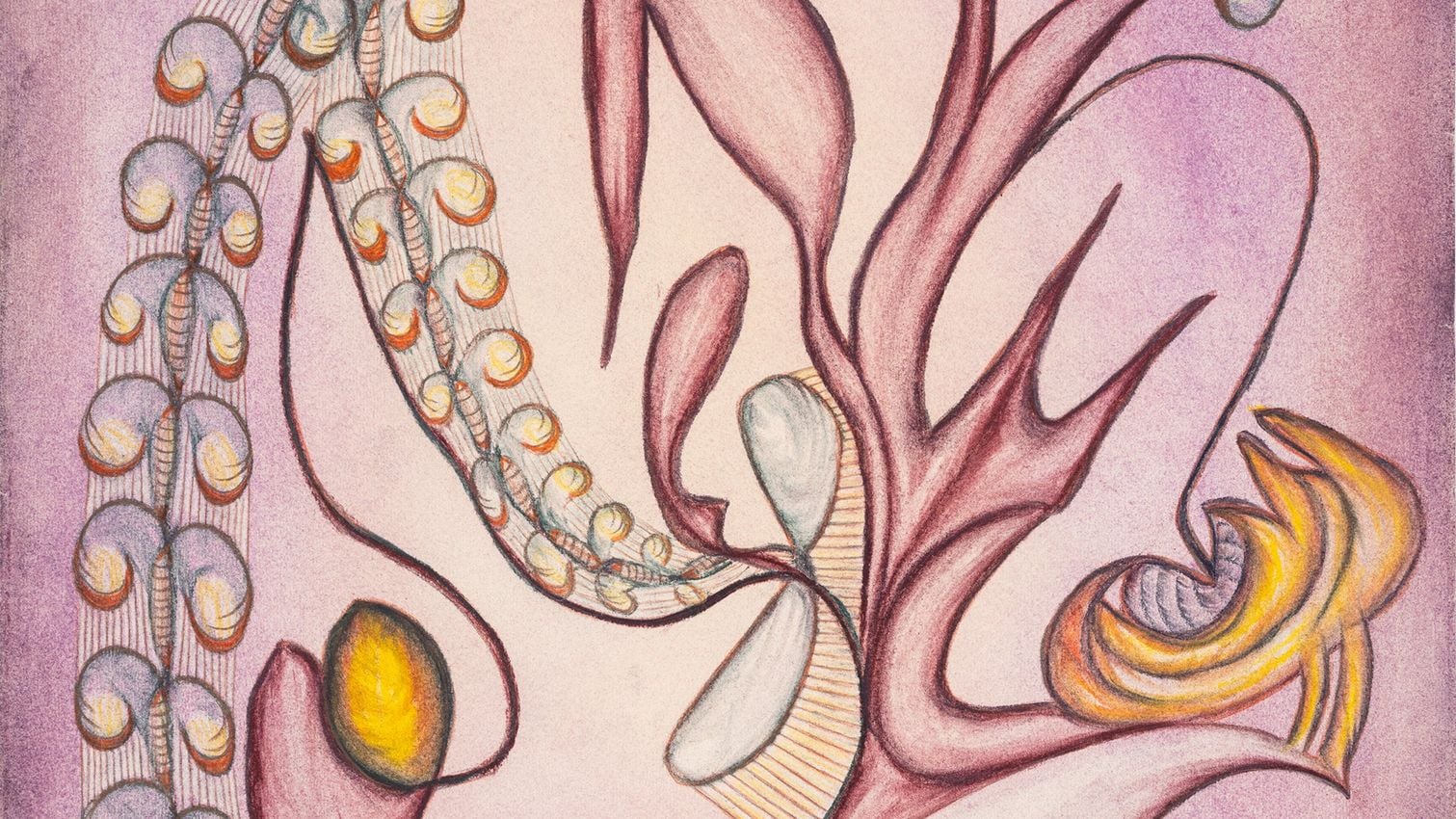
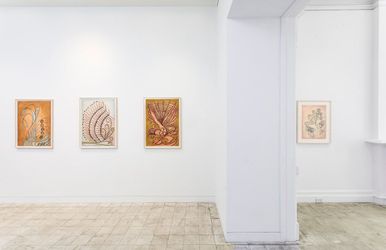
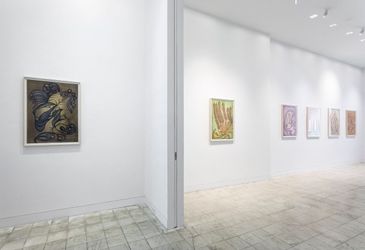
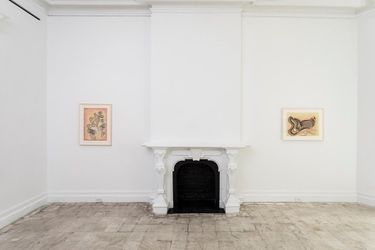
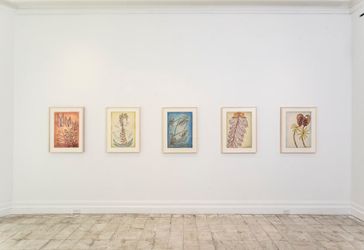
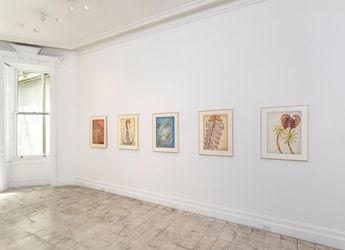
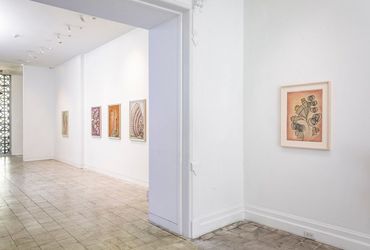
This May, Gladstone Gallery presents an exhibition of drawings by Czech artist Anna Zemánková (1908–1986), spanning her oeuvre from the 1960s-1970s. This exhibition emphasises the remarkable foresight of Zemánková’s work through an art historical lens, reflecting her trailblazing influence in abstraction and seeks to expand the psychological and spiritual realms of the form. The works in the show comprise rarely seen incandescent botanical drawings and pastel works on paper.

To engage with Zemánková’s art is to enter a realm of fluid metamorphosis. Her compositions pulse with biological urgency, as if each line were a living organism. Untitled(1970s), reminiscent of the zither her father once played at weddings, radiates effervescent yellows laced with electrifying blues, its thorns piercing velvety curves. Fibrous strings extend like tentacles or arpeggios of colour. Here, sound becomes substance in a stunning manifestation of synesthesia: a shimmering grid of magnified cork-cells vibrate with Charles Lloyd’s spatial melisma. Zemánková’s visual language thrives on the duality of microscopic precision and cosmic abstraction, a tension mirroring her process—trance-like improvisation guided by innate musicality.

A dentist, mother, and grandmother, Zemánková channeled life’s multiplicities into creations that defy simple categorisation. While often compared to mediumistic artists such as Kunz or Klint, Zemánková’s work rarely touches on spirituality directly, instead rooting itself in the subconscious—what the Surrealists termed ‘pure psychic automatism.’ In her quotidian back-and-forth between labor and leisure, Zemánková found a way to forge her cellular patterns into networks of visual information and stimulation, liberating herself from the physical confinement imposed by her diabetes. Her refusal to title works, another deliberate act of liberation, invites viewers to project their own narratives onto her wildly imaginative botany. Cleaving open otherworldly spaces with her art, Zemánková’s legacy lies in her fantastical elsewhere.

Born in Moravia, Zemánková came of age during the collapse of the Austro-Hungarian Empire and the birth of an independent Czechoslovakia in 1918. This era fostered a fervent patriotism, marked by a devotion to preserving cultural traditions such as folk costumes, songs, fairy tales, and ornamental drawings. These influences ignited Zemánková’s early passion for painting. Though gifted in depicting colourful, realistic landscapes, her parents discouraged her from attending art school, redirecting her toward dentistry. Amid the turmoil of political and social upheaval, Zemánková followed a conventional path: marriage, motherhood, and grandmotherhood—roles that temporarily eclipsed her artistic ambitions.

Zemánková’s artistic rebirth began serendipitously. In the late 1950s, her sons Slavomír and Bohumil discovered a forgotten suitcase filled with her early paintings in the family basement. Recognising the vitality of these works, they encouraged her to resume painting—a therapeutic act that blossomed into an astonishing late-career surge. Though self-taught, Zemánková was no recluse. Her son Bohumil and daughter-in-law Markét a, both trained sculptors, admired her intuitive genius, as did a circle of cultural figures including artist Jan Reich, filmmaker Vlastimil Venclík, and even First Lady of the Czech Republic, Olga Havlová. Zemánková actively courted public recognition, hosting an open house several times over the years (1964, 1967, 1968 and 1970). Her work was exhibited at Prague’s Theatre on the Balustrade in 1966 and later shown at London’s Hayward Gallery in 1979.

In the quiet hours before dawn, she would rise in her Prague apartment, surrounded by real and artificial flowers, and surrender to the classical music of Beethoven and Janáček or the Jazzy Blues of Charles Lloyd. These solitary sessions, lit by the soft glow of imagination, became her sanctuary. With paper as her stage, she conjured a universe of pulsating tendrils, succulent petals, and coiled organic forms—a paradise of biomorphic flowers that blurred the boundaries of reality. Born from the shadows of personal suffering, her work invites the viewer into a kaleidoscopic garden where beauty and the grotesque intertwine, where music morphs into matter, and where creation itself becomes transcendence.

This exhibition is presented in collaboration with the Estate of Anna Zemánková and Cavin-Morris Gallery.

‘Sure, I’ll draw you something, I’ll draw you one of my fantasies.’

—Anna Zemánková

Read More

Installation Views

About the Artist

Anna Zemánková (1908–1986) is considered one of the most important representatives of Art Brut. Her work is and was shown in the international pavilion at the Venice Biennale in 2024 and 2013. This has been preceded by international solo and group exhibitions since 1971. Among the most important were Outsiders at the Hayward Gallery in London in 1980 and the São Paolo Art Biennial in 1981. After her death, her work was shown in museums worldwide, in 1997 at the High Museum of Art Atlanta, USA, in 2007 at the Slovak National Gallery, Bratislava, in 2011 at the Museum Montanelli, Prague, the Saarland Gallery and the European Art Forum Berlin, in 2012 at the Museum of Art Kobe, Japan and the Hiroshima City Museum of Contemporary Art, Hiroshima, Japan, in 2017 at the Collection de l’Art Brut, Lausanne, Switzerland. It is part of numerous private and public collections, including Collection de l’Art Brut, Lausanne; Arnulf Rainer Collection; The Musgrave Kinley Outsider Art Collection; L’ Aracine; The Museum of Everything; and the abcd/Bruno Decharme Collection.

View Artist Profile

Also Exhibiting at Gladstone

About the Gallery
Gladstone is known for its commitment to artists whose prescient approaches and experimental practices have defined the contours of contemporary art. The gallery has long been an active partner in the cultivation of iconoclastic careers, fostering a roster of artists recognized for their ground-breaking contributions. Headquartered in New York and including outposts in both Brussels and Seoul, Gladstone’s impact extends globally, enabling both the presentation of new bodies of work, and an amplification of the international reach of its artists. Alongside its work with contemporary artists, the gallery is steward to the legacies of pivotal historical artists and serves as an advocate for the enduring power of art. Gladstone is led by a team of partners who spearhead its long-term vision and program, building on the values of its founder Barbara Gladstone.
View Gallery Profile
Address
130 East 64th Street
New York
United States
Opening Hours
Tuesday - Saturday
10am - 6pm
(1)
New York 130 East 64th Street
Gladstone
130 East 64th Street, New York, United States
+1 212 753 2200
http://gladstonegallery.com

Opening hours
Tuesday - Saturday
10am - 6pm
The art world in focus
