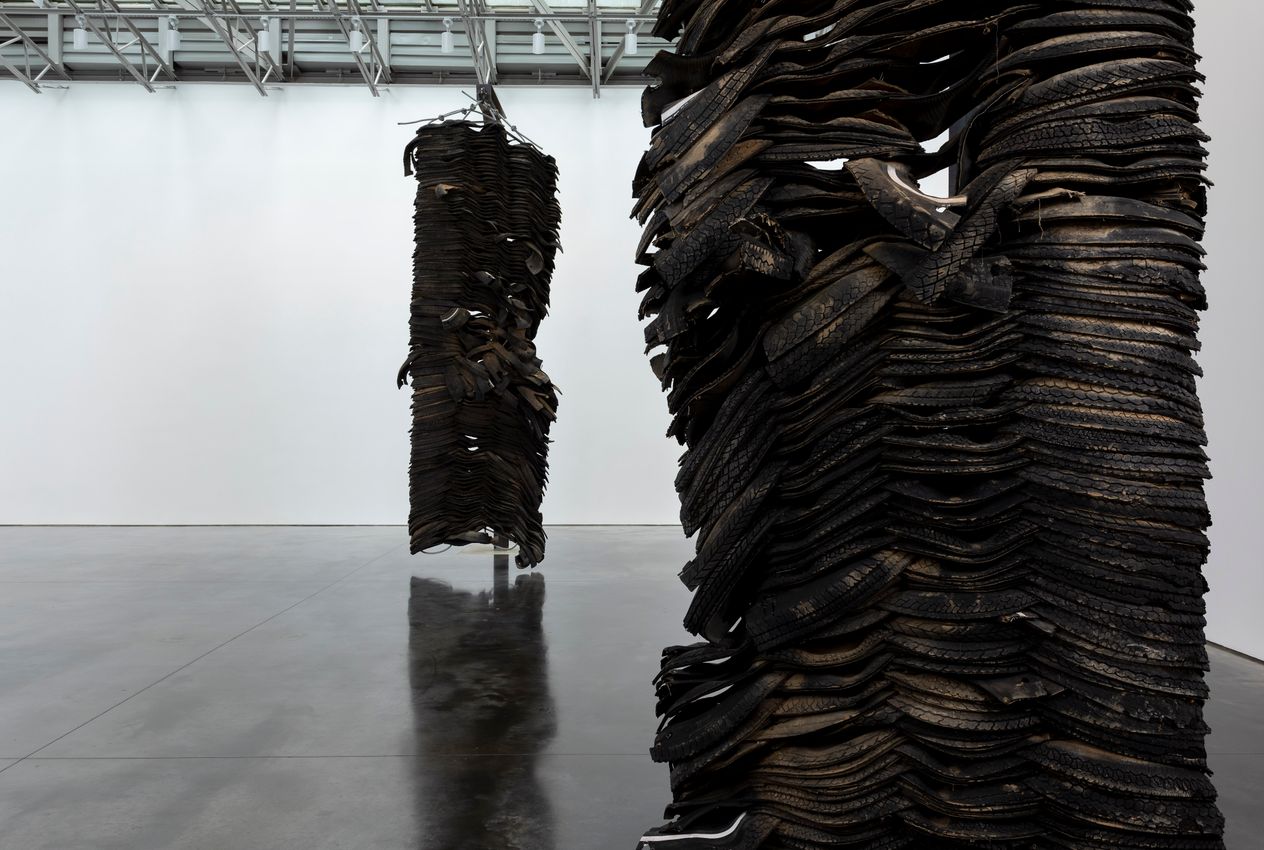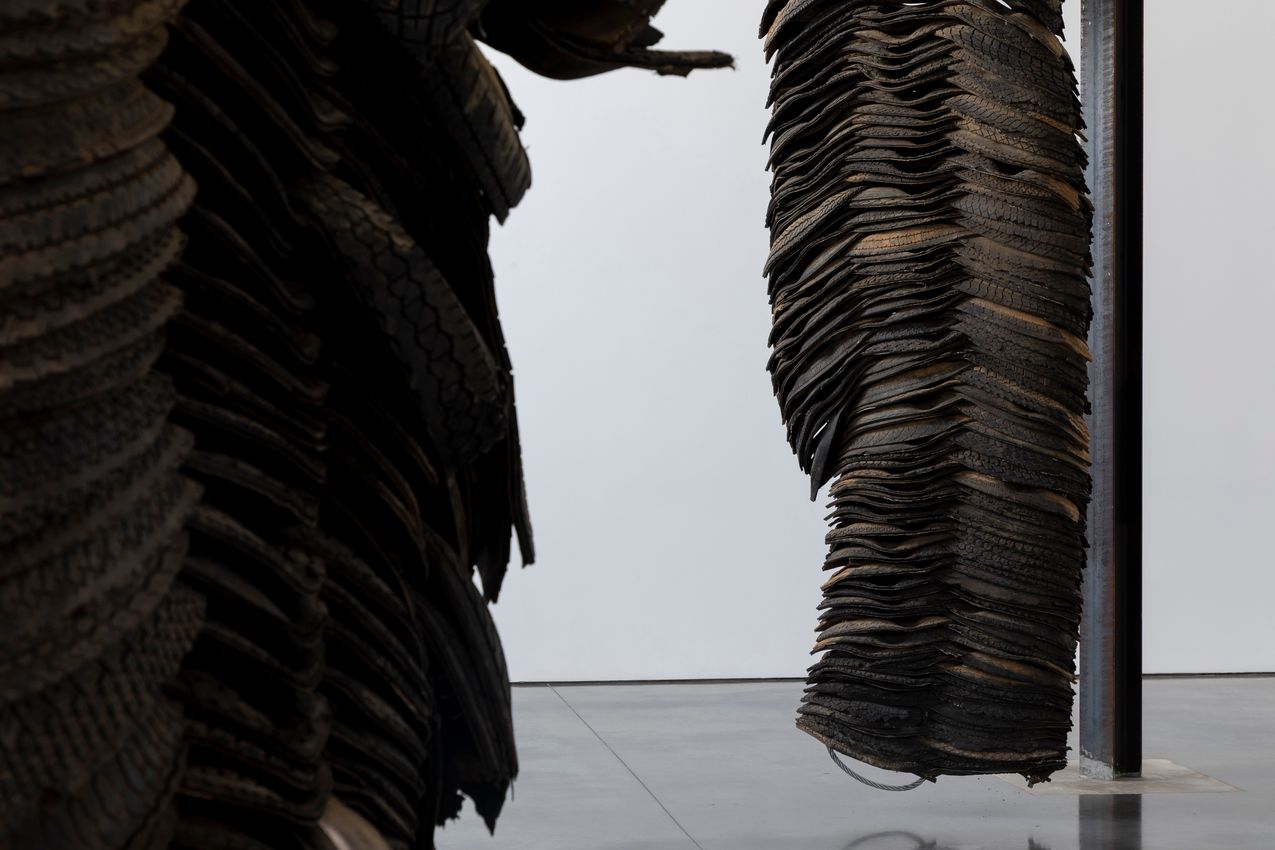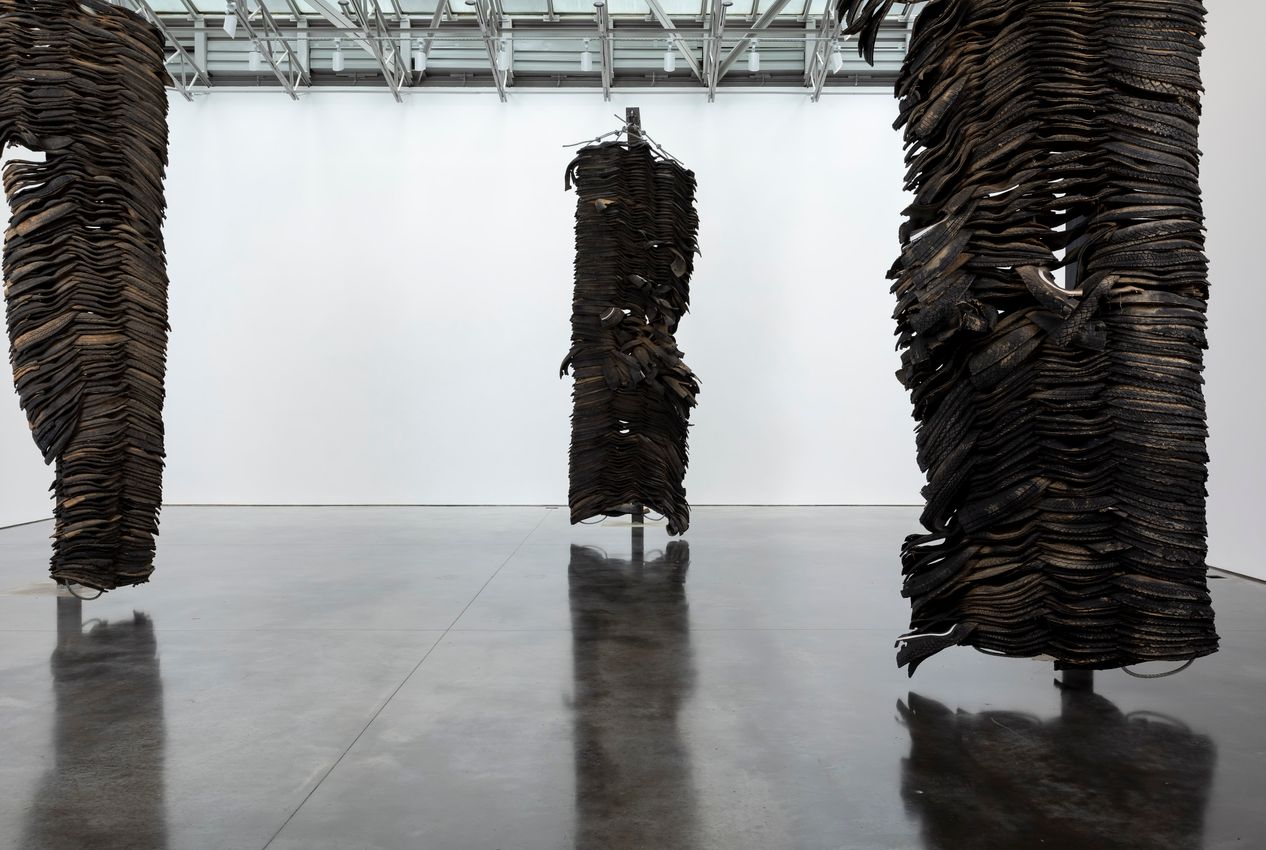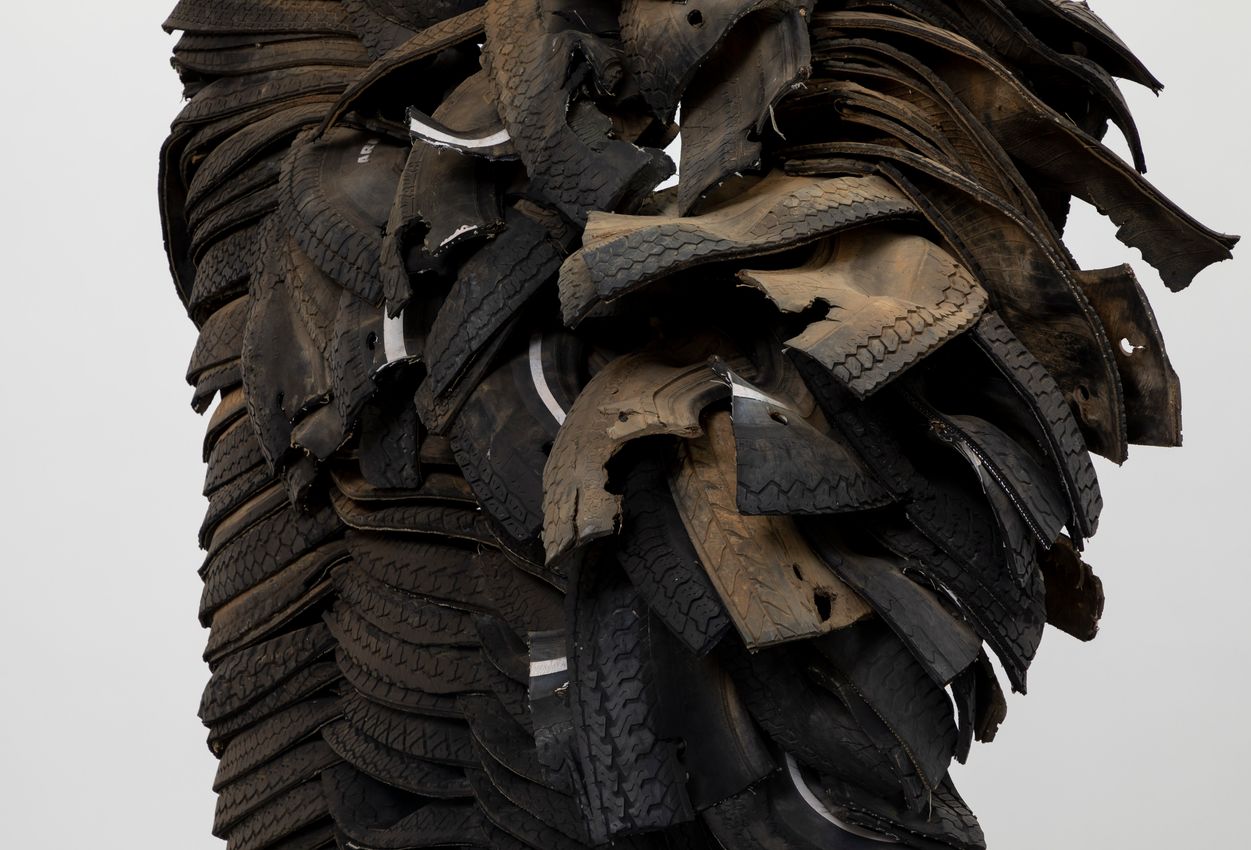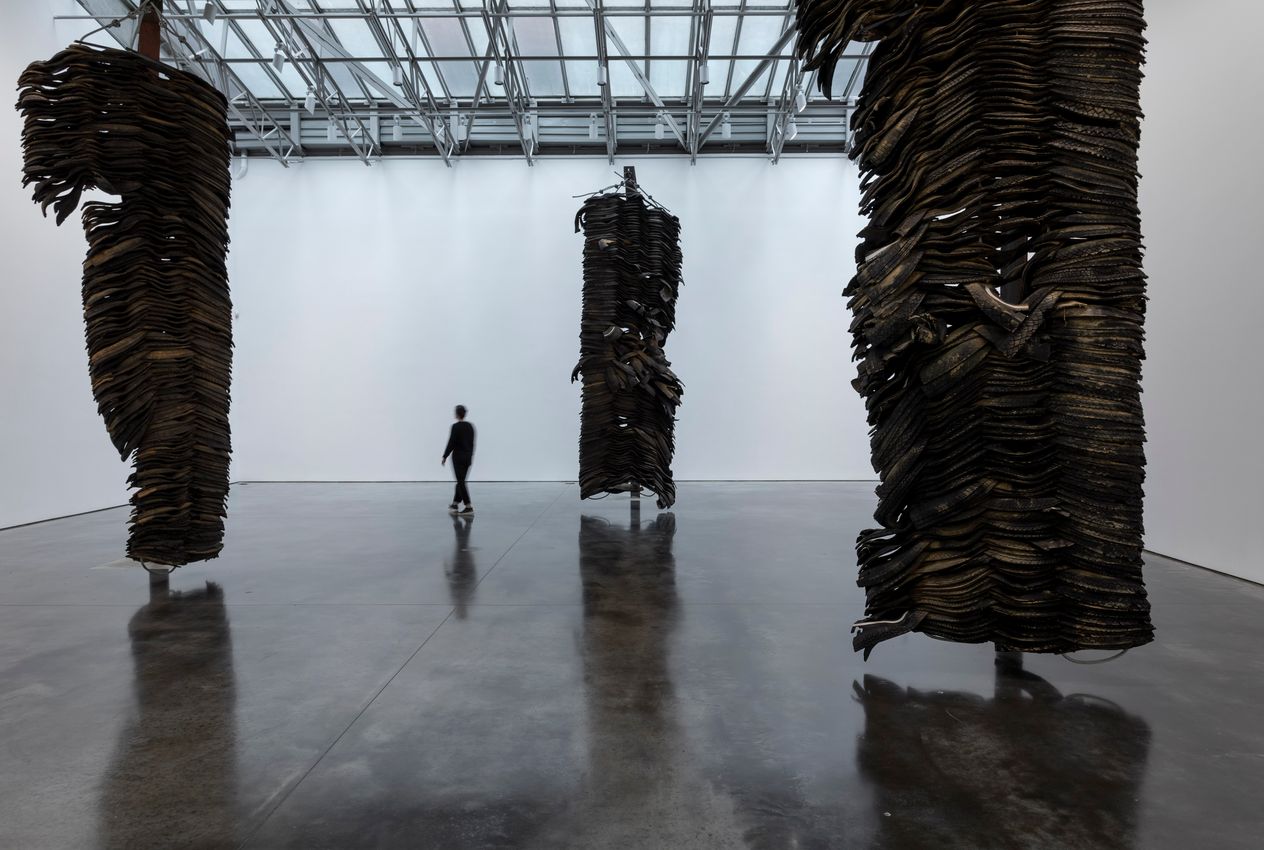
Blasting mats, for those unfamiliar, are heavy-duty mats stitched together from pieces of car tire, devised to catch flyrock from controlled explosions. Fifteen years ago, Richard Prince started making work from disused blasting mats, suspending them from customized frames at his studio in Rensselaerville. A trio of these sculptures, Untitled (Blasting Mats) (2006) are transposed to a gallery for the first time. They hang, slumped and heavy, from metal I-beams, structures with unforgiving, murderous associations.
The blasting mats belong to a vocabulary of impoverished imagery, much like the abandoned cars, solitary basketball hoops, and makeshift tire planters found scattered across rural New York, which Prince started photographing when he relocated Upstate in 1996. They are precisely the kind of object for the taking—readymade, symbolic...fictional. Contained within them are the vestiges of consumerism and industry and all their promises from the past. The artist’s further repurposing of auto parts conflates various junctures at which labor, lifestyle, and death are all, sometimes simultaneously, symbolized by the car. ‘The American dream has run out of gas,’ inferred J.G. Ballard, for whom the vehicle represented ‘the speed and violence of our age,’ back in the 1970s. The writer found the styling of the motor car— the American model in particular—to be the epitome of expectation at the time, offering a glimpse of the future, freedom, even an understanding of our very musculature. ‘These highly potent visual codes can be seen repeated in every aspect of the 20th Century landscape,’ he affirmed at a time when countercultural anti-heroes took to the road, and for whom speed meant freedom of the soul. Does such a vehicle of expression exist in the present age? Billie Eilish drives a Dodge Challenger, the same make Kowalski drove to his death in Vanishing Point (1971), which is either a case of everything old being new again or affirmation.
Strung up like racks of meat, Prince puts the butchery of the automobile on full view. Much like how blasting mats make use of recycled tires, the artist gleans from the leftovers of a culture already littered with its own remains. The carcass has been tradition for painters, allured by its viscera, and its inevitable comparisons to the crucifixion, the very embodiment of public execution. The sculptures bear more than a passing resemblance to the slabs of beef that hang in the background of Francis Bacon’s Figure with Meat (1954), a motif that the painter lifted from Rembrandt’s Slaughtered Ox (1655). Prince re-envisions the blasting mats as latter-day corpses, physical remnants of the speed and violence that defined an era of expectancy.
If history is an abattoir, ‘cursed and quarantined like a plague-ridden ship,’1 then the artist reveals what’s hidden from view from behind its doors to show how far our collective psyche has become detached from the sanctity of objects around us. Having trained his eye on discarded artifacts, or those that have become eviscerated from their own aspirational image, Prince’s blasting mats stand in as sculptural versions of the vanitas in still-life painting rendered in today’s vernacular—new symbols of inevitability culled from the American landscape.
1 Bataille, Georges. “Abattoir.” Documents, Number 6, November 1929, pp. 327-329.
Saim Demircan
Since the late 1970s, American contemporary artist Richard Prince has interrogated symbols of American mainstream culture and desires, including masculinity, sexuality, celebrity, and consumer culture.


A respected voice in contemporary art discourse.
Focusing on ambitious storytelling and insightful art-world commentary. Ocula Magazine publishes in-depth interviews, critical essays and timely analysis on the artists, exhibitions and ideas driving the global art world.
Learn more about Ocula Magazine
Showcasing the best of the art world.
Ocula partners with galleries from around the world to highlight their artists, artworks and exhibitions. Gallery membership is by application and invitation, with each member vetted by an independent panel.
Learn more about Ocula Membership

Specialises in the sale of major artworks.
Led by a team with deep ties to the world’s leading auction houses, galleries and collectors. Ocula’s advisory team offers bespoke services to high-net-worth clients from around the world who are looking to acquire the best of contemporary and modern art.
Learn more about our team and services