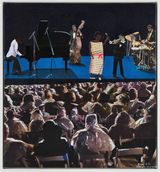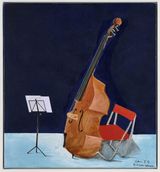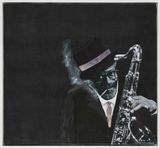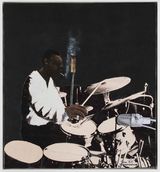




Goodman Gallery presents Common Purpose, an exhibition of works by David Koloane and Sam Nhlengethwa, two highly respected Johannesburg artists whose association with the gallery extends to the early 1990s. This two-person exhibition brings together new and historical paintings, as well as works on paper, that reflect their shared love of and longstanding engagement with jazz. For both Koloane and Nhlengethwa, jazz has remained a recurring presence across very different periods of their practice.
The exhibition includes Koloane’s Piano Player, an undated canvas recently discovered in the artist’s archive by his estate. The anonymous black performer at the centre of this work revisits a recurring presence in Koloane’s energetic drawings and etchings, a subject of admiration and even reverence. The exhibition also features a suite of drawings by Koloane from 2000, individual portraits of South African jazz legends Mackay Davashe, Jonas Gwangwa, Abdullah Ibrahim, Hugh Masekela and Sophie Mgcina.
Nhlengethwa’s work similarly portrays, and thereby honours, well-known jazz figures. Common Purpose includes a 2025 series of acrylic and collages paintings in a keynote of blue depicting, among others, Bheki Mseleku and Elvin Jones, as well as a suite of three- colour lithographs from 2021 portraying Cannonball Adderley, Miles Davis and Bill Evans. Collectively, these works monumentalise more than just the musicians portrayed, but honour the creative act itself. The installation also includes a multi-panel text painting from 2025 by Nhlengethwa, the individual letters of the panels spelling out “All Blues”, both a reference to the dominant chromatic register of the work but also an invocation of a word, blue, that resonates through the history of jazz.
The pairing of Koloane and Nhlengethwa is important beyond their shared interest in music. The artists exhibited in alternative galleries in 1980s Johannesburg, participated in the legendary Thupelo Workshops of the early 1990s, and for decades shared working space at the Bag Factory Studios in central Johannesburg. The title of the exhibition honours this fraternity, but also introduces an important historical awareness about the context in which they first emerged. The meaning of the term “common purpose” is both collective and coercive. In criminal law, the doctrine of common purpose concerns the relationship between individual action and collective responsibility: the ways in which association with others can become grounds for attributing intention, participation and liability. In South Africa, this doctrine has a specific and painful history. Under apartheid, the freedom to gather, whether for political action or simply to enjoy a night of music, was itself restricted and surveilled, and association could readily be treated as evidence of common purpose in the legal sense. To be part of a group was to risk being held responsible for it.
It is this charged double meaning that the exhibition holds onto. Jazz in South Africa developed its own, quite different form of common purpose: a network of musicians, audiences, clubs, writers and listeners who built a shared cultural life through improvisation, listening and mutual support. That community had to exist inside, and often in defiance of, the same conditions that made association a legal danger. The two senses of the term were not separate. The informal common purpose of the jazz world took shape under the shadow of the formal one, and its persistence, sustaining relationships, places and forms of participation across decades of restriction, is itself part of what the exhibition asks us to see.
Seen together, the works of Koloane and Nhlengethwa make visible the persistence of particular subjects and cultural references across changing periods of practice, treating their proximity as an occasion to ask what can be carried across time, what changes in the process, and what looking again at a familiar history reveals from the position of the present. What returns across these decades, from Koloane’s musicians to Nhlengethwa’s tributes, is a way of being together with sound, memory and history: something inherited, taken up again, and made anew each time.
Common Purpose will feature a collateral event that explores and honours Koloane’s and Nhlengethwa’s consistent engagement with jazz music as an embodied practice and public creative act.


Goodman Gallery is an international contemporary art gallery with locations in Johannesburg, Cape Town and London. The gallery represents artists whose work confronts entrenched power structures and inspires social change.

A respected voice in contemporary art discourse.
Focusing on ambitious storytelling and insightful art-world commentary. Ocula Magazine publishes in-depth interviews, critical essays and timely analysis on the artists, exhibitions and ideas driving the global art world.
Learn more about Ocula Magazine
Showcasing the best of the art world.
Ocula partners with galleries from around the world to highlight their artists, artworks and exhibitions. Gallery membership is by application and invitation, with each member vetted by an independent panel.
Learn more about Ocula Membership

Specialises in the sale of major artworks.
Led by a team with deep ties to the world’s leading auction houses, galleries and collectors. Ocula’s advisory team offers bespoke services to high-net-worth clients from around the world who are looking to acquire the best of contemporary and modern art.
Learn more about our team and services