



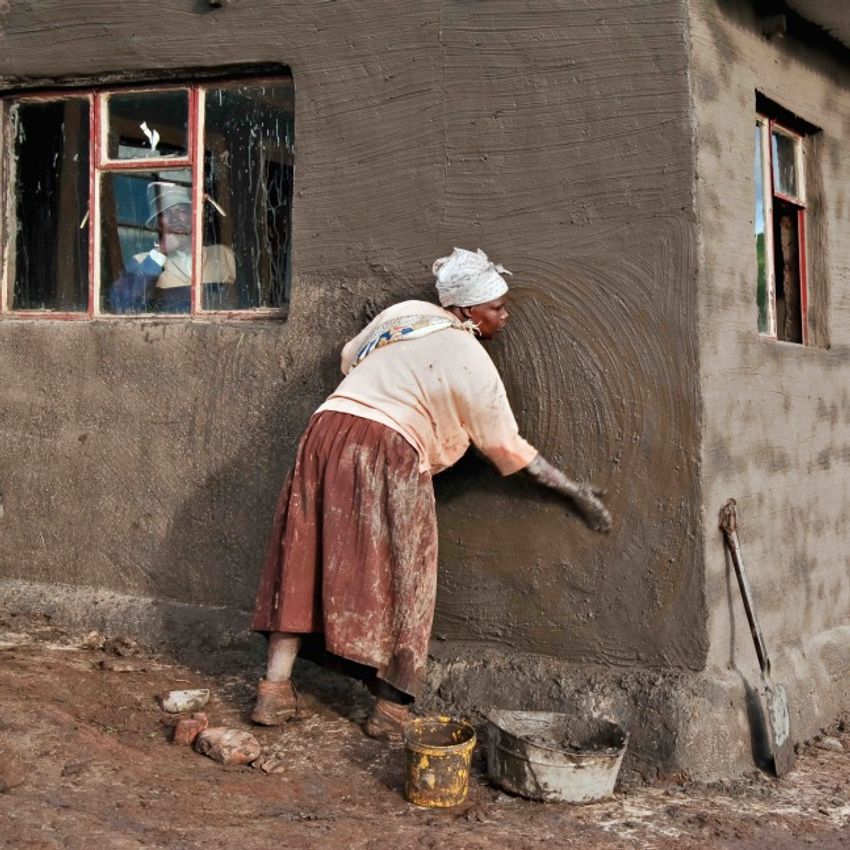
Goodman Gallery presents iHubo: Nkosi Sikelela, an exhibition of new work by Jabulani Dhlamini and Thembinkosi Hlatshwayo whose photographic practices converge on themes relating to collective trauma and generational memory in South Africa.
Dhlamini is one of South Africa’s most recognised documentary photographers. His approach to landscape and portrait photography involves capturing the everyday lives of people on society’s margins. Dhlamini, ten years Hlatshwayo’s senior, has mentored the young photographer for seven years, alongside curator John Fleetwood.
In Hlatshwayo’s developing practice, he uses his family-run tavern in Lawley, Johannesburg as a makeshift studio space in which to set up his images to explore first-hand and generational experiences of trauma.
iHubo: Nkosi Sikelela features collaborative work that forms part of an ongoing project, authored by both photographers in which they explore the relationship between collective memory and private reflections within the context of apartheid and the production of post-apartheid identities. The work adopts Dhlamini’s contemplative approach to documentary photography combined with Hlatshwayo’s conceptual approach to exploring violence and trauma.
Reflecting on iHubo, a traditional form of South African praise poetry that connects the present with the past, this project seeks to capture the contemporary South African communities through the idea of a personal return, of home, which for many remains a site of pain and suffering.
As a starting point, Dhlamini returned to the countryside of his childhood in the Free State in an effort to capture the landscape for its rich psychological associations. Hlatshwayo’s return involved visiting his family tavern where he transforms memories of violence into ghosts embedded in the walls. These spectral traces are further entrenched into the images through tactile interventions in Hlatshwayo’s image-making process.
This haunting body of work has been created through a process of mutual exchange, with each photographer contributing conceptually to the creation of each image. Dhlamini and Hlatshwayo would communicate with each other throughout the conceptual phase of the project, sharing thoughts and images to collectively unpack their ideas of home. The dynamics of this exchange will be further explored in conversation with Sean O’Toole.
Jabulani Dhlamini’s (b. 1983, Warden, South Africa) work focuses on his upbringing while also reflecting on various communities within contemporary South Africa. Dhlamini’s approach is meditative and subtly provokes a closer look at what lies on the edges by exploring personal and collective memory. Incorporating landscape imagery and intimate portraits, his work captures historical moments — such as the recollection of the Sharpeville Massacre, the effects of land dispossession and the funeral of anti-apartheid activist Winnie Madikizela-Mandela — while also documenting the quieter moments in the lives of everyday South Africans.
Recent group exhibitions include Inganekwane, North West University Gallery, South Africa (2022); iHubo – Whispers, PhotoSaintGermain festival, France (2022); Side to Side Johannesburg, La Permanence Photographique, France (2022); and A Different Now is Close Enough to Exhale on You, Umhlabathi Collective Gallery, South Africa (2022); as well as a solo exhibition at Mitre Gallery, Brazil titled Casa/iKhaya Lami (2023).
Dhlamini is an alumni fellow of the Edward Ruiz Mentorship programme and the Market Photo Workshop in Johannesburg, where he is currently based.
The exhibition also features a new body of work created this year by Dhlamini while on residency in Palmital and Belo Horizonte in Brazil. These images explore the intergenerational trauma that remains powerfully felt in South Africa and in Brazil today, making visible oral recollections of past and present experiences of structural violence and the residue of colonial brutality. This project aims to highlight these painful postcolonial connections across the global South and build solidarity across the Atlantic:
This shared history of struggle and oppression provided a powerful starting point in South Africa, the legacy of apartheid, and in Brazil, the history of slavery and social inequality. This created for me a sense of a shared context underpinning the challenges faced by marginalised communities. This work tries to address and heal these deep-rooted wounds - Jabulani Dhlamini
Thembinkosi Hlatshwayo (b. 1993, Johannesburg, South Africa) uses the tavern run by his parents as a studio in which to investigate themes of first-hand and generational trauma, violence and memory. The photographer Jabulani Dhlamini and photography curator and educator John Fleetwood mentored Hlatshwayo. He won the 2019 CAP Prize for Contemporary African Photography with his series Slaghuis I. Hlatshwayo was the Gisèle Wulfsohn Photography Mentorship Recipient for 2019. He held his first solo exhibition, Slaghuis II at the Market Photo Workshop in February 2020, and was an overall winner of the international Blurring the Lines photo award for 2020. His work has been featured in group exhibitions at Fotomuseum Winterthur, IAF Basel Festival, and Johannesburg’s Turbine Art Fair.
iHubo was first exhibited in Paris as iHubo - Whispers curated by Valérie Fougeirol. This was at the 2022 PhotoSaintGermain festival as part of the 10th-anniversary celebration of the Thokoza-based photography education programme Of Soul and Joy initiated by Rubis Mécénat. This exhibition marks the first time that it will be seen in South Africa and in the global South.
Jabulani Dhlamini was born in Warden, Free State in 1983; he lives and works in Johannesburg. Dhlamini majored in documentary photography at the Market Photo Workshop in Johannesburg and he was the recipient of the Edward Ruiz Mentorship 2011/2012. Dhlamini’s work focuses on his upbringing, as well as the way he views contemporary South Africa.


Goodman Gallery is an international contemporary art gallery with locations in Johannesburg, Cape Town and London. The gallery represents artists whose work confronts entrenched power structures and inspires social change.

A respected voice in contemporary art discourse.
Focusing on ambitious storytelling and insightful art-world commentary. Ocula Magazine publishes in-depth interviews, critical essays and timely analysis on the artists, exhibitions and ideas driving the global art world.
Learn more about Ocula Magazine
Showcasing the best of the art world.
Ocula partners with galleries from around the world to highlight their artists, artworks and exhibitions. Gallery membership is by application and invitation, with each member vetted by an independent panel.
Learn more about Ocula Membership

Specialises in the sale of major artworks.
Led by a team with deep ties to the world’s leading auction houses, galleries and collectors. Ocula’s advisory team offers bespoke services to high-net-worth clients from around the world who are looking to acquire the best of contemporary and modern art.
Learn more about our team and services