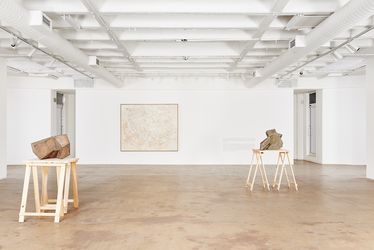
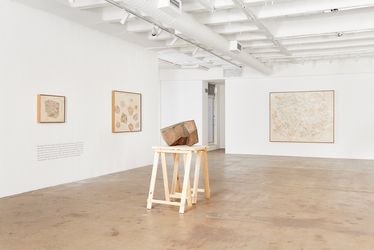
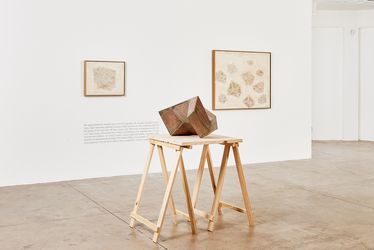
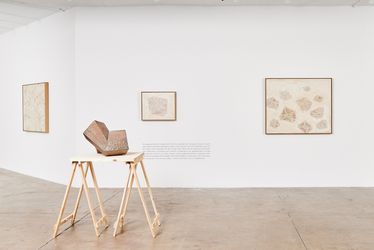
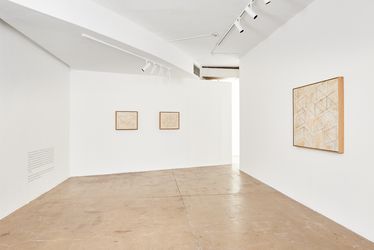
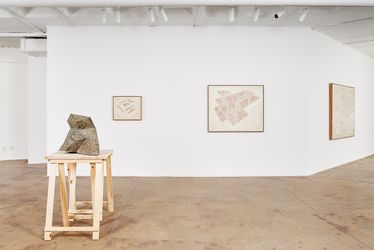
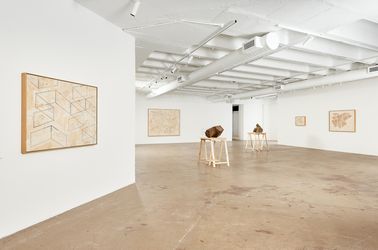
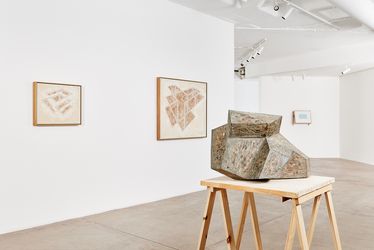
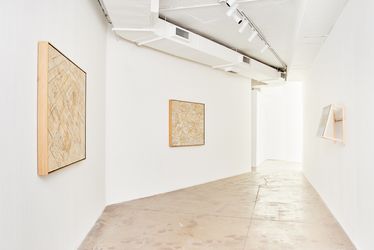
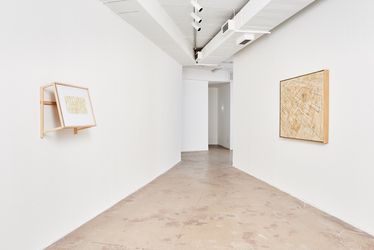
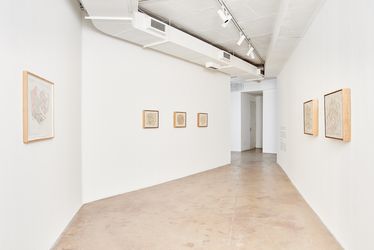
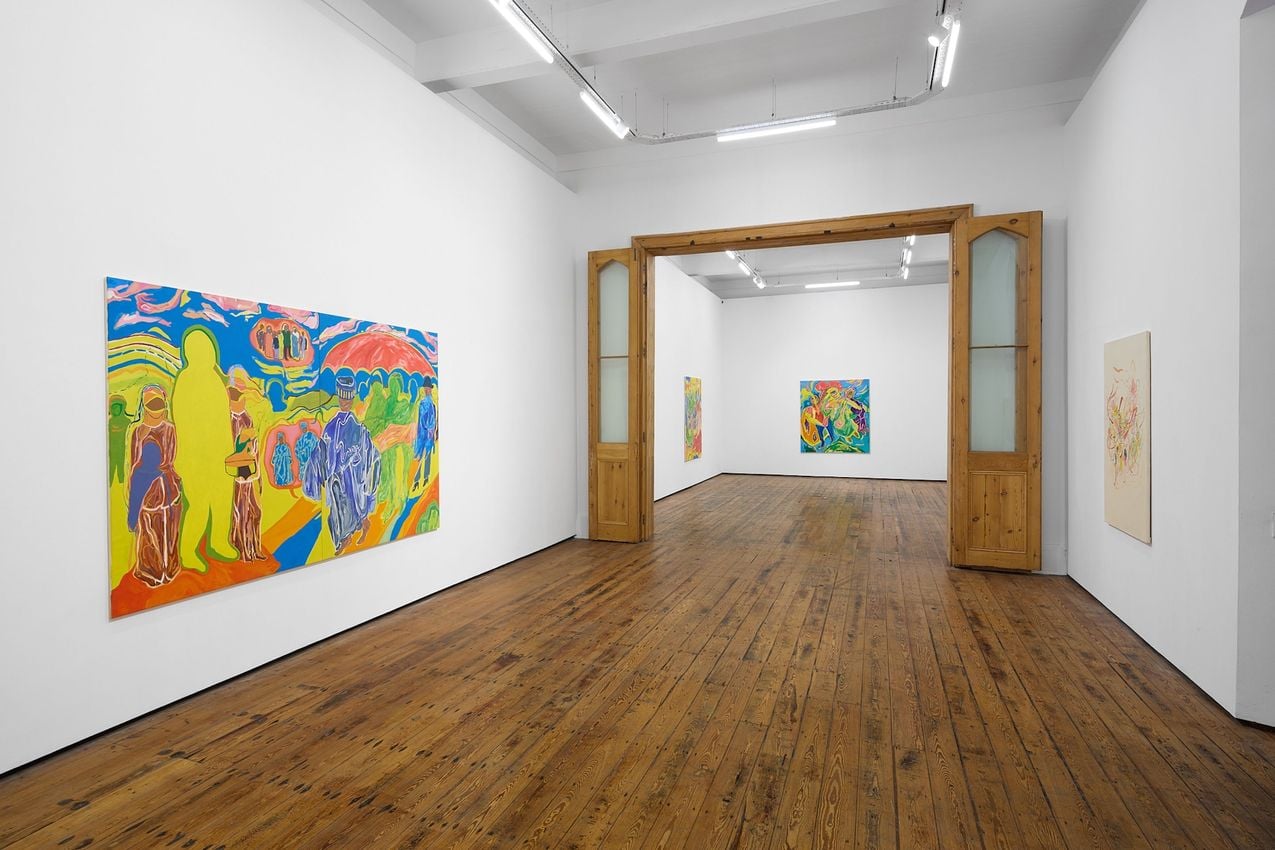
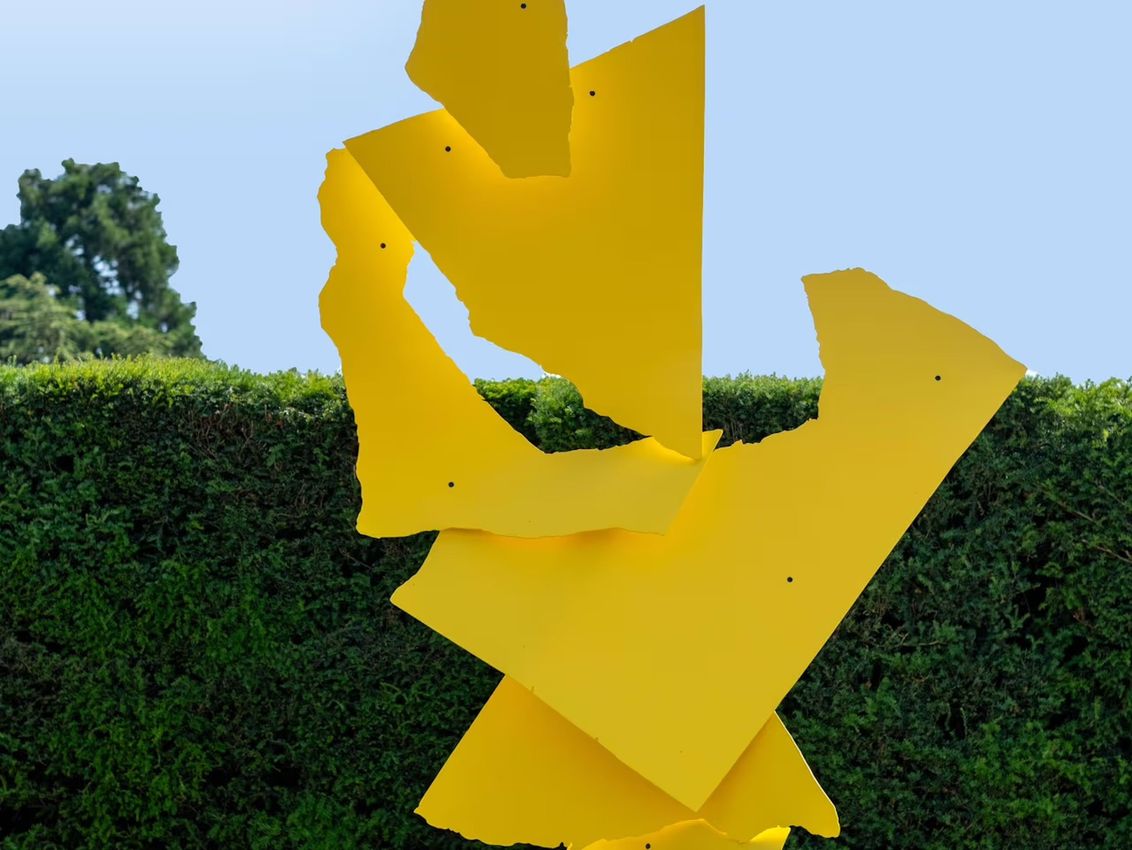
In his fifth solo exhibition with the Goodman Gallery, Gerhard Marx continues the project of transforming visual certainties into new spatial imaginaries as he engages his interest in the construct or idea of ‘distance’.
‘If an encounter with an object is an encounter of presence, then the idea of distance would in some way propose an opposite encounter, an encounter with absence. Of course, there is an emotional root to an encounter with distance; distance is an open space for longing, an architecture for loss, a space of blurred certainty, an entry point to the sublime. The question, however, is to engage distance without it turning into nearness.
I have started to see this project as being inherently political, a project of undoing; of unmaking categories; of unmaking the viewer’s centrality as implied by perspective. Distance would dissolve the crisp outlines of things seen up close. In distance things can become awash, there is no clear point where one thing begins and another ends. Perhaps, I thought, I can undo the artifice of intimacy, build distance into objects, and let things become feral.
Five thoughts toward an exhibition
1.
We approached the Anasazi ruins from from the opposite cliff, through a thicket of burnt trees. Black branches opened to reveal a valley and the vast clay-built settlement built into the shelter of the opposite cliff, like a wasp nest. What was an expansive small town with three storey structures and a weave of pathways now appeared like a single abandoned artefact, an empty vessel. Like an An elaborate Suiseki, a scholar’s rock. Like the architectures held caringly in the hands of Mary or some saint in so many icons and sculptures. The city as an object: once a settlement, now an unsettlement.
2.
The backgrounds to Giotto’s frescoes depict architectures that do not ascribe to the same perspective as the human drama that foregrounds them. Cities sit on hillsides, like things on shelves; crystal-like agglomerates that seem to grow according to an inner logic.
Interiors recede toward vanishing points that are not shared by the human figures that seemingly occupy them. The frescoes were painted before the construction of perspective aligned the entire environment to a central human viewer, before perspective constructed the illusion that landscape, the built world and the human shared the same horizon. These architectures are not mere backdrops to the scenes that they were meant to hold. They fold, jut, tower and lean with a drama of their own. They are backgrounds foregrounded, contexts as object.
3.
The top of Devils Peak holds a large pile of stones known as Maclear’s Beacon. The stones were placed in 1865 and used as a triangulation station as part of Maclear’s larger endeavour to re-measure the curvature of the earth. Maclear was tasked with returning the earth to its spherical form by correcting the previous measurements, made in the mid 18th century by the Abbot Nicolas de Lacaille. De Lacaille’s measurements of the Cape Arc of Meridian revealed the curvature of the southern hemisphere to be larger that that of the Northern Hemisphere. Accordingly, de Lacaile’s measurements depicted the earth as pear-shaped.
4.
On the day preceding lockdown, I realised that I would also lose access to stones. Some ongoing sculptural experiments with stone suddenly seemed urgent. Like something I could resolve during the time of lockdown. Of course my sudden hunger for stone was a hunger of the hands—the realisation that this period would imply a loss of tactility and access—I would still be able to see the mountain, but without access it would remain a spectre; an image only. I was reminded of a visit to a stone-built solitary confinement prison cell in the fort of Île Sainte-Marguerite. A small window torturously pierced the back wall of the cell, offering a magnificent view over the Riviera and the idyllic harbour of Cannes.
While others were stockpiling at shops, I was at the quarry on De Waal drive, overlooking Cape Town’s harbour and cityscape, collecting stone from the edges of the quarry, stockpiling stone, stockpiling touch.
5.
It is the middle of the night and I cannot sleep. I get out of bed and walk into the dark house to find that book. I know the text is underlined by a faint, quivering pencil line.
The thought that floated to the top of a soup of sweaty thoughts was of W.G. Sebald’s description in the book ‘Austerlitz’ of the magnificent but inevitably futile construction of fortifications. I find the book in the dark and it falls open, as if by habit; ‘it is often our mightiest projects that most obviously betray the degree of our insecurity’, Sebald writes.
The text floats above the wavering pencil line.
Sebald describes the elaborate defences built around the City of Antwerp and explains how the need to be surrounded by defences resulted in ever-complexifying structures of fortification. As the surrounding walls grew larger, so grew the need to protect the wall itself from attack and so the history of fortification is the development of ever complicating crystalline structures of defence that ripples outward in gigantic, starshaped gestures of stone, cement and futility.’ —Gerhard Marx, 2020


Gerhard Marx (b. South Africa, 1976) develops his projects through an engagement with pre-existent conventions and practices. This process entails careful acts of dissection and rearrangement, which allow Marx to engage the poetic potential and philosophical assumptions of his chosen material, developing original drawing, sculptural and performative languages. Marx completed his undergraduate degree at the Michaelis School of Fine Art, UCT and received his MA (Fine Art) (Cum Laude) from Wits School of Art, Johannesburg.


Goodman Gallery is an international contemporary art gallery with locations in Johannesburg, Cape Town and London. The gallery represents artists whose work confronts entrenched power structures and inspires social change.

A respected voice in contemporary art discourse.
Focusing on ambitious storytelling and insightful art-world commentary. Ocula Magazine publishes in-depth interviews, critical essays and timely analysis on the artists, exhibitions and ideas driving the global art world.
Learn more about Ocula Magazine
Showcasing the best of the art world.
Ocula partners with galleries from around the world to highlight their artists, artworks and exhibitions. Gallery membership is by application and invitation, with each member vetted by an independent panel.
Learn more about Ocula Membership

Specialises in the sale of major artworks.
Led by a team with deep ties to the world’s leading auction houses, galleries and collectors. Ocula’s advisory team offers bespoke services to high-net-worth clients from around the world who are looking to acquire the best of contemporary and modern art.
Learn more about our team and services