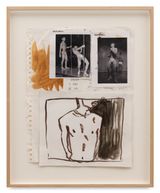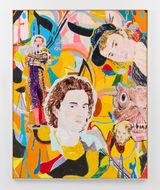
Richard Hawkins’s solo exhibition—his eighth at Greene Naftali—follows desire where it leads, in twin pursuit of art historical fandom and the lure of the celebrity crush. The new paintings on view pay tribute to the work of Pierre Bonnard, as Hawkins filters the late Impressionist’s touch through his own hand and boy-crazy obsessions. The new works channel Bonnard’s caressing eye and the reckless hedonism of his color; the encrusted dazzle of the painted surface that makes rapture its own reward. Hawkins takes Bonnard interiors and landscapes as prompts to loosen those genres from their genteel moorings, studding his lush, dappled gardens with floating faces of pretty young men.
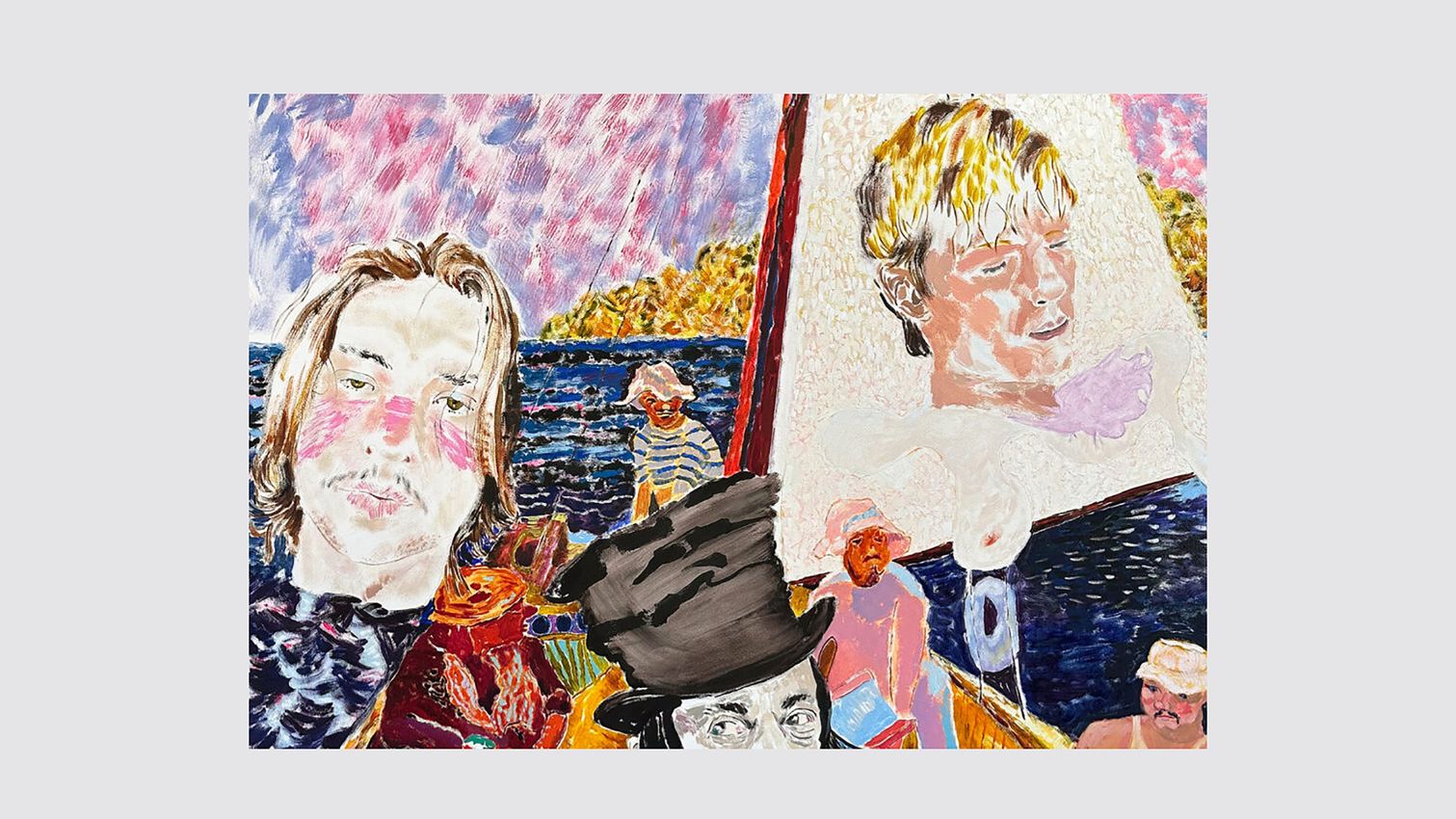
“Pleasure—undiluted essence of pleasure—is a suspect commodity in modern art,” John Ashbery wrote of Bonnard’s bruised reputation, for coming too late and being too decorative. Bonnard made his vibratory pictures well into the 1940s, and was faulted for embracing mere ornament against the yardstick of Cubism’s rigor or abstraction’s reserve. Hawkins, for his part, slyly perverts what was latent in his sources: ripe produce splayed on Bonnard’s tabletops are rechristened Fruits; an all-male boating party from 1924 becomes the backdrop for All Hands on D*ck. That maritime scene is overlaid with enlarged heads pulled from Hawkins’s personal pantheon: Mike Faist hovers over the sail like an aegis, his bared nipples colored with an ardent realism, resting atop a field of white dabs laid on with a palette knife, like a Ryman.
Hawkins refers to such passages in his paintings as “captivation traps”—bits of heightened detail amidst the laxer brushwork that snare the viewer’s attention. Throughout, he draws energy from the distortions and oddities baked into the Bonnard originals: the skewed sightlines that intensify a theater of objects, the figures and edges left unresolved. Each kink pastoral or still life is a “faulty, poetic translation,” as Hawkins puts it, taking liberties (swapping hues and shifting perspectives) that feel sanctioned by Bonnard’s example. These new paintings thus belong to what TJ Clark calls “the Bonnard strand” of modernism, one that depends on revelry and heedless formal invention as tonic for dark times—an art “dedicated to the proposition that the only hope, in a corrupt and invasive culture, is to put one’s trust in the realm of the senses, and expose oneself—naively, almost idiotically—to the play of light.”
Richard Hawkins lives and works in Los Angeles, where he serves as Professor of Painting & Drawing at the University of California, Los Angeles. Recent solo exhibitions include Loewe FW24 Men’s Show, Paris (2024); Reena Spaulings, Los Angeles (2023); Greene Naftali, New York (2022, 2019, 2018, 2016); Tate, Liverpool (2014); Le Consortium, Dijon, France (2013); and the Art Institute of Chicago, which traveled to the Hammer Museum, Los Angeles (2010). Hawkins was the 2012 recipient of the Guna S. Mundheim Fellowship in The Visual Arts at The American Academy in Berlin.


A respected voice in contemporary art discourse.
Focusing on ambitious storytelling and insightful art-world commentary. Ocula Magazine publishes in-depth interviews, critical essays and timely analysis on the artists, exhibitions and ideas driving the global art world.
Learn more about Ocula Magazine
Showcasing the best of the art world.
Ocula partners with galleries from around the world to highlight their artists, artworks and exhibitions. Gallery membership is by application and invitation, with each member vetted by an independent panel.
Learn more about Ocula Membership

Specialises in the sale of major artworks.
Led by a team with deep ties to the world’s leading auction houses, galleries and collectors. Ocula’s advisory team offers bespoke services to high-net-worth clients from around the world who are looking to acquire the best of contemporary and modern art.
Learn more about our team and services