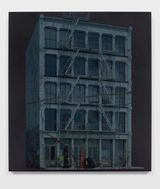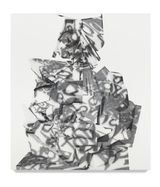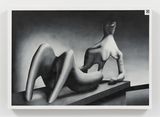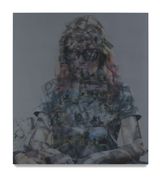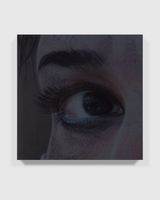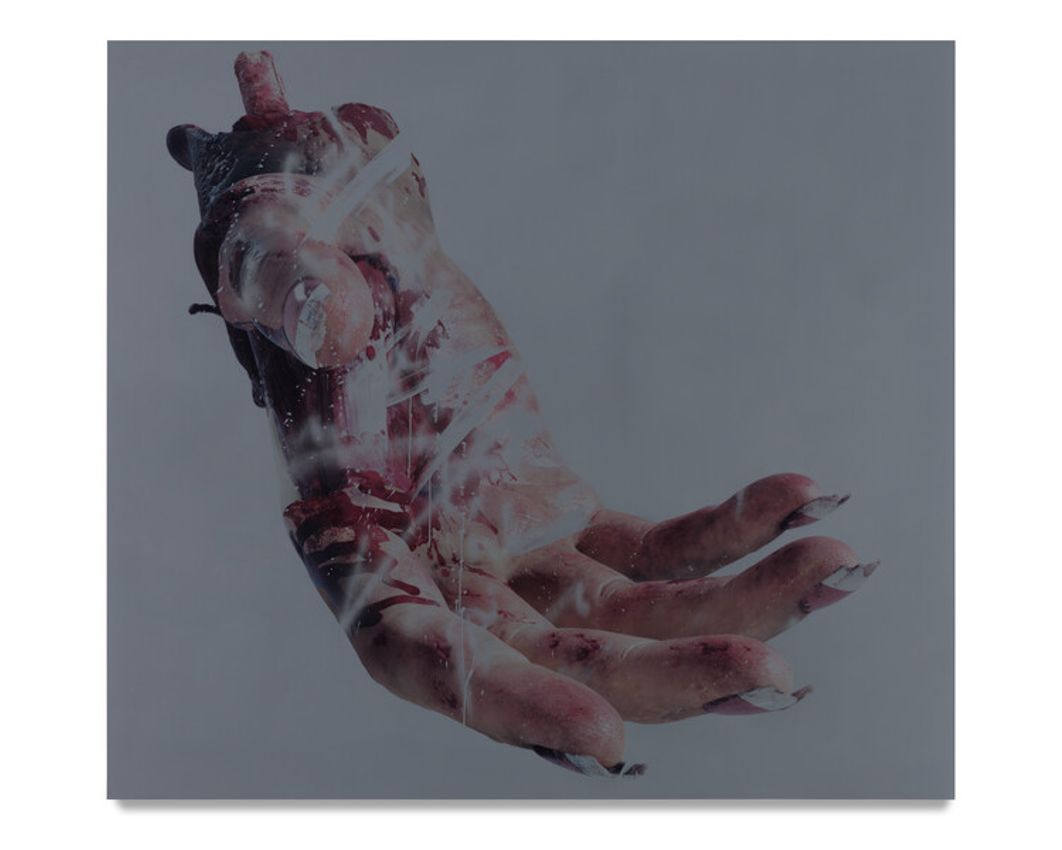
With ‘Free Fall’, her first solo exhibition in the UK, American artist Avery Singer reflects upon her personalexperience of the 9/11 terrorist attacks on the World Trade Center in New York City and explores thewider societal impact of collective trauma and proliferating image culture and media dissemination. Basedentirely upon Singer’s childhood memories, the works and architectural intervention in ‘Free Fall’ are atestament to the power of memory—and a memorial to a moment of terror and survival.
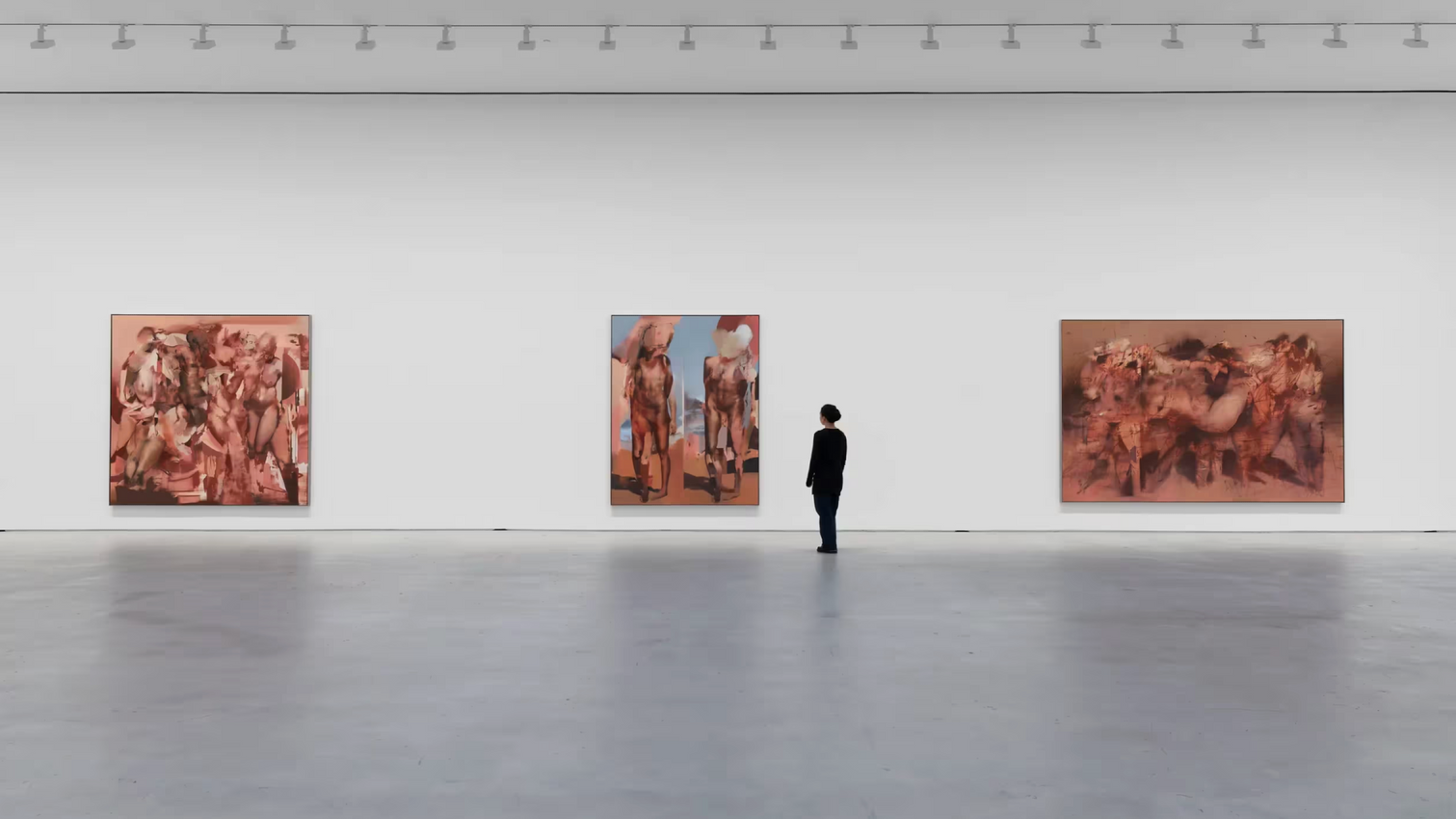
For the exhibition, Singer has created an environment that replicates her memories of the interior of theWorld Trade Center offices—spaces she regularly visited in the years prior to 9/11, as her mother workedin both towers of the World Trade Center. Here, Singer combines the atmospheric banalities of officelife with the architectural specificity of the towers’ iconic design by Minoru Yamasaki, creating a quietlydisorientating installation that is part stage-set, part minimalist sculpture. Within this environment, theartist displays new paintings that bridge the gap between the anonymous digital world and her owninterior universe by merging computer-generated worlds created on programs such as Autodesk Maya,the same 3D software used to build the exhibition’s immersive architectural environment based uponSinger’s memories.
Since 2010, Singer has employed the binary language of computer programs and industrial materialsto remove the trace of her own hand while engaging the great traditions of painting and the legacy ofmodernism. The new large-scale paintings on view in ‘Free Fall’ combine digital renderings with manualand digital airbrush techniques, liquid and solid masking, and complex layering processes.
Avery Singer gives her personal account in the following statement:
‘Free Fall is part of an ongoing body of new work that combines changes in my painting technique,to construct images using high-definition digital rendering and poor-quality machine airbrushing. Thisdevelopment also brought with it a shift in subject matter, to explore something autobiographical that tookplace in my life before I became an artist.
With ‘Free Fall’, her first solo exhibition in the UK, American artist Avery Singer reflects upon her personalexperience of the 9/11 terrorist attacks on the World Trade Center in New York City and explores thewider societal impact of collective trauma and proliferating image culture and media dissemination. Basedentirely upon Singer’s childhood memories, the works and architectural intervention in ‘Free Fall’ are atestament to the power of memory—and a memorial to a moment of terror and survival.
For the exhibition, Singer has created an environment that replicates her memories of the interior of theWorld Trade Center offices—spaces she regularly visited in the years prior to 9/11, as her mother workedin both towers of the World Trade Center. Here, Singer combines the atmospheric banalities of officelife with the architectural specificity of the towers’ iconic design by Minoru Yamasaki, creating a quietlydisorientating installation that is part stage-set, part minimalist sculpture. Within this environment, theartist displays new paintings that bridge the gap between the anonymous digital world and her owninterior universe by merging computer-generated worlds created on programs such as Autodesk Maya,the same 3D software used to build the exhibition’s immersive architectural environment based uponSinger’s memories.
Since 2010, Singer has employed the binary language of computer programs and industrial materialsto remove the trace of her own hand while engaging the great traditions of painting and the legacy ofmodernism. The new large-scale paintings on view in ‘Free Fall’ combine digital renderings with manualand digital airbrush techniques, liquid and solid masking, and complex layering processes.
Avery Singer gives her personal account in the following statement:
‘Free Fall is part of an ongoing body of new work that combines changes in my painting technique,to construct images using high-definition digital rendering and poor-quality machine airbrushing. Thisdevelopment also brought with it a shift in subject matter, to explore something autobiographical that tookplace in my life before I became an artist.
hallways—I’d walk past suite after suite, each demarcated with a number. I remember the iconic eighteeninch slit windows, designed by Minoru Yamasaki to combat people experiencing vertigo, so distinctly. I’vedesigned the exhibition space to recreate architectural elements as an installation within the show, sothat it feels as if you’ve walked into the lobby of an office, both past and present. The windows, elevatordoors, bland carpet, curtains, building materials, and paint finishes, all conjure a corporate environment.I wanted to create something that is part minimalist sculptural installation, part stage-set, a space thatforms a narrative backdrop for my paintings. I’ve also designed a bookstore that will house self helpbooks, reminiscent of the Borders below the towers that I visited as a kid, looking at books like ‘ChickenSoup for the Soul’ by Jackhansen Canfield.
In confronting this topic, I wanted to use art as a kind of conceptual mediator, to create an emotionallandscape of this history for the audience to enter into and define their own experience.’
The solo exhibition ‘Avery Singer: Unity Bachelor’ at the Institute of Contemporary Art in Miami is also ondisplay until 15 October 2023.
Education Lab
As part of Hauser & Wirth’s global learning platform, this exhibition will be complemented by an EducationLab for the first time in the London gallery. In keeping with the concept of memory in Singer’s works,visitors will be encouraged to transform their own personal positive memories into physical form throughcreative writing and drawing. An extensive learning programme will also accompany the exhibition; thisincludes drop-in interactive recordings as part of The Big Draw Festival throughout October, an educatorpreview evening and a discursive event ‘Painters on Painting’ in which artists and tutors facilitate aconversation with university students around Singer’s practice.
About Avery Singer
Born in 1987 in New York, Avery Singer has emerged as a powerful contemporary voice whose workexplores the possibilities in the convergence of painting and technology. Her highly distinctive oeuvreincorporates both autobiographical and fictional narratives, reflecting upon the art world today and thewider sweep of art history that she has inherited as a painter. Singer’s pioneering techniques are deployedto question the ways in which images and their distribution in our contemporary world, are increasinglyinformed by new media and technologies.
Singer has developed a highly original visual vocabulary that evokes established traditions of archivaldocumentation and a preferred iconography that references the familiar art historical notions of the artist,the muse and the ironies suggested by these tropes. At the same time, her dexterous process is highlytechnologically advanced, yielding completed works characterized by atmospheric spaces conjuring thedigital realm. Singer’s nuanced use of industrial automation and three-dimensional computer modeling, suchas SketchUp, Blender and DAZ 3D, underpins a complex process of layering. She projects imagery ontolarge-scale canvases and builds the compositions through airbrushed acrylic paint. The resulting paintingscontrast clarity with ambiguity, past with future and geometric precision with intuitively generated forms.
Avery Singer’s work gained immediate critical recognition via important solo exhibitions at respectedinternational institutions, including Kunsthalle Zürich (2014), the Hammer Museum, Los Angeles (2015),Foundazione Sandretto re Rebaudengo, Turin (2015), the Stedelijk Museum, Amsterdam (2016), Secession,Vienna (2016), the Kölnischer Kunstverein, Cologne (2017) and the Museum Ludwig, Cologne (2019). Theartist has participated in the 6th Glasgow International Festival of Art, Glasgow, Scotland (2014), the13th Biennale de Lyon, Lyon, France (2015), ‘2015 Triennial: Surround Audience,’ New Museum, NewYork (2015) and further acclaim followed Singer’s selection by Ralph Rugoff for the 58th International ArtExhibition of the Venice Biennale in 2019. The solo exhibition ‘Avery Singer: Unity Bachelor’ opened atICA Miami in 2023.
Singer’s work is held in public collections such as Guggenheim Museum, New York; Hammer Museum,Los Angeles; The Metropolitan Museum of Art, New York; Museum Ludwig, Cologne, Germany; TheMuseum of Modern Art, New York; Neue Nationalgalerie, Berlin; Stedelijk Museum, Amsterdam; Tate,London; and Whitney Museum of American Art, New York, among many others.
Avery Singer (b. 1987) was born and raised in New York. Her parents, the artists Janet Kusmierski and Greg Singer, named her after Milton Avery. Growing up in a creative community, Singer experimented with photography, film, and drawing, but in those years never considered working with paint. In 2008, Singer studied at the Städelschule, Frankfurt am Main, and in 2010, she received her B.F.A. from Cooper Union, New York. During her studies, Singer engaged in performance art, video making, as well as sculpture utilising carpentry, metal casting, and welding. After graduation, she discovered her chosen art form from an unanticipated experiment with SketchUp, a program used by her peers to design exhibition spaces, and airbrushed a black-and-white painting based on a digital illustration. Since then, Singer has employed the binary language of computer programs and industrial materials in order to remove the trace of the artist’s hand while engaging the tradition of painting and the legacy of Modernism.
Hauser & Wirth was founded in 1992 in Zurich by Iwan Wirth, Manuela Wirth and Ursula Hauser, who were joined in 2000 by Partner and Vice President Marc Payot. A family business with a global outlook, Hauser & Wirth has expanded over the past 26 years to include outposts in Hong Kong, London, New York, Los Angeles, Somerset and Gstaad. The gallery represents over 70 artists and estates who have been instrumental in shaping its identity over the past quarter century, and who are the inspiration for Hauser & Wirth’s diverse range of activities that engage with art, education, conservation and sustainability.
A respected voice in contemporary art discourse.
Focusing on ambitious storytelling and insightful art-world commentary. Ocula Magazine publishes in-depth interviews, critical essays and timely analysis on the artists, exhibitions and ideas driving the global art world.
Learn more about Ocula Magazine
Showcasing the best of the art world.
Ocula partners with galleries from around the world to highlight their artists, artworks and exhibitions. Gallery membership is by application and invitation, with each member vetted by an independent panel.
Learn more about Ocula Membership

Specialises in the sale of major artworks.
Led by a team with deep ties to the world’s leading auction houses, galleries and collectors. Ocula’s advisory team offers bespoke services to high-net-worth clients from around the world who are looking to acquire the best of contemporary and modern art.
Learn more about our team and services