‘If you ask why I make sculpture, I must answer that it is my way of life, my balance, and my justification for being.’ —David Smith
One of the foremost artists of the 20th Century and the sculptor most closely associated with the abstractexpressionist movement, David Smith (1906–1965) is celebrated for his use of industrial materials andprocesses and the integration of open space into sculpture. ‘David Smith. Four Sculptures’ will be held inHauser & Wirth’s glass-fronted exhibition space on Bahnhofstrasse 1, Zurich. The exhibition will showcasefour extraordinary, painted sculptures that represent major sculpture groups Smith made in the early 1960s.
Throughout his career, Smith referred to himself as both a painter and a sculptor, working in both mediumssimultaneously. Citing the unification of painting and sculpture in ancient Egyptian and Greek art, Smithapplied painting concepts to his sculpture and vice versa. ‘I’ve always made painted sculpture,’ Smithasserted in 1962, ‘not one year that I’ve worked have I failed to do this.’ By the early 1960s, he had arrivedat a new phase of creativity: he made nearly one-third of his entire sculptural output in the last five years ofhis life while working on a monumental scale. The large, painted works in ‘David Smith. Four Sculptures’ areoutstanding examples of the culmination of Smith’s long exploration of colour and form.
Zig I (1961) is a part of Smith’s ‘Zig series’ that comprises seven large-scale, vertical works, each numberedby the artist. The series’ name was an ‘affectionate term,’ according to Smith, that derived from ‘ziggurat’—astepped pyramid found in ancient Mesopotamia. Each of the Zigs features inventive arrangements of planesand rounded forms that yield surprising spatial relationships as a viewer walks around the sculpture. Zig I is made from cut sections of steel tubes that ascend in a playful dance along a vertical axis. The surface ofthis work is activated by an application of feathery, black brushstrokes over a russet ground, harnessing thegestural vigour seen in the work of Smith’s fellow abstract expressionists.
By contrast, the yellow sculpture Untitled (1964) is characterised by angularity and a monochromatic surface.It has been suggested that this sculpture could possibly be Zig VI—a number that is missing from the ‘Zigseries’. While Untitled does bear certain formal similarities with the Zigs, it retains a distinct individuality inits nearly-minimalist, matter-of-fact construction and chromatic uniformity. In this sculpture, Smith stackedI-beams of various sizes and balanced them on four small, found wheels, a feature that connects it to threeother wheeled sculptures from the Zig series, all of which are in museum collections. It is especially related to Zig VII (1963), in the collection of The Museum of Modern Art, New York which is painted with a large swathof bright yellow and sits on four comparatively sized wheels.
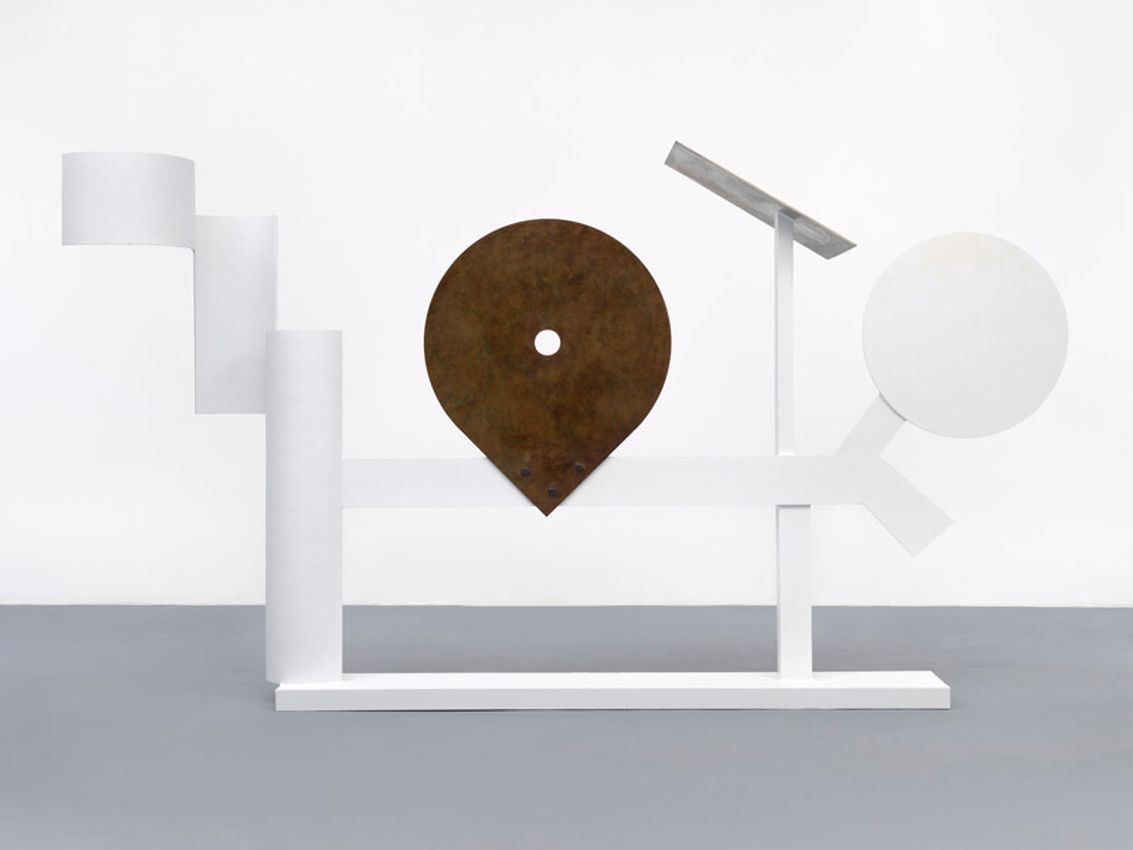
In 1962, Smith was invited to make two sculptures for an exhibition associated with the Festival of Two Worldsin Spoleto, Italy. Working with a crew of local metalworkers in an abandoned steel factory in the nearby townof Voltri, Smith produced a total of twenty-seven sculptures within a month. The experience would have aprofound impact on Smith’s work. After returning to Bolton Landing, he sustained the energy he demonstratedin Voltri and made, over a six-week period, three large sculptures that define his Primo Piano series. The titleis Italian for ‘first floor’—the floor above the ground floor—where, Smith explained, ‘most of the action takesplace.’ In Primo Piano II (1962), for example, two vertical elements elevate a central, horizontal beam, abovewhich a dynamic interplay of different shapes and metals unfolds across a span over thirteen feet long. In a
natural setting, this large-scale sculpture commands a strong visual presence, as a graphic contrast to thelandscape. While the other two works in this series are entirely white, ‘Primo Piano II’ incorporates elementsof unpainted bronze and stainless steel that introduce compelling variations within the work itself.
Smith described Gondola II (1964) as his latest painted sculpture in a lecture delivered at BenningtonCollege shortly before his untimely death in May 1965. The chromatic surface of Gondola II is elegantlyarticulated, with a black, diamond-shaped plane topped by a cream-coloured stanchion and flanked by twocloud-like forms, one in cream and the other a deep purple—tonal contrasts that counterbalance the generalsymmetry of the work. The title is a reference to the Italian name for the cart used in factories, such as Smith’sworkspace in Voltri, to transport large, heavy materials. Smith would incorporate the term ‘gondola’ into thetitles of two other large, planar sculptures, now in museum collections. He made the first ‘Gondola’ in 1961as a response, in sculpture, to Robert Motherwell’s renowned series of paintings, the Elegies to the SpanishRepublic. A dialogue, through art, with other artists was part of Smith’s ‘workflow’ and inspiration.
‘David Smith. Four Sculptures’ offers a rare opportunity to consider these distinct sculptures in relation to oneanother, and to explore the many ways Smith mined history and his own prolific career to continue expandingthe definition of sculpture.
About the artist
Regarded as one of the most innovative sculptors of his generation, David Smith (1906–1965) soughtto redefine what sculpture could be in the modern world. Born in Decatur, Indiana, Smith worked as anautomobile welder before moving to New York City, where he studied painting at the Art Students League.In 1929 he bought property in Bolton Landing, in the Adirondack Mountains of upstate New York. He wouldsettle there permanently in 1940.
Smith’s metalworking experience inspired his choice to make sculpture by welding steel, eschewing theconventional sculptural methods of casting and carving. He is widely acknowledged to have created the firstwelded metal sculpture in the United States and for his ability to use steel as an expressive, sculptural material.Over a 33-year career, he broadened the cultural and material conditions of sculpture, while questioning andadvancing its relationship with nature. Smith often worked on multiple series at the same time and regardedhis sculptures, paintings and drawings as part of a continuous flow of creativity. When Smith died suddenly inMay 1965, he left behind an expansive, complex and powerful body of work that continues to exert influenceupon younger generations of artists.
Exhibitions devoted to David Smith’s work have been presented internationally since the 1950s. The Museumof Modern Art in New York NY presented Smith’s first retrospective in 1957. Smith represented the UnitedStates at the São Paulo Biennale in 1951 and at La Biennale di Venezia in 1954 and 1958, followed by Documenta II in 1959 and Documenta III in 1964. In 1962, at the invitation of Giovanni Carandente and theItalian government, Smith went to Voltri, near Genoa, Italy, where he produced 27 sculptures for the Festivalof Two Worlds in Spoleto.
Subsequent retrospectives have been held at the Solomon R. Guggenheim Museum (2006), which travelledto Tate Modern in London, UK and the Centre Pompidou in Paris, France; and at the Los Angeles CountyMuseum of Art (2011) in Los Angeles CA, which travelled to the Whitney Museum of American Art in New YorkNY and the Wexner Center for the Arts in Columbus OH. Major surveys have been organised at the SezonMuseum of Art, Tokyo, Japan (1994); the Institut Valencià d’Art Modern, Valencia, Spain (1996); the MuseoNacional Centro de Arte Reina Sofía, Madrid, Spain (1996); Storm King Art Center, Mountainville NY (1998 –1999); and Yorkshire Sculpture Park, Wakefield, England (2019 – 2020). In June 2023, The Hyde Collectionin Glens Falls NY, near Bolton Landing, will open the exhibition ‘Songs of the Horizon: David Smith, Music,and Dance.’
Smith’s sculptural output has been definitively recorded in ‘David Smith Sculpture: A Catalogue Raisonné,1932–1965,’ published in three volumes in 2021 by the Estate of David Smith and distributed by Yale UniversityPress. ‘David Smith: The Art and Life of a Transformational Sculptor’ by Michael Brenson, the first biographyon the artist, was published by Farrar, Straus and Giroux in October 2022.
One of the foremost artists of the twentieth century and the sculptor most closely linked to the Abstract Expressionist movement, David Smith is known for his use of industrial methods and materials, and the integration of open space into sculpture. Over a 33-year career, Smith greatly expanded the notion of what sculpture could be, questioning its relationship with the space it was created in and its final habitat; from the artist’s atelier and art foundry into the realms of industry and nature. Spanning pure abstraction and poetic figuration, Smith’s deeply humanist vision has inspired generations of sculptors for the decades since his death.


Hauser & Wirth was founded in 1992 in Zurich by Iwan Wirth, Manuela Wirth and Ursula Hauser, who were joined in 2000 by Partner and Vice President Marc Payot. A family business with a global outlook, Hauser & Wirth has expanded over the past 26 years to include outposts in Hong Kong, London, New York, Los Angeles, Somerset and Gstaad. The gallery represents over 70 artists and estates who have been instrumental in shaping its identity over the past quarter century, and who are the inspiration for Hauser & Wirth’s diverse range of activities that engage with art, education, conservation and sustainability.

A respected voice in contemporary art discourse.
Focusing on ambitious storytelling and insightful art-world commentary. Ocula Magazine publishes in-depth interviews, critical essays and timely analysis on the artists, exhibitions and ideas driving the global art world.
Learn more about Ocula Magazine
Showcasing the best of the art world.
Ocula partners with galleries from around the world to highlight their artists, artworks and exhibitions. Gallery membership is by application and invitation, with each member vetted by an independent panel.
Learn more about Ocula Membership

Specialises in the sale of major artworks.
Led by a team with deep ties to the world’s leading auction houses, galleries and collectors. Ocula’s advisory team offers bespoke services to high-net-worth clients from around the world who are looking to acquire the best of contemporary and modern art.
Learn more about our team and services