Press Release

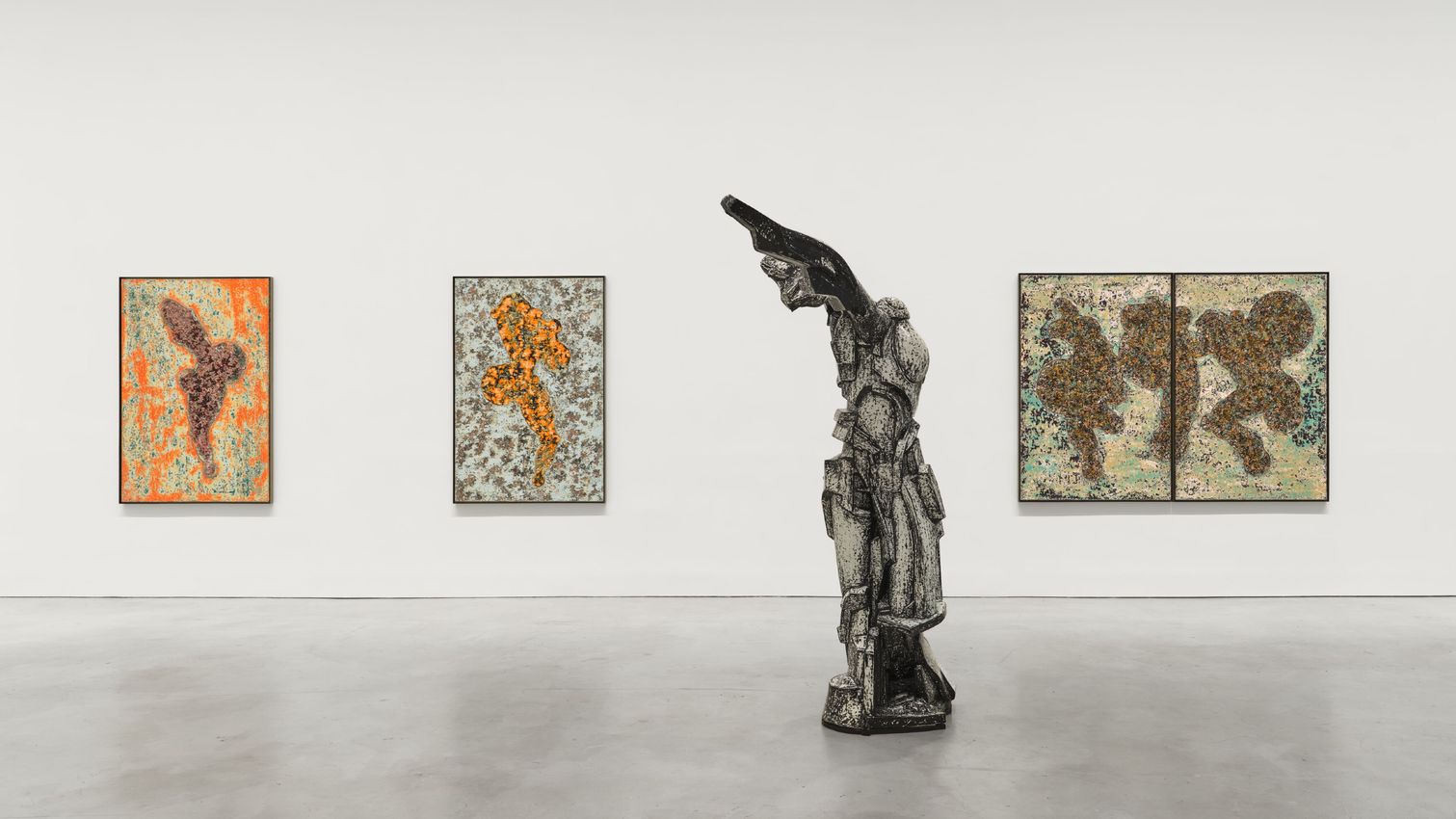
Frank Bowling’s exhibition ‘Collage,’ the artist’s first solo exhibition in France, explores collage as a conceptual tool and technique for Bowling’s practice and thinking. The exhibition features works from the early 2000s up until the present day, where at the age of 90 Bowling still paints on a daily basis. The starting point for the show is reflected in four new large-scale paintings on display in the ground floor gallery, which are comprised of multiple canvas panels. These monumental works—including the 4.4 meter-tall ‘Skid’ (2023)—are a renewal of Bowling’s use of collaged canvas and marouflage, which has long formed an important part of his practice. The exhibition is complemented by an academic program.

Bowling’s attraction to collage was partly influenced by Henri Matisse’s cut-outs, which he first encountered in the late 1950s and again at the 1992 MoMA retrospective in New York. For an article in the 1999 Winter issue of ‘Modern Painters,’ Bowling was asked to reflect on his career and select a work of art that most shaped or changed his own vision and chose ‘The Snail’ (1953) by Matisse. Paying homage to this work, Bowling has made several collaged pieces directly referencing the spiral pattern, including ‘Back to Snail’ (2000).

Bowling’s first conceptual engagement with collage can be found in his early work in the ‘60s. Stating his material ambitions he has said, ‘I wanted to marry up all these disparate bits like color, mannerism, where you paint, this fandango of all these styles and make up a sort of strong work that has aspects of painting and sculpture and architecture [...] they can hang together like something new.’

The works selected for this exhibition also evidence the development in Bowling’s incorporation of found objects. Since the 1980s, diverse materials have found their way into his paintings, from children’s toys to medical equipment. In ‘Skid,’ for example, there are pieces cut from a medical plastic bag, a protruding medical tube, loose canvas string and strips of canvas. These everyday objects provide the viewer with an entry point and most have some personal meaning to Bowling, acting as a form of autobiography. These items are embedded into the picture plane along with the translucent fluidity of acrylic gel and paint, breaking and erupting from the surface. ‘I’m moved to chuck in detritus, and watch it swim and settle,’ Bowling once said, ‘it makes me feel I can get to a whole vision of what I’ve passed through in life.’

Read More
About the Artist

Over the course of six decades, Frank Bowling has relentlessly pursued a practice which boldly expands the possibilities and properties of paint. Ambitious in scale and scope, his dynamic engagement with the materiality of his chosen medium, and its evolution in the broad sweep of art history, has resulted in paintings of unparalleled originality and power. Bowling has been hailed as one of the foremost British artists of his generation. Born in Guyana (then British Guiana) in 1934, he arrived in London in 1953, graduating from the Royal College of Art with the silver medal for painting in 1962. By the early 1960s, he was recognized as an assured force in London’s art scene. During this period, his highly individual language of painting, which emerged from expressionistic figuration and pop art, encompassed autobiographical elements and the artist’s socio-political concerns.

View Artist Profile

Also Exhibiting

Address
26 bis rue François 1er
Paris
France
(1)
Paris 26 bis rue François 1er
Hauser & Wirth
26 bis rue François 1er, Paris, France
The art world in focus