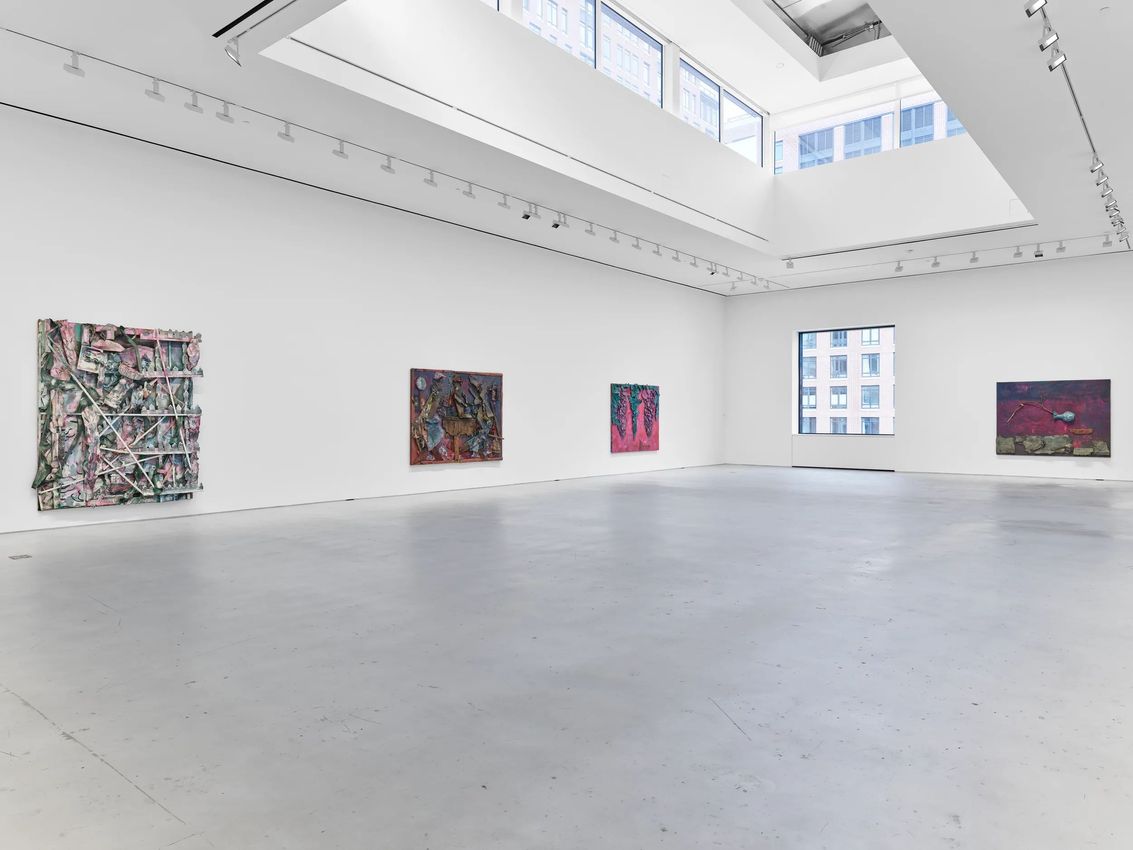
New York... Beginning 2 November, Hauser & Wirth will present an exhibition of large-scale paintings and assemblages by late American master Thornton Dial (1928 – 2016). The exhibition features major works from each period of Dial’s extraordinary career and draws upon a history of critical literature shaped by insights from such preeminent writers as Toni Morrison and Amiri Baraka. As its title implies, this presentation highlights Dial’s accomplishments as a maker of powerfully physical works (‘the visible’), while illuminating the often-obscured patterns of systemic trauma and exclusion (‘the invisible’) that drove his life and his prodigious artistic project.
The exhibition begins with two early important examples from the body of work known as ‘the Tiger Paintings’––a sprawling opus unto itself that culminated in an historical survey exhibition in 1993, titled ‘Thornton Dial: Image of the Tiger,’ a collaboration between the New Museum and the American Folk Art Museum in New York City. The two Tiger paintings on view at Hauser & Wirth assert Dial’s poetic power and his visual and symbolic ambition to dramatise and reflect upon his identity as an African American artist in a fraught American society. They reveal how Dial was a relentlessly reflexive image maker from the start, an artist whose works question their own assumptions and the traditions of art just as intensely as they do the world in which they were made and received.
Following the ‘Image of the Tiger’ exhibition, Dial turned his critical gaze to specific aspects of American artistic enterprise and events of modern American life. He produced visual meditations on lynching, and odes to the quilters of Gees Bend and women’s labor. At the same time, Dial was pushing the physical properties of his work beyond painting into the realm of assemblage, narrowing a gap between painting and sculpture through an increasingly virtuosic use of found materials and ever more inventive handling of the conventional medium of paint. ‘Strange Fruit: Alabama Grapes’ (2003), for example, displays Dial’s signature use of repurposed paint cans to create a bacchanalia, redolent of Matisse in its delirious chromatic extroversion. Grape-clusters and cut-tin grape-leaves hang—in an evocation of a lynching—above the outlines of a grape arbor below.
During the final years of his career, Dial’s work became increasingly lyrical, ecological and meditative. The magisterial assemblage ‘Mr. Dial’s America’ (2011) was occasioned by the Occupy Wall Street protests. In the work, Dial unleashes his apocalyptic vision of American political history, cosmic in its intensity and its breadth. Dial-the-alchemist is similarly at full power in ‘Nuclear Condition’ (2011), a response to the meltdown and flooding at the Fukushima Daiichi power plant in Japan, which evokes a sparse, haunted, perhaps undersea world—and an implicit hope of a more just world to follow.
About the artist
Thornton Dial was born in Emelle, Alabama, in 1928, and worked as a welder at the Pullman train plant in nearby Bessemer for much of his adult life. He emerged as an important original voice in art at the start of the 1990s and was celebrated in 1993 with a survey at the New Museum in New York City. About his work in the exhibition Amiri Baraka wrote: ‘The paintings featured in ‘Thornton Dial: Image of the Tiger’ will have to be acknowledged, one day soon, as one of the most important artistic gestalts by a North American painter of the period, and remember that these are a single fragment of Dial’s oeuvre.’ Refusing to be categorised or limited to the confines of any school or genre, Dial continued until his death in 2016 to develop a body of physically seductive and symbolically layered assemblages that wrestle with questions of American history and the role of the artist in society, challenging all boundaries in becoming a central figure in the expanded canon of contemporary art.
Dial’s work is held in the collections of many prestigious institutions, including at the Brooklyn Museum, Brooklyn, NY; Dallas Museum of Art, Dallas, TX; de Young Museum of Art, San Francisco, CA; Harvard Art Museums, Cambridge, MA; High Museum of Art, Atlanta, GA; Hirshhorn Museum and Sculpture Garden, Washington, D.C.; Indianapolis Museum of Art, Indianapolis, IN; The Metropolitan Museum of Art, New York, NY; Museum of Fine Arts, Boston, MA; The Museum of Fine Arts, Houston, TX; Museum of Modern Art, New York, NY; Pérez Art Museum Miami, Miami, FL; Philadelphia Museum of Art, Philadelphia, PA; Princeton University Art Museum, Princeton, NJ; Smithsonian National Museum of African American History & Culture, Washington, D.C.; Whitney Museum of American Art, New York, NY; among others.
Pioneering American artist Thornton Dial is known for his large-scale assemblages and paintings that reflect on the Black experience through coded and allegorical visual language.


A respected voice in contemporary art discourse.
Focusing on ambitious storytelling and insightful art-world commentary. Ocula Magazine publishes in-depth interviews, critical essays and timely analysis on the artists, exhibitions and ideas driving the global art world.
Learn more about Ocula Magazine
Showcasing the best of the art world.
Ocula partners with galleries from around the world to highlight their artists, artworks and exhibitions. Gallery membership is by application and invitation, with each member vetted by an independent panel.
Learn more about Ocula Membership

Specialises in the sale of major artworks.
Led by a team with deep ties to the world’s leading auction houses, galleries and collectors. Ocula’s advisory team offers bespoke services to high-net-worth clients from around the world who are looking to acquire the best of contemporary and modern art.
Learn more about our team and services