Press Release

Ramesh Mario Nithiyendran’s Liquid Artefacts

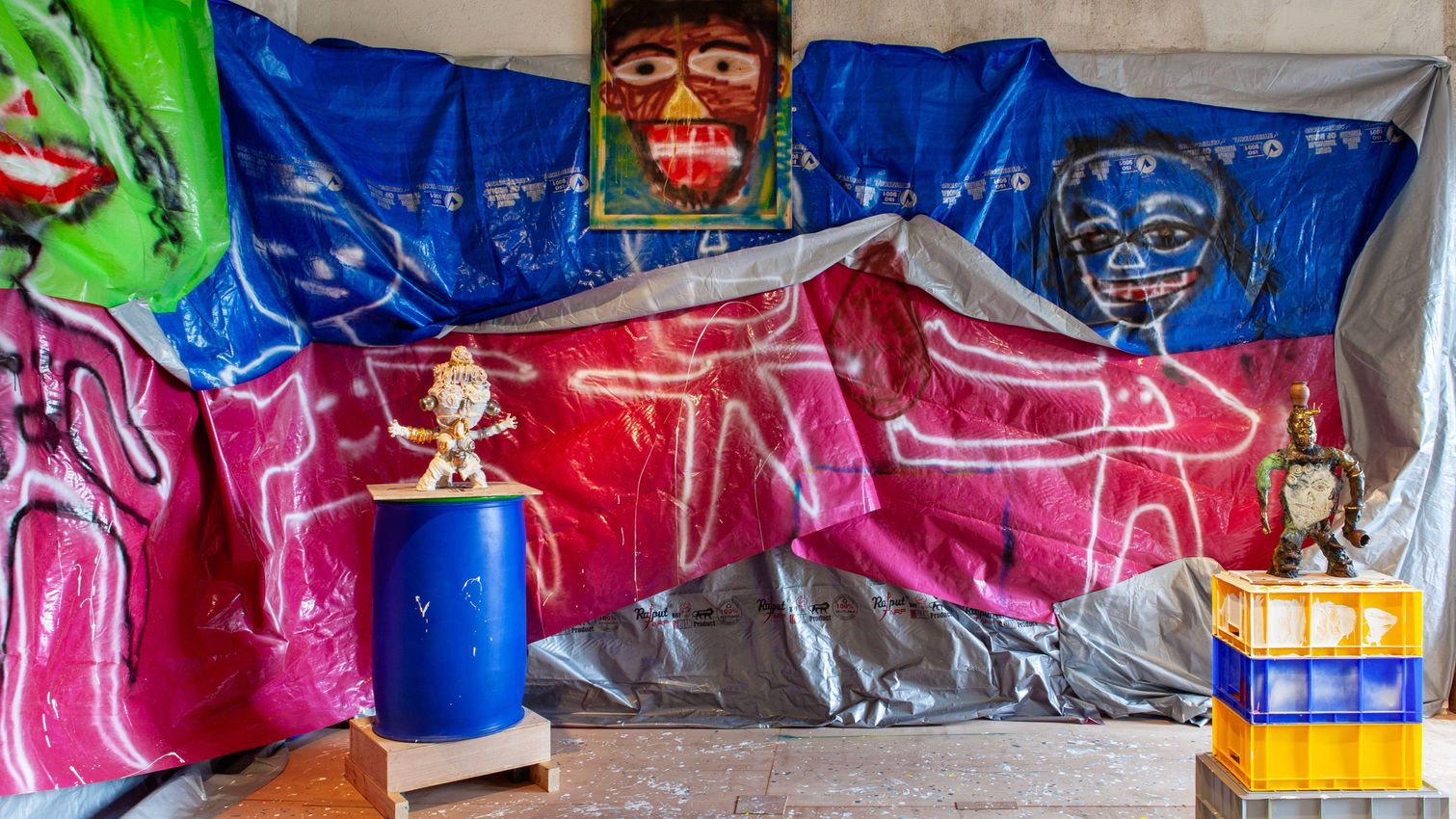
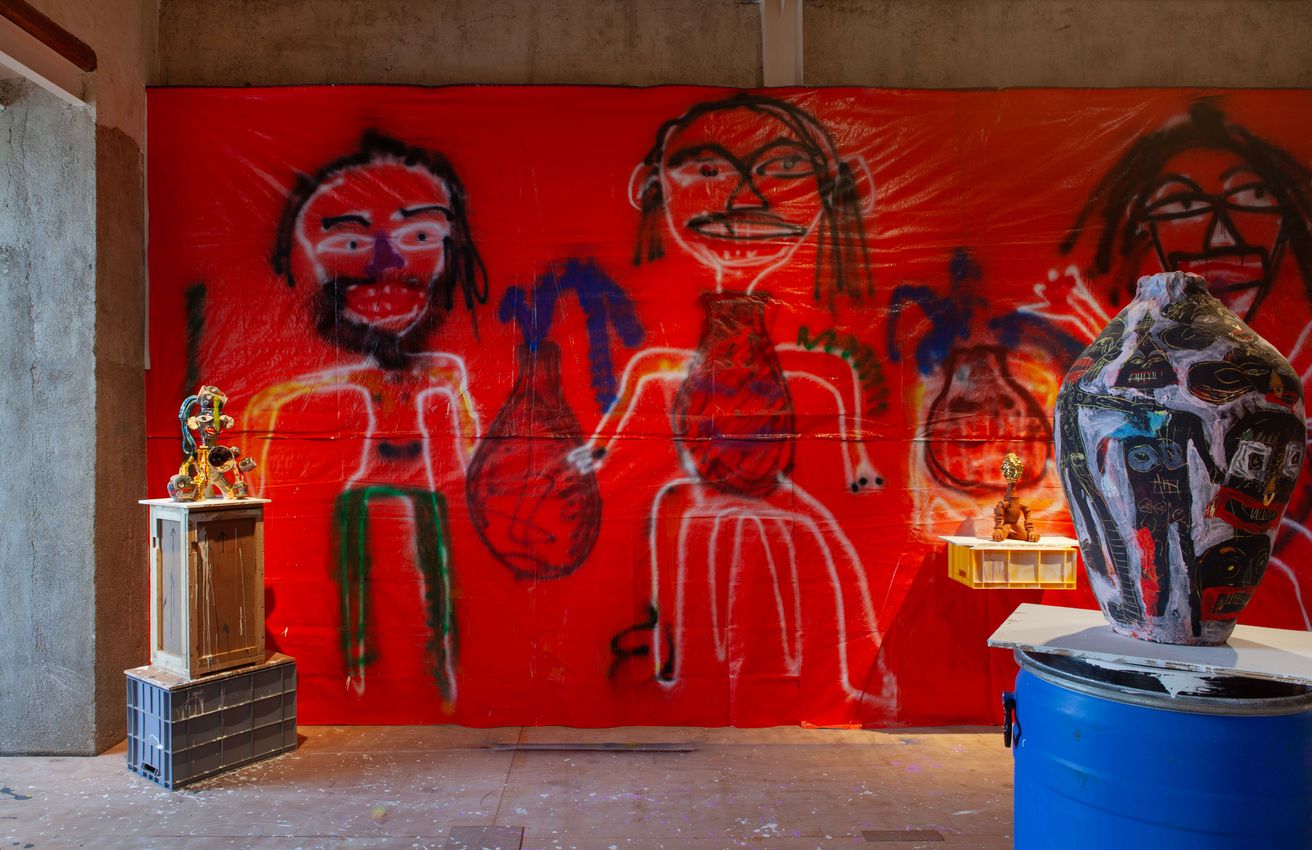
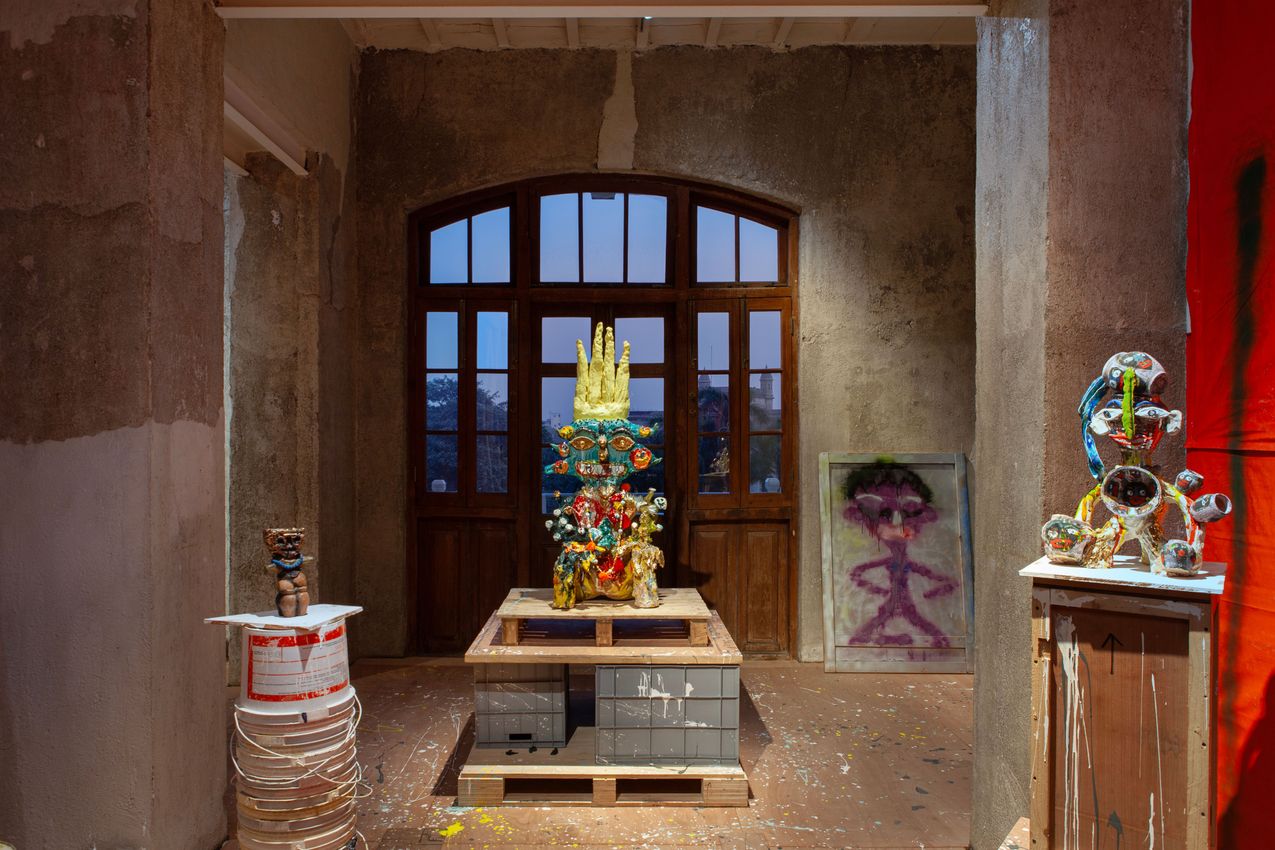
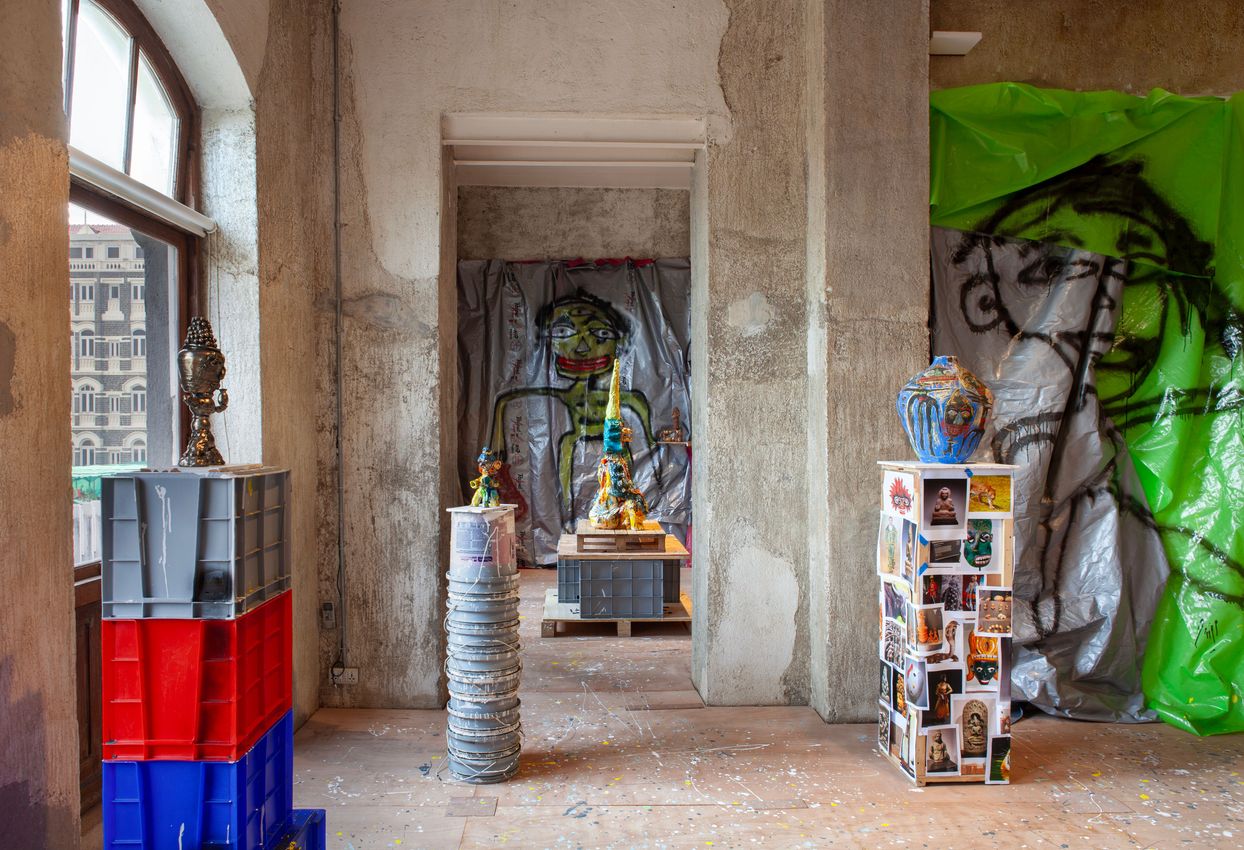
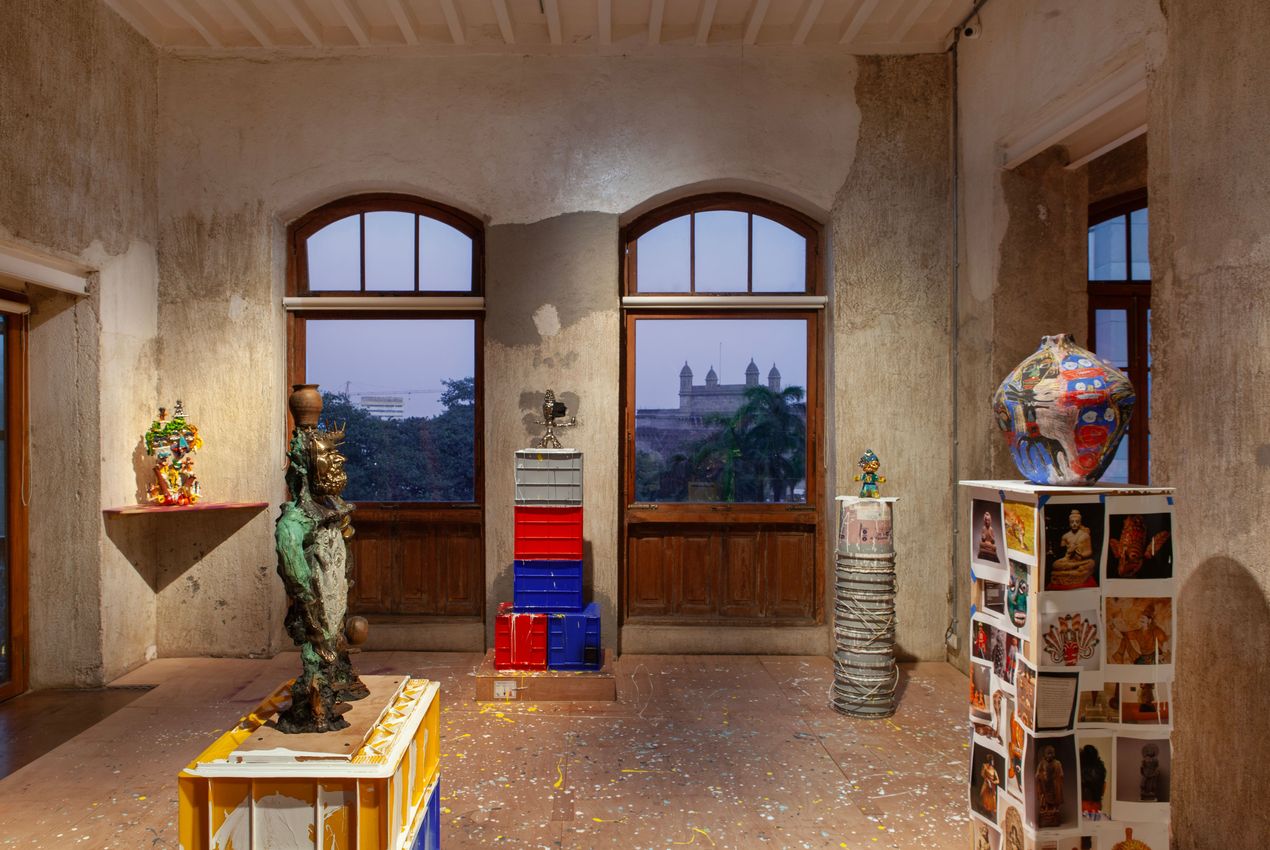
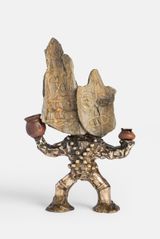
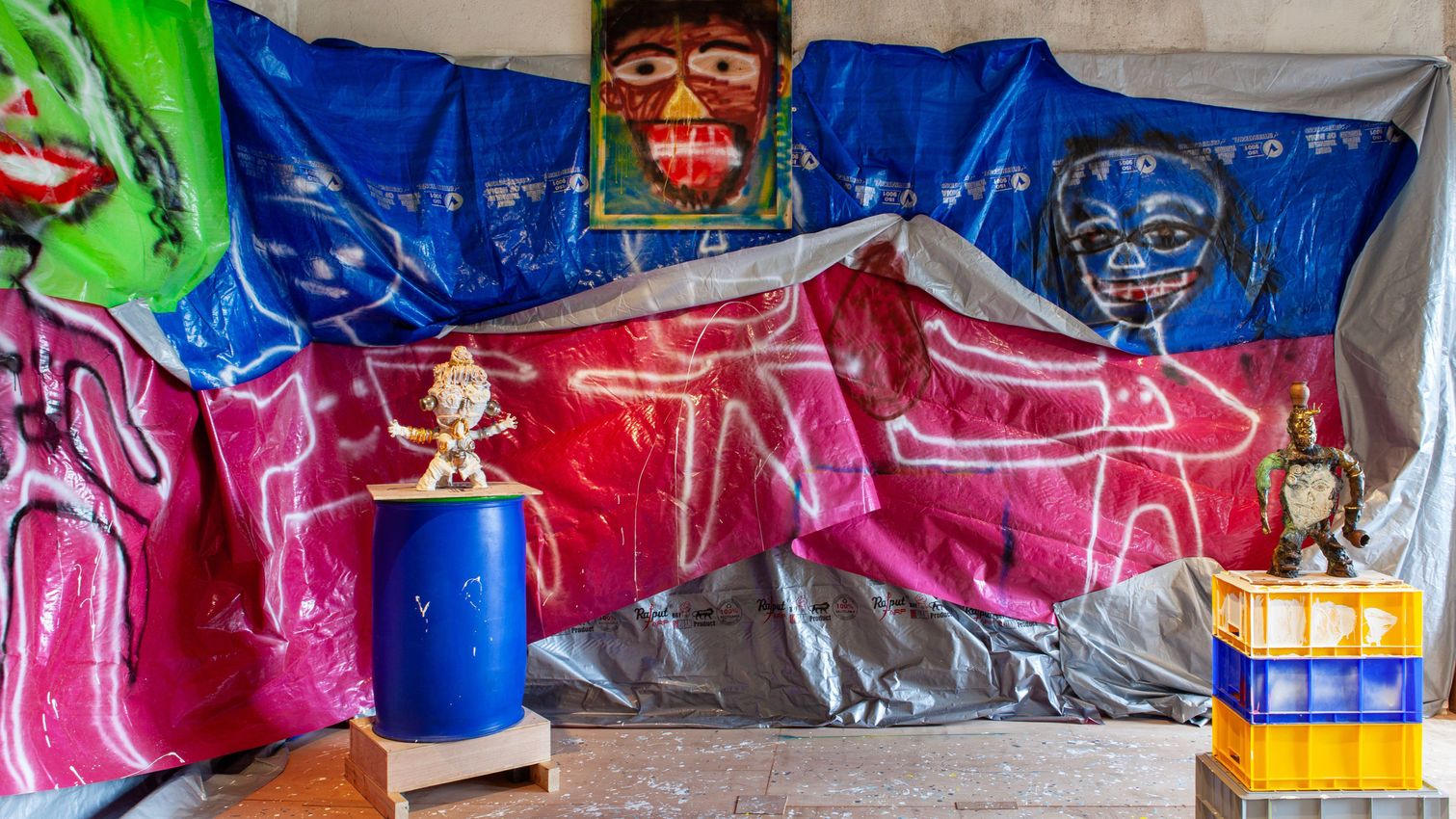
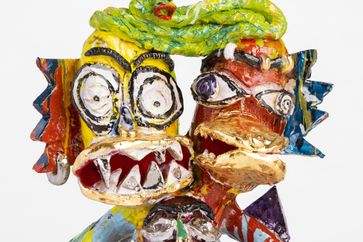
****A small bronze figure with two faces and an elongated neck, created with lost-wax casting, holds a collection of pots and a toy dinosaur head. Ramesh Mario Nithiyendran’s Vessel Figure with Masks and Dinosaur (2025) playfully performs its materials and metaphors, as though a kind of a speculative and surreal archaeological artefact. Born in Colombo, having relocated to Australia at a young age, Nithiyendran’s exhibition Of Dreaming and Remembering at Jhaveri Contemporary uses experimental aesthetic strategies to trace ceramic connections across South India. At the centre of the show is the idea and image of the vessel as transporter of forms of collective cultural knowledge across borders and boundaries that have continuously shifted and been subverted over deep spans of time.

‘Archaeology has no frontiers’, writes historian Osmund Bopearachchi, surveying the ceramic links between Sri Lanka and South India in the ancient world.1 Inscribed potsherds with Prakrit (old Sinhalese) have been found near the Indian subcontinent’s eastern sea ports alongside corresponding Tamil counterparts in Jaffna from the second century BCE onward.2 Such objects formed part of a much larger trade network, which stretched from South East to East Asia; with sixteenth-century Asian ceramic sherds found in the Torres Strait Islands.3 Attentive to these long histories of exchange, Nithiyendran sought to make his sculptures ‘look compellingly old’.4 He perceives the creation of such seemingly aged artefacts as a performance, drawing analogies to the way South Asian diasporic communities —himself among them—have encountered their vernacular sculptural objects in Western museums.

The modern development of such museums are bound up with nineteenth-century colonial disciplines of archaeology, palaeontology, geology, and anthropology—intellectual practices interconnected with British resource extraction, land theft, and mythological projections of and onto both Australia and South Asia—where the discovery of prehistoric fossils fed white supremacist theories of race, which attributed certain people as remnants of a deep past.5 The toy dinosaur head in Vessel Figure with Masks and Dinosaur mocks the very prospect of such conclusions—its contemporary plastic rendered in revered bronze, simultaneously performing and puncturing any notion of being a recently unearthed ancient artefact. Nithiyendran’s humour is surrealist, building imaginative worlds through playful absurdism.

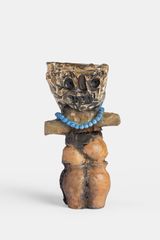
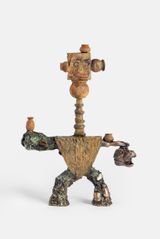
The artist’s use of materials is self-reflexively performative, dramatising a sense that ‘ceramics are performing ceramics, bronze performing bronze, glaze performing glaze’.6 In earthenware and glaze Figure with Many Vessels II (2025), a collection of pots forms a composite being, shimmering with a fluvial liquidity, dripping with gushing flows of colour. Art critic Justin Paton recognises a ‘just made quality, the feeling the figures are emergent ... seemed still to be wet and forming’ in the artist’s work.7 For critic and curator Mark Rappolt, ‘Nithiyendran is driving towards an idea of sculpture as an animate form ... something that embraces change and ephemerality. Something that is constantly between states’.8 Important for the artist is an ‘approach to materiality that has a kind of queerness’, while creating multi-gendered or genderless figures that joyfully evade binary categorisations.9

Gender binaries themselves in South Asia are the product of the British Empire: from racist scientific claims about sexual dimorphism, to marriage and sexuality legislation that sought to intervene in land relations as a method of managing populations as colonial workforces.10 For India in 1860 and Sri Lanka in 1883, the British outlawed homosexuality as ‘against the order of nature’—a Penal Code struck down by the Indian Supreme Court in 2018, while the Sri Lankan Parliament announced decriminalisation plans in 2023. As a result of this history, in Sri Lanka there is a body of modern and contemporary queer art which circumvents legibility within overdetermined Global North taxonomic identity categories: what poet and philosopher Édouard Glissant might call the right to opacity.11 Nithiyendran’s aesthetic approach could be described in similar terms: in his practice, evasion is a queer strategy.12

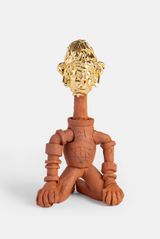
Liquid forms are a recurring motif in the artist’s work because they slip, spill, and seep across borders and boundaries. Drips of white glaze suspend in a moment of seeming perpetual motion in Figure with Many Vessels (2025), a porous pierced body wearing silver pots. Painterly marks in earthenware Seated Figure with Yellow Headpiece (2024) splash in blue and red streams, rivers running against otherworldly yellow flesh. Nithiyendran’s fluvial and fluid imaginary suggests the kind of aqueous aesthetic possibilities proposed by literature studies scholar Jeremy Chow, who argues that water and queerness can be read together not via conventional identity politics, but because each rejects stasis and stability.13 Distinct to Nithiyendran’s work, however, are vessels as specific South Asian water technologies.

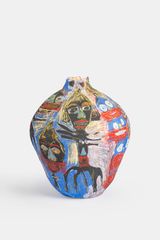
Though much smaller in scale, the pots that adorn many sculptures in Of Dreaming and Remembering recall water tanks in Sri Lanka and South India. In the former’s dry zone and the latter’s Tamil lands from the second century BCE, sophisticated systems of hydro-engineering developed before being largely dismantled by nineteenth-century British colonial rule, which failed to understand either the ritualised forms of sustainable living or flexible and fluid social relations they were bound up with.14 Nevertheless, the technologies themselves offer forms of collective knowledge and survival in the midst of water scarcity and climate breakdown. At the centre of such practices is a sacred understanding of water itself: a belief found in Nithiyendran’s work too. In glazed earthenware pot Sgraffito Vessel V (2025), an assembly of surreal beings swim in blue sea, a kind of collective aquatic body.

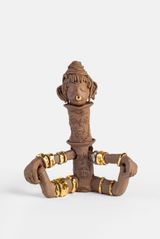
A Sri Lankan king once decreed that no drop of water should reach the ocean without passing through six bellies: a perception of the material itself as a site of social and environmental connection.15 Sgraffito Vessel V proposes a fluid imaginary that seeps beyond the geopolitical boundaries or bordered identities that violently structure our current world. The various vessels that recur throughout Of Dreaming and Remembering act as containers of South Asian hydraulic knowledge, which circulated across a shared sea over thousands of years: a cultural link that has left traces in ancient ceramic potsherds, despite British colonial attempts to partition the two regions.16 Testifying to enduring points of contact, Nithiyendran’s sculptures appear as strange artefacts: performing their materials with a surrealist humour, dreaming a generous and expansive aesthetics of liquid world-building.

1 Osmund Bopearachchi, ‘Ancient Sri Lanka and Tamil Nadu: Maritime Trade’, Jean-Luc Chevillard and Eva Wilden eds., South-Indian Horizons (Pondicherry: French Institute of Pondicherry, 2020), pp.539-551, p.594.

2 Bopearachchi, p.546; Himanshu Prabha Ray, ‘Inscribed Pots, Emerging Identities: The Social Milieu of Trade’, in Patrick Olivelle ed., Between the Empires: Society in India 300 BCE to 400 CE (Oxford: Oxford University Press, 2006), pp.113-138, p.123.

3 Terrence H. Witkowski, ‘Early History and Distribution of Trade Ceramics in Southeast Asia’, Journal of Historical Research in Marketing, Volume 8, Issue 2 (2016), pp.216-237, p.216; Peter Grave and Ian J. McNiven, ‘Geochemical Provenience of 16th–19th Century C.E. Asian Ceramics from T orres Strait, Northeast Australia’, Journal of Archaeological Science, Volume 40, Issue 12 (December 2013), pp.4538-4551, p.4538, p.4550.

4 Ramesh Mario Nithiyendran in conversation with the author, 22 September 2025.

5 Pratik Chakrabarti, Inscriptions of Nature: Geology and the Naturalization of Antiquity (Baltimore, MD: Johns Hopkins University Press, 2020), p.1, p.3, p.5, p.7, p.10-11, p.13, p.15- 17, p.19, p.21, p.26, p.35, p.51-52, p.56, p.58-63, p.66-69, p.74.

6 Nithiyendran.

7 Justin Paton, ‘The Welcome Party: Ramesh Here and Now’, in Jaklyn Babington ed., Ramesh (London: Thames and Hudson, 2022), pp.13-19, p.15.

8 Mark Rappolt, ‘Ramesh Mario Nithiyendran: Action and Drama’, ArtReview, 2 November 2023, https://artreview.com/ramesh-mario-nithiyendran-idols-of-mud-and-water-tramway- glasgow, accessed 6 October 2025.

9 Nithiyendran.

10 Sita Balani, Deadly and Slick: Sexual Modernity and the Making of Race (London: Verso, 2023), p.xix, p.31.

11 Edwin Coomasaru, ‘Queer Ecologies and Anti-Colonial Abundance in Lionel Wendt’s Ceylon’, Art History, Volume 46, Issue 4 (September 2023), pp.750-776, p.753-754; Édouard Glissant, Poetics of Relation, Betsy Wing trans. (Ann Arbor, MI: University of Michigan Press, 2010), p.189-194.

12 Nithiyendran.

13 Jeremy Chow, The Queerness of Water: Troubled Ecologies in the Eighteenth Century (Charlottesville, VA: University of Virginia Press, 2023), p.8.

14 David Mosse, ‘Epilogue: The Cultural Politics of Water – A Comparative Perspective’, Journal of Southern African Studies, Volume 34, Issue 4 (2008), pp.939-948, p.940-942, p.945; Sureshkumar Muthukumaran, ‘Rice and Water in Early Historic South India and Sri Lanka’, South Asian Studies, Volume 38, Issue 2 (2022), pp.101-115, p.105-107; Wiebke Bebermeier, Nuwan Abeywardana, Maija Susarina, Brigitta Schütt, ‘Domestication of Water: Management of Water Resources in the Dry Zone of Sri Lanka as Living Cultural Heritage’, WIREs Water, Volume 10, Issue 4 (2023), pp.1-17, p.1, p.9-11; Prasannan Parthasarathi, ‘Water and Agriculture in Nineteenth-century Tamilnad’, Modern Asian Studies, Volume 51 , Issue 2 (March 2017), pp.485-510, p.484, p.494, p.496-497, p.500-502, p.505.

15 David Robson and Dominic Sansoni, Bawa: The Sri Lankan Gardens (London: Thames and Hudson, 2017), p.14.

16 Sujit Sivasundaram, Islanded: Britain, Sri Lanka, and the Bounds of an Indian Ocean Colony (Chicago, IL: University of Chicago Press, 2013), p.14-18, p.23, p.25, p.29-31, p.43-54, p.54- 61, p.63, p.71-73, p.82-88, p.93, p.116, p.136, p.174-175, p.207, p.209, p.283, p.286, p.321- 323, p.325, p.329-331, p.335.

Press release courtesy Jhaveri Contemporary, Mumbai. Text: Dr. Edwin Coomasaru, 2025, UCL/University of Bristol

Read More

Installation Views

Selected Works

Loading...
About the Artist

Ramesh Mario Nithiyendran (b.1988 Colombo. Lives and works in Sydney) explores global histories and languages of figurative representation. He has specific interests in South Asian forms and imagery as well as politics relating to idolatry, the monument, gender, race and religiosity. While he is best known for his irreverent approach to ceramic media and audacious use of colour and ornamentation, his material vernacular is broad. He has worked imaginatively with sculptural materials including bronze, concrete, neon, LED and fibreglass, as well as conventional painting and printmaking materials and techniques.

View Artist Profile Ramesh Mario Nithiyendran contemporary artist
About the Gallery

Jhaveri Contemporary was formed in 2010 by sisters Amrita and Priya with an eye towards representing artists, across generations and nationalities, whose work is informed by South Asian connections and traditions. The gallery’s dedication to original scholarship, engendered through its carefully crafted shows, is one of the many ways it distinguishes itself. Entwined with this philosophy is another guiding principle: showcasing the heterogeneous practices of long-celebrated luminaries as well as emerging talents, often in generously interrogative conversations. With a focus on mining lesser-known art histories, Jhaveri Contemporary facilitates dialogue between artists, curators and historians to add to the wider field of art. Estates served by the gallery include Mrinalini Mukherjee and Anwar Jalal Shemza.

View Gallery Profile
Address
3rd Floor Devidas Mansion
4 Mereweather road
Apollo Bandar Colaba
Mumbai
India
Opening Hours
Tuesday – Saturday
11am – 6:30pm
(1)
Mumbai 3rd Floor Devidas Mansion, 4 Mereweather road
Jhaveri Contemporary
3rd Floor Devidas Mansion, 4 Mereweather road, Apollo Bandar Colaba, Mumbai, India

Opening hours
Tuesday – Saturday
11am – 6:30pm
The art world in focus