



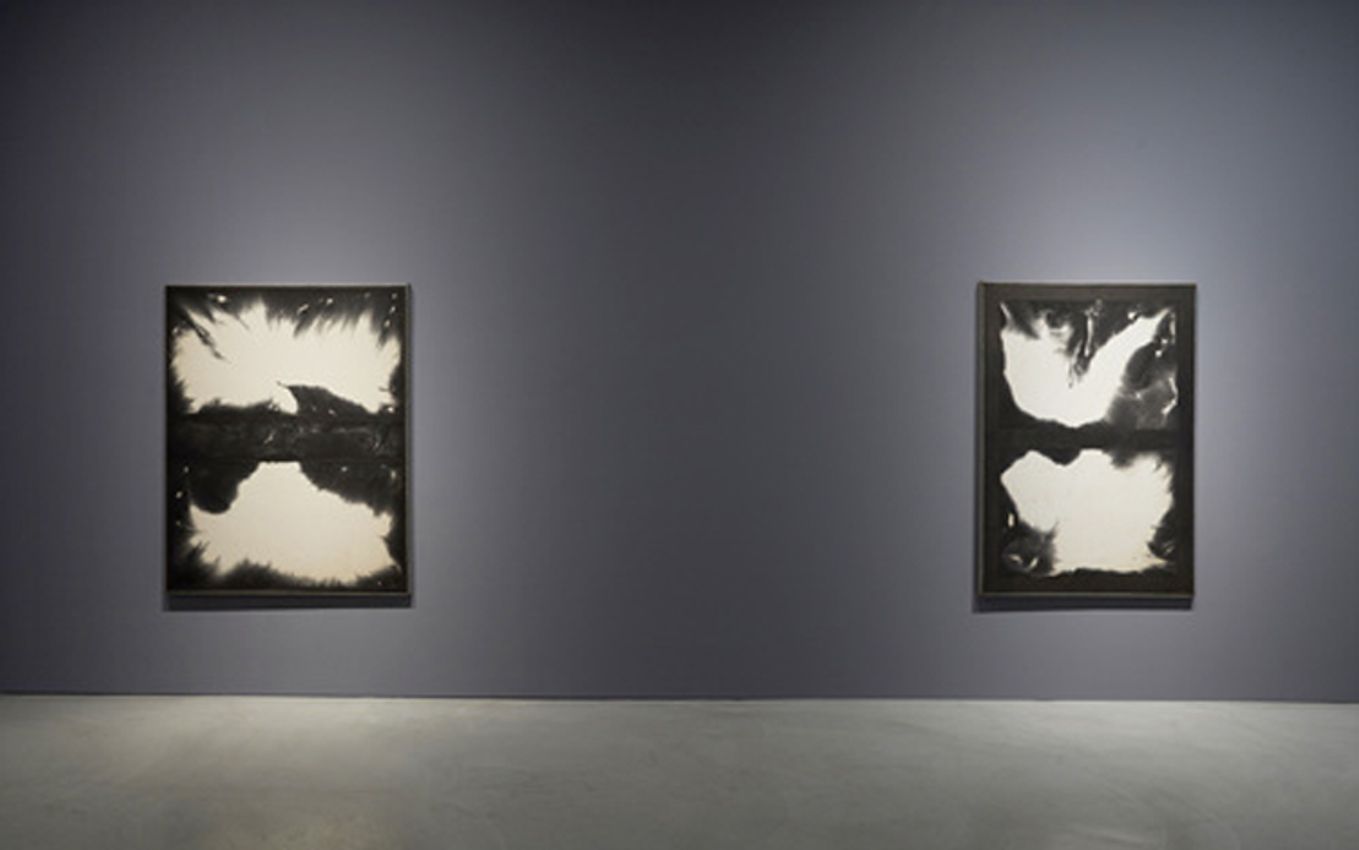
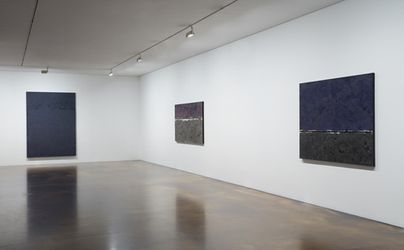
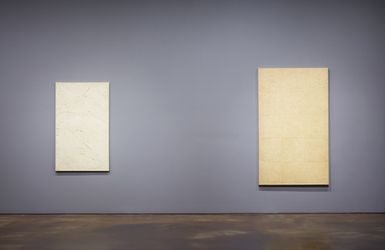
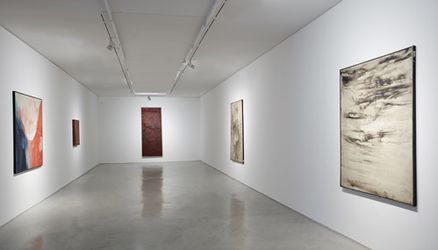
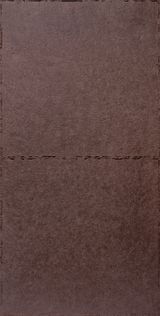
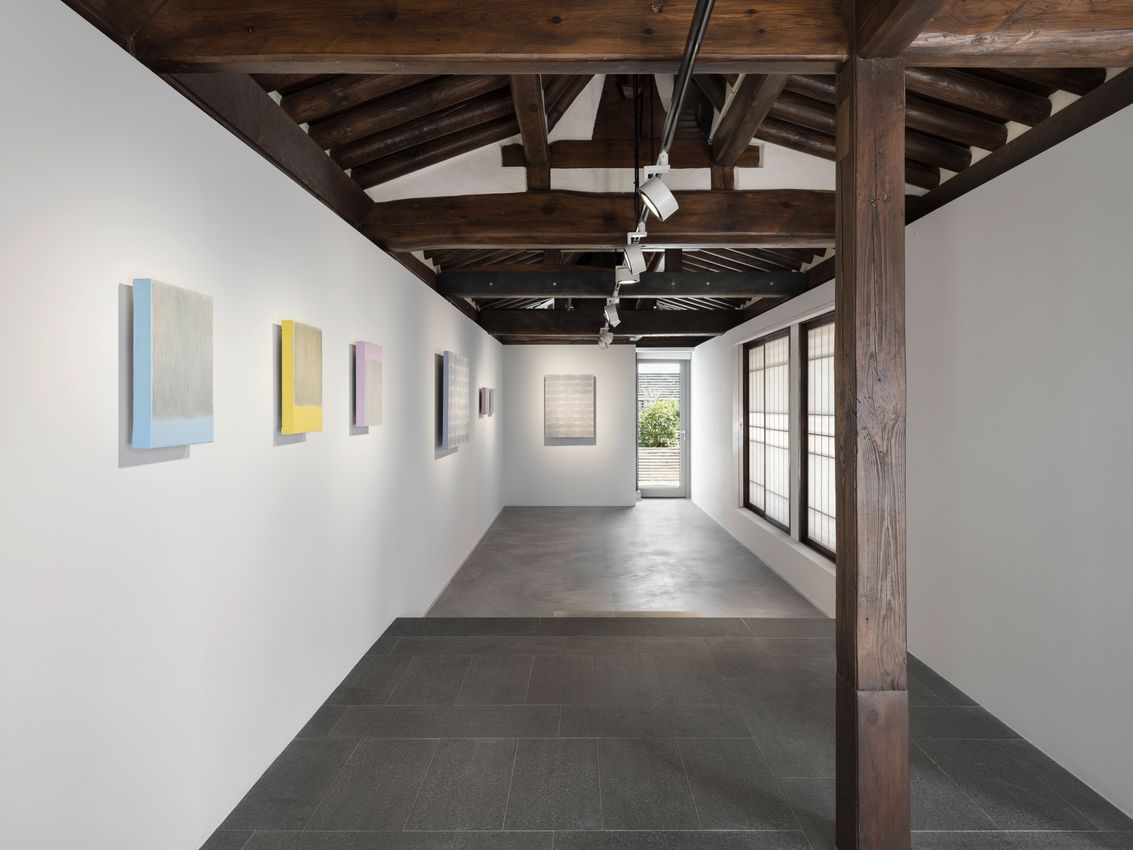
Kukje Gallery is pleased to present a solo exhibition of Chung Chang-Sup, one of Korea’s most celebrated Dansaekhwa masters and historically important abstract painters. Using traditional Korean paper pulp or tak, Chung’s work expresses a distinct Korean sentimentality and ideology,founded on his attempt to unify material and gesture. Installed throughout K1 and K2, this exhibition will be comprised of twenty-one major artworks that span his entire life’s practice; the exhibition provides a comprehensive introduction to the artist’s ideology of “unity between the thing and the self.
“When I first found tak paper in the 1970s, I did not think “I might just try this,”but it immediately made sense to me so naturally that I felt as though I had known tak paper all along and something in me clicked. No sooner had I found it then I found myself absorbed in it. […] Maybe that was the reason why I felt so comfortable and familiar with the paper when I chose it as an agent to express material-hood.It simply had a feeling, and it was coming towards me.”1
Chung Chang-Sup’s unique body of works began with his attempt to rediscover Korean traditions. When he began his art practice, Korea was in social turmoil following the Korean War and in a major transition toward modernization. The Korean art scene, which was centered around the Korean National Art Exhibition (Kukjeon)at the time, was adopting Western modernism without any of its ideological foundation. At first Chung followed the trends of Informel and other Western art movements of the 1960s, and he joined the abstract movement initiated by a younger generation of artists who were looking to challenge institutional art practices. During this period he used oil paint to create a suffused effect, investigatingEastern ink-and-wash painting. In the mid-1970s Chung was introduced to the Korean paper hanji, which became a major turning point in his practice.
Hanji is a material commonly and widely used in Korea for everyday utilitarian needs such as furniture, calligraphy, and fans. Hanjiis also used as a translucent window covering, known as changhoji, in traditional architecture. Changhojiis a material that acts as a filter, effectively becoming a symbol for combining the duality that is “in” and “out.”The artist began using hanji because of this strong association,and to connect to the importantKorean traditions that were being lost. This can be seen clearly in Chung’s Return series, where he attached hanji to the canvas and let the natural permeation of ink-and-wash bleed through the paper. This series powerfully investigates Korean identity, and at the same time evokes the traditional sentimentality lying dormant inside us.
In the 1980s, in order to overcome the limitation of paper becoming a mere background material, Chung Chang-Sup began to explore tak, the raw material of hanji, resulting in the Tak series. In this body of work, the artist first soaked tak in water and kneaded it into a thick paste before applying it on canvas and sculpting subtle folds with his hands. The results of this technique, once dried, exposed various delicate, diagonal lines and revealed the unique rhythm and structure of the fibers in the paper. For the artist, this approach was based on his effort to remove his own ego, a process where he waits for the innate characteristics of the tak to naturally surface. Instead of using a brush, the artist used his hands to mould and apply the tak, a process that became an important element of the artist’s work where his actions, identity, and soul integrated with the material. In this way the artist himself was able to permeate into the material transforming the large canvas into paper.
In the 1990s, Chung started his Meditation series, a body of work consisting of orderly grids and deep colors. Combining burgundy, indigo blue, and brown to the wet tak paste in order to achieve a darker palette, the artist created an optical effect, mirroring an endless abyss of color. The solid square surface of the grid is reminiscent of the partitions found in traditional Korean windows, which was where Chung found inspiration for their use, and the hanji, contrasts with the rich textures of the fibrous tak. For Chung, this dynamic interplay between the various material textures embodies his desire for “paintings that hanji paints by itself.”
Beginning in the 1990s,the Meditation series was simplified to an ascetic black and white monochrome palette,a mood that evoked a state of absolute silence. Reducing his aesthetic to reflect humble materials and a simple Korean sentimentality, the raw muted colors in this later series,produced until 2010, reflect the artist’s deepening identification with Korean aesthetics and traditions.
Chung Chang-Sup’s works embody his strong pursuit of the ideal of removing the ego. This practice emphasizes a return to fundamental form in order toexpress an abstraction of Korean consciousness, where, in the artist’s words,the “artwork depicts aworld without depiction” through hanji and tak. The artist has saidthat “tak paper,as the symbol of national sentiment,mediates the process of acclimatization of my existence and the material-hood of tak.I want my works to bethe truthful reflectionof myself and ourcontemporary society.”This exhibition explores deeplyChung Chang-Sup’s artistic vision and philosophy highlighting his interest inreturning to natureand the ideals of Korean cultural identity.
Born in 1927 in Cheongju in the North Chungcheong Province of South Korea, Chung Chang-Sup graduated from the Department of Painting, College of Fine Arts, Seoul National University in 1951. He made his debut exhibiting inthe 2nd Korean National Art Exhibition in 1953, with his work Sunset, a work inspired by Cubism’s deconstruction and analysis of objects.The artist was also influenced by Informel which was developing in a more radical circle of younger artists such as Park Seo-Bo and Young-Whan Kim. Despite his interest however, Chung did not involve himself formally with any movements and instead pursued his individual practice. From the late-1960s,Chung explored Eastern ink-and-wash aesthetics combining them with oil paints. In his Circles series, he articulated ideas of circulation and the circle, core concepts inKorean aesthetic consciousness. He was a professor from 1961 to 1993 at the College of Fine Arts at Seoul National University, and was granted the title of Honorary Professor upon retirement.
Beginning with his participation in the inaugural Modern Artists Association Exhibition in 1957, Chung Chang-Sup exhibited widely establishing his place as a vital member of the Korean art scene. He participated in major international exhibitions such as the 2nd Paris Youth Biennale (1961); Actuel Exhibition, Seoul (1964); São Paulo Art Biennial (1965); Working with Nature: Traditional Thought in Contemporary Art from Korea at Tate Liverpool (1992); Dansaekhwa, official collateral event of the 56th Venice Biennale (2015); and the 12th Sharjah Biennial (2015). The artist’s major solo exhibitions include Duson Gallery, Seoul (1984); Tokyo Gallery (1994); a major retrospective at the National Museum of Modern and Contemporary Art, Gwacheon (2010).Chung’s works are in major collections including the National Museum of Modern and Contemporary Art, Gwacheon; Seoul Museum of Art; Leeum, Samsung Museum of Art, Seoul; Tokyo Metropolitan Art Museum; Hiroshima City Museum of Contemporary Art; M+ Museum forVisual Culture, Hong Kong; and the Guggenheim Abu Dhabi. The artist died in 2011.


The unique works of Chung Chang-Sup (1927-2011) have been called “unpainted painting” in which he molds traditional Korean papers after soaking them in water. The resulting artworks reveal themselves as a result of the alchemy of materials and the creational process of nature. Pigments are not added to the papers, rather the unique tones of the works are achieved based on the length of time the paper is soaked in water before being applied with handmade glue onto canvas. Chung’s works reflect his Taoist belief that the artist is in unity with the material and nature, allowing the work to reveal itself, throughout the creation process. Chung represented Korea in the Second Paris Biennale in 1961 and his work has come to be known as the epitome of the Dansaekhwa monochrome ideal of unity between artist and nature. Chung honors Korea’s traditional craft through the use of handmade paper made of mulberry pulp, long considered one of Korea’s most prized medium and a symbol of Korea’s unique, rich cultural heritage. Chung Chang-Sup was the subject of a major retrospective exhibition at the National Museum of Contemporary Art, Korea in 2010.


Established in the heart of Seoul in 1982, Kukje Gallery is a leading Korean gallery dedicated to showcasing works by Korean and international artists and promoting modern and contemporary art. At 54 Samcheong-ro, Jongno-gu, the gallery has 3 key exhibition spaces, respectively named K1, K2, and K3. In 2018, the gallery opened a second location in F1963, a cultural complex housed in a former wire factory in Suyeong-gu, Busan.

A respected voice in contemporary art discourse.
Focusing on ambitious storytelling and insightful art-world commentary. Ocula Magazine publishes in-depth interviews, critical essays and timely analysis on the artists, exhibitions and ideas driving the global art world.
Learn more about Ocula Magazine
Showcasing the best of the art world.
Ocula partners with galleries from around the world to highlight their artists, artworks and exhibitions. Gallery membership is by application and invitation, with each member vetted by an independent panel.
Learn more about Ocula Membership

Specialises in the sale of major artworks.
Led by a team with deep ties to the world’s leading auction houses, galleries and collectors. Ocula’s advisory team offers bespoke services to high-net-worth clients from around the world who are looking to acquire the best of contemporary and modern art.
Learn more about our team and services