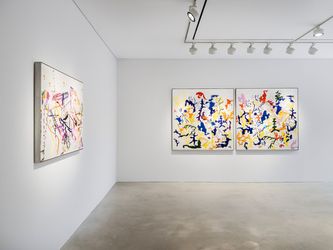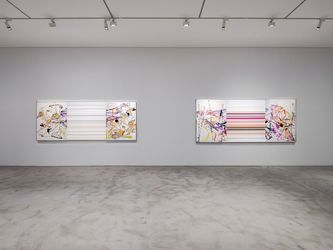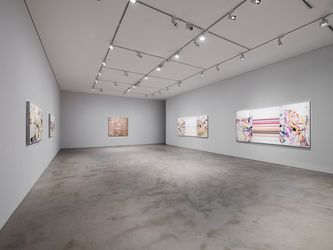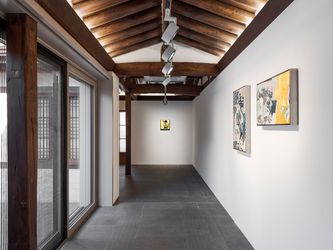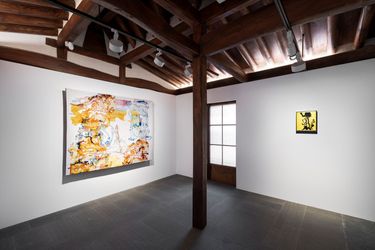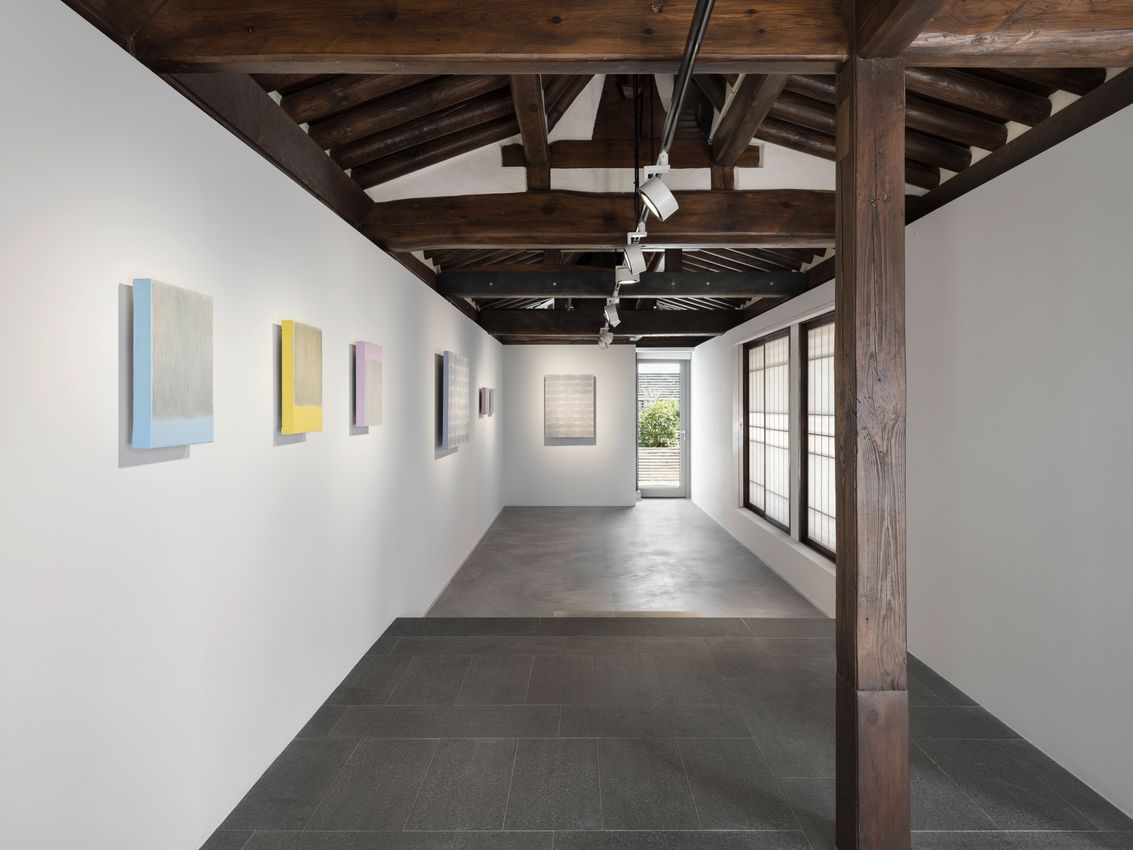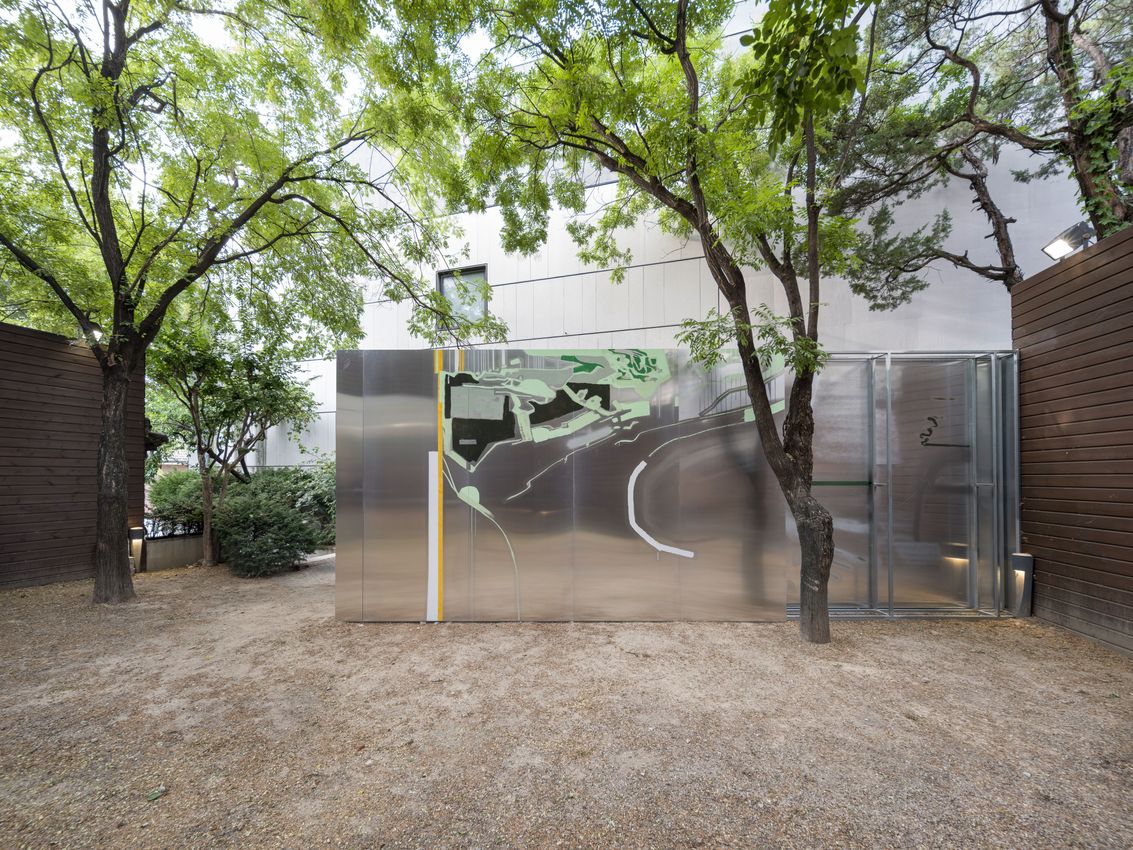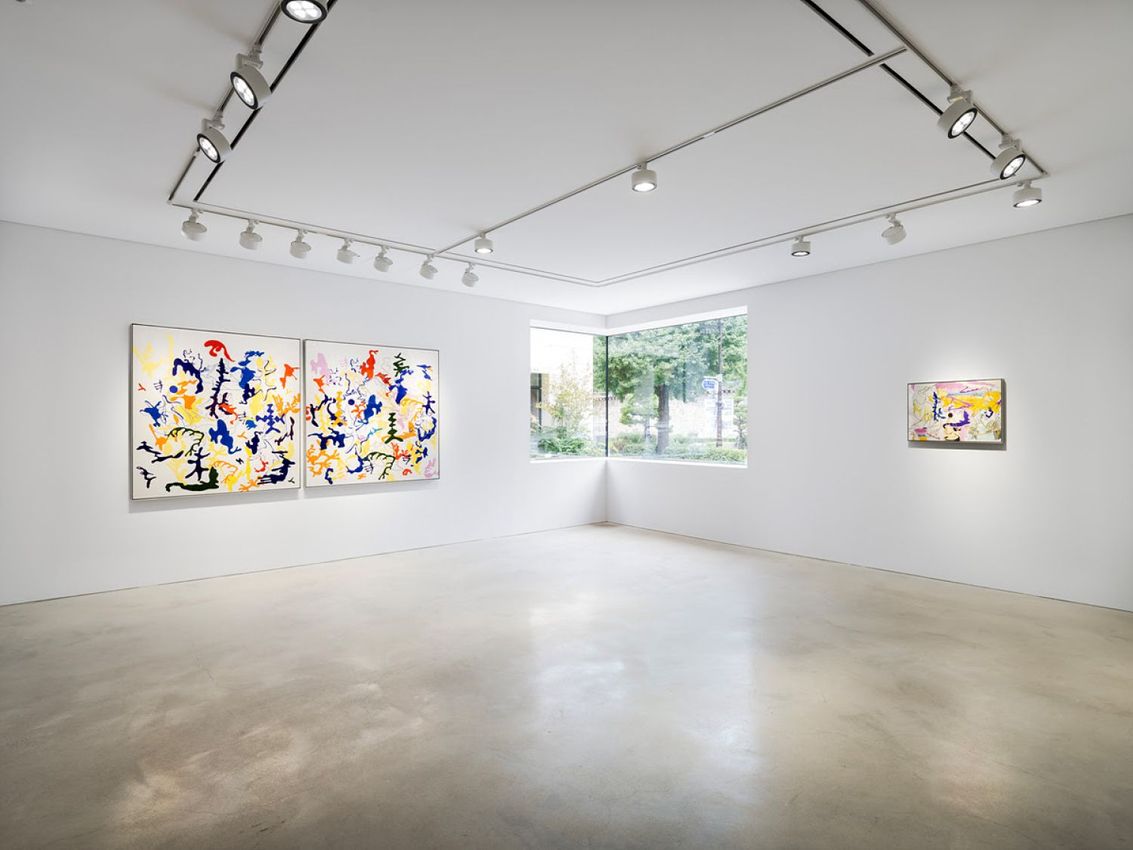
Kukje Gallery is pleased to present Phantom and A Map, a solo exhibition by Kyungah Ham from August 30 to November 3 in both the K1 and K3 galleries and the Hanok space. Organised in three chapters, Ham’s exhibition frames today’s society beginning with the choice of the term ‘phantom’. The term holds significant meaning in Ham’s practice, signifying all the invisible cues and connections that power society and constitute the illusion of culture. Following themes Ham explored in her 2015 exhibition with the gallery, Phantom Footsteps, which contemplated the dynamic between the visible and the invisible, Phantom and A Map seeks to present a deeper meditation on the world as it is recorded by these ‘footsteps’—a map that the artist paints as she constantly moves between the real and the unreal dimensions of this world.
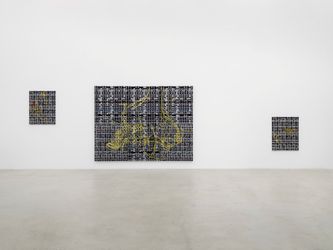
Beginning in K1, Ham has installed work from her iconic Embroidery Project, a series introduced since 2008. Embroidery Project actively embraces various layers of shared sociopolitical memory and meaning—for example, she has translated the mushroom clouds of Hiroshima and Nagasaki into black and white embroidery—while the complex production process she employs also weaves together complex and fraught dimensions of Korean society. As is well known, Ham designs her pieces by first making a sketch, which is then delivered to artisans in North Korea through a secret middleman. After a period of time which cannot be predicted in advance and is steeped in unpredictable circumstances, the finished embroidered work is returned to the artist, once again through a middleman. Most of the time, the initial design comes back in fragmented pieces, each done by a different artisan, after which Ham must combine the fragments into a finished work. This allows the artist to add her own touches as she mounts the fabric onto a canvas frame. Each work acknowledges the hours of manual labor put into the work in the caption. Confronted with the fact that a large embroidery is estimated to have taken 1,400 hours per person, we look anew at the hundreds of thousands of threads that constitute the finished image as well as the manual labor of the anonymous phantom. For the artist, embroidery serves as the most analog means of communication with the people with whom communication is possible not through the physical world, but only the virtual world. Embracing unpredictability is the prerequisite for collaboration with these neighbors who are so close but nevertheless strictly forbidden to contact. With no guarantee that any of the works will be completed, the most fundamental logic for this production, or one certain promise in her production process, is the series of unforeseeable delays as established by the ever-fluctuating political climate between the two Koreas.
K1 presents embroidery works that have completed this fraught journey. Two pieces reminiscent of Henri Matisse are inspired by the late artist’s illustrations for his selection out of Charles Baudelaire’s poetry cycle titled Les Fleurs du Mal, and they share the same title. Just as Matisse had surpassed the temporal gap of eight decades in his referencing of Baudelaire and their common interest in human nature, Ham thinks of Matisse as she paints her work. Also installed in K1 are works from her representative SMS series, which reproduce Donald Trump’s words speaking about the North Korean leader Kim Jong Un. In boasting his diplomatic record, the former U.S. president referred to his relationship with Kim as a ‘fantastic relationship,’ while at a campaign rally in 2018, he went as far as to declare that ‘we fell in love.’ Aside from a politician uttering romantic words as if he were a poet, the works in K1 genuinely frame poetry as embodying an abstraction of the artist’s sentimental impressions of today’s society.
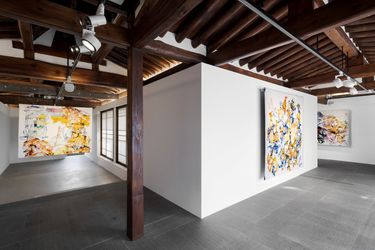
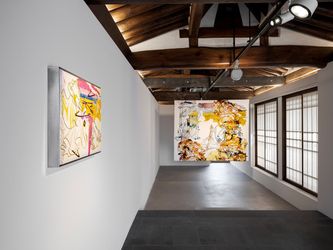
The abstract language of the embroidery work grouped under the subtitle Poetry in K1 can be seen in the works installed in the Hanok. These works are not only embroidery pieces but also tapestry works produced in collaboration with Magnolia Editions. In these works, formalized compositional gestures coalesce into Kyungah Ham Solo Exhibition Phantom and A Map at Kukje Gallery 2 / 7 patterns reminiscent of tears and stains, filling the Hanok space and prompting the audience to engage in a purely optical experience of the painterly woven fabrics.
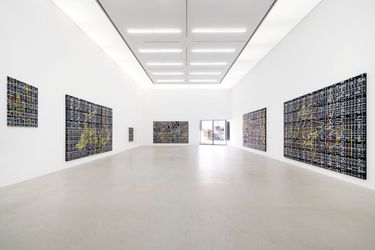
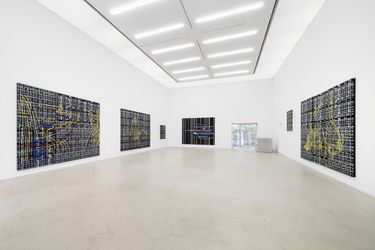
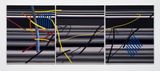
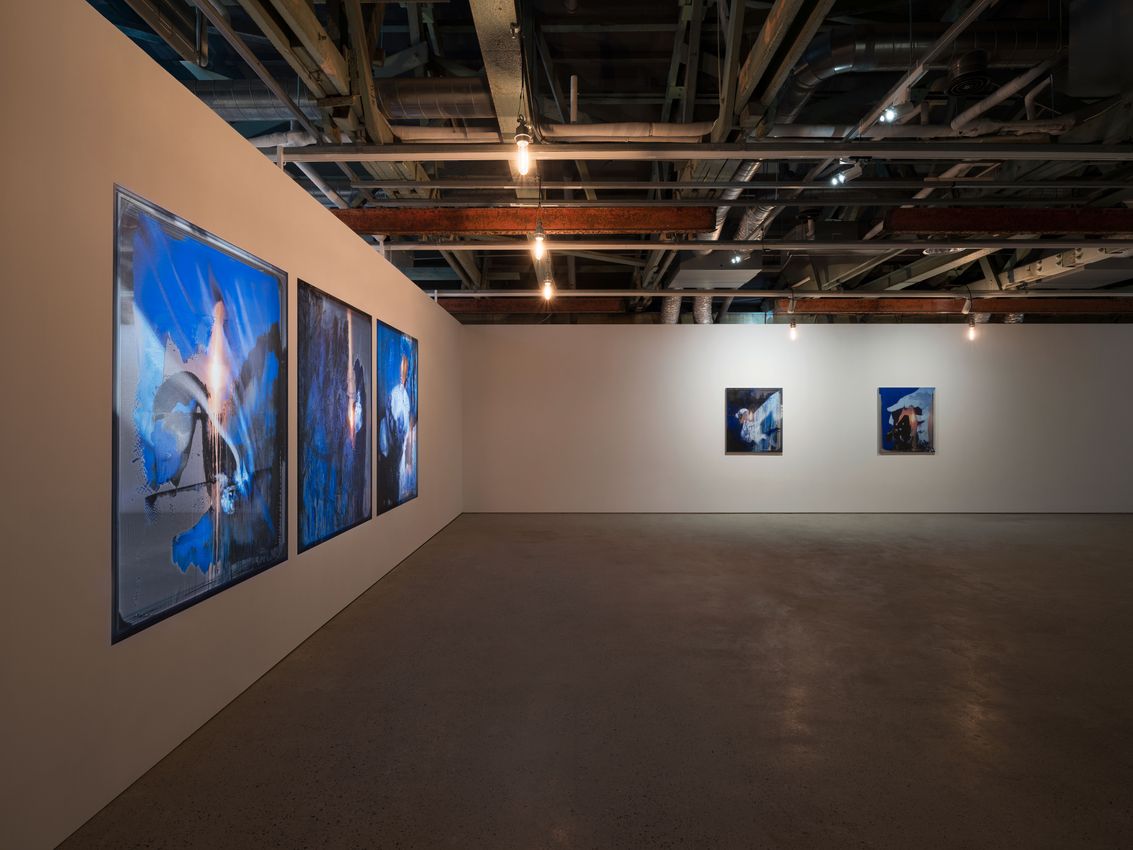
Ham had described her embroidery production process as: ‘If the process requires 10,000 steps, I walk 9,999 steps out of the 10,000 with nothing confirmed, with no idea where I am headed, totally unable to predict what will happen.’” While one might expect her to have become accustomed to this unique and highly unpredictable process, the recent global pandemic and volatile politics have prolonged the instability in her contact with North Korea. Whereas the middle panel in the triptych Phantom and A Map / Poetry 01WBL01V1T in K1 formalizes the period of waiting through horizontally composed color ribbons, the works in K3 present a more active interpretation of that time. Reminiscent of computer programming or abstract expressionism, the woven net of grids and complex dimensional matrices portrayed in the K3 works is grouped under the title Phantom and A Map / ‘Did you come by photograph or train?’—a quotation from John Berger’s The Seventh Man, where the author writes the following as he describes photography as a form of transport and an expression of absence: ‘A friend came to see me in a dream. From far away. And I asked him in the dream, ‘Did you come by photograph or train?’
The digital world, or the virtual world that we encounter every day, imitates our physical reality, but it exists as an independent entity. In much the same way, the production logic of the Embroidery Project–where the artist seeks an analog communication with those she is not able to meet in real life—has naturally led Ham to be fixated on the relationship between the real and the virtual. Living through the pandemic years, it was only natural that she dove deeper into contemplating the split between communication within the virtual world and that within the real. In contemplating what the true essence of reality is, the artist finds herself facing and championing personal emotions. As we become increasingly distanced from physical reality and become more immersed in the digital world, our emotions exploding amidst the chemistry between disparate stimuli and information sources are becoming even more amplified in a primitive, ‘analog’ sense. As such, the K3 works, woven with ribbon tapes of various fabrics, are an abstract portrait of today’s world, where two different dimensions and realms continuously collide.


Kyungah Ham was born in Seoul in 1966. Her work has been exhibited in solo shows including Room with a View, Gallery Loop, Seoul (1999), Such Games, Ssamzie Space, Seoul (2008), and Desire and Anesthesia, Artsonje Center, Seoul (2009). She has participated in selected group shows held at: British Museum, London (2005), Musee Palais de Tokyo, Paris (2010), Stiftung Ludwig Wein, Vienna (2010), National Museum of Moder and Contemporary Art, Gwacheon, Korea (travelled to Kunstmuseum Bonn, 2013), and Kunsthalle Dusseldorf (2014). She also participated in the 9th Guangdong Triennial (2012) and 7th Liverpool Biennial (2012).


Established in the heart of Seoul in 1982, Kukje Gallery is a leading Korean gallery dedicated to showcasing works by Korean and international artists and promoting modern and contemporary art. At 54 Samcheong-ro, Jongno-gu, the gallery has 3 key exhibition spaces, respectively named K1, K2, and K3. In 2018, the gallery opened a second location in F1963, a cultural complex housed in a former wire factory in Suyeong-gu, Busan.

A respected voice in contemporary art discourse.
Focusing on ambitious storytelling and insightful art-world commentary. Ocula Magazine publishes in-depth interviews, critical essays and timely analysis on the artists, exhibitions and ideas driving the global art world.
Learn more about Ocula Magazine
Showcasing the best of the art world.
Ocula partners with galleries from around the world to highlight their artists, artworks and exhibitions. Gallery membership is by application and invitation, with each member vetted by an independent panel.
Learn more about Ocula Membership

Specialises in the sale of major artworks.
Led by a team with deep ties to the world’s leading auction houses, galleries and collectors. Ocula’s advisory team offers bespoke services to high-net-worth clients from around the world who are looking to acquire the best of contemporary and modern art.
Learn more about our team and services