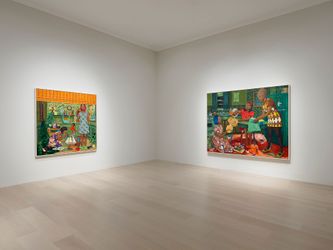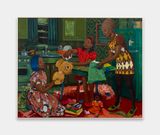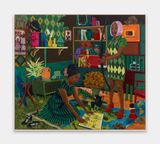
Lévy Gorvy Dayan is delighted to announce Wangari Mathenge: Re-membering, the artist’s first solo exhibition with the gallery, opening on the ground floor of 19 East 64th Street on September 17, 2026. Probing how culture, memory, and landscape are made and unmade, the presentation will mark Wangari Mathenge’s first public exhibition of sculpture and will debut five paintings.
The exhibition’s title Re-membering derives from the artist’s series of the same name, which she began in the fall of 2024. It was inspired by Ngugi wa Thiong’o’s 2009 book Something Torn and New: An African Renaissance—which focuses on the critical impacts of colonialism and slavery on the experience of diasporic and continental Africans, as well as strategies of resistance and recovery. The first part of Mathenge’s project involved extensive study of Kenyan colonial literature and cultural objects from 1900 to 1963—the year of Kenya’s independence from the United Kingdom—to examine and interrogate how history and her own cultural identity had been formed. Her research resulted in the first cycle of canvases (dated 2025) in the series, featuring colourful overhead views of lone figures in states of contemplation, surrounded by accumulated books, objects, and textiles.
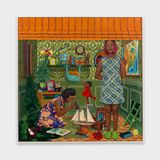
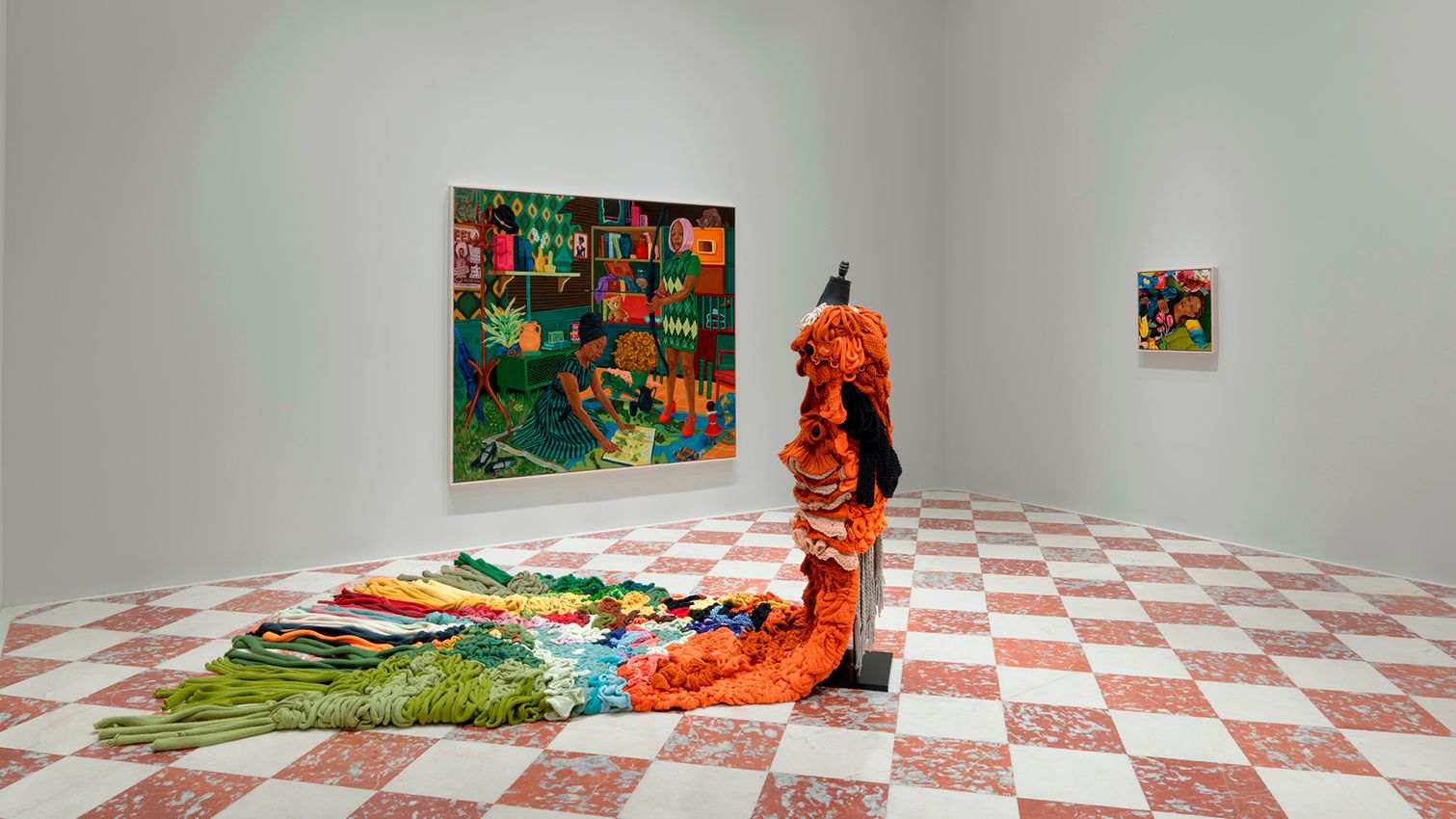
The new paintings on view at Lévy Gorvy Dayan constitute another path in Mathenge’s journey, representing her project as one of action. As she explains, “‘Re-membering’ signifies not merely the act of recall, but the active gathering and reassembly of what has been fragmented: cultural memory, inherited forms, histories, and ways of seeing.” In these new works, Mathenge portrays women—each an avatar for the artist—in vibrant domestic interiors interacting with, altering, and reconstructing the objects and spaces around them. Rich in symbols and signifiers of history, culture, and landscape—the imagined, charged scenes take place in the 1960s, a decade that saw a cultural shift in Africa following the liberation of numerous nations.
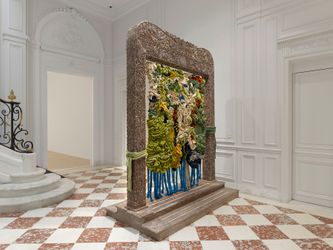
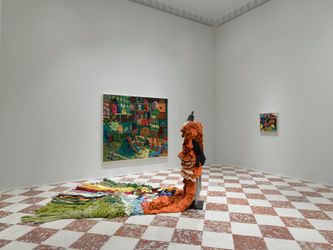
Directly relating to imagery in her canvases, Mathenge’s two sculptural works extend her investigation into three dimensions, creating opportunities for physical engagement with viewers. Re-membering VIII (Before Us, After Us, Ever Changing) (2025–26) features a wooden doorframe—intricately hand-carved by Malindi artisans—on which a densely embellished macramé textile is suspended. The sculpture derives from the nineteenth-century carved doors found on the East African coast, specifically those in the oldest preserved Swahili settlement of Lamu Old Town, Kenya. Decorated with diverse patterns and motifs, the elaborate doorframes represented the status, wealth, and prestige of their owners—and signified their access to social and economic networks established through trade and cultural exchange with India, the Middle East, East Asia, and Europe, as well as central Africa. Here, Mathenge activates this significant architectural legacy in New York, creating a threshold and portal through which history is discovered and inherited. The hanging knit tapestry, made with help from her family and members of her community, represents an unnamed landscape, echoing an abstracted map which appears in one of the painted compositions. “Rather than presenting the territory as fixed,” she states, “I wanted the work to evoke a landscape that is assembled from fragments: stitched together, carried forward, and continually reimagined.”
Displayed on a dress form, the ornate and voluminous knit sculpture Re-membering IX (The Shape of Inheritance) (2025–26) stems from the memory of a historical Gikuyu garment. The largest ethnic group in Kenya, to which Mathenge also belongs, the Gikuyu’s traditional modes of dress were deeply rooted in craft, in particular their practice of treating leather, including sheep- and goatskins, resulting in warm ochre- and cinnamon-toned clothes. With colonisation, Western fashion was imposed and adopted, resulting in a prolonged period in which Gikuyu dress was absent. Yet, in recent years, contemporary interpretations of traditional garments have notably reemerged in cultural ceremonies, such as weddings. Mathenge created this sculpture to be a reimagining, drawing from historical references and hues but also colonial influences like the Victorian bustle and train. Again bringing her practice into her community, the knitting was done with contributions from Mathenge’s circle, in her words, “extending ‘Re-membering’ into a collective act of making, in which cultural form is not simply preserved but remade through shared labour, memory, and care.” As the dress moves down towards the train, allusions to the human figure transform into those of landscape and terrain, bridging the distinctions between body and land. In Re-membering, Mathenge deconstructs how history is produced and experienced and composes how it can be inhabited and reenvisioned.
—
About the Artist
Wangari Mathenge’s paintings explore community and belonging through history, memory, and place. Her detailed, colorful portrayals of figures and groups in domestic settings feature objects that are filled with personal meaning or act as cultural markers. In her work, Mathenge draws on her heritage as well as memories and events in her own life, often centering on aspects of the diasporic experience. Born in 1973 in Nairobi, Kenya, she moved to London with her family as a young child. She later relocated to Washington, DC, where she studied law—later practicing in Massachusetts—before turning to painting, completing an MFA in Painting and Drawing at the School of the Art Institute of Chicago. Mathenge lives and works in Nairobi and Buckinghamshire, England.
Mathenge’s paintings have recently been included in exhibitions at the Nasher Museum, Duke University, Durham, North Carolina (2026); Indianapolis Museum of Art at Newfields (2025); Manetti Shrem Museum of Art, University of California, Davis (2025); Dallas Museum of Art (2025); Liljevalchs Konsthall, Stockholm (2025); Kunstmuseum Basel (2024); Memphis Brooks Museum of Art, Tennessee (2023–24); Spelman College Museum of Fine Art, Atlanta (2023); Zeitz Museum of Contemporary Art Africa, Cape Town (2022–23); and the Los Angeles County Museum of Art (2021–22), among others. Her work is held in public collections including those of the Crocker Art Museum, Sacramento, California; Dallas Museum of Art; Detroit Institute of Arts; Fondazione Sandretto Re Rebaudengo, Turin; High Museum of Art, Atlanta; Hirshhorn Museum and Sculpture Garden, Washington, DC; Muzeum Susch, Switzerland; Nasher Museum of Art, Duke University, Durham, North Carolina; Indianapolis Museum of Art at Newfields; Rubell Museum, Miami; Weisman Art Museum, University of Minnesota, Minneapolis.
Courtesy Lévy Gorvy Dayan.


Within her painting, Wangari Mathenge (b. 1973, Nairobi, Kenya) celebrates the multiplicity of African identity and culture, examining the creation and dissemination of ideas, objects and social practice. Her figurative compositions explore hybridity across the continent and diaspora, at times reflecting on the artist’s personal experience of movement between the two. In particular, the visibility and perspective of black women is integral to her work, often seeking to reclaim the domestic sphere as a place of sanctuary and learning. By drawing on a wide range of references, Mathenge explores her relationship to the broader narratives that frame her work, questioning her own position as an artist. Bold colours, vibrant patterns and soft, expressive brushstrokes enhance the mood embodied by each figure, inviting connection and introspection.


Helmed by Dominique Lévy, Brett Gorvy, and Amalia Dayan, Lévy Gorvy Dayan collaborates with artists, estates, non-profit organizations, foundations, museums, and private collections to increase the visibility of twentieth- and twenty-first century works and artists—realizing seminal projects and furthering legacies. In forming Lévy Gorvy Dayan, the partners merge their respective specialties across twentieth- and twenty-first century art, their reputations as leaders and tastemakers, and their respective backgrounds in the primary and secondary markets. Lévy Gorvy Dayan provides opportunities for education, exposure, and access to acquiring exceptional art through its museum-quality exhibition program and thoughtful participation in international art fairs. Expanding, refining, and enhancing world-class modern and contemporary art collections, the gallery emphasizes connoisseurship and curation in its collection development, estate planning, and art appraisal services. Both international and local in practice and perspective, Lévy Gorvy Dayan has unique spaces and unmatched market knowledge in New York, London, and Hong Kong, in addition to representation in Geneva, Milan, Paris, Shanghai, Singapore, and Taiwan.

A respected voice in contemporary art discourse.
Focusing on ambitious storytelling and insightful art-world commentary. Ocula Magazine publishes in-depth interviews, critical essays and timely analysis on the artists, exhibitions and ideas driving the global art world.
Learn more about Ocula Magazine
Showcasing the best of the art world.
Ocula partners with galleries from around the world to highlight their artists, artworks and exhibitions. Gallery membership is by application and invitation, with each member vetted by an independent panel.
Learn more about Ocula Membership

Specialises in the sale of major artworks.
Led by a team with deep ties to the world’s leading auction houses, galleries and collectors. Ocula’s advisory team offers bespoke services to high-net-worth clients from around the world who are looking to acquire the best of contemporary and modern art.
Learn more about our team and services