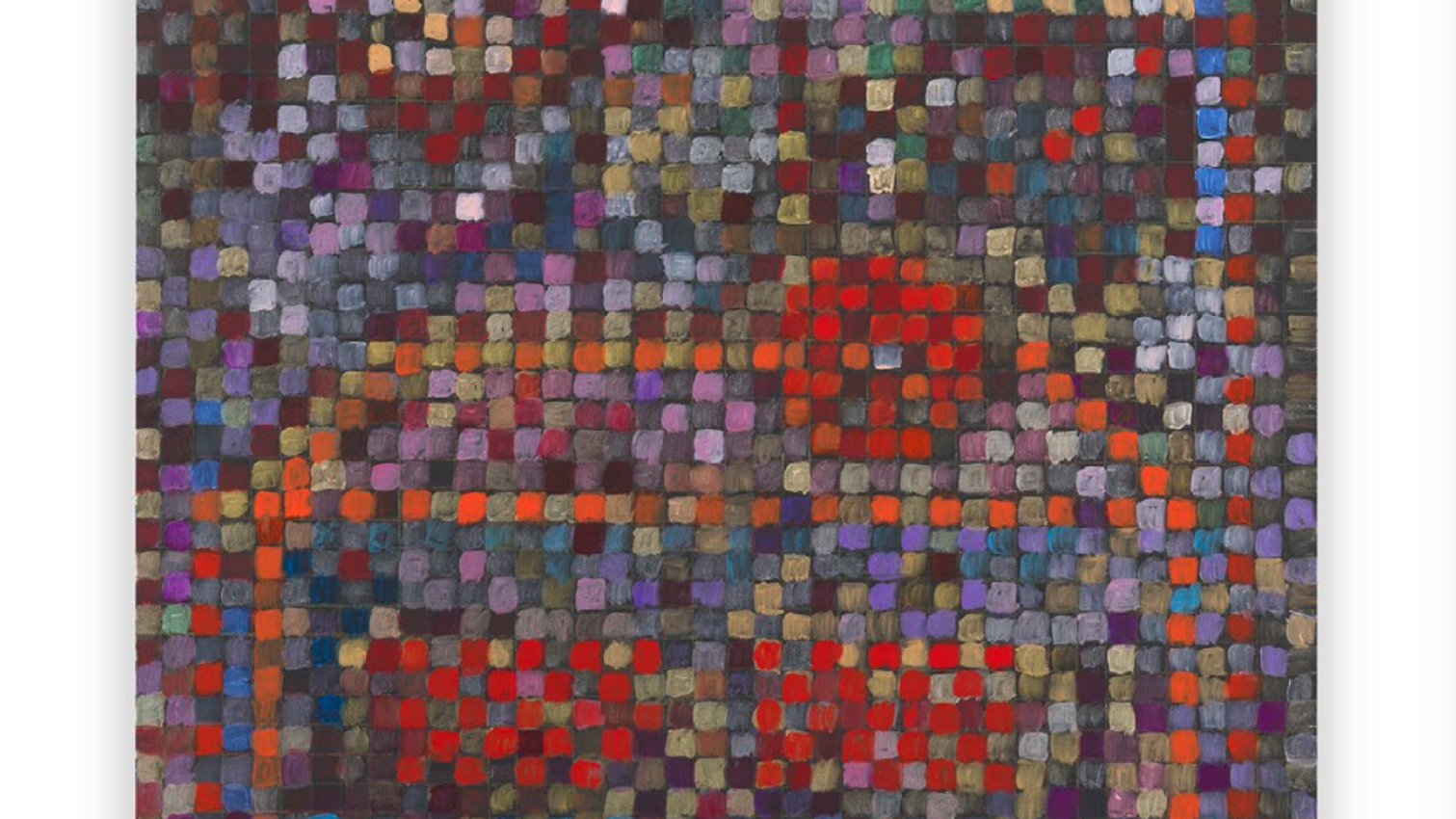
Lévy Gorvy Dayan is pleased to announce Jutta Koether: tRaVeLiNgliGHt, the artist’s first solo exhibition at the gallery’s 1932 Beaux Arts-style townhouse at 19 East 64th Street, New York. Through twelve new canvases, Koether reveals the most recent phase of her Grid paintings, created in direct dialogue with Alberto Giacometti’s Still Life with an Apple (1937)—an important work in his radical investigations of perception held in the collection of the Metropolitan Museum of Art, New York. Reflecting on her new series, Koether cites Giacometti’s quote, “I am only making by unmaking.”
Koether’s practice is defined by her decades-long engagement with the histories of painting. The paintings in the present series are titled Let ‘em roll, a phrase differentiated across the canvases with the artist’s unconventional capitalizations. In these works, Giacometti’s composition is deconstructed and transformed by Koether’s gridded structures—which in themselves relate to the lineage of geometric abstraction, including the work of Piet Mondrian and Paul Klee. Koether began her Grid paintings in the mid-2000s to explore her relationship to figuration and modernism, considering Mondrian as well as the abstraction of Agnes Martin, among others. Here, notably, the size of the underlying grid changes throughout the twelve canvases. Other “disturbances,” in the artist’s words, appear in her gestural paint application and use of iridescent, neon, and metallic colors—stimulating different perceptual effects. This, in concert with the varied interpretations of Giacometti’s source canvas, incite questions around the act of looking and, above all, create an invitation to further study.
Speaking of the apple, Koether notes that it “rolls through all of my work”—often used to indicate the ambiguity inherent to figuration by becoming a “red sphere or even a breast.” Throughout her career, Koether has used what she refers to as “motifs that have made their own journeys.” For instance, Giacometti’s depiction of an apple drew on the flattened and expressive still lifes of Paul Cézanne—the post-Impressionist who constitutes another important influence on Koether. Her palette in the Let ‘em roll series is particularly suggestive of Cézanne’s rich reds and blues—underscoring the recent influx of blues in her Grid paintings, previously dominated by red hues.
Enchanted with Cézanne’s red apples tumbling over blue fabrics, early twentieth-century poet Rainer Maria Rilke wrote, “This rolling of red into blue is an action that seems to arise...” Koether’s phrase “Let ‘em roll” is a gesture that further points to her relationship with music and the histories of punk rock and the post-punk scene in Germany and New York. In tRaVeLiNgliGHt, Koether establishes inquisitiveness at the core of her practice, merging explorations of art-historical motifs and recognition, intervention and disruption. “What are we relating to when we say modernism?” she asks, encouraging the viewer to occupy a space in relation to painting that situates the medium and the act in the present moment.
Courtesy Lévy Gorvy Dayan.
Born in Cologne in 1958, Jutta Koether studied art and philosophy at the University of Cologne and the Independent Study Program of the Whitney Museum of American Art in New York. In 1980, she joined the editorial staff of the music and art journal Spex. She has also written for such publications as Eau de Cologne, Artforum, _Texte zur Kuns_t, and Flash Art. She is the author of several books, including f. (1987), which was translated into English and republished by Sternberg Press in 2015. Her work is marked by multiple collaborations, including her participation in the collective Reena Spaulings, and her musical performances with Rita Ackerman, Tony Conrad, Kim Gordon, John Miller, Steven Parrino, and Tom Verlaine.


Helmed by Dominique Lévy, Brett Gorvy, and Amalia Dayan, Lévy Gorvy Dayan collaborates with artists, estates, non-profit organizations, foundations, museums, and private collections to increase the visibility of twentieth- and twenty-first century works and artists—realizing seminal projects and furthering legacies. In forming Lévy Gorvy Dayan, the partners merge their respective specialties across twentieth- and twenty-first century art, their reputations as leaders and tastemakers, and their respective backgrounds in the primary and secondary markets. Lévy Gorvy Dayan provides opportunities for education, exposure, and access to acquiring exceptional art through its museum-quality exhibition program and thoughtful participation in international art fairs. Expanding, refining, and enhancing world-class modern and contemporary art collections, the gallery emphasizes connoisseurship and curation in its collection development, estate planning, and art appraisal services. Both international and local in practice and perspective, Lévy Gorvy Dayan has unique spaces and unmatched market knowledge in New York, London, and Hong Kong, in addition to representation in Geneva, Milan, Paris, Shanghai, Singapore, and Taiwan.

A respected voice in contemporary art discourse.
Focusing on ambitious storytelling and insightful art-world commentary. Ocula Magazine publishes in-depth interviews, critical essays and timely analysis on the artists, exhibitions and ideas driving the global art world.
Learn more about Ocula Magazine
Showcasing the best of the art world.
Ocula partners with galleries from around the world to highlight their artists, artworks and exhibitions. Gallery membership is by application and invitation, with each member vetted by an independent panel.
Learn more about Ocula Membership

Specialises in the sale of major artworks.
Led by a team with deep ties to the world’s leading auction houses, galleries and collectors. Ocula’s advisory team offers bespoke services to high-net-worth clients from around the world who are looking to acquire the best of contemporary and modern art.
Learn more about our team and services