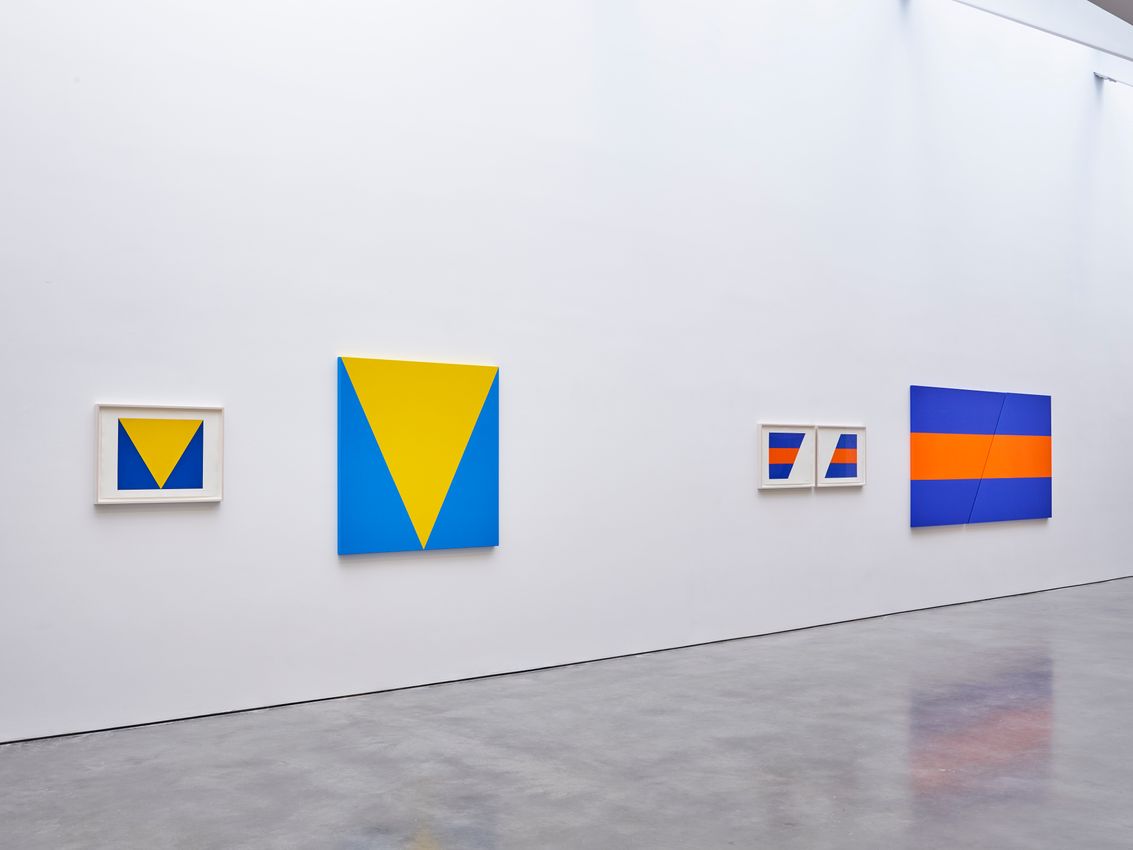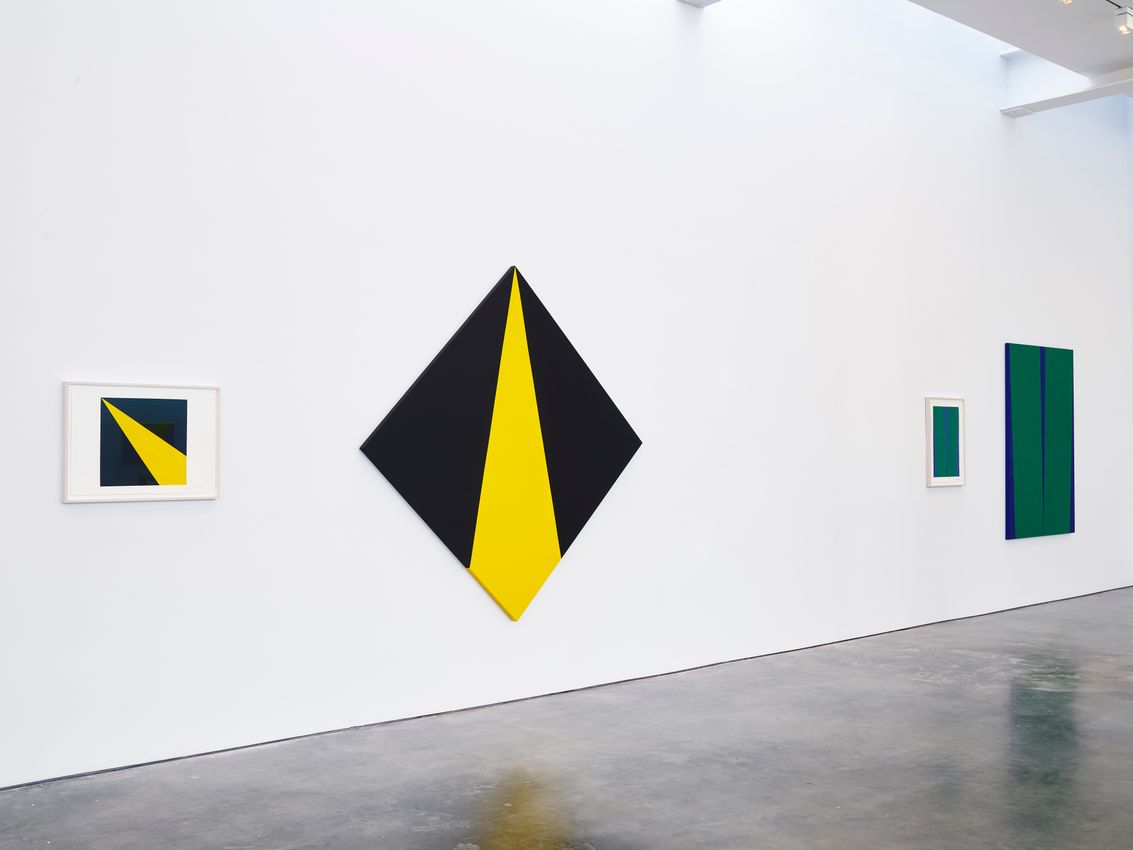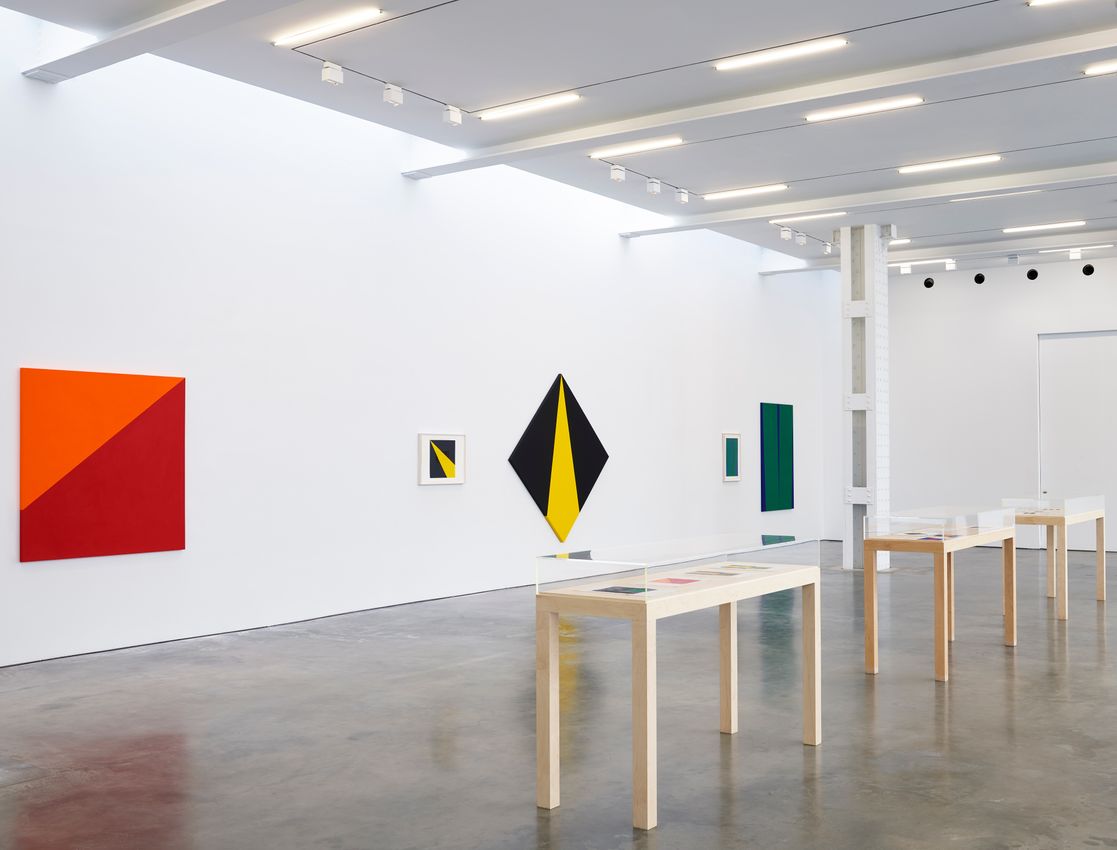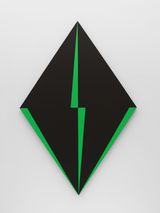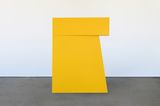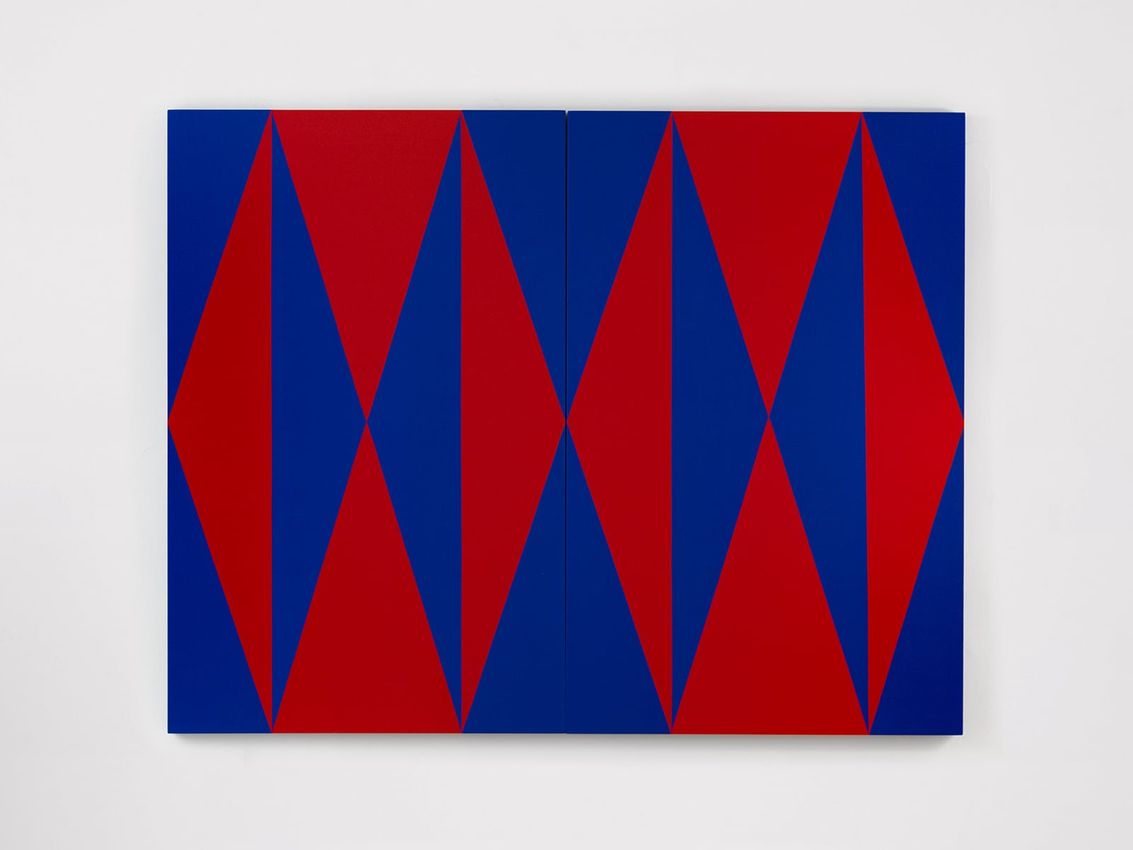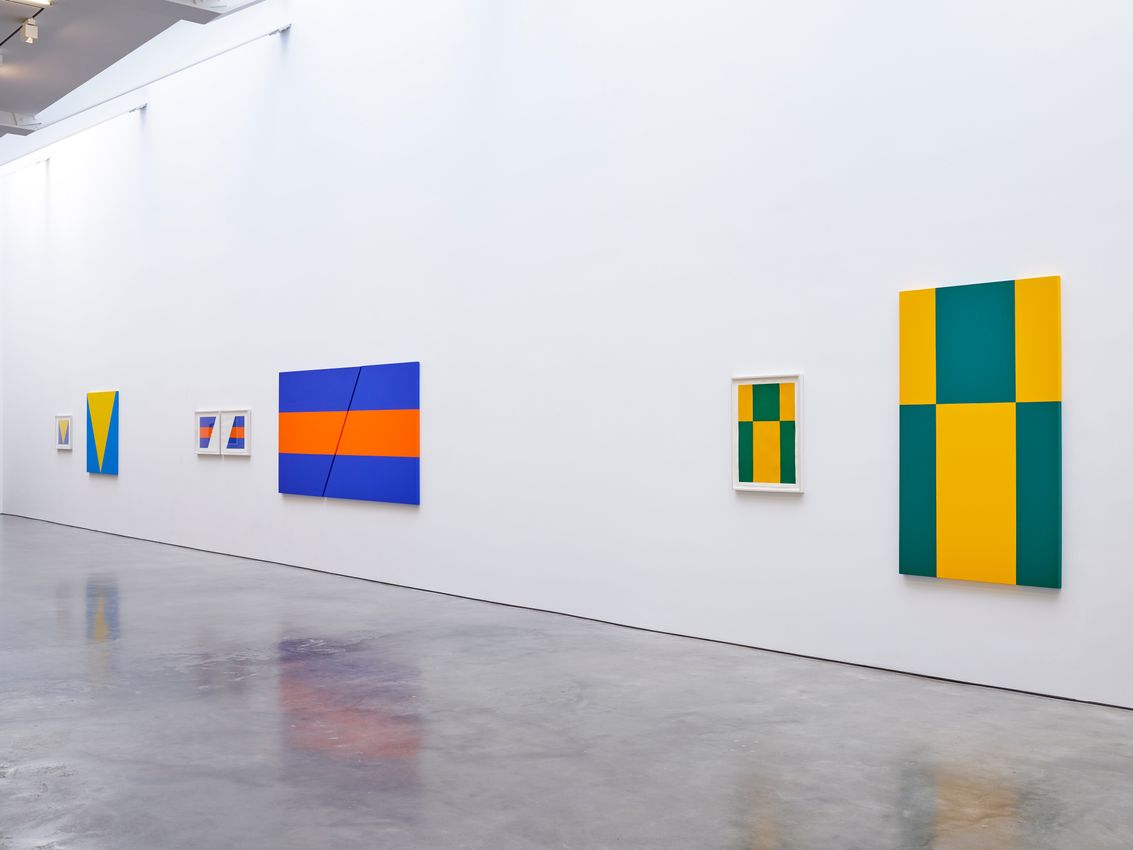
Lisson Gallery is pleased to present a selection of works by Carmen Herrera from the past decade, entitled Painting in Process. Since her time in post-war Paris when she first developed her signature hard-edged style, Herrera has instilled a rigorous practice to create her distinctive body of work. This will be the first time her painting process has been examined and shown publicly, and the exhibition also marks the first presentation of her paintings in New York since the gallery’s opening in the city in 2016.
Carmen Herrera has often noted that her identity and visual language were shaped during the formative years she spent in Paris in the late 1940s and early 1950s. The origins of her process, however, trace back to her early studies in architecture at Universidad de La Habana in Cuba (1938–1939). She often credits this training as where she learned to draw and to think abstractly, stating ‘I wouldn’t paint the way I do if I hadn’t gone to architecture school.’ Working in this method, Herrera begins every work with a sketch on gridded paper, using a ruler or triangle to create structure and divide space. In the sketching phase, Herrera also selects the colours she will apply, always with careful consideration of their relationship so that no one hue is more dominant than the other. Colour cannot be separated from form, and by laying out the different compositions and colours in these initial drawings, she works through many possibilities, breaking down her options by process of elimination. When the framework is established, Herrera then proceeds with a formal painting on paper. Here, she further refines the composition by introducing acrylic paint. The painting on paper may then be translated to canvas, with occasional slight adjustments in orientation to account for the larger scale.
While Herrera’s process is often characterised by meticulous constraint and distillation of choice, it is perhaps best described as a perfect synergy of artistic and scientific creativity. The three-staged approach creates greater potentiality for change throughout a painting’s creation. Each step adds an additional, but manageable, level of complexity, and within each progression, Herrera is able to re-examine and re-evaluate each decision, continuously building upon what she has learned in the stage prior. Thus, no painting is complete without the ideas that were explored in the painting on paper and sketch which came before.
Herrera’s work is the subject of several additional solo exhibitions this autumn, including Colour Me In, an exhibition of important and rarely seen works made in the mid 1980s and early 1990s, at The Perimeter in London, as well as two simultaneous presentations in Houston, Texas hosted by Buffalo Bayou Partnership and the Museum of Fine Arts, Houston. Organised with Public Art Fund following the successful presentation in City Hall Park last year, Estructuras Monumentales in Buffalo Bayou Park marks the first time the large-scale outdoor sculptures will be shown outside of New York City and includes two never before seen works. At the MFA Houston, Structuring Surfaces will include a survey of over 30 works from the 1960s to the present, highlighting the central role that the ‘Estructuras’ played in her artistic development.
Core to Carmen Herrera’s painting is a drive for formal simplicity and a striking sense of colour: “My quest”, she says, “is for the simplest of pictorial resolutions” (2012). A master of crisp lines and contrasting chromatic planes, Herrera creates symmetry, asymmetry and an infinite variety of movement, rhythm and spatial tension across the canvas with the most unobtrusive application of paint. As she moved towards pure, geometric abstraction in the post-war years in Paris, she exhibited alongside Theo van Doesburg, Max Bill and Piet Mondrian and a younger generation of Latin American artists, such as members of the Venezuelan Los Disidentes, Brazilian Concretists and the Argentinian Grupo Madi. Her work also chimed with painters from the US school such as Barnett Newman, Leon Polk Smith and Ellsworth Kelly. Reflecting on this period, she says, “I began a lifelong process of purification, a process of taking away what isn’t essential” (2005). While allied with Latin American non-representational concrete painting, Herrera’s body of work has established, quietly but steadily, a cross-cultural dialogue within the international history of modernist abstraction.


Established in 1967 in London, Lisson Gallery is one of the most well-known galleries operating globally. Boasting an influential and continuing legacy, including playing a pivotal role in the careers of many pioneers of historically important art movements, the gallery works with some of the most significant contemporary artists today.

A respected voice in contemporary art discourse.
Focusing on ambitious storytelling and insightful art-world commentary. Ocula Magazine publishes in-depth interviews, critical essays and timely analysis on the artists, exhibitions and ideas driving the global art world.
Learn more about Ocula Magazine
Showcasing the best of the art world.
Ocula partners with galleries from around the world to highlight their artists, artworks and exhibitions. Gallery membership is by application and invitation, with each member vetted by an independent panel.
Learn more about Ocula Membership

Specialises in the sale of major artworks.
Led by a team with deep ties to the world’s leading auction houses, galleries and collectors. Ocula’s advisory team offers bespoke services to high-net-worth clients from around the world who are looking to acquire the best of contemporary and modern art.
Learn more about our team and services