‘I want to achieve a sense of floating, as though memory were suspended in a mystical space’
Best known as a textile artist, this exhibition positions Olga de Amaral as a vital force in sculpture, installation art and indeed in painting, albeit using her foundational materials of fibre, thread, wool, gesso and metallic leaf. Amaral’s inaugural show at Lisson Gallery New York coincides with her first major retrospective in North America, To Weave a Rock, which is now on view at the Cranbrook Art Museum, Michigan after its debut at the Museum of Fine Arts, Houston.
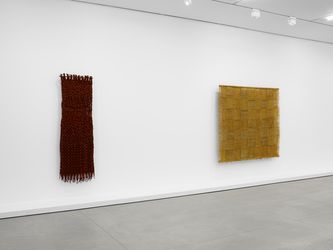
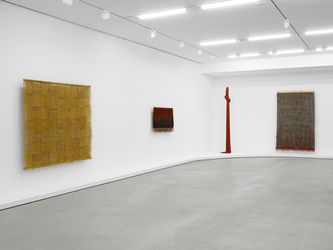
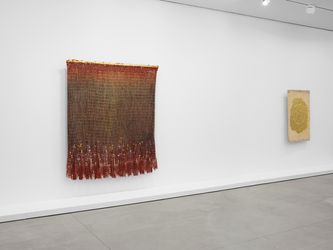
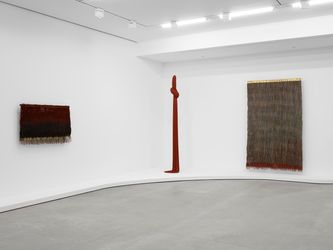
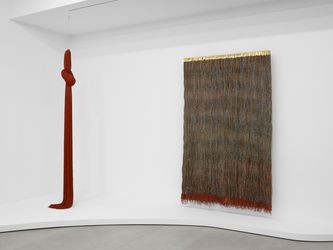
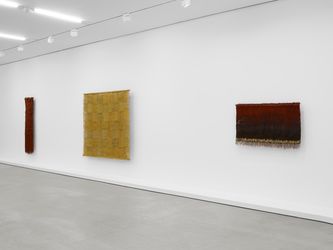
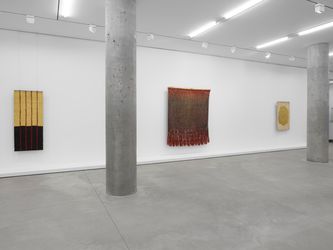
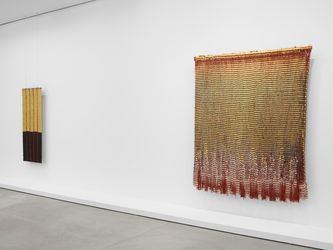
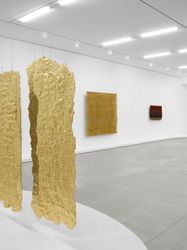
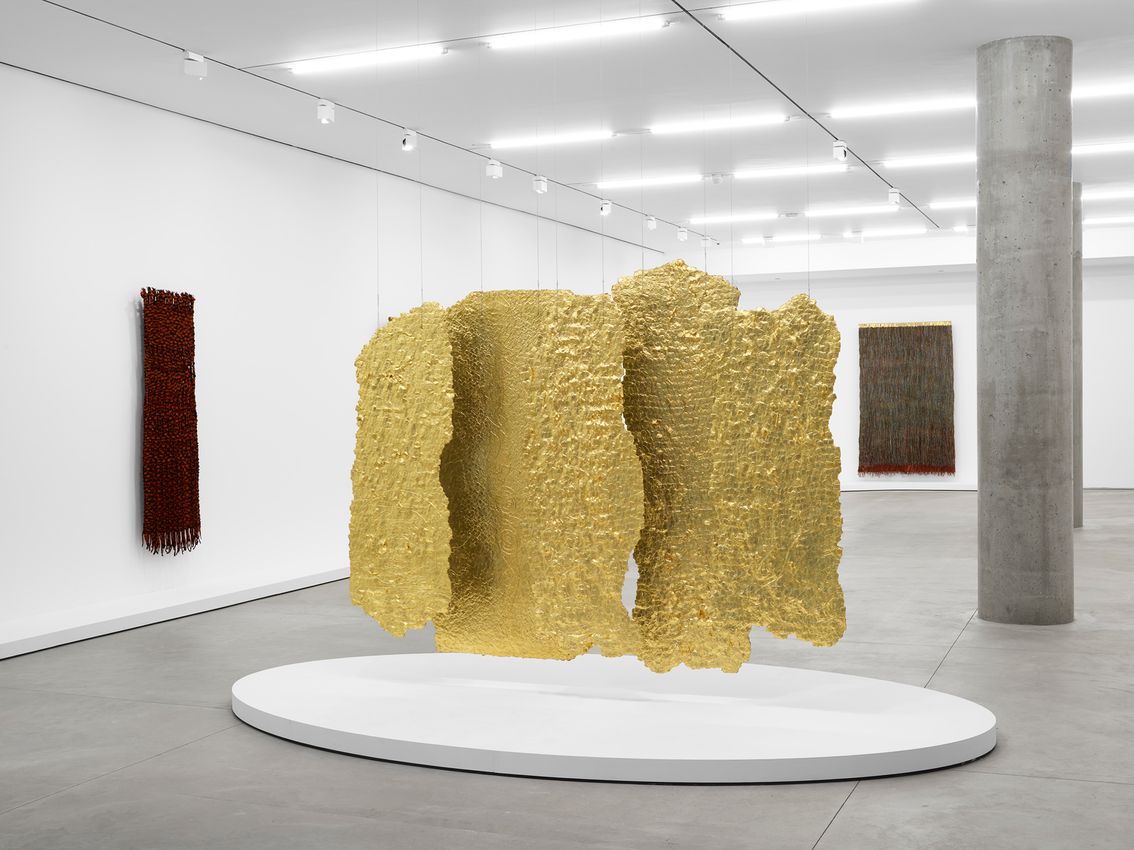
Exploring the core principles of her varied career, this combination of seven different bodies of work, spanning 40 years, reveals how Amaral’s oeuvre ranges all the way from an appreciation of Colombian heritage and indigenous craft, through the influence of Latin American Modernism, to latter-day developments in experiential art, optical abstraction and post-Minimalism. The earliest work in the show, Estudio en dos Elementos (Study in Two Elements) from 1976, is composed of coarsely intertwined horsehair and serpentine coils of cord, which switch from deep red and ochre to black, recalling the natural tones of earthworks she was making at the time. A decade later comes the 1988 Tierra y Oro (Earth and Gold), a free-floating cascade of vertical lines that relates in conception to her imposingly physical structures titled Woven Walls—as well as the comparably large-scale Memorias (Memories) (2014)—but with the addition of light as an extra material or element—the looser weave allowing a moiré pattern to develop in its interstices.
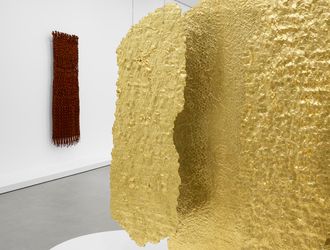
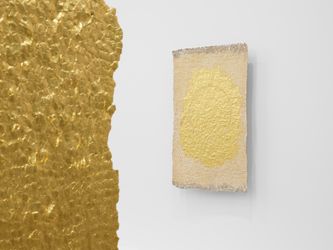
Visitors are greeted at the entrance by the vision of five hanging ‘stones of gold’, invoking a sacred convention of ancient monoliths. Hovering above ground, these shimmering Estelas (Stelae) defy gravity and form individual parts to an ongoing series of densely packed tapestries, conjoined by layers of linen, gesso and gold leaf, with a stony grey painted on the back. Amaral’s work veers away from the domestic in feel, approaching monumental architectural proportions through the spectral presence of crosses, stripes, lines and organic shapes in others. Indeed, she initially trained in architectural drafting in Bogotá during the 1950s, but went on to study textiles at Cranbrook Academy of Art, which makes the opening of her retrospective in Michigan even more poignant.
Employing not only these forces and forms of nature and leaving behind both the ceiling and the wall, comes another singular Amaral form, the Nudo (Knot) (2016). Hundreds of painted threads strung up by hand form a giant mane, with multiple loops and threads performing the knotting gesture—an essential yet overlooked aspect of weaving. Gravity finishes the composition as the threads reach the floor and touch back down to earth.
Amaral discusses her first major museum retrospective in the United States, consisting of some 60 works that elucidate her seminal influence and technical innovations.
Olga de Amaral: To Weave A Rock is organised by Cranbrook Art Museum and The Museum of Fine Arts, Houston. The exhibition is curated by Laura Mott, Senior Curator of Contemporary Art and Design, and Anna Walker, Assistant Curator, Decorative Arts, Craft, and Design, The Museum of Fine Arts, Houston. The project is generously supported by The National Endowment for the Arts, a Craft Research Fund Grant from the Center for Craft, and The Graham Foundation for Advanced Studies in Fine Arts.


Olga de Amaral spins base matter into fields of colour and weaves tectonic lines through space, unselfconsciously testing the borders between crafted object and the work of art. From the flat surfaces of tapestry through to resolutely three-dimensional sculptural forms made from fibre, the Colombian artist’s work spans more than 60 years, in turn reaching even further back to the spiritual qualities and ancient craquelure of medieval icon paintings or else the rigour and simplicity of the modernist grid, as if run through a loom. Developing her own tools and techniques, while relying on the hand for her strip-woven expanses of wool, linen and cotton, Amaral has also knotted reams of horsehair together and bolstered her fabric works through a painterly application of gesso or stucco, often highlighting the reverse, or foregrounding the edges. Working not only on the floor or the wall, Amaral carves up interiors with her hanging tapestries, creates floating formations from yarn or plastic, while following nature’s lead for outdoor works such as Hojarascas (Dried Leaves), begun in the 1970s, or working at architectural scale, for the creation of the six-story façade commission, El Gran Muro (The Great Wall), in 1976.


Established in 1967 in London, Lisson Gallery is one of the most well-known galleries operating globally. Boasting an influential and continuing legacy, including playing a pivotal role in the careers of many pioneers of historically important art movements, the gallery works with some of the most significant contemporary artists today.

A respected voice in contemporary art discourse.
Focusing on ambitious storytelling and insightful art-world commentary. Ocula Magazine publishes in-depth interviews, critical essays and timely analysis on the artists, exhibitions and ideas driving the global art world.
Learn more about Ocula Magazine
Showcasing the best of the art world.
Ocula partners with galleries from around the world to highlight their artists, artworks and exhibitions. Gallery membership is by application and invitation, with each member vetted by an independent panel.
Learn more about Ocula Membership

Specialises in the sale of major artworks.
Led by a team with deep ties to the world’s leading auction houses, galleries and collectors. Ocula’s advisory team offers bespoke services to high-net-worth clients from around the world who are looking to acquire the best of contemporary and modern art.
Learn more about our team and services