Maureen Paley is pleased to present the second solo exhibition by Felipe Baeza at the gallery. Open by appointment, book here.
At the heart of Felipe Baeza’s work is the body: abstracted, dismembered, remembered, obscured, suspended, floating, drowning, sprouting wings, feathers, leaves, both human and celestial, entrapped and expansive, unbound and unruly. In his series of collages Gente del Occidente de México II, for instance, Baeza renders the body grotesque and monstrous. Human limbs, torsos, and mouths are conjoined with photographs of pre-Columbian art objects to create totemic, hybrid entities that straddle multiple temporalities. They are at once more-than-human and anti-human as they scramble logics of self and other, male and female, subject and object. Disjointed, hyper-sexualized human body parts both male and female, replete with stereotypical gender markers (long painted fingernails, garter belts, jewellery, stilettos, sneakers) are attached to the heads and torsos of the pre-Columbian figurines. Baeza culls the images of the pre-Columbian art objects from a 1946 book, Arte Precolombino Del Occidente de México, published by the Mexican Secretary of Education. That Baeza titles his series as he does–substituting the word ‘Gente’ for ‘Arte Precolombino’ in the book’s original title–is significant. By collapsing ‘Arte Precolombino’ into ‘Gente,’ Baeza references the ways in which ancient art objects come to stand in for contemporary people and communities. The indigenous artifact, in other words, serves as a substitute for indigenous bodies and lives.
Baeza thus astutely comments on the decontextualising ethnographic gaze through which these art objects are typically seen, and through which contemporary indigenous lives and struggles are effaced. These objects, sutured to images of body parts sourced from contemporary porn and fashion magazines, demand a reckoning with the fraught location of indigeneity within the Mexican national project. The Mexican nationalist gaze consumes, objectifies, and instrumentalises indigeneity that it locates comfortably in the past. It simultaneously devalues living indigenous cultures and communities and effaces their agency and autonomy. Baeza’s monstrous, unruly bodies speak back to this fetishising nationalist gaze, and refuse to be passively consumed and contained.
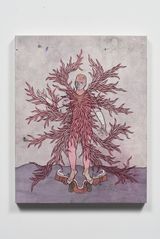
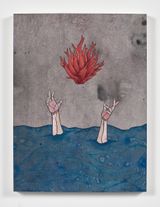
In the series Unruly Suspension, Baeza’s bodies are similarly made up of fragments, refusing totality and wholeness. Here however the bodies are rendered translucent and almost marbled, and the paintings ask what it means to inhabit a state of indeterminacy both spatially and temporally: the space in-between here and there, now and then. Even the colour palette of moody, mottled, muted blues, purples, greys, and pinks with the occasional shock of blood red, evoke the moment of transition from day to night. This is often the moment when crossings happen, over borders, fences, bodies of water. We can understand these works as a response to the dominant binary through which US national citizenship and belonging are meted out, one that distinguishes ‘good’ from ‘bad,’ ‘deserving’ from ‘undeserving’ migrants. Baeza’s delicate, layered paintings, replete with painstaking detail that includes twine and yarn embroidered into the paper, repudiate this binary and instead suggest what it means to dwell in a state of suspension. The works intimate the ways in which one works the traps that one is in, in order to not simply survive and endure, but thrive and live fully.
Baeza does not romanticize the difficulty of this location: the violence, pain, and hardship of fugitivity is evident in the deliberate ambivalence and ambiguity of his images. Are these bodies landing or lifting off? Are they entrapped or expansive? Does the webbed netting that obscures their faces and torsos ensnare them, or enable them to soar? Rather than settling these questions, both Gente del Occidente de México and Unruly Suspension instead present us with a capacious queer, indigenous, migrant imaginary: one that demands not belonging or inclusion in the nation-state (whether in the US or Mexico) but rather what Edouard Glissant terms “the right to opacity”: the right to refuse the transparency and knowability required of racialised, migrant, indigenous, queer subjects that is the precondition of their regulation, surveillance, and capture.
Felipe Baeza was born in 1987, Celaya, Guanajuato, Mexico and lives and works in New York, USA.
Recent exhibitions include Desert X, curated by Desert X Artistic Director Neville Wakefield and Co-curator César García-Alvarez, Coachella Valley, Palm Springs (2021); Through the Flesh to Elsewhere at The Mistake Room, Los Angeles, CA, USA (solo, 2020); Nobody Promised You Tomorrow: Contemporary Art in the 50th Year of the Stonewall Era, Brooklyn Museum, New York, NY, USA (2019) traveling to Center for Creativity and Arts, Fresno State University, Fresno, CA (2021). View From Here, LACMA, Los Angeles (2020); La Emergencia de Hacer Memoria, Fortnight Institute, New York (solo, 2019); and Felipe Baeza, Maureen Paley, London (solo, 2018). He is the recipient of the Robert Rauschenberg Foundation Residency, Captiva (2021); the NXTHVN Studio Fellowship, New Haven (2019); and the Joan Mitchell Foundation Painters and Sculptors Grant (2018). He earned a BFA from The Cooper Union, New York (2009) and an MFA from Yale University, New Haven (2018).
Gayatri Gopinath is Professor of Social and Cultural Analysis at New York University, and is the author of Unruly Visions: The Aesthetic Practices of Queer Diaspora.
Press release courtesy Maureen Paley. Text: Gayatri Gopinath.


The gallery programme began in 1984 in a Victorian terraced house in London’s East End. Initially named Interim Art the gallery changed its name to Maureen Paley in 2004 as a celebration of its 20th anniversary. Since September 1999 the gallery has been situated in light industrial space in Bethnal Green. In July 2017 Maureen Paley opened a second space in Hove called Morena di Luna. In October 2020 a third space was opened in London called STUDIO M. From its inception the gallery’s aim has remained consistent: to promote great and innovative artists in all media.

A respected voice in contemporary art discourse.
Focusing on ambitious storytelling and insightful art-world commentary. Ocula Magazine publishes in-depth interviews, critical essays and timely analysis on the artists, exhibitions and ideas driving the global art world.
Learn more about Ocula Magazine
Showcasing the best of the art world.
Ocula partners with galleries from around the world to highlight their artists, artworks and exhibitions. Gallery membership is by application and invitation, with each member vetted by an independent panel.
Learn more about Ocula Membership

Specialises in the sale of major artworks.
Led by a team with deep ties to the world’s leading auction houses, galleries and collectors. Ocula’s advisory team offers bespoke services to high-net-worth clients from around the world who are looking to acquire the best of contemporary and modern art.
Learn more about our team and services