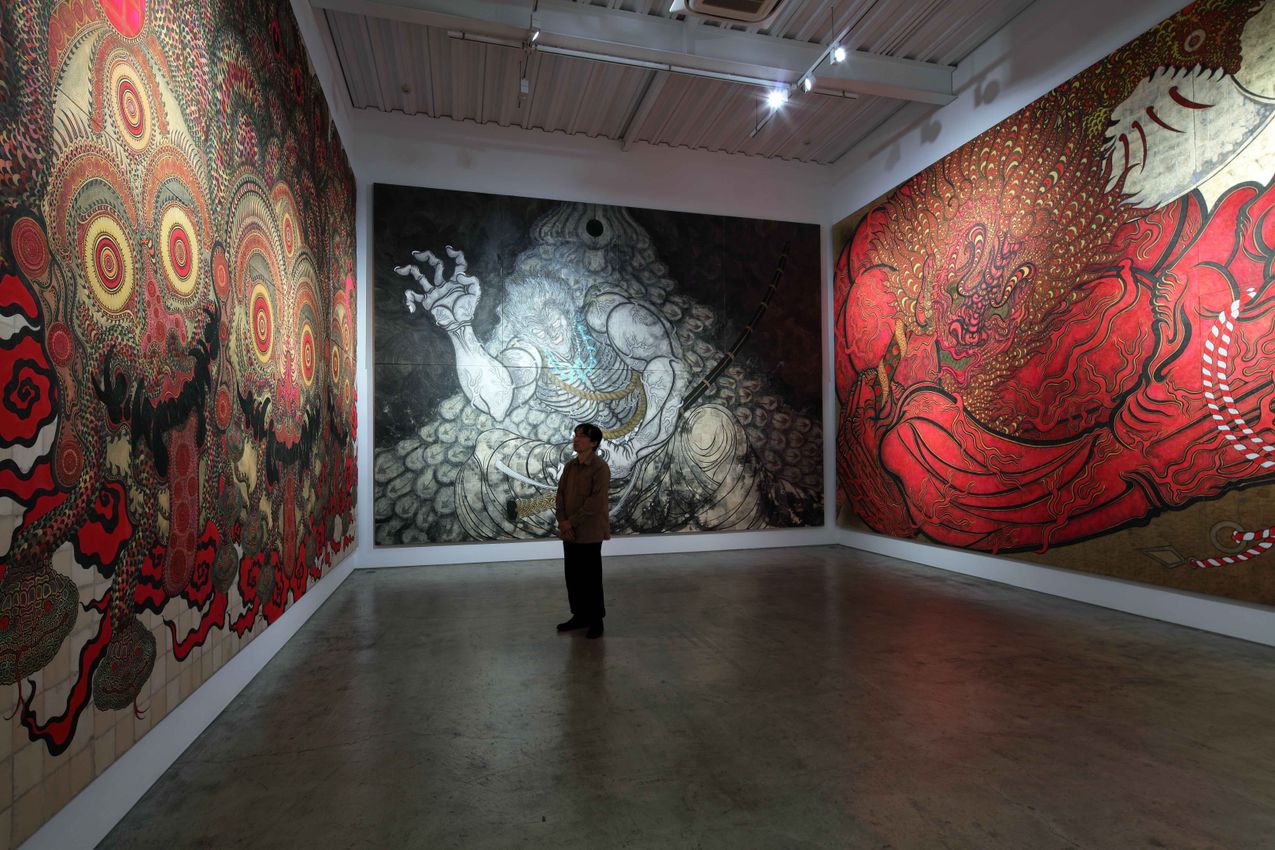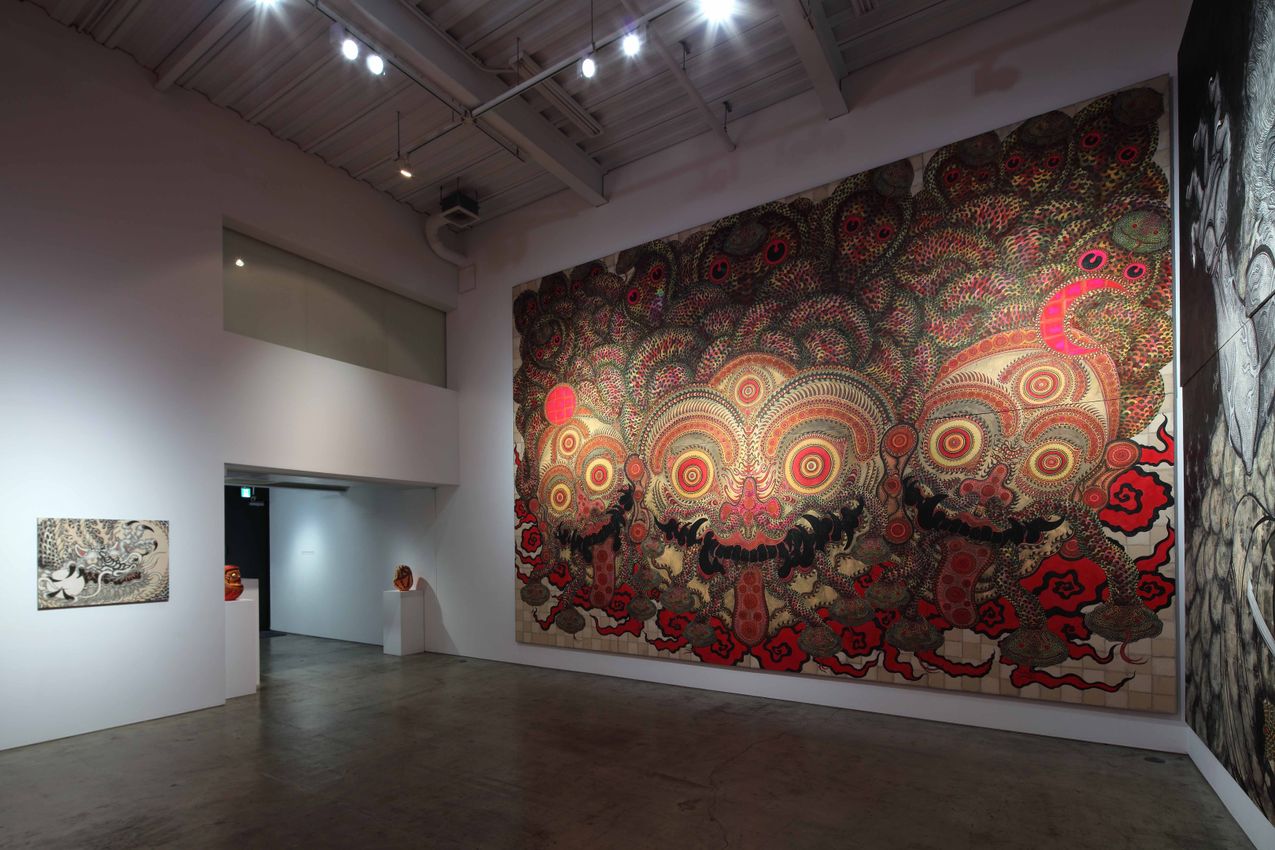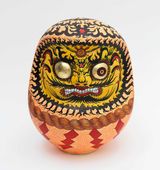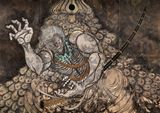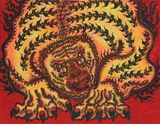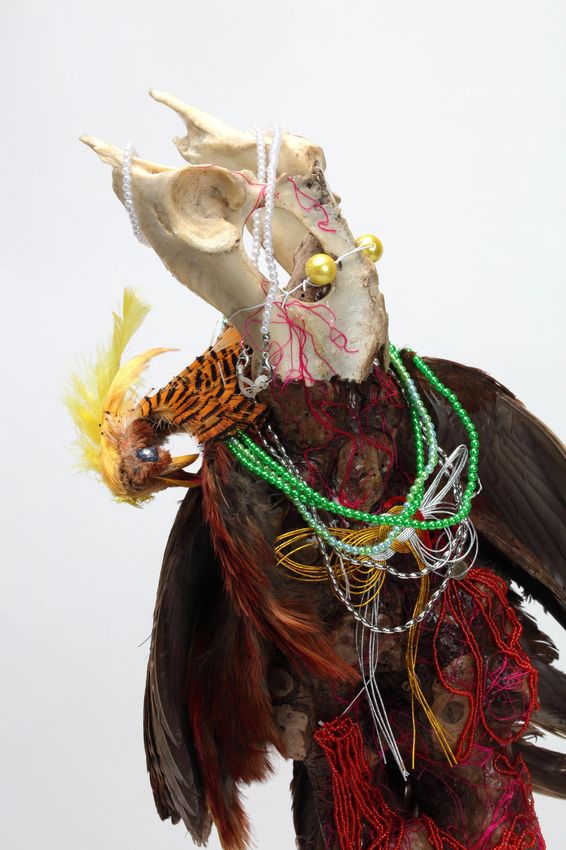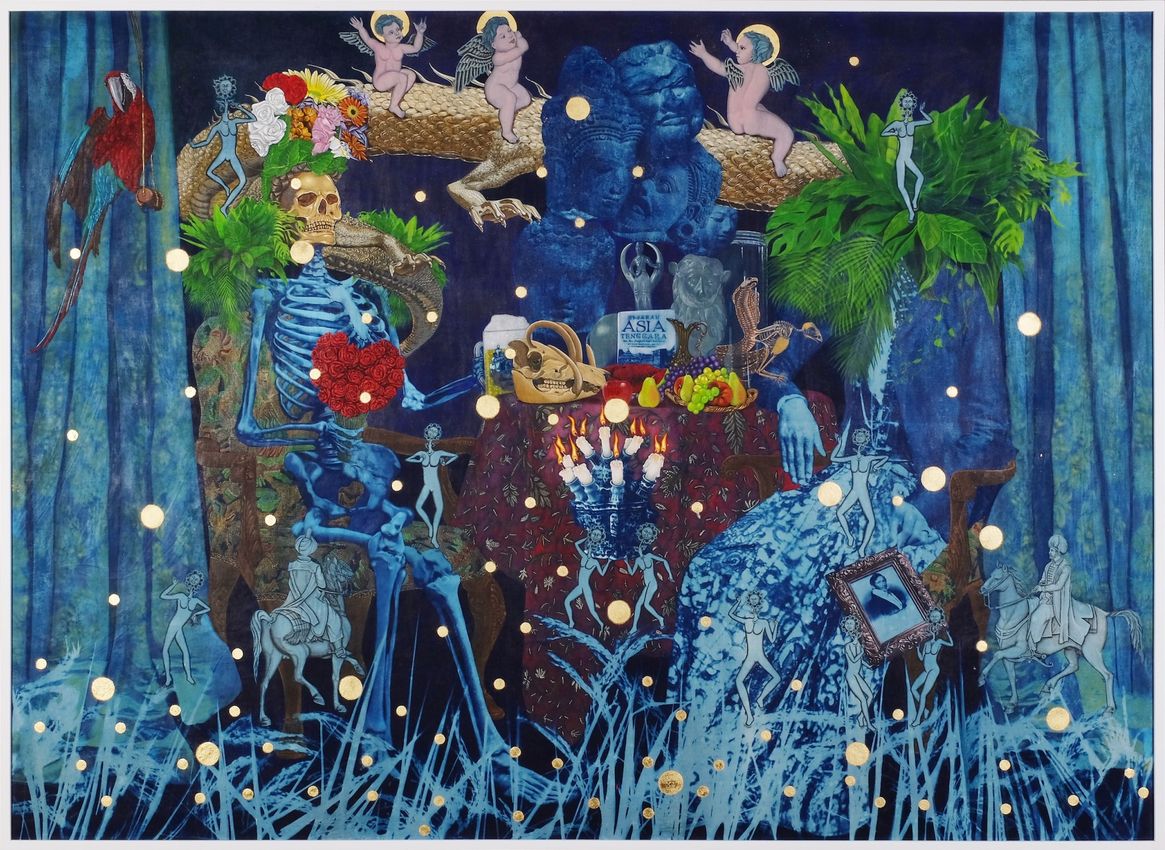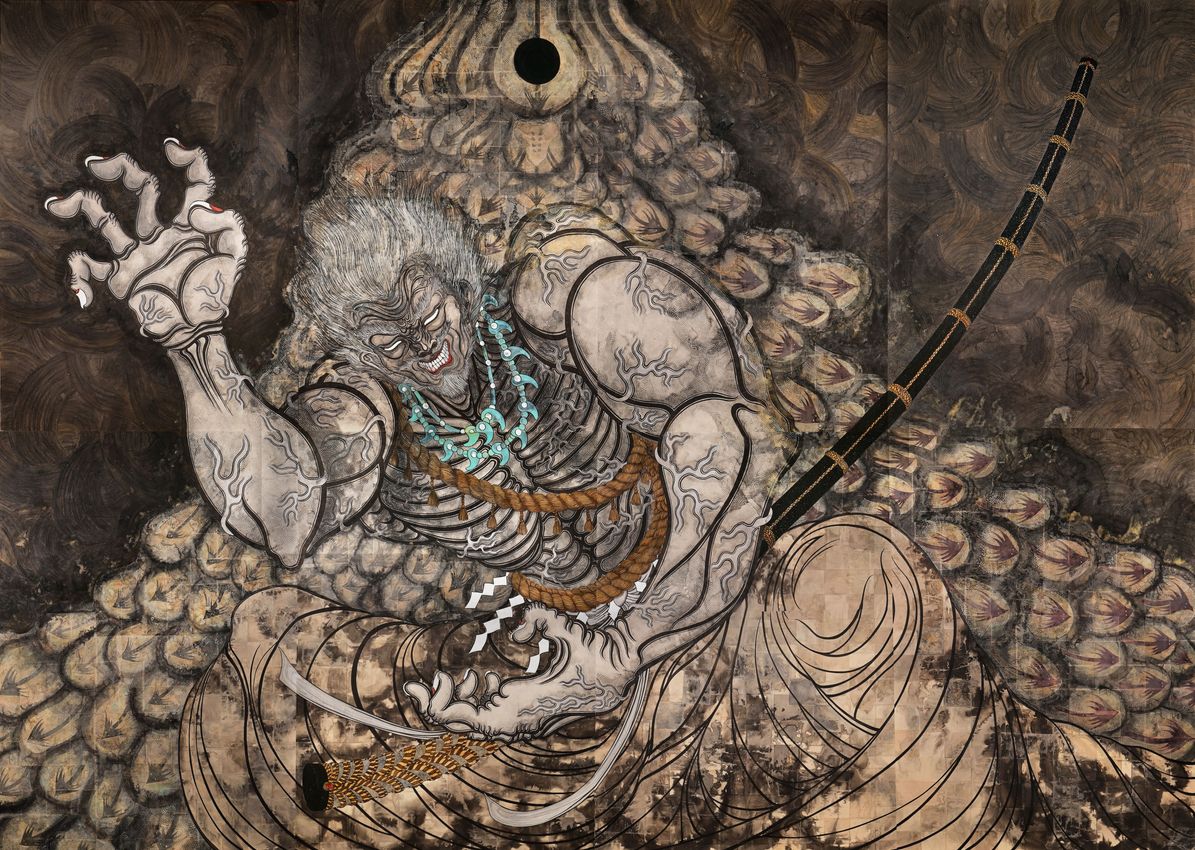
Mizuma Art Gallery is pleased to present “Breath of Susanoo”, a solo exhibition by KANEKO Tomiyuki opening on Wednesday, April 22, 2026. The exhibition centres on three monumental paintings (460×640cm) that envelop the gallery walls, all inspired by Susanoo, the tempestuous deity of Japanese mythology. They will be presented together with more than a dozen small- and medium-sized works, including painted stones, a paper mache mask, and a Daruma figure.
In an era of disorder and acceleration, how do we confront uncontrollable forces? Since ancient times, mythology has expressed the duality of opposing powers: wild, raging energy on the one hand, and forces that pacify on the other. Seeking distance from the clamour of the rapidly accelerating city, Kaneko established his residence in a remote village in Yamagata, Tohoku. Whilst investigating traces of faith and reverence embedded in the landscape, he has attempted to give form to invisible spiritual beings such as deities and buddhas, spirits, and yokai.
In his 2023 solo exhibition “Apotropaic Deities”, Kaneko focused on powerful deities who ward off evil, presenting large-scale works including Gozu Tenno. These figures embody a dynamic interchange of good and evil: whilst feared as epidemic deities that bring disease, they also possess the power to suppress it, functioning as protective deities against epidemics and misfortune. Continuing his exploration of the expression of power, the artist now turns to Susanoo, a deity who, through the syncretic traditions of Shinto and Buddhism, has long been identified with Gozu Tenno and stands as a symbol of fierce and untamed power in Japanese mythology. Grounded in the name of this deity, Kaneko confronts the awe and faith woven through layers of derivation and syncretism, from which these three works emerged.
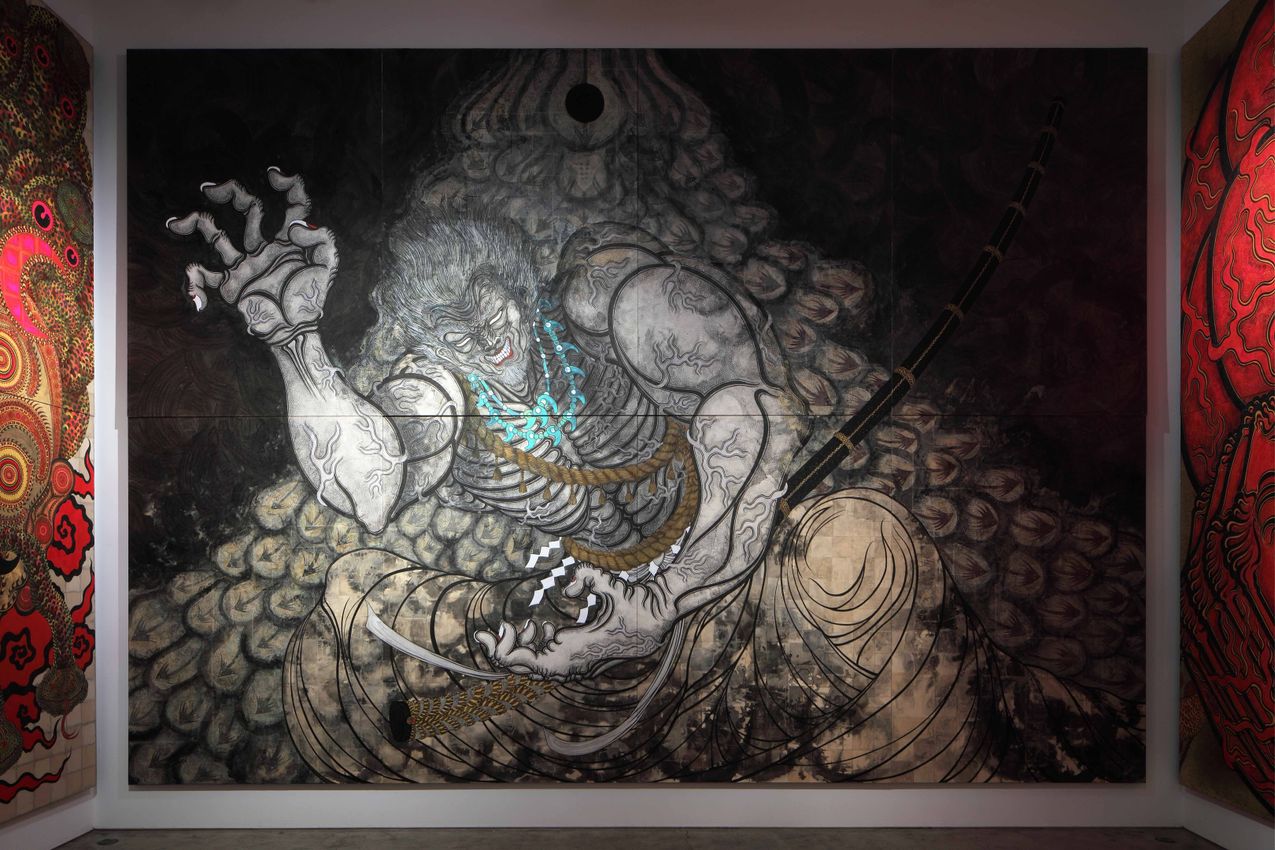
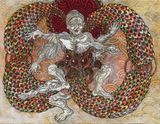
Takehaya Susanoo, whose title “takehaya” signifies bravery, momentum, and speed, is portrayed as a sword-bearing martial deity. Though his entire body radiates strength, the work evokes the ultimate state of unity between sword and Zen. Gion Daimyojin, the guardian deity of Jetavana Vihara (Gion-Shoja), derives from Gozu Tenno and appears in a wrathful form, gripping a lasso and an axe whilst radiating authority through the apotropaic colour red. Sun and Moon Snakeheads Obanshin enshrines Rahu, one of the Nine Luminaries of ancient Indian astrology. Originating in the serpent deity Rahu who swallows the sun in Indian mythology, the figure later became intertwined in Japan with the myth of the hiding of the Sun Goddess in the Heavenly Rock Cave and was syncretised with Susanoo.
Across cultures, reinterpretations of awe and worship converge in the figure of Susanoo, a deity who possesses both the terrifying force of chaos and the power to breakthrough and subdue it. For over a thousand years, he has been revered as a symbol of primordial power. These manifestations of power surrounding the gallery space summon the breath of the raging god into the present. Natural disasters, epidemics, wars—since recorded history, humanity has repeatedly faced overwhelming forces that radically reshape society. Myths evolve with each era, accumulating new interpretations as they are passed forward. Within this continuing current, we invite visitors to encounter these three newly created monumental paintings and experience their formidable presence firsthand.


Tomiyuki Kaneko (b. 1978, Saitama, Japan) graduated with a PhD in Japanese painting from the Graduate School of Tohoku University of Art & Design, Yamagata prefecture in 2009. Kaneko continuously challenges himself by exploring themes that many nihonga (Japanese painting) artists avoid, such as yokai (supernatural creatures), specters and deities—making him a truly unique presence even within the diverse field of contemporary nihonga. Having been fascinated by the unique traditional deities and yokai of particularly localities since early childhood, and sensing the presence of unseen, unknown beings in nature, Kaneko aspired to become a nihonga painter to express this spiritual world. Today, he lives and works in Yamagata, where he continues to explore not only depictions of yokai, specters, demons and deities from mythology, but also spiritual beings rooted in Buddhist and Hindu theology.


Executive Director Sueo Mizuma established Mizuma Art Gallery in Tokyo in 1994. Since then, the gallery has continuously presented artists from Japan and, increasingly, from the surrounding region whose works demonstrate distinctive sensibilities, unaffected by fleeting stylistic trends.

A respected voice in contemporary art discourse.
Focusing on ambitious storytelling and insightful art-world commentary. Ocula Magazine publishes in-depth interviews, critical essays and timely analysis on the artists, exhibitions and ideas driving the global art world.
Learn more about Ocula Magazine
Showcasing the best of the art world.
Ocula partners with galleries from around the world to highlight their artists, artworks and exhibitions. Gallery membership is by application and invitation, with each member vetted by an independent panel.
Learn more about Ocula Membership

Specialises in the sale of major artworks.
Led by a team with deep ties to the world’s leading auction houses, galleries and collectors. Ocula’s advisory team offers bespoke services to high-net-worth clients from around the world who are looking to acquire the best of contemporary and modern art.
Learn more about our team and services