
Press Release

‘Yuyu (幽幽)’ describes a state that is deep and distant, where light or sound lingers faintly. It suggests something that is difficult to grasp, present before us without ever fully revealing itself. Jang Koal’s Yuyu occupies this ambiguous space, allowing perception to linger between what is seen and what remains unseen.

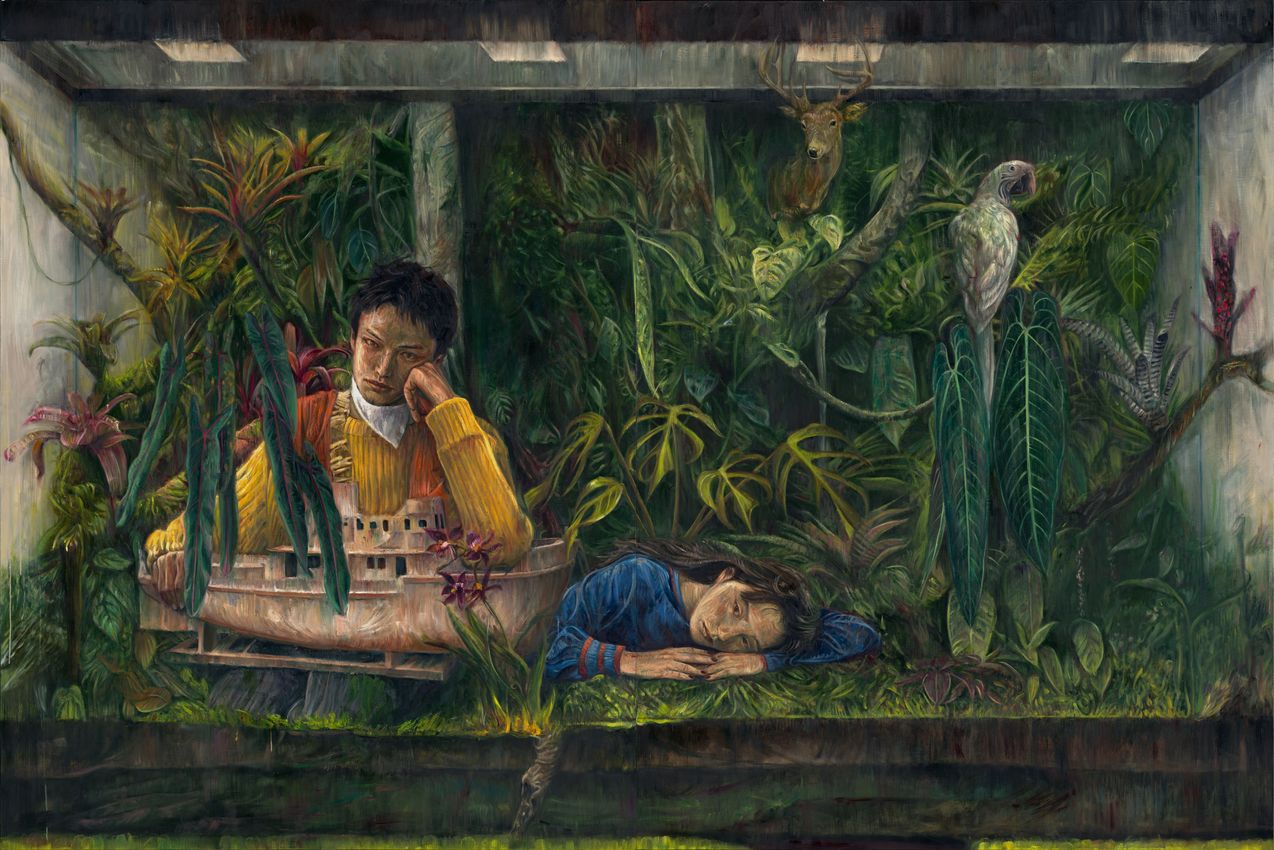
Jang Koal’s paintings begin with scenes and impressions encountered in everyday life, images from the imagination, and views from the window of her studio. These fragments are gradually transformed through memory, imagination and sensation. The worlds that emerge on the canvas resemble the reality we know, yet appear subtly displaced, as though another time or sensibility has entered the image. Familiar figures and landscapes are transported into unfamiliar settings, while the boundary between reality and imagination gradually begins to dissolve.

There are moments when looking at Jang Koal’s paintings feels like recognising a scene without being able to recall exactly where or when it was encountered. The figures and spaces are clearly present, yet the relationship between them remains difficult to define. What we see is never entirely separate from our own experiences, memories and sensations. The same scene can therefore be experienced differently by each viewer. Perception is not simply a matter of receiving the world as it is, but of continually forming a relationship with what we see.

Jang Koal embraces this incompleteness of perception, leaving her images open rather than resolving them into a single narrative.

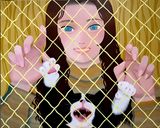
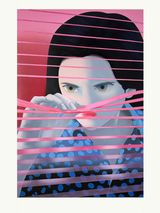
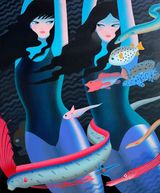
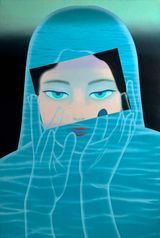
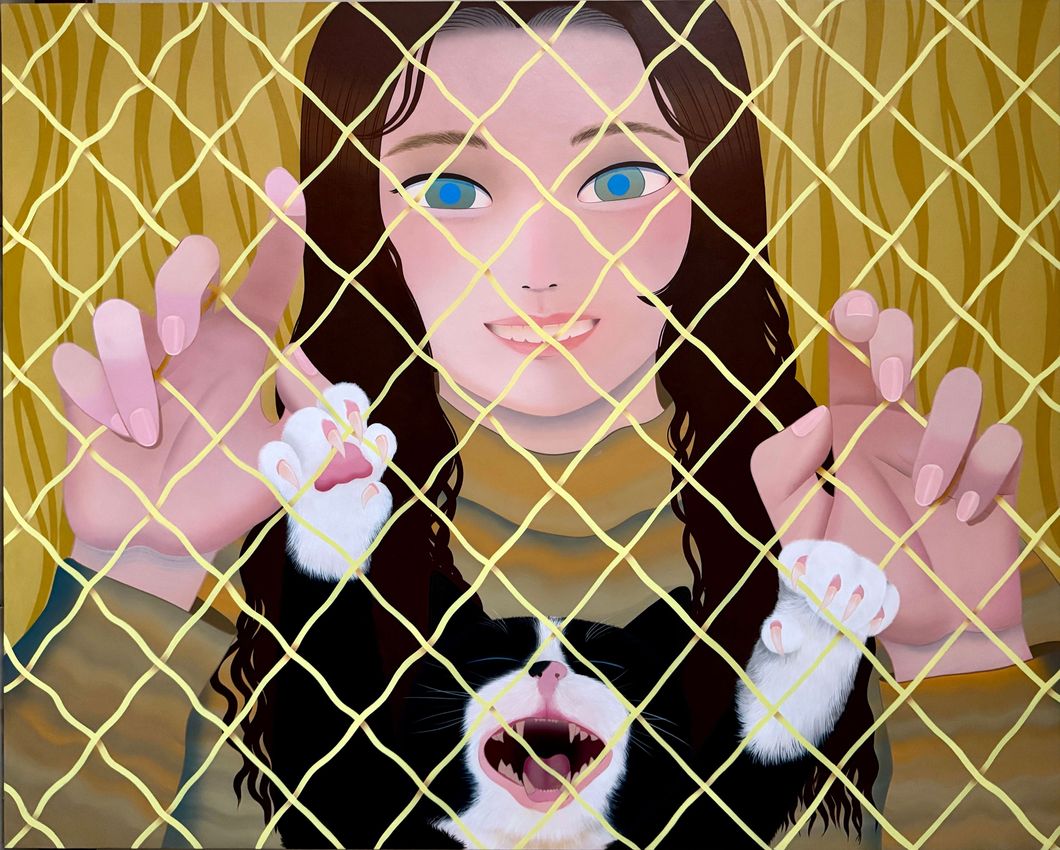
One of the most striking features of the exhibition is the range of boundaries placed between the figures and the viewer. Water, wire and web-like forms cross the picture plane, partially obscuring the bodies behind them. Lines, planes and vegetation intervene between the figures and the viewer. In some paintings, figures appear to exist beneath water or within mist; in others, lines and structures interrupt the gaze. In works such as Come Closer, Look Out, Midwater and Silk Vigil, concealment and overlapping forms recur in different ways.

These elements both conceal the figures and draw our attention towards them. Because something remains hidden, the eye continues to follow what lies beyond it. What is obscured makes us increasingly aware of what cannot be seen. In Jang Koal’s paintings, concealment becomes a space of possibility rather than an absence.

We look at the figures, yet we can never know everything about them. Here, Jang Koal’s paintings move beyond the question of the gaze itself. We may look at another person and believe that we understand them, yet another’s inner life can never be fully contained within our field of vision. There is always a certain distance between one person and another. Perhaps to respect another person is not to eliminate that distance, but to acknowledge it. Jang Koal’s figures maintain precisely this distance.

The figures appear before our gaze, but never become entirely exposed. They conceal themselves within the picture, overlap with other forms, and at times seem to approach the viewer only to withdraw again. This makes the title Come Closer particularly suggestive. The invitation to come closer appears to suggest intimacy, yet the closer we look, the more apparent it becomes that something remains concealed, beyond what we can know.

This relationship is also present in the materiality of the paintings. Jang Koal builds acrylic paint on hanji, allowing vivid colours to form the surface while the delicate, fibrous texture of the paper beneath remains visible. One layer does not simply erase another. Traces of what came before remain alongside the new layer, allowing revelation and concealment to take place together.

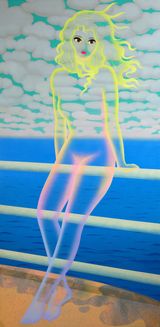
The works in this exhibition extend this material quality in different ways. Colours and forms overlap, figures merge with other elements within the picture, and certain images appear to exist beneath the surface of water, creating a sense of depth. As suggested by titles such as Inner Weather, Midwater and Surface Tension, the picture plane becomes more than a flat surface. Interior and exterior, surface and depth, continually meet within it.

Inner Weather offers a particular point of entry into Jang Koal’s figures. The phrase evokes an emotional state that cannot easily be articulated. We may infer another person’s feelings from their expression, but we can never know exactly what is taking place within them. What we see is always the surface, beneath which unspoken emotions and memories remain.

Jang Koal’s paintings inhabit this distance between surface and interior.

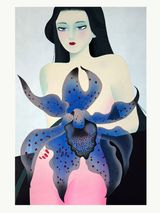
Within the works, comfort and unease, intimacy and distance, openness and withdrawal coexist within the same image. Works such as Rose & Blue, Shadowed, Silk Vigil and Slack Tide similarly evoke these contrasting and indeterminate states. What matters in Jang Koal’s paintings is not the precise definition of an object or condition, but the ability to remain with what has not yet been defined.

Through the spaces the artist leaves within her paintings, we look towards the figures and imagine their worlds. At the same time, we become conscious of our own gaze. Am I seeing the figure as they are, or the figure I have projected onto them? Is the sense of intimacy I experience present within the painting, or has it been shaped by my own experience? We look at the work, but the work also returns our gaze. It makes us aware of what we are looking at, and how we are looking.

A dark, quiet, distant place.

A place that is neither fully revealed nor entirely concealed.

A place we may approach, but never entirely possess.

Jang Koal’s paintings remain within this space and invite us to remain there with them.

Yuyu gives form to a state in which questions remain unresolved. The visible and invisible, proximity and distance, reality and imagination, surface and interior remain together within the same image, leaving its meaning open.

Here, painting is not something to be explained, but a state in which to linger for a while.

Read More

Selected Works

Loading...
About the Artist

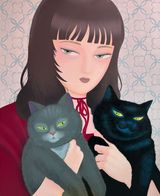
Jang Koal (b. 1989, Ulsan, South Korea) is a self-taught artist who has possessed a deep love for drawing from a young age. Growing up in the care of her grandparents, she was often brought along when visiting Buddhist temples. Here she became acquainted with the striking traditional art that covers the temples’ exterior and interior, which sparked a fascination for their colourful depictions and enigmatic atmosphere. These early impressions continue to reverberate in her present-day artistic practice; however, the now Seoul-based artist has pushed on to explore more contemporary themes and methods of working on hanji, a traditional Korean paper. Utilising modern materials and techniques, she works with contrasting vivid, solid colour sections against intricate patterns and constructs elegant imagery in which female figures are immersed in an imaginary parallel world filled with cats, flowers, and nature. Sourcing positive memories from her personal life, Jang addresses seemingly mundane and peaceful scenes but simultaneously touches on subjects that she is only able to express without restrictions through painting. Mixing the surreal, often ambiguous, or mystical atmospheres with bright colours and harmonious lines and compositions, she is able to create a captivating tension in which her subjects seem to feel most comfortable.

View Artist Profile

Also Exhibiting at Tang Contemporary Art

About the Gallery

Tang Contemporary Art was established in 1997 in Bangkok, and now institutes over 48,000 square feet of gallery spaces in Bangkok, Beijing, Hong Kong, and Seoul. The gallery has also recently opened its headquarters space in Beijing, covering a building of 6 storeys. Tang Contemporary Art is fully committed to curating critical projects and exhibitions, as well as collaborating with other art museums and institutions, to promote Chinese contemporary art regionally and worldwide, and encourage a dynamic exchange between Chinese artists and those abroad.

View Gallery Profile
Address
B2
6, Apgujeong-ro 75-gil
Gangnam-gu
Seoul
South Korea
Opening Hours
Tuesday – Saturday
10:30am – 6pm

Closed on Public Holidays.
(1)
Seoul B2, 6, Apgujeong-ro 75-gil
Tang Contemporary Art
B2, 6, Apgujeong-ro 75-gil, Gangnam-gu, Seoul, South Korea
+82 (0)2 3445 8889
http://www.tangcontemporary.com

Opening hours
Tuesday – Saturday
10:30am – 6pm

Closed on Public Holidays.
The art world in focus