Press Release

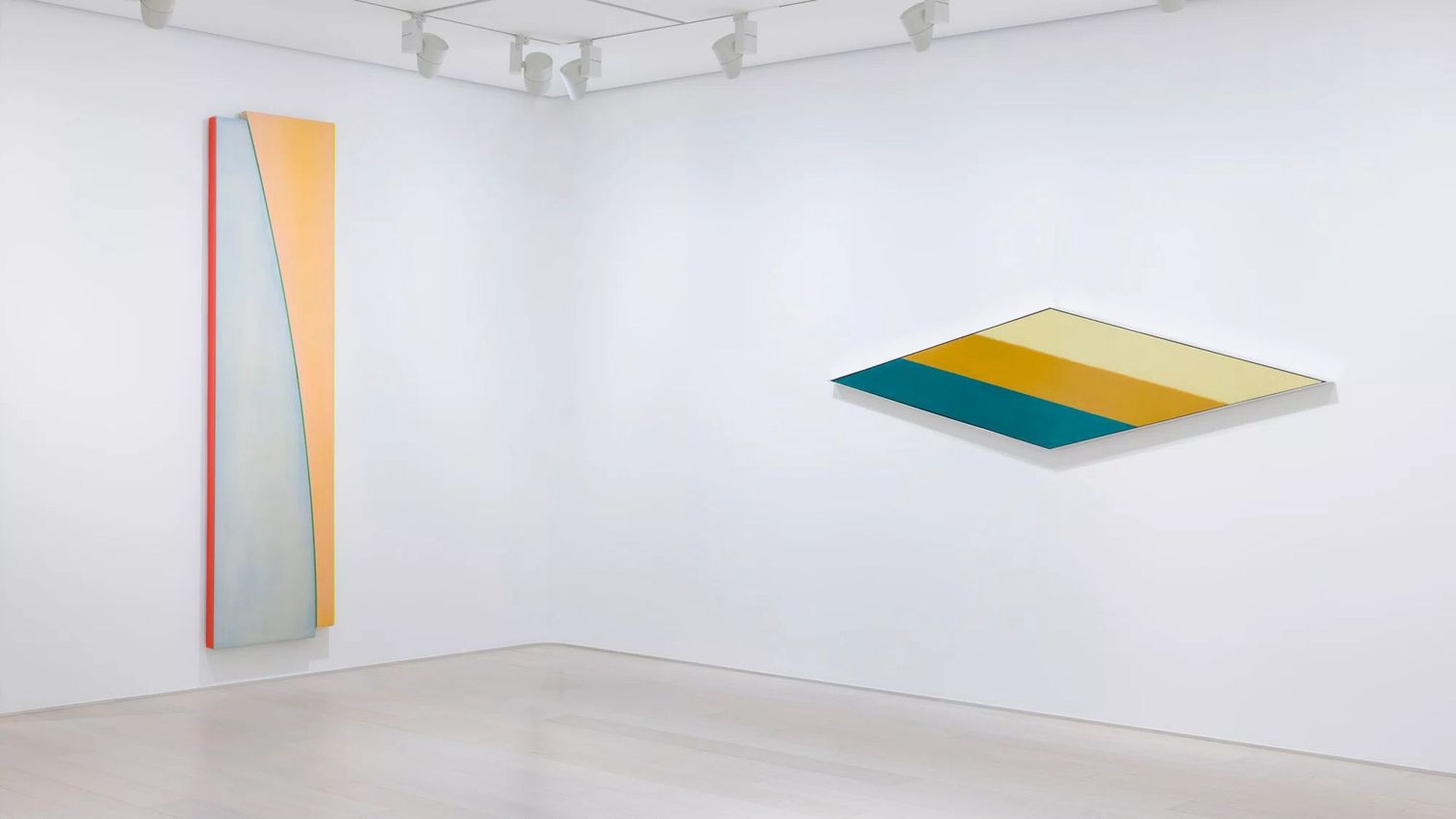
Pace is pleased to present the second instalment of its two-part Kenneth Noland survey at its Tokyo gallery from March 7 to May 6. Following a related presentation of the American painter’s work at Pace’s Seoul gallery earlier this year, this exhibition will feature a distinct grouping of rare, museum-quality paintings created between the 1960s and early 2000s, encompassing Noland’s most celebrated series.

A founding member of the Washington Colour School—which included Sam Gilliam, Morris Louis, and Alma Thomas among others—Noland was instrumental in forging the language of postwar abstraction in the US. His experimental approach to form and colour gave rise to radical works that redefined the medium of painting. Between 1946 and 1948, Noland studied at Black Mountain College in his native North Carolina. There, he was exposed to the ideas of seminal figures such as Josef Albers and John Cage, developing an early interest in the expressive potential of colour and chance. As his style matured, the artist would continue to treat colour as a resonant force in his abstractions, which feature circles, chevrons, and other geometric forms.

“By 1960, Ken Noland had become an artist of the first rank, often great, and a primary force in the development of abstract art,” the late curator William Agee, who knew Noland personally, wrote in a 2014 essay accompanying Pace’s first exhibition of the artist’s work in New York. “His was from start to finish an art of colour, part of a long tradition that dates in the modern era to Impressionism, runs through Cézanne and Matisse, into the 20th century...“Eminent critics and artists also lauded Noland’s work, with Donald Judd affirming in 1965, “By now Kenneth Noland’s salience isn’t debatable; he’s one of the best painters.”

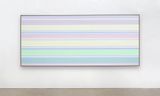
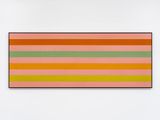
The gallery’s survey of Noland’s work in Asia presents a full picture of his practice, featuring marquee paintings from his Stripe, Shape, Plaid, Chevron, Diamond, Flares, Doors, Mysteries, and Into the Cool series. The earliest paintings in the exhibition include Stripe and Diamond works he produced in the mid and late 1960s, when a new visual language emerged from his early Circles from the 1950s. These horizontally-oriented Stripe and Diamond paintings stretch across several meters beyond the viewer’s peripheral vision, evoking the feel of a vast, enveloping landscape. Noland would use an array of techniques to apply bands of colour in specific proportions—including staining the raw canvas or using a traditional paint roller—to create textural variation. With his use of acrylic paint, which cannot be reworked as easily as oil, Noland embraced the risk factor, quipping that he was a “one-shot painter.” Regardless of the technique he employed in his painting practice, Noland intentionally removed traces of his hand to focus attention on the materiality of the works while also allowing for chance reactions where bands of paint meet.

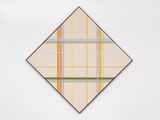
At the start of the 1970s, Noland began painting vertical stripes over his horizontal bands. The resulting works, his Plaid paintings, draw parallels with the paintings of Piet Mondrian, an early influence on Noland via his Black Mountain College teacher Ilya Bolotowsky, a proponent of the De Stijl philosophy. But unlike Mondrian, Noland retained the soft blur of stained canvas in his lines, cultivating a quasi-alchemical effect as colours overlap and knit together.

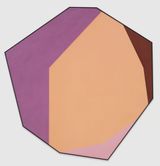
In the ensuing years—when Noland was the centre of a community of artists in Bennington, Vermont that also included Jules Olitski and Anthony Caro—he turned his attention to the canvas support itself. By creating shaped paintings that took unusual, asymmetrical forms, Noland emphasised the objecthood of the painting. These works, with their large expanses of a single colour, have a textural richness resulting from the paint’s interaction with the raw canvas and the artist’s distinct and often uneven application.

Chevron paintings from the mid-1980s in Pace’s exhibition refer to a pattern and shape that Noland first began exploring in the 1960s but attest to a new concern with texture. In these later Chevron paintings, vertical v-shapes contain a range of colours applied in various depths, thick and thin, creating nuanced textural qualities on their surfaces.

Noland’s melding of colour and shape is also evident in his Flares series, the first body of work he conceived and executed in California, from the early 1990s. These paintings are especially innovative for their incorporation of colourful and translucent plexiglass strips. Wedged between the irregularly shaped panels of each work, these glossy bands activate a complex interplay between colour, material, and form. To Noland, the Flares were “constructed pictures” with “separate component parts,” relating them to both collage and sculpture. He further enhanced the objecthood of the Flares by painting their sides in colours that do not match their frontal surfaces.

Small-scale Doors paintings from the late 1980s and early 1990s in Pace’s show offer a more intimate experience of Noland’s abstractions, while Mysteries works from the early 2000s—composed of concentric or horizontal bands of varying width and colour—harken back to his early Circles. By 2001, the artist had moved from Santa Barbara, California to Port Clyde, Maine, and the landscape and light of the East Coast captured his imagination and influenced his work in new ways.

The latest works in the survey, dating to 2006, are from Noland’s Into the Cool series. These joyous compositions speak to the emotional effects and expressive potential of colour and form, reflecting the artist’s enduring love of jazz in their jaunty, gestural abstractions. Though he returned to the image of the circle in his Into the Cool paintings, Noland approached colour through subtle tone and transparency, moving away from the hard-edge style of his earlier work.

Up until his last works, Noland continued pushing his investigations of color and shape to new limits. Today, his work can be found in major museum collections around the world, including the Art Institute of Chicago; the Metropolitan Museum of Art, the Museum of Modern Art, the Guggenheim Museum, and the Whitney Museum in New York; the Los Angeles County Museum of Art; the National Gallery of Art in Washington, D.C.; the Hara Museum of Contemporary Art in Tokyo; Tate in London; the Stedelijk Museum in Amsterdam; and the National Gallery of Australia in Canberra, among many others.

Pace’s Noland survey is the first presentation dedicated to his work to be mounted in Seoul since 1995, when he exhibited at Gana Art Gallery, and the first in Tokyo since 1986, when he showed at Satani Gallery.

Concurrent with the run of its Noland show in Seoul and Tokyo, Pace is presenting an exhibition of work by another key Washington Colour School painter, Sam Gilliam, at both gallery locations.

Read More
About the Artist

Kenneth Noland (b. 1924, Asheville, North Carolina; d. 2010, Port Clyde, Maine) attended Black Mountain College in the late forties and developed an early interest in the emotional effects of colour and geometric forms. He taught at various art schools including the Institute of Contemporary Art, Washington, D.C., Catholic University, Washington, D.C., Washington Workshop Center of the Arts and Bard College, Annandale-on-Hudson, New York. In 1977 a major traveling retrospective of the artist’s work was presented by the Solomon R. Guggenheim Museum in New York. In response, late art critic of The New York Times Hilton Kramer wrote, ‘An art of this sort places a very heavy burden on the artist’s sensibility for colour, of course—on his ability to come up, again and again, with fresh and striking combinations that both capture and sustain our attention, and provide the requisite pleasures...Mr. Noland is unquestionably a master.’ The first in-depth survey of Noland’s career was written by Kenworth Moffet and published by Abrams in 1977.

View Artist Profile

Also Exhibiting at Pace Gallery

Address
1F; Azabudai Hills Garden Plaza-A
5-8-1 Toranomon, Minato-ku
Tokyo
Japan
Opening Hours
Tuesday – Sunday
11am – 8pm
(1)
Tokyo 1F; Azabudai Hills Garden Plaza-A, 5-8-1 Toranomon, Minato-ku
Pace Gallery
1F; Azabudai Hills Garden Plaza-A, 5-8-1 Toranomon, Minato-ku, Tokyo, Japan

Opening hours
Tuesday – Sunday
11am – 8pm
The art world in focus