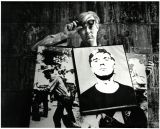
Andy Warhol lifted the sheet of acetate to the light, and for a moment, he and Marilyn Monroe dissolved into the same image. It was early 1964 in the Silver Factory, and the photographer William John Kennedy had asked Warhol what the large roll leaning against the wall was for. “These are the acetates used in my silkscreens,” Warhol replied, and with a flurry of movement, held one sheet up. Through Marilyn’s face, the artist peered out at the camera; Kennedy pressed the shutter. In a single frame, he had done what no portrait could: he folded the man into his own masterpiece, maker and icon collapsed into one.
Dellasposa is pleased to present Warhol / Indiana: On the Origins of Pop, a collection of original, signed photographs by William John Kennedy of Andy Warhol and Robert Indiana in 1963 and 1964, several of which exist as Artist Proofs or unique pieces outside of an edition.
Kennedy’s work is defined by a single, radical insight: that the truest portrait of an artist is one made through his art. Rather than photograph Warhol and Indiana as isolated subjects, Kennedy embedded each within his own work at the very moment of its making — folding Warhol through the acetate of Marilyn, or standing in Indiana’s studio as the LOVE canvas was first raised. Granted a year of unguarded access to Warhol at the Silver Factory on East 47th Street and to Indiana at his Coenties Slip studio, Kennedy documented both artists in the precise months before either ascended to prominence. The photographs in this exhibition trace that formative passage, from the birth of an icon to the dawn of a movement.
The collection takes its subject from a chain of encounters Kennedy himself described. Reflecting on the origins of the series, he recalled: “When I look back on my involvement with the Pop artists, it all came off my initial involvement with Robert Indiana. He was the lynchpin”. It was Indiana who, in the winter of 1963, introduced Kennedy to an as-yet-unknown Warhol at the Museum of Modern Art’s Americans exhibition — the meeting from which this entire body of work would unfold.
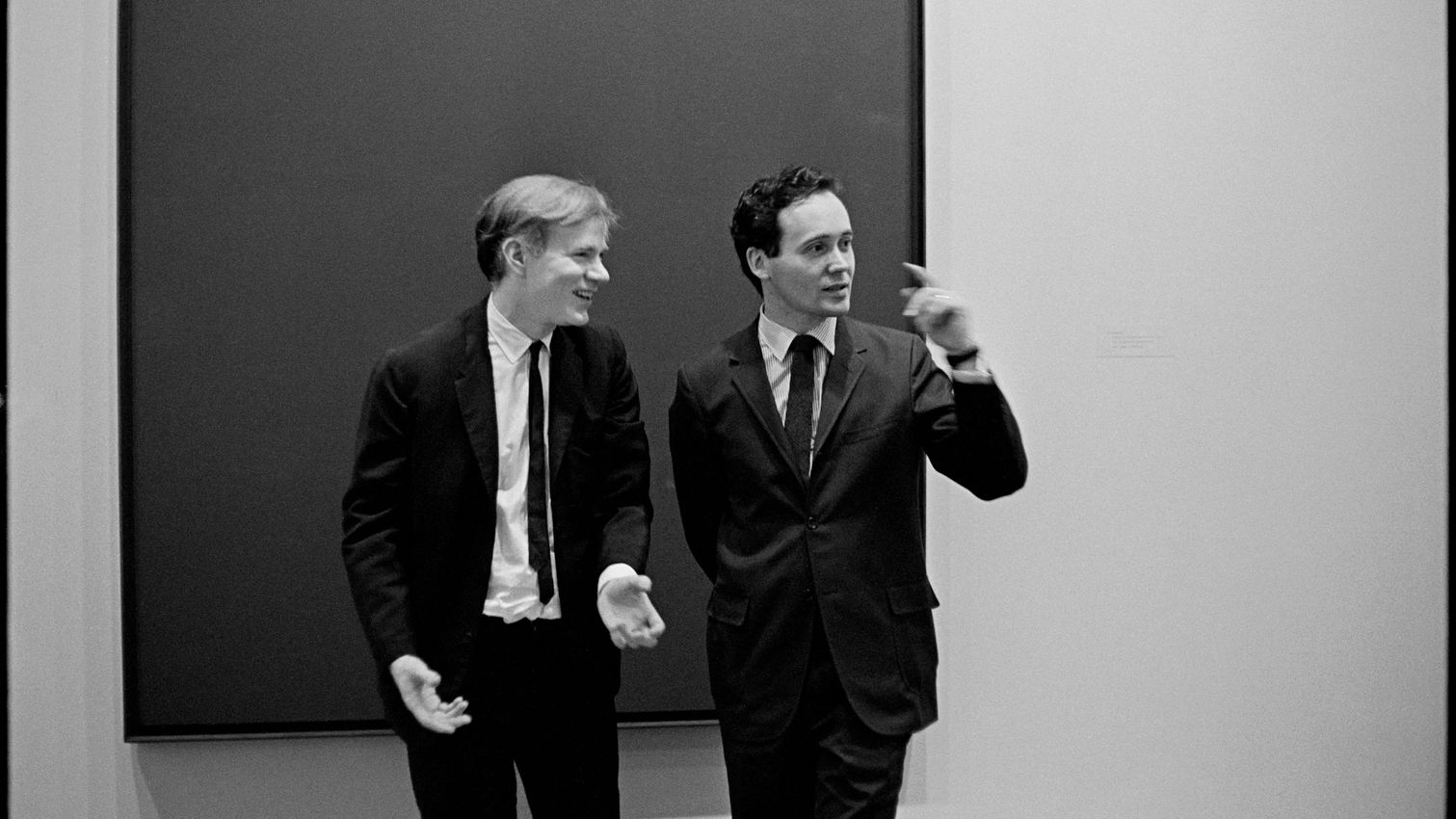
The earliest work in the series, Andy Warhol and Robert Indiana (1963), captures the two artists in an unguarded exchange, a social document that fixes the informal milieu from which Pop would emerge. In Warhol Holding Marilyn Acetate I (1964), Kennedy posed Warhol behind the clear acetate of Marilyn Monroe from which his most celebrated silkscreens would soon be painted, collapsing artist and subject into a single frame. Robert Indiana Holding Love (1964), made at Coenties Slip, remains the only existing photograph of Indiana with the painting that would become one of the most reproduced images in American art. Together, from Warhol Flowers III to Warhol with Race Riot Sandwich Board — the only print ever pulled from its intended edition — the selection forms a coherent record of two artists at the threshold of their legend.
As Eric C. Shiner, former Director of The Andy Warhol Museum, has written of the series: “The Kennedy photos are perhaps the most intimate portraits of Andy that I have ever seen — capturing him at the point of his emergence”. That intimacy underpins each work on view, in which Warhol is seen, as Shiner puts it, “literally through his work”.
watch documentary
password: warhol
William John Kennedy (1930–2021) was a New York-based photographer and editorial contributor to LIFE magazine, whose private photographic practice produced the primary visual record of Warhol and Indiana during a pivotal moment in Pop Art history. His work is held in the permanent collections of The Andy Warhol Museum, Pittsburgh, which acquired 100 of his photographs in 2012, describing them as “rare and highly significant”, in addition to the Whitney Museum of American Art, the Detroit Institute of Arts, and Newfields / Indianapolis Museum of Art, among others.
ARRANGE VIEWING APPOINTMENT
From the Silver Factory to Coenties Slip: the photographer who documented Warhol and Indiana at the dawn of Pop Art
Dellasposa presents William John Kennedy’s 1963–64 rare photographs of Andy Warhol and Robert Indiana as museums rewrite both artists into the canon
LONDON — He lifted the sheet of acetate to the light, and for a moment, Andy Warhol and Marilyn Monroe dissolved into the same image. It was early 1964 in the Silver Factory, and the photographer William John Kennedy had asked Warhol what the large roll of plastic leaning against the wall was for. “These are the acetates used in my silkscreens,” Warhol replied — and with a flurry of movement held one sheet up. Through Marilyn’s face, the artist peered out at the camera; Kennedy pressed the shutter. In a single frame, he had done what no portrait could: he folded the man into his own masterpiece, maker and icon collapsed into one. Of this very photograph, Patrick Moore, former Director of The Andy Warhol Museum, has said: “We see Warhol in a fresh light — young, victorious, on the verge of dominating the art world… We see Warhol through his art.”
A century after Marilyn Monroe’s birth, as the National Portrait Gallery draws the world back to Warhol’s silkscreens with Marilyn Monroe: A Portrait (until 6 September 2026) — Dellasposa presents the photographs that document the exact moment those icons were born. Kennedy, a LIFE magazine photographer, was granted something no one else received: a year of unguarded access to Warhol at the Silver Factory and to Robert Indiana at his Coenties Slip studio in 1963–64, the precise months before either artist ascended the heights of the art world. He photographed Warhol peering through the clear acetate of Marilyn from which the paintings would be printed, and he stood in Indiana’s studio the day the artist first raised the LOVE canvas — “there he was,” Kennedy recalled, “holding his Love painting”.
Kennedy’s genius was never just to take a portrait. He fused each artist’s work with his own at the moment of creation, turning the camera into a witness. “Kennedy’s insight was to reveal Andy by embedding Warhol in Warhol artworks,” says Eric C. Shiner, former Director of The Andy Warhol Museum. “Warhol is literally seen through his work; Kennedy knew intuitively that the only way to truly see Warhol was to see his art.” The result, Shiner adds, is unrepeatable: “The Kennedy photos are perhaps the most intimate portraits of Andy that I have ever seen — capturing him at the point of his emergence.”
That intimacy has an art-historical counterpart. As MoMA curated an exhibition on the artists of Coenties Slip — the Lower Manhattan waterfront where Indiana worked alongside Ellsworth Kelly, Agnes Martin and Cy Twombly — Kennedy’s studio photographs have become the primary visual record of one of the most influential circles of post-war artists. His frame of Indiana with LOVE is the only photograph in existence of the artist holding the painting that would become one of the most reproduced postwar images in American art.
In 2026, as collectors move away from their focus on painting to building collections across mediums, favouring documented works with secure provenance, Kennedy’s photographs sit at the centre of that shift, and in an unusual position within it: his institutional standing, anchored by the Andy Warhol Museum, which holds 100 of his works in its permanent collection, has outpaced his market prices, leaving room for the most astute collectors to recognise first.
“What collectors are really searching for is authenticity of a moment, not simply an art object,” says Jessica Phillimore, founder of Dellasposa. “Everyone knows the Marilyn silkscreen paintings; almost no one has seen the work in the process, before the paintings were finished. Kennedy captured Warhol and Indiana in the moment their most enduring works were being born. When scarcity, art-historical significance, and cultural weight converge in a body of work, that is when experienced collectors move. Today, a collector in New York, Dubai, Singapore, or Sydney can examine the full provenance and acquire these works through Dellasposa, from anywhere in the world.”
Every photograph in this collection is a signed silver-gelatin print, issued with a Certificate of Authenticity and drawn from Kennedy’s original 1963–64 negatives; several exist as editions of five or fewer, and Warhol with Race Riot Sandwich Board is the only print ever pulled from its edition. For experienced collectors building across mediums with documented provenance, it is a rare opportunity to acquire the origin of the images that defined a century, at the very moment institutions are rewriting Monroe and the Coenties Slip artists into the canon. The collection may be viewed privately by appointment in London and acquired internationally at www.dellasposa.com, with works also discoverable via Artsy, Artnet, Ocula and 1stDibs.
— ENDS —
NOTES TO EDITORS. About Dellasposa: founded in 2016 by Jessica Phillimore, Dellasposa is a private gallery and advisory in Kensington, London, specialising in Modern, Post-War and Contemporary art, serving UK and international collectors through www.dellasposa.com — a space for contemplation in an age of digital distraction. In 2012 The Andy Warhol Museum acquired 100 of Kennedy’s photographs for its permanent collection, describing the acquisition as “rare and highly significant”. High-resolution images, the full catalogue and founder interviews are available on request.
Media contact: Jessica Phillimore, 07988 022 859, jessica@dellasposa.com
Dellasposa was established in 2016 by gallerist and curator Jessica Phillimore and collector Julian Phillimore. In addition to its gallery and exhibition programme, Dellasposa offers bespoke art advisory.

A respected voice in contemporary art discourse.
Focusing on ambitious storytelling and insightful art-world commentary. Ocula Magazine publishes in-depth interviews, critical essays and timely analysis on the artists, exhibitions and ideas driving the global art world.
Learn more about Ocula Magazine
Showcasing the best of the art world.
Ocula partners with galleries from around the world to highlight their artists, artworks and exhibitions. Gallery membership is by application and invitation, with each member vetted by an independent panel.
Learn more about Ocula Membership

Specialises in the sale of major artworks.
Led by a team with deep ties to the world’s leading auction houses, galleries and collectors. Ocula’s advisory team offers bespoke services to high-net-worth clients from around the world who are looking to acquire the best of contemporary and modern art.
Learn more about our team and services