The art world in focus
Subscribe to our newsletter for news and insights on artists, galleries and exhibitions.

I have never liked John Berger. This has always felt like a scandalous confession to make in England, where he has the status of saint. For a long time, I didn’t like talking about paintings, although I enjoyed them, because Bergerism was so much in the air. I admit I found, and still find, something seductively disarming in the plain-speaking clarity of it all. To read Berger write of Caravaggio that “His darkness smells of candles, over-ripe melons, damp washing waiting to be hung out the next day: it is the darkness of stairwells, gambling corners, cheap lodgings, sudden encounters” is to struggle against the pull of a romantic narrative worldview.
Berger’s visual language is very often that of the dinner table, the garden party or the Brit abroad in Italy for whom the common people, whom he does not quite understand, have a special charm. Its component parts are earthy metaphors and moralising judgments. He could, with comfort, write: “Those who live precariously and are habitually crowded together develop a phobia about open spaces which transforms their frustrating lack of space and privacy into something reassuring. He shared those fears.” This outlook, part distantly observed anthropology, part essentialism about class, made Berger quintessentially English. He spoke to a society segregated by caste yet fetishistically obsessed with the marginalised.



Looking back, I can see that I was reacting against a suggestion in Berger’s writing that evoked a troubling tendency in culture whose rise coincided with my adolescence. In England throughout the 2000s, there was a subcurrent of moralising and reductively political thinking that became a popular religion in the 2010s as the Tories came to power. In this distinctly austere English mood, the primary question to be asked of art was “Does this work help to encourage men to know and claim their social rights?”, as Berger wrote in the introduction to his much-celebrated 1960 essay collection Permanent Red. If a painting had ever told me to claim my social rights, I hadn’t noticed.
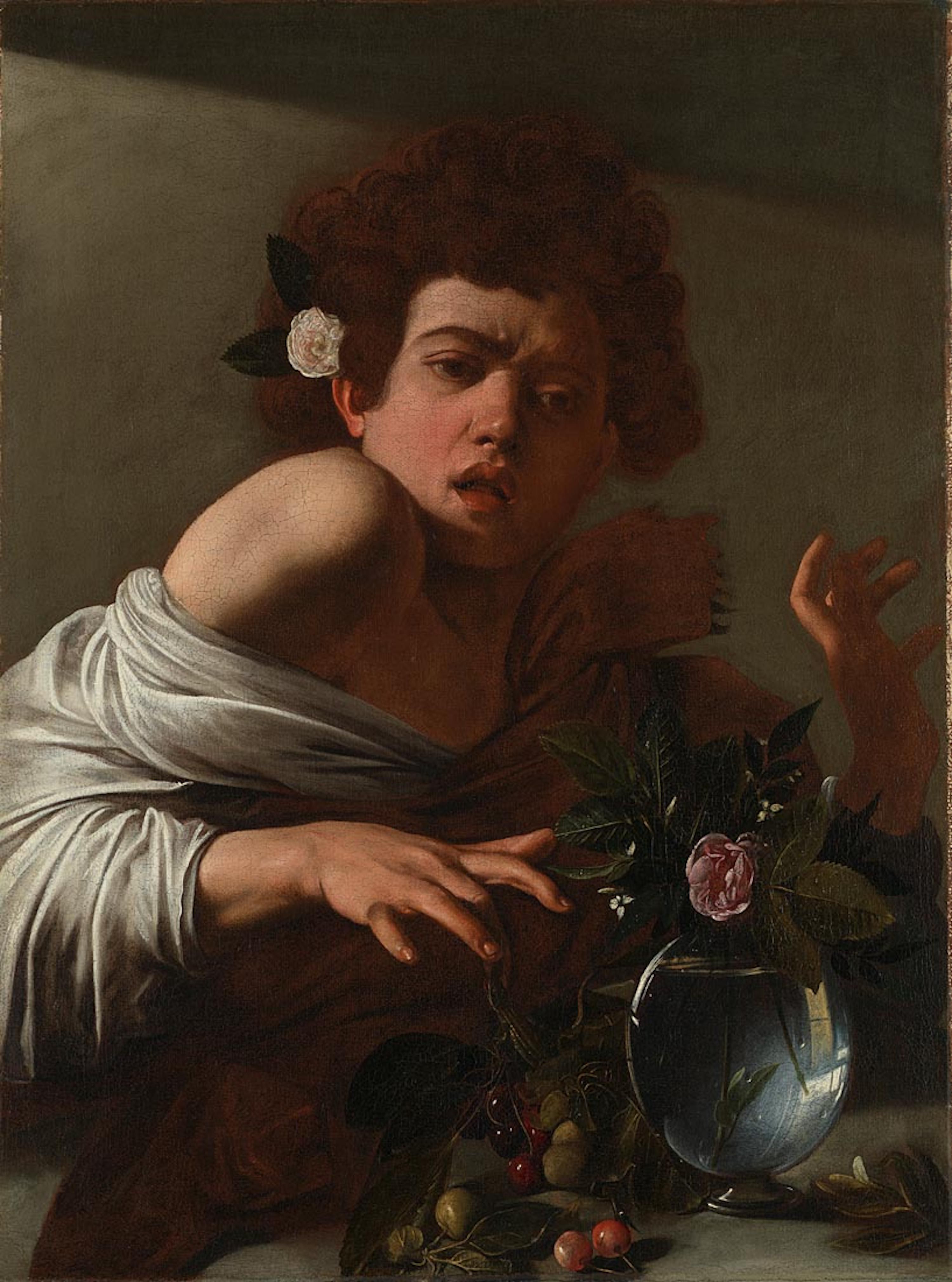
What I do remember noticing, on a trip to the National Gallery around 2012, was Caravaggio’s Boy Bitten by a Lizard (c 1594–1595). The boy’s left hand is cocked and splayed, just slightly recoiling in unison with a face whose mouth moves towards, but does not quite reach, the “O” shape of a gasp; the whole body is reacting to a lizard that has latched itself on to the boy’s middle finger—the point with which he would apply pressure, were he to have a pencil or a small brush in his hand. This was a self-portrait, clearly. There was also something going on here about looking, I recall thinking. Looking not just at oneself, but at others, as well as at others looking at themselves. There is something obscene, lurid and—perhaps in this thought was some residue of the Catholicism in which I was raised, too sticky to shake-off—punishable in the desire to look: as if the pencil with which we seek to depict the world ought to turn into a snake and force us to recoil against what we’re doing, “as though to protect/ what it advertises”, as the poet John Ashbery wrote (Self-Portrait in a Convex Mirror (1975).
I liked the Caravaggio, too, because it seemed to aim at some Third Way alternative to a glib disinterest in the world of passions and emotions and the guilt-fuelled obsession with “authentic” subaltern and proletarian versions of them. Here, both the viewer and the subject are doing the same thing: observing, noticing themselves observing, seeing that there is something obscene about doing so but going along with it anyway. This struck me as a more honest view of the world, one in which we are more often dragged along by, rather than engineering, the forces around us.
“Berger spoke to a society segregated by caste yet fetishistically obsessed with the marginalised”
I stayed with this outlook, which encouraged an avoidance of art that wasn’t engaged in a game of look-don’t-look, for a few years. I remember thinking, with a zealot’s conviction, at one point during a six-month stint in Washington DC during which I spent hours almost every day at the National Gallery in front of Manets, that the ideal painting was, like his Olympia (1863), one that made you feel like you shouldn’t be looking at it, as if you were a hapless customer walking in on a working girl outside her office hours. At this point, I was only a step away from admiring paintings such as Robert Ryman’s almost-all-white canvases: art that was the culmination of a modernist project concerned with playing tedious games with the viewer that I struggled to describe without using the word “decadent”. Today, seeing this moralising tone creep into my thinking, as if through a back door, I find myself making some tacit admission that the deep moralism behind Berger’s writing is harder to shake off than it initially seemed.—[O]



A respected voice in contemporary art discourse.
Focusing on ambitious storytelling and insightful art-world commentary. Ocula Magazine publishes in-depth interviews, critical essays and timely analysis on the artists, exhibitions and ideas driving the global art world.
Learn more about Ocula Magazine
Showcasing the best of the art world.
Ocula partners with galleries from around the world to highlight their artists, artworks and exhibitions. Gallery membership is by application and invitation, with each member vetted by an independent panel.
Learn more about Ocula Membership
Specialises in the sale of major artworks.
Led by a team with deep ties to the world’s leading auction houses, galleries and collectors. Ocula’s advisory team offers bespoke services to high-net-worth clients from around the world who are looking to acquire the best of contemporary and modern art.
Learn more about our team and services