The art world in focus
Subscribe to our newsletter for news and insights on artists, galleries and exhibitions.

Joyce Kozloff (left) with Linda Nochlin (right), author of _Why Have There Been No Great Women Artists? _at the home of curator Joyce Pomeroy Schwartz, 1990. Photo: Mel Rosenthal. Courtesy Joyce Kozloff.
After many years of anonymity, the founding member of Guerrilla Girls known by the pseudonym Liubov Popova has revealed her true identity: she is 83-year-old US-based painter and sculptor, Joyce Kozloff, a major figure in the Pattern and Decoration movement of the 1970s.
In an interview published yesterday by the American publication Art Journal Open, Kozloff confirmed her role in the renowned feminist artist collective, known for their provocative poster campaigns on art world sexism. She also disclosed, for the first time, that she was a key creator of the famed text-based work, The Advantages of Being a Woman Artist (1988).
Asked why she chose now as the moment to come forward, Kozloff told Ocula: “I’d had a pact with another Girl that whoever died first, the survivor would bring her out. But I suddenly realised that if I were dead, I couldn’t tell the story my way.
“More and more, I see life as Rashomon: we all remember it differently, and so we all have different stories to tell.”
Speaking with Art Journal Open for the publication’s Feminist Interview Project, organised by the College Art Association’s Committee for Women in the Arts, Kozloff discussed her early involvement with Guerrilla Girls, explaining that she was invited to join the group in 1985 by two younger women. Initially made up of seven artists, she recalled the collective’s decision to adapt a language and visual style that would combat a perceived disinterest in feminism.
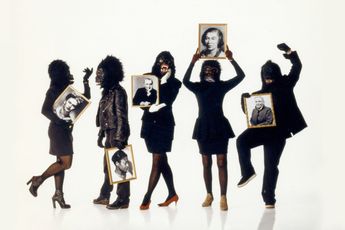
“It was a surprising conversation for me,” she told the publication. “We decided to call ourselves the Guerrilla Girls, wear fishnet [stockings] and short skirts, call out the worst misogynists in the art world, appear publicly in masks, like avengers.
“We quickly expanded our ranks. A new member had misunderstood our name, brought a gorilla mask to a meeting, and voila! We all had aliases, the names of dead women artists: I was Liubov Popova.”
Kozloff told Ocula that she was assigned the name of the Russian avant-garde painter and educator, but soon became interested in her work. In a 2016 “homage” to Popova, Kozloff described her as “vivacious, audacious, and passionately political, a meteor”.
Formed in response to the Museum of Modern Art’s 1984 exhibition An International Survey of Recent Painting and Sculpture, which included 169 artists, only 13 of which were women, Guerrilla Girls went on to describe themselves as the anonymous “conscience of the art world”. Wearing gorilla masks and each named after a famous woman artist, including Frida Kahlo, Alice Neel and Käthe Kollwitz, they plastered New York with then-revelatory facts and figures about the absence of women and artists of colour from the city’s museums and galleries.
Asked about that time, Kozloff said: “It was fun! Really fun. I loved being at art openings where people were speculating about who we were—they were always wrong.”
The artist told Ocula that she was previously “one of a small group of stalwart holdouts” from that time who continue to maintain their anonymity, and that she believes other founding Guerrilla Girls will continue to withhold their identities. “I spoke to them before I did, and they gave me permission,” she said of her own decision to come forward.
Among the most notable of Guerrilla Girls’ works from the 1980s is The Advantages of Being a Woman Artist, which lists “benefits” including “Working without the pressure of success” and “Not having to choke on those big cigars or paint in Italian suits”. Speaking to Art Journal Open, Kozloff recalled that she was inspired to create a first draft of the work after taking part in an artist residency where she witnessed the unpaid labour of younger women artists in relation to their older male partners.
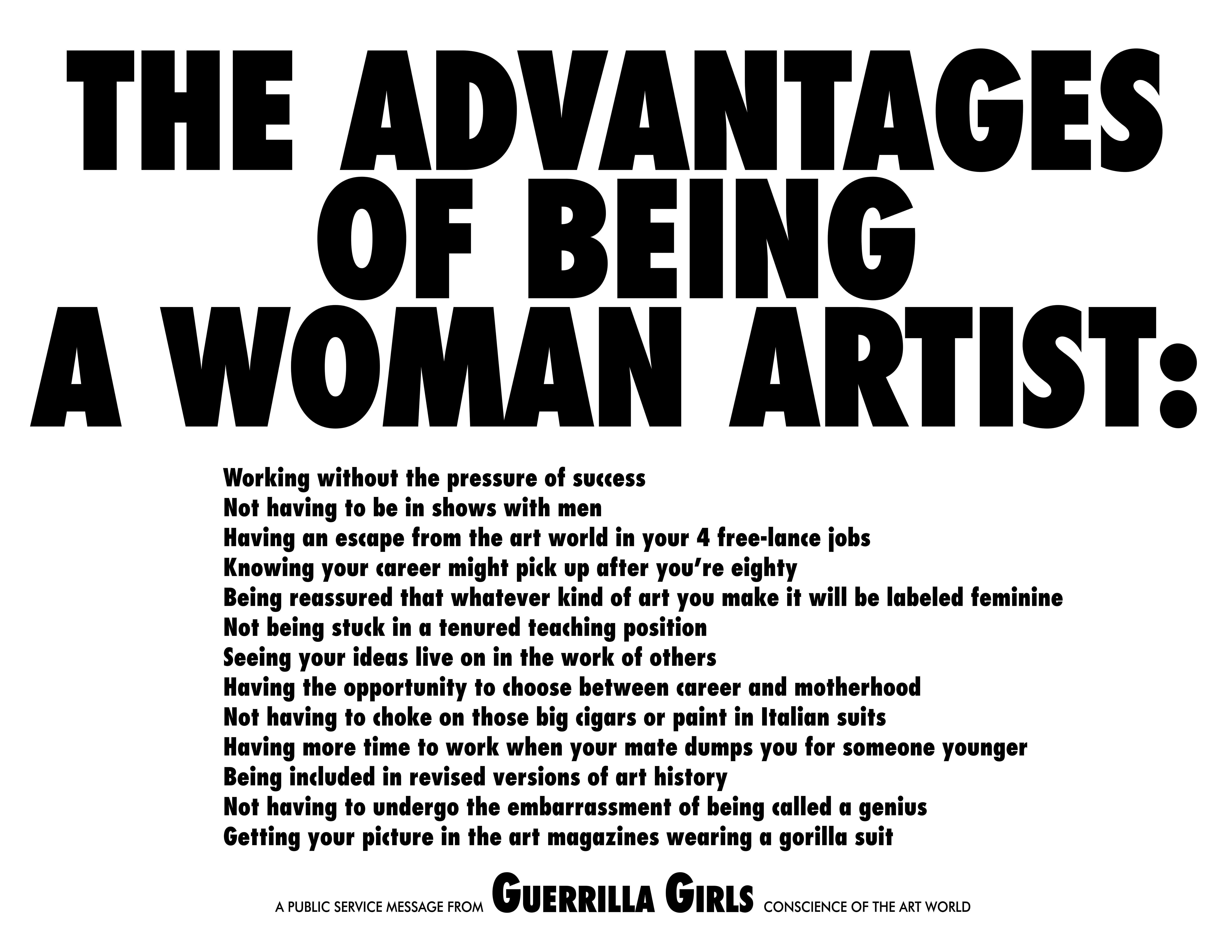
“When I got back, I wrote a rough draft, The Disadvantages of Being a Woman Artist,” she recalled. “Until then, our posters always had verifiable statistics, so this was a stretch. But then, our clever members turned it around to ‘Advantages’ and it worked!”
Referencing the “Italian suits” line, Kozloff told Ocula that, while highly relevant at the time, some elements of the work now feel dated. “It has to be rewritten for each generation, for each audience,” she said.
Unlike some of her fellow Guerilla Girls—several of whom have revealed their identities in the past—Kozloff is no longer active with the group. Speaking to Art Journal Open, the artist described herself as “restless” and said she “love[s] starting things”, but is “not so good in the long haul”.
She told Ocula: “Some of the original members are active globally—they’re amazing! We used to say, when asked who we were, ‘all women are Guerrilla Girls’, and I believe that.”
Kozloff’s own practice has, since the 1990s, often employed cartography as a foundation for paintings, sculptures, frescoes and collages, through which she explores nationhood, culture and global politics. The result combines inviting decorative works with a sharp critique of warfare and Western expansionism.
The artist told Art Journal Open that she considers the anti-war and feminist movements to be interconnected. Asked whether, despite having retired from the collective, the messaging of Guerrilla Girls can be seen in her practice, she said: “I don’t know about my practice as a one-to-one comparison.
“I have always considered myself a political artist—although according to a friend, my rich, decorative surfaces may have created a subterfuge.”
She continued: “Since Vietnam I’ve been obsessed with the aerial bombardment of civilian populations, and how it’s anaesthetised for us. If I can make it more visceral, more real, I will feel I’ve made a small contribution.”
A respected voice in contemporary art discourse.
Focusing on ambitious storytelling and insightful art-world commentary. Ocula Magazine publishes in-depth interviews, critical essays and timely analysis on the artists, exhibitions and ideas driving the global art world.
Learn more about Ocula Magazine
Showcasing the best of the art world.
Ocula partners with galleries from around the world to highlight their artists, artworks and exhibitions. Gallery membership is by application and invitation, with each member vetted by an independent panel.
Learn more about Ocula Membership
Specialises in the sale of major artworks.
Led by a team with deep ties to the world’s leading auction houses, galleries and collectors. Ocula’s advisory team offers bespoke services to high-net-worth clients from around the world who are looking to acquire the best of contemporary and modern art.
Learn more about our team and services