Press Release

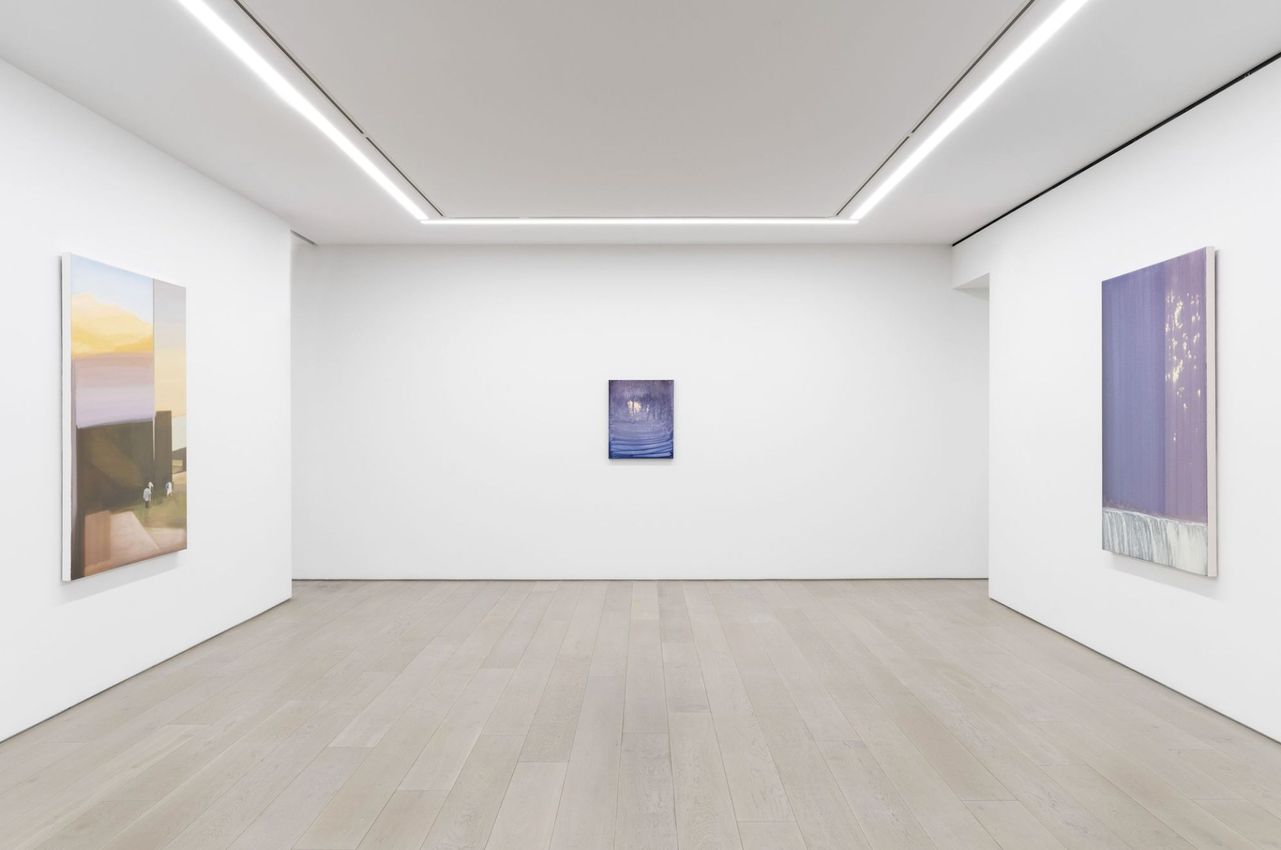
Perrotin New York is pleased to present Imaginary Country, an exhibition by Chilean-born, Paris-based artist Christiane Pooley, marking her first show in the United States. In her new body of paintings, Pooley draws inspiration from the landscapes of South America in ethereal terrains on canvas and copper plate. Imaginary Country invites viewers to reflect on the elusive and evolving nature of identity and belonging.

The imaginary man lives in an imaginary mansion surrounded by imaginary trees on the banks of an imaginary river — Nicanor Parra

In the Ursula K. Le Guin short story “Sur,” a female diarist shares the remarkable account of an all-woman expedition to the South Pole from Chile years before explorers Roald Amundsen and Robert Falcon Scott set foot on the planet’s southernmost axis, respectively, in 1911 and 1912. Relayed with an assured voice and finicky detail, Le Guin’s chronicle transforms a formal narrative experiment into fantastic world-changing fiction—an imagined tale that foregrounds the ingenuity and difference of the female gaze as a way of nimbly, shrewdly and bravely encompassing the world.

Like a well-thumbed book of speculative fiction, “Sur” provides pointers for considering Christiane Pooley’s most recent paintings. A commentator not so much on El Dorados or Narnias as on the fate of a far-flung, austral Atlantis, the Chilean-born, London-educated and Paris-based artist fashions pictures that revisit painterly certainties and scramble artistic traditions. Her newest paintings imagine (and reimagine) a country of lakes and mountains, rivers and waterfalls, groves and copses; they feature desolate highways, floating houses (in clear reference to the Mingas, or “flying homes,” that characterise life on the island of Chiloe in Southern Chile), and stooped figures that worry rather than work the land (their resemblance to Jean-Francois Millet’s The Gleaners and Vincent van Gogh’s The Road Menders is inescapable). Like Le Guin’s story, Pooley portrays a country that is way more paradox than certainty. Her paintings represent, in equal parts, native landscape—hers, among others—and contested territory.

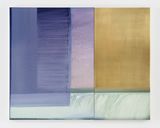
A series of fifteen oil on canvas and oil on metal works—with a nod to the collaged compositions on copper plate that Robert Rauschenberg “invented” on his 1981 trip to Chile—Pooley’s paintings freely admix eras and influences, like certain immigrant- rich countries do genetics. One painting, Change of Plans, channels both the Romantic sublime and the modernist grid. Two others, To Fold a Map and Whisper, evoke Frederic Edwin Church panoramas and geometric abstraction. (According to the artist, both canvases make direct reference to Church’s 1857 depiction of Niagara Falls by employing what she terms “a crepuscular palette”). In Pooley’s pictures, time and geography don’t fall away, they fall apart. This suggests, among other recurrent phenomena, tectonic alterations, displacements, slippages. Consider the painting Midlife Crisis. A gloamy, Rothko-like stack featuring blue and brown horizontal bands, the canvas depicts a quartet of homes sliding into the sea; a ghost- like image Pooley rescued from photographs of the 1960 earthquake in Valdivia, Chile—at 9.5 magnitude, the most powerful in recorded history.

What remains in the wake of such upheavals, Pooley’s works submit, are “the stories embedded in the landscape”—a terrain the artist returns to again and again with tidal insistence. Despite her paintings’ calm demeanour, their lambent surfaces consistently convey gradual and seismic change. Looked at closely, pictures such as Some intuitions are hard to explain and Feeling a Way incorporate seams; these also read like fault lines. To quote Chinua Achebe citing W.B. Yeats, things fall apart, in Pooley’s paintings just as they do in life. Among the possible casualties: religious and civic abstractions, identities, core beliefs, archives filled to the brim with topographies, clannish memories. One aspect of Pooley’s pictures holds like a levee: her continued commitment to the malleability of her medium. For the artist, painting remains, as it does for all first-rate practitioners of oil- on-whatever-surface, the most trustworthy method to apprehend the organisation of visual data and its opposite, representational chaos—not just as a set of landscapes or an exhaustive map, but as a territory that is fundamentally unstable, tractable and ever shifting.

Beauty is the promise of happiness Edmund Burke once wrote. Consider Burke as you approach Pooley’s deceptively beautiful paintings—among them, Croquis Paso Fronterizo and Pais Imaginario, the exhibition’s titular work inspired by Nicanor Parra’s poem. Both compositions feature what Pooley has described as “stains, brushstrokes, lines, colors, finishes (brilliant and opaque), different surface temperatures,” and the “warm and cold colours of sunlight and its shadows.” Note, also, while you peruse, that for Pooley, beauty has a catch. It functions like a Trojan horse: smuggling personal and collective histories into transitions from light to dusk—themselves invocations of change from one state to another—to create ecstatic images that, invariably, stand in for unnamed challenges.

Most personal among the latter, for the artist, is the simmering conflict affecting her native region of Araucanía. A place of spectacular beauty and not a little colonial cruelty, this southernmost locale remains Pooley’s principal imaginative wellspring. Her paintings are her speculative fiction. Resplendent depictions of a radiant space beyond simple appearances, her landscapes propose privileged yet enigmatic lookouts onto another less callous and more generous country.

— Christian Viveros-Fauné

Read More

Installation Views

Also Exhibiting

About the Gallery
Emmanuel Perrotin founded his first gallery in 1989 at the age of 21. He has opened since then over 17 different spaces, with the aim of continuing to offer increasingly vibrant and creative environments to experience artists work. He has worked closely with his roster of artists, some since more than 25 years, to help fulfill their ambitious dreams and projects. The gallery is now based in New York, Paris, Hong Kong, Seoul, Tokyo, and participates in all the significant worldwide art fairs each year (Art Basel (Hong Kong, Miami, Basel), Frieze (London, New York), FIAC (Paris), Dallas Art Fair, Art Cologne, Art Stage Jakarta, Expo Chicago, Art021 & West Bund Art & Design, Shanghai, Zona Maco Mexico, amongst others).
View Gallery Profile
Address
130 Orchard Street
New York
United States
Opening Hours
Tuesday – Saturday
10am – 6pm
(1)
New York 130 Orchard Street
Perrotin
130 Orchard Street, New York, United States
+1 212 812 2902
http://www.perrotin.com

Opening hours
Tuesday – Saturday
10am – 6pm
The art world in focus