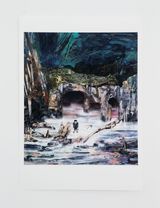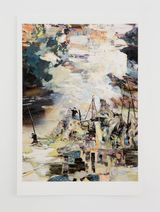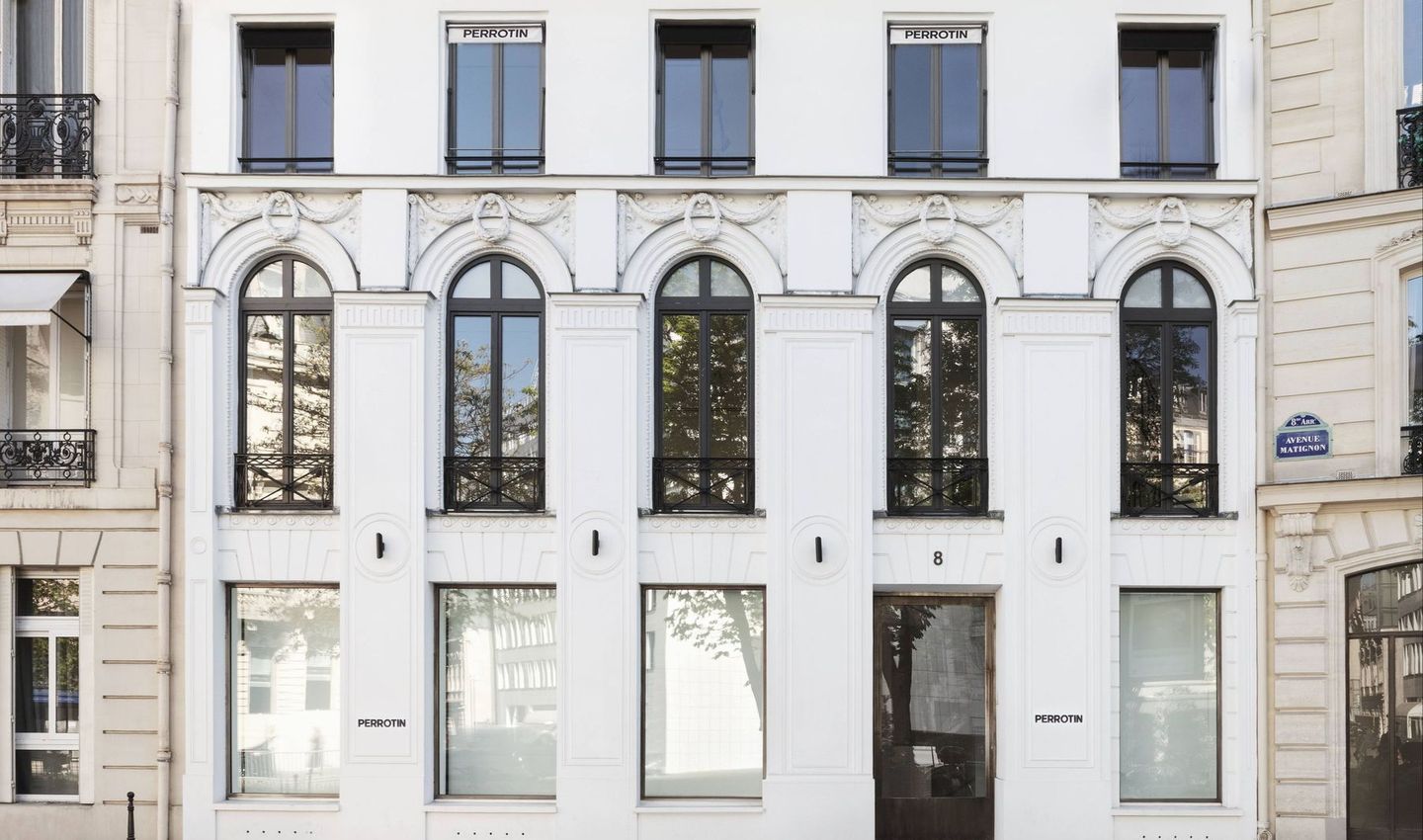
Eight years after his last exhibition in Japan, Perrotin is pleased topresent a new solo exhibition by Hernan Bas in Tokyo, on view fromSeptember 9 to November 11, 2026. Through his evocative paintings,Bas continues to explore themes of desire, fantasy, literature, andqueer identity, creating richly atmospheric worlds suspendedbetween reality and imagination.The following is an essay authored by curator Yuko Hasegawa on theoccasion of this exhibition.
The Tension of Limbo - Shedding Light on the Forgotten
Hernan Bas’s canvases hit the viewer with an unsettling impact: atonce deeply ornate and charged with a sense of disquiet. They existin a constant dialogue between beauty and absurdity, melancholy andhumour, decadent aestheticism and critique. Framed with photographicimmediacy, his scenes leave no space untouched—brimming withintricate detail, vibrant colour, and an exclusive cast of young male figures.Caught between youth and adulthood, these figures inhabit the fragile,liminal space that Bas calls “fag limbo”, where time seems to freeze.This state of suspension is the very source of the underlying tension inBas’s paintings. They exist as romantic dreamers—forever paused on the brink of becoming—while simultaneously operating as activeparticipants in capitalist display and self-presentation. It is preciselywithin this ambiguity that a contemporary critique emerges. In TheVisitors—a series exhibited this year at the Ca’ Pesaro Museum in Venicefeaturing figures wandering aimlessly through tourist destinations—Basconjures a portrait of modern flâneurs drifting through a globalised world.Hovering within their environments, the figures are framed by a richcollection of attributes—jewellery, tattoos, slogans—revealing their storiesin conversation with their backdrops. Drawing on mythology, literature,history, subculture, and mass media, Bas invokes the idiosyncrasies ofcultural identity through charged, symbolic references, inviting the viewerinto the thrill of a chimerical reading.
Words and stories are important to Bas. He first creates a list of titles,which he then transforms into visual ideas and translates intopaintings through his distinctive pictorial practice. This methodrepresents a paradoxical creative process in which the painting firstexists as text before being visualised. When speaking about his work,Bas describes a dual fascination: a deep engagement with the writtenword, alongside a desire to elevate it into images that ultimatelytranscend language to become self-sustaining. His lineage tracesback to late-19th century Decadent literature—the dark aestheticismof Oscar Wilde, Joris-Karl Huysmans, and Charles Baudelaire. Inmany ways, his practice re-enacts 19th-century Aestheticism throughthe lens of a 21st-century queer sensibility.
Bas has once said, “What I try to do is create images which can beautonomous. I love that moment when everything I have read andthought to get to this painting disappears and it takes on a life of its own and finds its own space for interpretation”. Infusing the traditions offigurative and landscape painting with motifs borrowed from Symbolistpoetry, he has developed an experimental painterly gesture.
Consider, for example, the series wittily titled The First and the Last.These works bring together a diverse array of concepts—from thewinners or first instances of specific events to the final iterations ofothers. In the monumental canvas The last museum guard at t__he lastmuseum on Earth, a dapper, suited guard wearing a badge, standsbefore Picasso’s Guernica. Framed above and below by the lushgreen of houseplants that hint at an outdoor realm, the youth standsbefore this sombre masterpiece; his eyes, a blend of perplexity andmelancholy, gleam with a heightened blue. At his feet sits a ‘NoPhotography’ sign. The allure and enigma of the title invite endlessspeculation: Is violence imminent? Is this truly the final painting lefton Earth? At the exact moment where the image transcends wordsto claim its own distinct space, Bas’s signature ambiguity achievesits maximum resonance.
The psychopolitical dynamics of Bas’s art are fully realised in TheConceptualists. Set within the realm of Conceptual Art—which, at itsnorthernmost extreme, permits ‘anything’ to be art—the work extendsa playful absolution to peculiar, queer acts. The young man applyinggold leaf to withered plants finds his action endowed with form andmeaning through a blend of precision, sensuality, and wild abandon.
Bas was born in Miami in the late 1970s into a family of Cubanimmigrants. Having fled Cuba following the rise of the Castro regime,his parents, including his musician father, relocated the family of six children deep into the woods of North Florida. Bas spent his first sixyears wandering and embarking on small adventures with his siblingsin this remote, time-isolated forest. ‘It was a very strange place,’ Basrecalls. Conversations about Bigfoot sightings, UFOs, and ghostswere entirely commonplace. This environment laid a firm foundation forthe Gothic sensibility and unbridled imagination that thread throughhis mature work. The affection for the esoteric and the naive faith in theunseen nurtured during his childhood serve as the prototype for theenigmatic, fantastical landscapes inhabiting Bas’s adult painting.
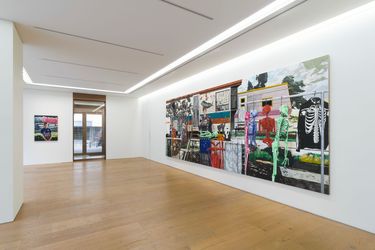
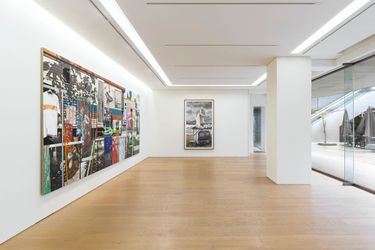
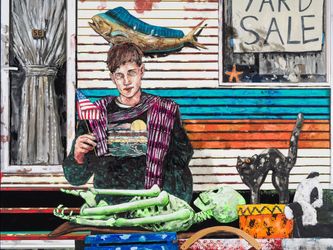
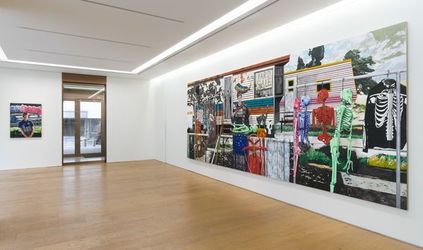
In his latest body of work, TIME TO SHINE! (the salesmen), Bas shiftsthis sense of limbo away from mythic landscapes and tourist hubs,relocating it to the mundane yet strangely theatrical spaces of suburbancommerce—yard sales, florist stalls, and seaside souvenir stands. Thetitle itself draws on an idiom for that fleeting moment when somethingobscured is briefly thrust into the light. In the monumental 5.5-metrewide canvas, All you ever wanted to know about 5B, secondhandclothes and knick-knacks are staged across a front lawn like theatricalprops, creating a quiet tension where the figure standing before themfeels like an exhibit themselves. He is depicted not as an artistdisplaying their work but as an individual attaching a price tag to theirown possessions—even including his youth and time itself—exposing them to the gaze of passersby.
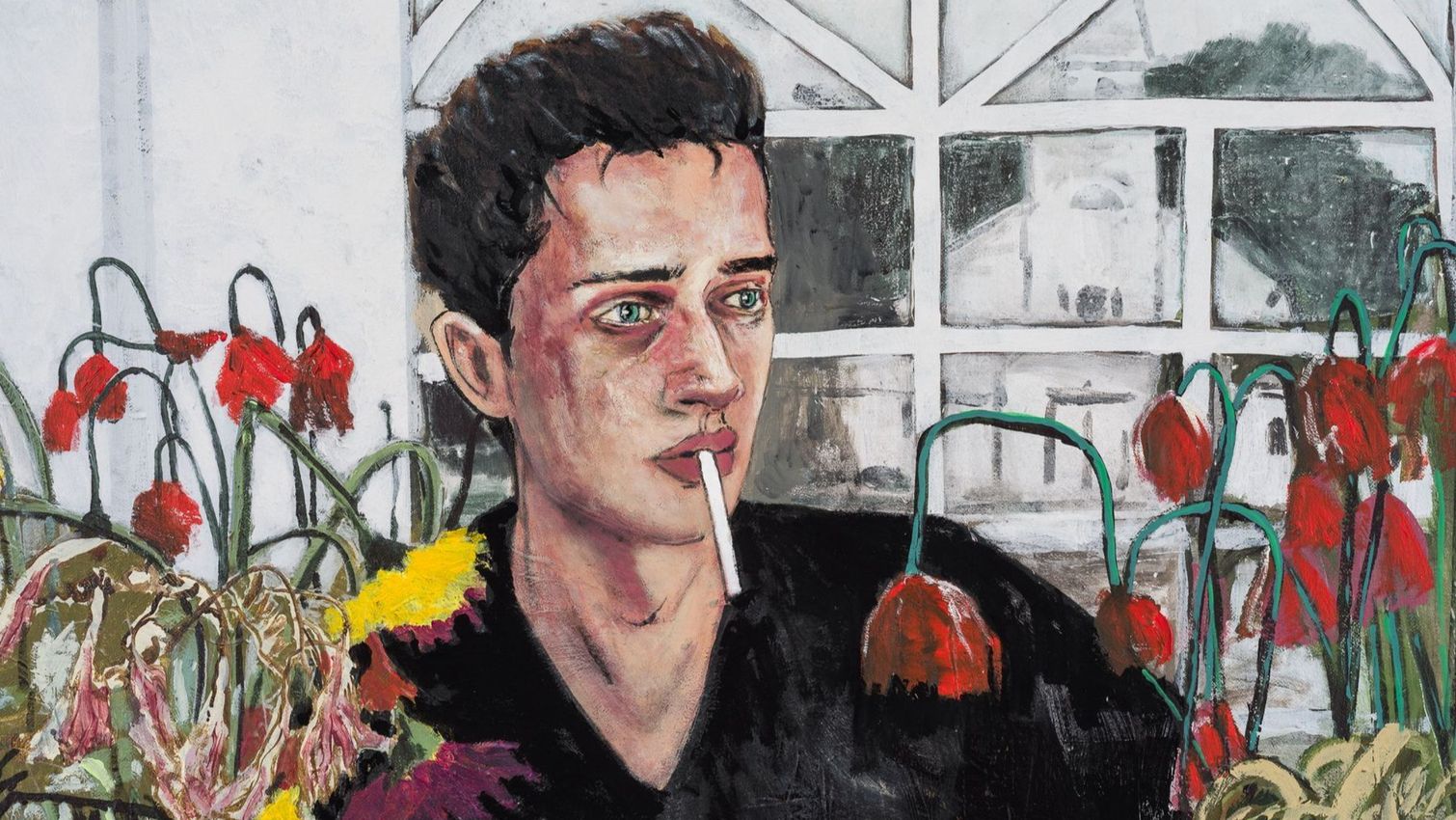
In The prodigal son (farmers market, 3:30 pm), a young man sellingwilted flowers beneath a “Happy Mother’s Day” banner, a figure on thebeach selling shells with a handwritten price list—what is depictedhere is both the merchandise itself and the youth and labour of theperson offering it. A discount sign taped by drooping flowers signals asubtle transposition: the traditional vanitas motif—an allegory oftransience and vanity—is transposed onto the portrait of a livingsubject. The painting depicting a young man in uniform standingbefore an empty stadium belongs to this same continuum. It is unclearwhether he ever reached his moment to shine, instead suspended in amoment that belongs neither to the winner nor the loser.
His meticulous renderings of price tags, wilted petals, and sun-bakedshells emanate a staged quietude, functioning as contemporaryvanitas. Bas’s ongoing struggle to transcend the written word andarrive at a singular, “autonomous” image remains directly tethered tohis primal gesture as a ten-year-old boy: hand-painting storiesborrowed from the library’s occult shelf.
_TIME TO SHINE! _(the salesmen) superimposes capitalist display withpersonal self-presentation, blurring the boundary between seller andsold. Through mundane, commonplace scenes, the series quietly yetincisively confronts universal themes of value, time, and ageing.
— Yuko Hasegawa
Courtesy Perrotin
Hernan Bas’s expressionist and highly detailed figurative paintings are openly inspired by late-nineteenth-century decadent art and literature, as well as the concurrent symbolist and decorative style of the French group Les Nabis. While they are aesthetically grounded in the iconography of the male androgynous dandy, the young protagonists of his oneiric visions are usually portrayed alone or in small groups within descriptions of pure flânerie. Whether confined in the intimacy of a genre scene or lost in the vertigo of a dense, lush, romantic-like landscape, they inhabit a fantasised world of implicit eroticism and ambiguous sensuality. Always appearing as if suspended in time, between adolescence and adulthood, they embody the fragile in-between state that the artist refers to as ‘fag limbo.’ With a flamboyant palette and a refined touch, Hernan Bas overall masterly revisits and reinterprets all the categories of classical painting from a seemingly melancholic yet often humorous and witty, homoerotic perspective.


A respected voice in contemporary art discourse.
Focusing on ambitious storytelling and insightful art-world commentary. Ocula Magazine publishes in-depth interviews, critical essays and timely analysis on the artists, exhibitions and ideas driving the global art world.
Learn more about Ocula Magazine
Showcasing the best of the art world.
Ocula partners with galleries from around the world to highlight their artists, artworks and exhibitions. Gallery membership is by application and invitation, with each member vetted by an independent panel.
Learn more about Ocula Membership

Specialises in the sale of major artworks.
Led by a team with deep ties to the world’s leading auction houses, galleries and collectors. Ocula’s advisory team offers bespoke services to high-net-worth clients from around the world who are looking to acquire the best of contemporary and modern art.
Learn more about our team and services