Press Release

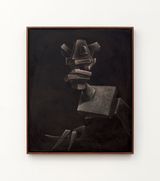
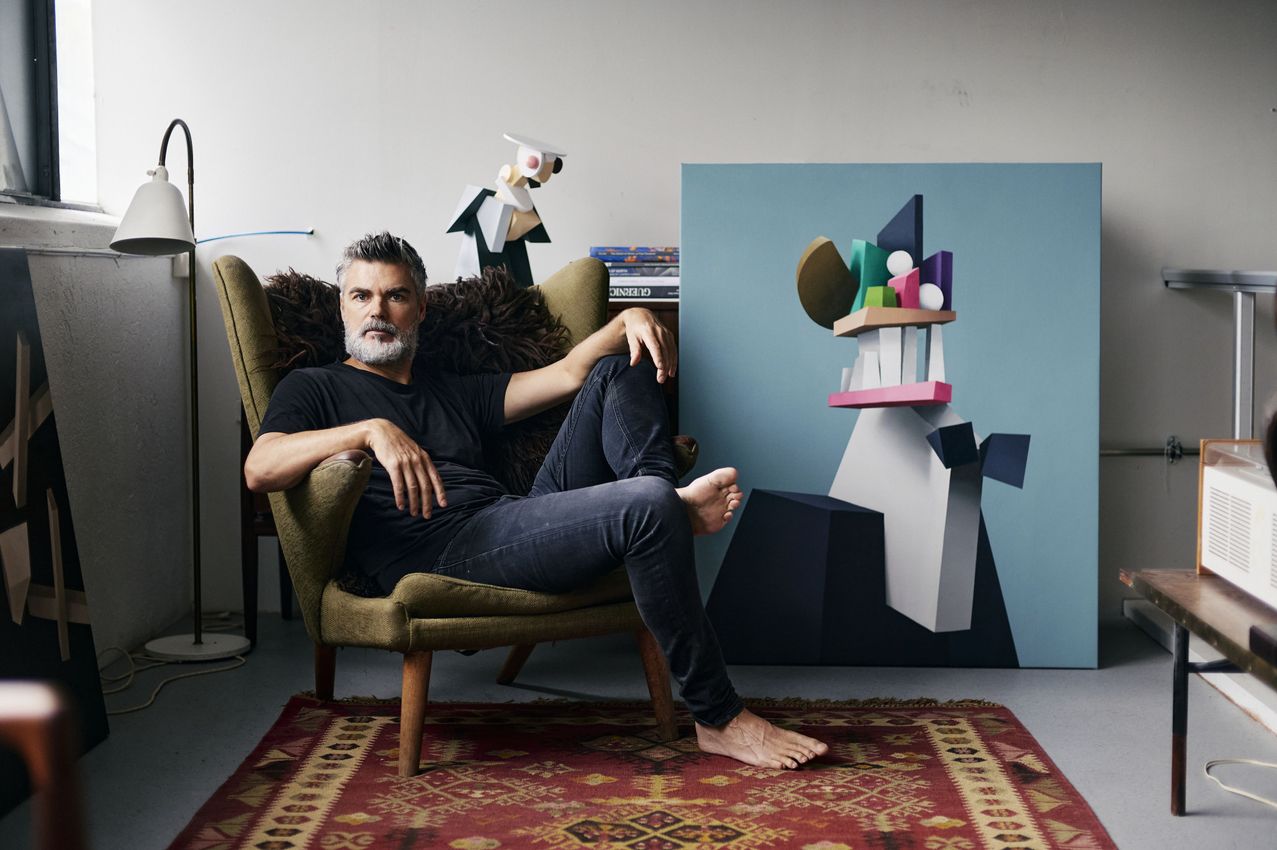
Perrotin Seoul is pleased to present Ghost in the Machine, a solo exhibition by Canadian artist Jason Boyd Kinsella, based in Oslo. At the core of Kinsella’s art is the representation of the human mind and psychology. Drawing on subjective perspectives and the Myers–Briggs Type Indicator (MBTI), the artist explores the nature of the human psyche by breaking down traits and personalities into geometric units, defining individuality through various shapes, colours, and sizes.

The exhibition’s title, ‘Ghosts in the Machine,’ is a phrase coined by British philosopher Gilbert Ryle to describe his critique of mind-body dualism, a theory advocated by French philosopher René Descartes. This theory posits that the body and mind are fundamentally distinct substances and that they can exist independently of each other. Ryle criticised this distinction for failing to account for the interaction between body and mind. Kinsella’s paintings focus on isolating and revealing the unseen self (mind) as an entity separate from physical space (body or material existence). While traditional Western portraiture has aimed to represent the body through external depictions, Kinsella’s works are psychological portraits emphasising the interconnectedness of the mind and body while still distinguishing between them. As the artist puts it, this approach offers ‘a new way of representing the self today.’

The clean surface of his paintings recalls classical art. Kinsella’s paintings incorporate various elements of classical portraiture, such as finely tuned sfumato, compositions that capture the upper half of the human body, and linear perspective, but he also actively borrows from technologies such as digital rendering. Ultimately, his figures, created by blending analog and digital methods, are, like all good portraits, representative of contemporaries and a mirror to the complex and contradictory inner lives of people.

There is a dynamic economy in Jason Boyd Kinsella’s paintings of cubic portraits. Reduction generates a kinetic potential for the sitter whose semblance both cherishes and complicates two pillars of portraiture, the emotional complexity and a visceral likeness. The Oslo-based Canadian traverses art’s innate essence to capture the human physicality through various penchants across time: Pre-historic simplicity of the stick figure, Renaissance era’s grasp of the facial expression for transcendence, and the distorted contemporary abstraction. He builds his case on an interplay between the malleable motifs of existence—bodily as well as cerebral—and a minimised configuration of imperative gestures, particularly the line and the circle.

Stripped to the essential, the oil paintings and sculptures in Ghost in the Machine incorporate the canonised into an openness for pliability. The exchange is indeed codependent. Imagination is unlocked through the aperture of forms that defy a direct representation. A tube could be a neck or a limb—or neither. Two discs resemble eyes but they also exist simply as circular shapes. This vastness of possibilities animates a portrait, broadening the vocabulary of an emotive language within geometry. ‘Today, there are so many ways people can escape from their true selves,’ says Kinsella. ‘It becomes more and more confusing and difficult to ascertain a true likeness of somebody.’ The intricate process of association ushers an intuitive connection between the subject and the viewer—the assemblage of geometric forms suggests a rather felt idea of a portrait as opposed to a deliberate illustration.

The show’s only video work, Self-Portrait (2024), turns Kinsella’s painterly gaze towards himself. Humorous and self-satirising, the two-and-half minutes long film lifts the curtain to the artist’s creative operations and life, carrying the camera into his studio and personal space. Kinsella paints, cleans, plays guitar, and draws at a lingering Scandinavian pace while his mannerism suggests contemplation and search. The emotions however are on the viewer to predict: the artist’s face remains swapped with a portrait a lá Kinsella through the video’s finale. Colourful pyramids, tubes, and discs fill in for his facial features on the surface, as well as constructing, deep down, his own emotional panorama in abstraction.

Kinsella internalises the ritual of encountering a face—or the suggestion of it—through a language that he precisely conducts. Fluent in its vast juxtapositions, a tight grammar of ubiquitous patterns, such as pyramids, globes, crescents and ellipses, arise in his orchestration. He translates his visual and subjective regimen through the Myers-Briggs Type Indicator. He was gifted the infamous World War II-era character analysis book by his mother at age 15—today, the notion of psychometric portraiture explores a complex architecture of optic codes. The kinship between a face and its emotionality is not only determined by chunky blocks and lanky sticks but also through colours that embody at a character. ‘A feeling-based approach,’ the artist describes his attribution of hues to a poser’s layered panorama: ‘Rather than a conscious effort to draw from a palette, I rely on my own candid response to a connection.’

From dating apps to human resource departments, the 16-character personality playbook still inhabits the fringes of daily culture, and it commits to a definitively structured chart. For Kinsella, this sharp network illustrates the interchangeability of personalities in stark compositions. The invitation to decode—both visually and emotionally—energises the exchange with the viewer. Not unlike an Arcimboldo or a Bosch painting, Kinsella’s lexicon prompts the onlooker to process and sift an elaborate build-up, an enigmatic composite of being engineered with a delicate impermanence. The paintings’ titles simply address their subjects with their first names, suggesting an immediate, supple, and penetrable form of identity that is reminiscent of the quirkily allusive form of self-presentation online.

The artist’s richest resource is the bond he concocts with each sitter. Whether with a friend, a family member, or a fellow artist, the essence, according to Kinsella, is to ‘mine the genuine connection with the person to make the work relatable.’ Basing his approach on the Myers-Briggs method provides an outline that is emotional and bizarre, as much as fungible and chronologically cyclical.

Depth is an ally in the artist’s quest in constructing ‘ethereal’ but disarmingly physical portraits. Not only through the paintings but also with sculpture, dimensionality challenges and contributes to a completely analogue process. Perspective tricks the eye by hinting at a digital intervention which remains an illusion. Kinsella is however far less concerned with subverting the line between the cyber and the hand, nor he attempts to thin the optic distinctions between the two. A delicate use of light guides towards a new direction in response to the rapidly-transforming human image. From face-tuning apps to personified avatars, the familiar oddity of a fluid face grasps its embodiment in the thickness of oil paint, a glorious disconnect between the flesh and the spirit. A jagged triangle utters glee or a slouched pentagon, confusion; precarious, fickle, or persistent, all feelings settle on a gentle construction of the self.

Kinsella’s process requires an ongoing relationship with the subject. He begins with a sketch in pencil, followed by incorporation of colour on the computer, before the portrait takes its final form in painting. In Gareth, Kinsella employs a new technique inspired by etchings of Anders Zorn, Albrecht Dürer and Rembrandt, whereby he uses a steel tool to create etchings on black canvas, resulting in a figure that appears to emerge from the darkness. Now the artist’s hand visible through his precise hand drawn lines, gesture, too, leads the way for emotion rather than only colour.

Read More
About the Artist

Jason Boyd Kinsella’s work is concerned with the constituent parts of the human condition.

View Artist Profile

Also Exhibiting at Perrotin

Address
10, Dosan-daero 45-gil
Gangnam-Gu
Seoul
South Korea
Opening Hours
Monday – Saturday
10am – 6pm
(1)
Seoul 10, Dosan-daero 45-gil, Gangnam-Gu
Perrotin
10, Dosan-daero 45-gil, Gangnam-Gu, Seoul, South Korea

Opening hours
Monday – Saturday
10am – 6pm
The art world in focus