Press Release

Perrotin Los Angeles is pleased to present Olympia, a solo exhibition of work by Paul Pfeiffer. The artist returns to Los Angeles following his highly acclaimed retrospective at the Museum of Contemporary Art, Los Angeles, with a new body of work that puts the City of Angels squarely in the crosshairs of his canny examination of media, spectacle, architecture, and the body.

On the occasion of Paul Pfeiffer’s solo exhibition, Olympia, join us for a conversation with artist Paul Pfeiffer and Britt Salvesen, Curator and Department Head at LACMA, as they discuss the spectacle of sport and the upcoming LA Olympics.

The Situationist thinker Guy Debord once famously wrote that “the spectacle is not a collection of images, but a social relation among people, mediated by images.” 1. It’s a lot to absorb, although it sounds like an apt, if perhaps too gentle, description of the current world that we’re living in. Put more simply, Debord’s concern was with the manner in which post-war capitalism had over-inundated the world not simply with consumer products but with a deluge of images through advertising and an explosion of transmitting media. For him, writing in 1967 on the cusp of the social uprisings in Paris, this profusion of images constituted a new theatre of political contestation.

For the better part of the last three decades Paul Pfeiffer has undertaken a continuous exploration of the long tail of Debord’s spectacle but with a twist. From his earliest video investigations into the spectacular emanations of televised sporting events in works such as Long Count (Thrilla in Manilla), 2001, where the artist erased the bodies of Muhammad Ali and Joe Frazier only to leave a ghostly pas de deux for the camera to follow, Pfeiffer has analytically pursued a deep fascination with both the social mechanisms of viewing and, more importantly, the relationship between our own viewing bodies and the bodies that we view. As Debord’s countryman Maurice Merleau-Ponty wrote in 1945, “The body is our general medium for having a world.” 2 In the work of Paul Pfeiffer, we see the convergence of Debord’s analysis of the spectacle with Merleau-Ponty’s concern with embodiment. In Pfeiffer’s estimation, all viewing, spectacular or otherwise, is an embodied form of worldbuilding.

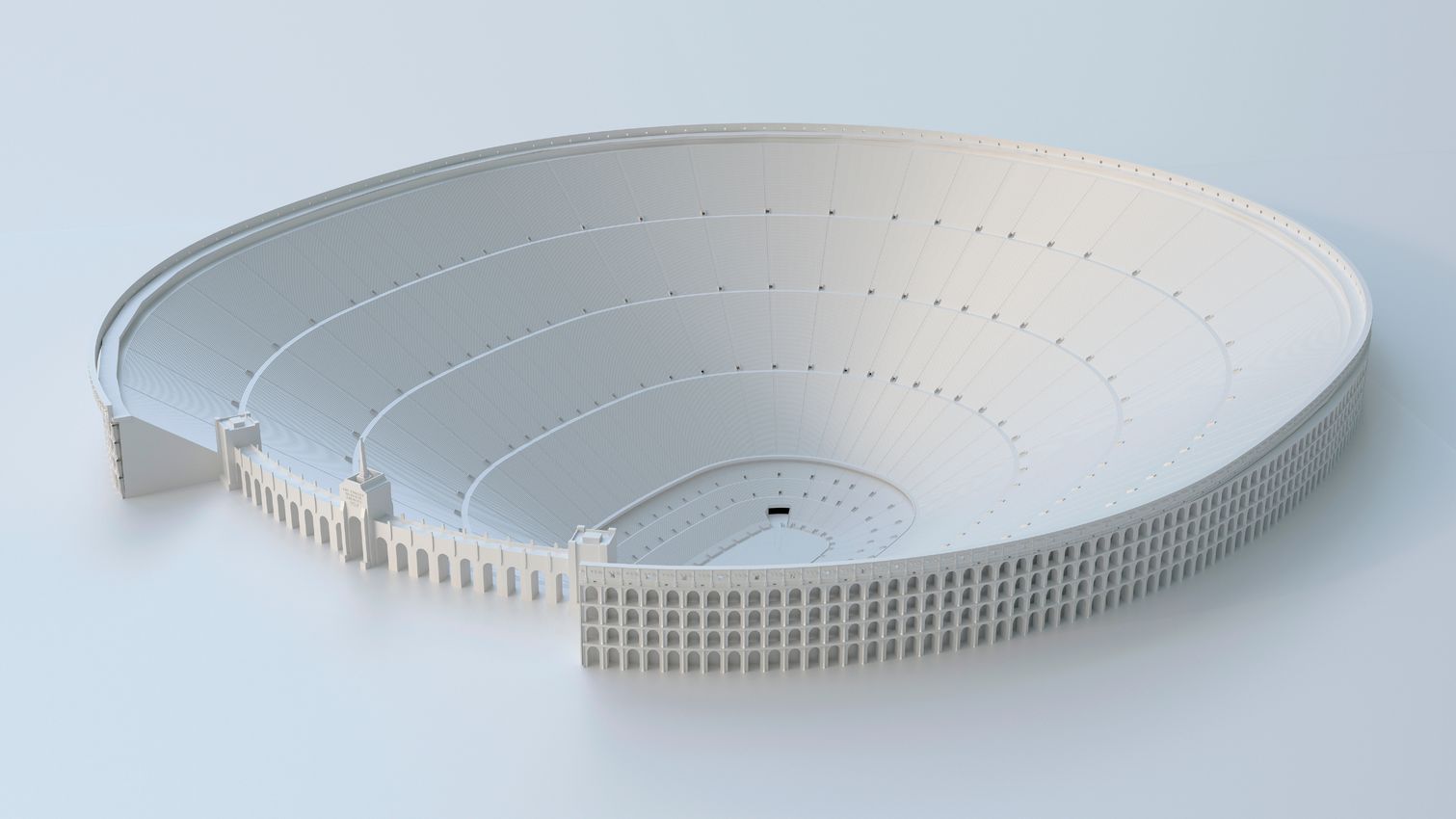
Pfeiffer has long been attuned to the architecture of viewing and how structures such as sports stadiums overtly direct a very particular kind of embodied sight. In the wake of his acclaimed 2023–24 survey at the Museum of Contemporary Art, Los Angeles, the artist returns to LA as the city prepares for the upcoming 2028 Summer Olympics. In his new exhibition Olympia at Perrotin Los Angeles, Pfeiffer has expanded the idea behind his 2008 sculptural work Vitruvian Figure, a large-scale maquette of a phantasmatic 1,000,000-seat stadium, by proposing a similar exponential blow-up of an iconic local sports venue: the L.A. Memorial Coliseum, built in 1923. The resulting project, Vitruvian Figure (Olympia), seen here in a series of architectural renderings, explores the way in which architecture embodies the spectacle as well as the way that our bodies inhabit that built environment. The L.A. Memorial Coliseum was explicitly modelled after the original Roman Colosseum built by the Flavian dynasty between 70 and 80 AD and even features a block of granite from the original structure that was gifted by the Italian government to Los Angeles in 1949. As a site of social entertainment, the Roman Colosseum was a structure that directed visitors’ sight to its stadium floor, which hosted free public games and spectacular gladiator exhibitions, exotic animal hunts, and theatrical recreations of great battles. All of this was provided for a viewing public that was hierarchically divided architecturally by social class. In many ways we can think of the Roman Colosseum as the birthplace of the society of the spectacle and the ancestor of the rapidly evolving digital attention economy that we now inhabit.

Having hosted the 1932 Summer Olympiad in a quaint era where media was dominated by newsreel footage, the L.A. Memorial Coliseum will become the site of the 2028 Olympics alongside other venues such as the recently-built SoFi Stadium, a contemporary hi-tech structure whose main feature consists of a massive, ovular, double-sided 4K HDR video screen that channels images and text to every seat in the house without regard to the cost of the seat. With a televised and streamed global spectatorship of an estimated five billion people, the upcoming Olympic Games will inescapably intertwine event and broadcast in what Debord might think of as an apotheosis of the society of the spectacle. Considering the architectural legacy of spectacular viewing through the lens of the L.A. Memorial Coliseum’s connection to the past (the birthplace of spectacular architecture in Rome’s Colosseum) and the future (new hi-tech structures such as SoFi Stadium), Pfeiffer’s impossibly immense 1,000,000-seat structure poetically questions the emergence of a tentacular digital attention economy to which we are all subject. Are we watching the action on the field or the replay on an immersive screen? Are we living in the moment and experiencing a game, or are we live streaming ourselves, the crowd, and the event over a social media app on our phones? In this mise-en-abyme of attention, narcissism, and hyper-media we are at once spectators, consumers and subjects. This is the feedback loop that Pfeiffer is attempting to shortcircuit as he asks his own viewers to consider both the absurdity and the power of our new world order of techno-architectural spectatorship.

Alongside Pfeiffer’s architectural explorations of the spectacle, the artist has long been fascinated with the visual economy of celebrity and its global circulation of images. As a corollary to Vitruvian Figure (Olympia), the artist will also exhibit the newest installment of his ongoing Incarnator series (2018–), a multi-part wooden sculpture of bodily fragments based on historical icons of the body of Christ. Made in collaboration with traditional woodcarving artisans from the Seville region of Spain known for their production of religious icons, Pfeiffer asked these artists to create a Christ-like sculptural interpretation of the tattooed body of the born-again Christian pop singer Justin Bieber. Fragmented into pieces—arms, torso, legs, and head—Pfeiffer creates another version of a Vitruvian figure (Leonardo da Vinci’s iconic drawing of the human body within a circle and a square exhibiting the Roman architect Vitruvius’s ideal proportions) with a religious bent. In the case of Incarnator, the body of Bieber takes on the character of a Christian reliquary, a wooden incarnation of the pop star whose career began as a child posting what became viral YouTube videos. In choosing Justin Bieber as a model, Pfeiffer has directed his focus on a celebrity born of the era of social media whose personal and career path has been entwined with, or rather incarnated by, the viral hyper-circulation of images in the era of social media. In light of Bieber’s scaled-down, yet massively viewed, recent performances at both Coachella, in which the singer performed in front of his early social media clips, and the halftime ceremonies of the 2026 FIFA World Cup final in which he sang “Unplugged” with an acoustic guitar in a performance seen by over two billion people, Pfeiffer’s Incarnator effigy asks us to consider whether there can be such a thing as embodied authenticity in the era of AI and social media. Both Pfeiffer’s Vitruvian Figure (Olympia) and the Incarnator series provide us with a roadmap to both the history of the spectacle as it originated in Roman architecture and the circulation of Christian icons, while also asking us to consider the ethical and societal implications of the new hyper-mediated world of digital social media and artificial intelligence. In a historical moment where the spectacle has seemingly reached its transformative tentacles into every corner of existence, can the body that Merleau-Ponty posited as the “general medium for having a world” survive and resist? This is the existential quandary that Paul Pfeiffer asks us to consider.

–Douglas Fogle

Endnotes 1 Guy Debord, The Society of the Spectacle, trans. Fredy Perlman (Detroit: Black & Red, 1983; originally published 1967), Thesis 4.

2 Maurice Merleau-Ponty, Phenomenology of Perception, trans. Donald A. Landes (London: Routledge, 2012; originally published 1945), 147.

Read More
About the Artist

Paul Pfeiffer recasts the visual language of pop spectacle to investigate how media images shape our perception of the world and ourselves. Working in video, photography, sculpture and sound, he is drawn to moments intended for mass audiences (live sports events, stadium concert tours, televised game shows, celebrity glamour shots), which he meticulously samples and re-edits to expose an uncanny emptiness underneath. From the hyperreality of photo retouching and digital erasure to the endless repetition of video loops, his mastery of post-production allows him to magnify the surreal aspects of contemporary existence where bodies become sites of saturated observation, and violence-as-entertainment flirts with nationalism, religion and ancient myth. While he also experiments with the format and scale of his works, immersive audiovisual installations often cohabit with portable fetish objects in his exhibitions. Throughout his practice, Paul Pfeiffer means to reflect and heighten the existential condition of the viewer as consumer by perversely blurring the boundary between voyeurism and contemplation.

View Artist Profile

Also Exhibiting at Perrotin

About the Gallery

Emmanuel Perrotin founded his first gallery in 1989 at the age of 21. He has opened since then over 17 different spaces, with the aim of continuing to offer increasingly vibrant and creative environments to experience artists work. He has worked closely with his roster of artists, some since more than 25 years, to help fulfil their ambitious dreams and projects.

View Gallery Profile
Address
76 rue de Turenne
Paris
France
Opening Hours
Tuesday – Saturday
10am – 6pm
(1)
Paris 76 rue de Turenne
Perrotin
76 rue de Turenne, Paris, France
+33 1 42 16 79 79
http://www.perrotin.com

Opening hours
Tuesday – Saturday
10am – 6pm
The art world in focus