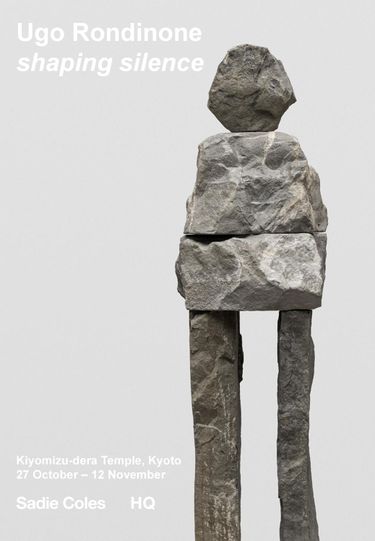
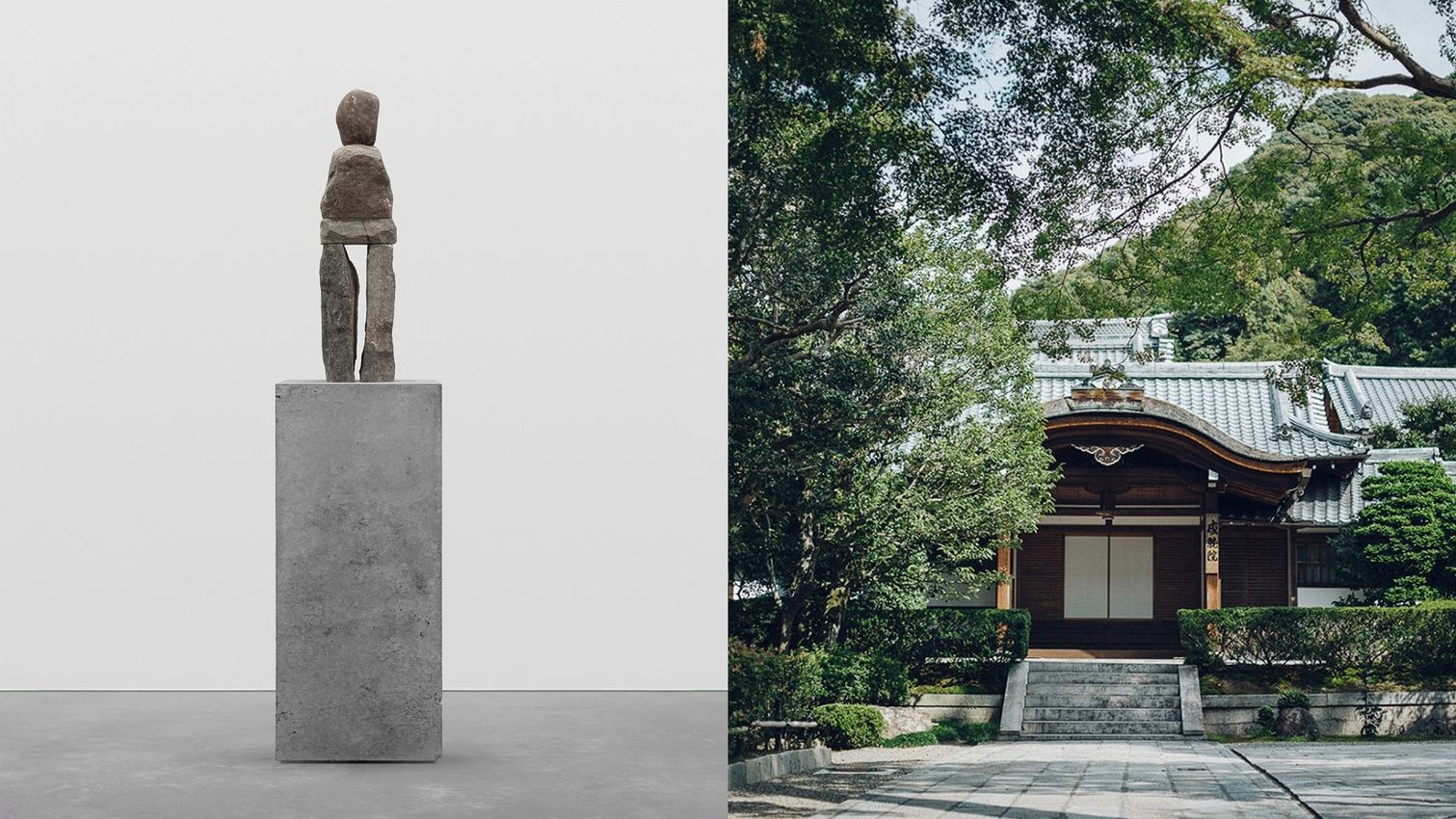
Throughout his career, Ugo Rondinone has approached nature not simply as landscape, but as a psychic and spiritual condition—a space through which to contemplate the body, consciousness and our place within the vastness of space and time. For a new off-site project by Sadie Coles HQ and the artist’s first solo exhibition in Japan, seventeen stone figure sculptures, a sun painting, and a single totemic monk sculpture will be installed at Kiyomizu-dera Temple in Kyoto, one of the most celebrated and historic Buddhist places of worship in the country.
Rough-hewn from bluestone, the stone figures draw upon archaic forms, ancient cairns and the enduring human impulse to gather, balance and stack stone. Their elemental silhouettes evoke the inuksuk structures of Arctic Indigenous cultures, while also carrying a deeply personal resonance for Rondinone: his father was a stonemason. Installed in Jōju-in, or ‘Moon Garden Temple’, the sculptures bring the language of contemporary art into contact with an ancient spiritual landscape. Modernist forms appear to emerge from, rather than interrupt, their surroundings, creating a quiet conversation between different times and traditions.
Installed in direct response to the temple’s architecture and the contemplative atmosphere of its garden, the figures vary in scale, their elemental forms lending them an almost primordial presence. They appear at once as timeless deities, navigational markers and monumental forms. Their silent, grounded presence establishes a dialogue between the human body and the landscape, between permanence and impermanence, and between geological time and the fleeting duration of human life. This sense of elemental symbolism is also present in examples of Rondinone’s ongoing Sun and Monk series, in which recurring images of the sun and the meditative, anonymous figures serve as vehicles for contemplation and transcendence.
At Kiyomizu-dera, where centuries of ritual, architecture and landscape are closely intertwined, the exhibition encourages a slower way of looking, inviting reflection on how we inhabit the natural world and how our bodies, like the stones themselves, are shaped by forces that extend far beyond the limits of an individual life.
I feel deeply fortunate that my first exhibition in Japan takes place at Kiyomizu-dera, a place where nature, architecture, and spiritual life have coexisted for centuries. I cannot imagine a more meaningful setting for the first presence of my work in Japan. shaping silence, brings together three elemental archetypes: the monk, the human figure, and the sun. Each embodies a different relationship between the physical world and our inner lives, between what we see and what we experience beyond sight.
At the foot of Sai-mon, the temple’s historic West Gate, a blue-white monk bronze sculpture stands beside the bronze sculpture of Seiryū, the Blue Dragon. According to the temple’s tradition, Seiryū is an incarnation of Kannon, the bodhisattva of compassion, a guardian spirit associated with water and protection.
The blue white monk, possesses a monumental yet vulnerable presence. Its irregular white body, surmounted by a blue head, suggests a solitary figure wrapped in a robe. The rough mineral surface gives it the appearance of something shaped by nature rather than by human hands. Standing beside the dragon, the two sculptures establish a quiet encounter between different histories and forms of spiritual presence. The dragon embodies movement, protection, and transformation; the monk embodies stillness, contemplation, and inwardness. Their dialogue is not one of opposition but of coexistence, suggesting that the spiritual can manifest itself through both movement and immobility.
In another part of the temple complex, seventeen figures inhabit the intimate interiors of Jōju-in, a historic sub-temple overlooking its celebrated Moon Garden. The garden, with its carefully composed stones, moss, water, and borrowed mountain landscape, offers a setting in which the natural world becomes an object of sustained contemplation. The seventeen figures belong to an ongoing exploration of the relationship between the human body and the mineral world. Within Jōju-in, the seventeen figures become a silent community. Their presence echoes the garden beyond, where stones, moss, and vegetation exist in a continuous relationship of growth, erosion, and transformation.
A single red, red and black sun painting occupies a traditional tokonoma alcove. Its concentric fields of color radiate from a dark center, creating a sensation of light that simultaneously expands and withdraws. The painting holds movement within stillness, suggesting the continuous passage of time through the eternal cycle of light and darkness. The sun painting introduces another dimension to the dialogue between the body and the natural world. While the figures embody the slow duration of geological time, the sun evokes the cyclical time of days, seasons, and human existence. One is grounded in matter; the other exists as pure radiance. Yet both share an essential stillness.
Together, the three archetypes; the monk, the stone body, and the sun, inhabit a landscape shaped by moss, wood, water, and light. They do not seek to impose themselves upon the temple, but to enter into a relationship with its architecture, its spiritual history, and the natural world surrounding it.
shaping silence is a meditation on being, on the body as a vessel of time, and on stillness as a form of presence. It proposes a contemplative space in which the boundaries between the external landscape and our internal world begin to dissolve and the body becomes landscape, the mineral becomes spirit, and silence becomes a way of seeing.
ugo rondinone, October 2026
Courtesy Sadie Coles HQ.
Ugo Rondinone (Swiss, b. 1964) lives and works in New York. He has long embraced a fluid range of forms and media. As a whole, his work constitutes a complex network of responses to social and physical structures. By allowing himself such formal and thematic freedom, Rondinone creates the conditions for an expansive emotional range. His work has become recognised for its ability to channel both psychological expressiveness and profound insight in the human condition and the relationship between human being and nature. Recent solo exhibitions include naturaleza humana, Museo Anahuacalli, Coyoacan, Mexico, 2014; thank you silence, M Museum, Leuven, Belgium, 2013; we run through a desert on burning feet, all of us are glowing our faces look twisted, Art Institute of Chicago, 2013; human nature, Public Art Fund, Rockefeller Plaza, New York, 2013; primitive, Common Guild, Glasgow, 2012; nude, Museum of Cycladic Art, Athens, 2012; and The Night of Lead (Die Nacht aus Blei), Aargauer Kunsthaus, Aarau, Switzerland, 2010. This October, Rondinone’s exhibition I ♥ John Giorno opens at Palais de Tokyo, Paris; forthcoming solo exhibitions in 2016 include Vocabulary of Solitude, Boijmans van Beuningen, Rotterdam; Becoming Soil, Carré d’Art, Nimes; and Present Tense, Museo d’Arte Contemporanea, Rome. In early 2016, his public outdoor installation, Seven Magic Mountains, will open in the Nevada desert, co-produced by New York’s Art Production Fund and Nevada Museum of Art, Reno (NE).


Founded in London in 1997 by Sadie Coles, Sadie Coles HQ is a contemporary art gallery that presents the work of over fifty established and emerging international artists.

A respected voice in contemporary art discourse.
Focusing on ambitious storytelling and insightful art-world commentary. Ocula Magazine publishes in-depth interviews, critical essays and timely analysis on the artists, exhibitions and ideas driving the global art world.
Learn more about Ocula Magazine
Showcasing the best of the art world.
Ocula partners with galleries from around the world to highlight their artists, artworks and exhibitions. Gallery membership is by application and invitation, with each member vetted by an independent panel.
Learn more about Ocula Membership

Specialises in the sale of major artworks.
Led by a team with deep ties to the world’s leading auction houses, galleries and collectors. Ocula’s advisory team offers bespoke services to high-net-worth clients from around the world who are looking to acquire the best of contemporary and modern art.
Learn more about our team and services