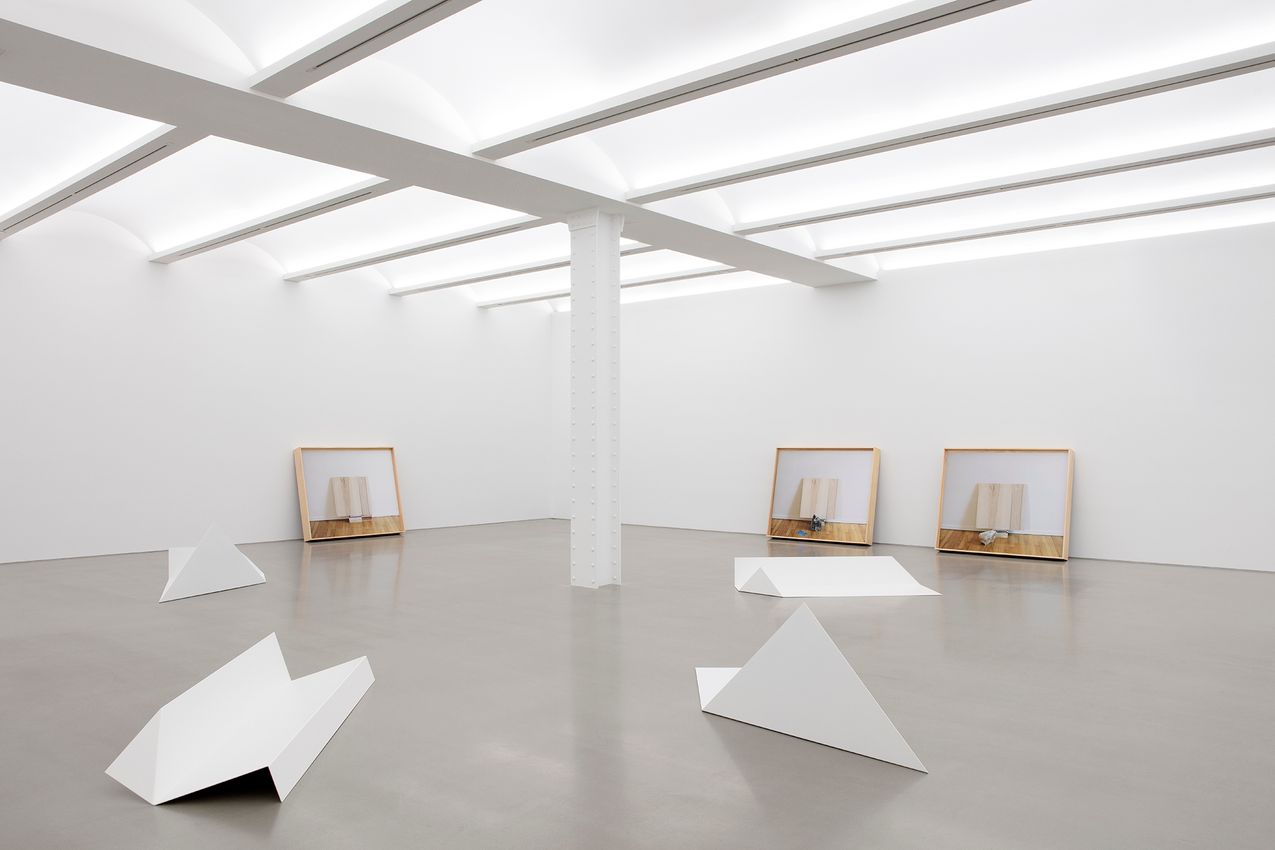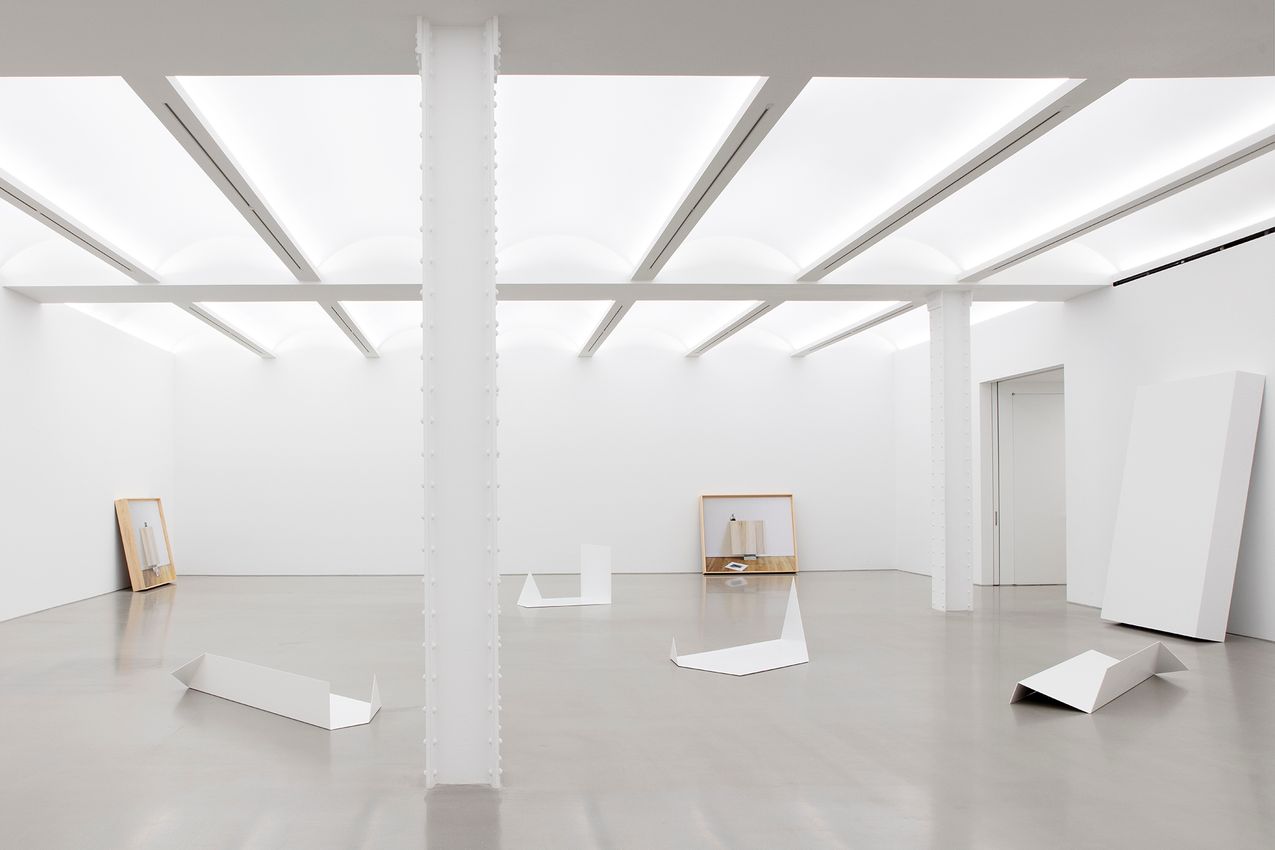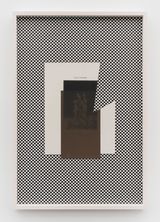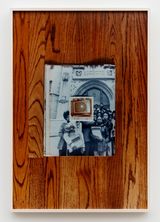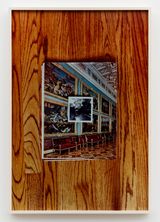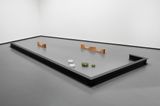
Perrotin New York is pleased to present Reading Room, a solo exhibition by New York-based artist Leslie Hewitt, opening September 11 and on view through October 26, 2019. For this exhibition, Hewitt introduces new bodies of work, including a series of photo-sculptures, wall interventions and steel objects, as well as a conceptual reframing of the gallery’s adjacent bookstore.
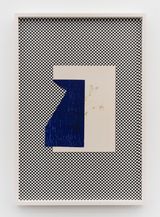
The exhibition’s title Reading Room is a nod to one of the central theses of Hewitt’s practice, which works to disrupt and complicate entrenched readings of images and art objects as fixed or static, exposing a web or at times a knot of overlapping interpretations. For more than fifteen years, Hewitt has explored the relationship between image, text and object, but also the influence of repetition, meter and perspective as an extension of photography’s aesthetic power. Hewitt composes simple shifts and rearrangements by introducing or removing media, textures or geometries within a single frame, imbuing the overall series with a cadence and unique grammar. Her application of these principals often creates an ambiguity that destabilizes engrained forms. This rupture or betweenness is where Hewitt builds an open and discursive space to collectively grapple with questions of erasure, poetry, post-memory, temporality and technology.
In 2007, Hewitt began working with the form of Vanitas (still life) while studying this particular genre of 16th and 17th century painting at the Rijksmuseum Research Library in Amsterdam. For the Reading Room exhibition, Hewitt found herself immersed in the local and global vantage points found in the work of Arturo Schomburg (1874–1938) and Lewis Michaux (1932–1976). Her exploration into their relationship with the abstract idea of diaspora, the physicality of books and the cosmopolitan spaces each built, influenced and inspired the tone of her current exhibition.
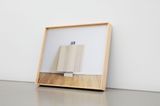
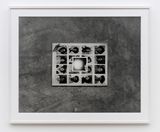
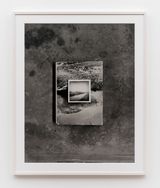
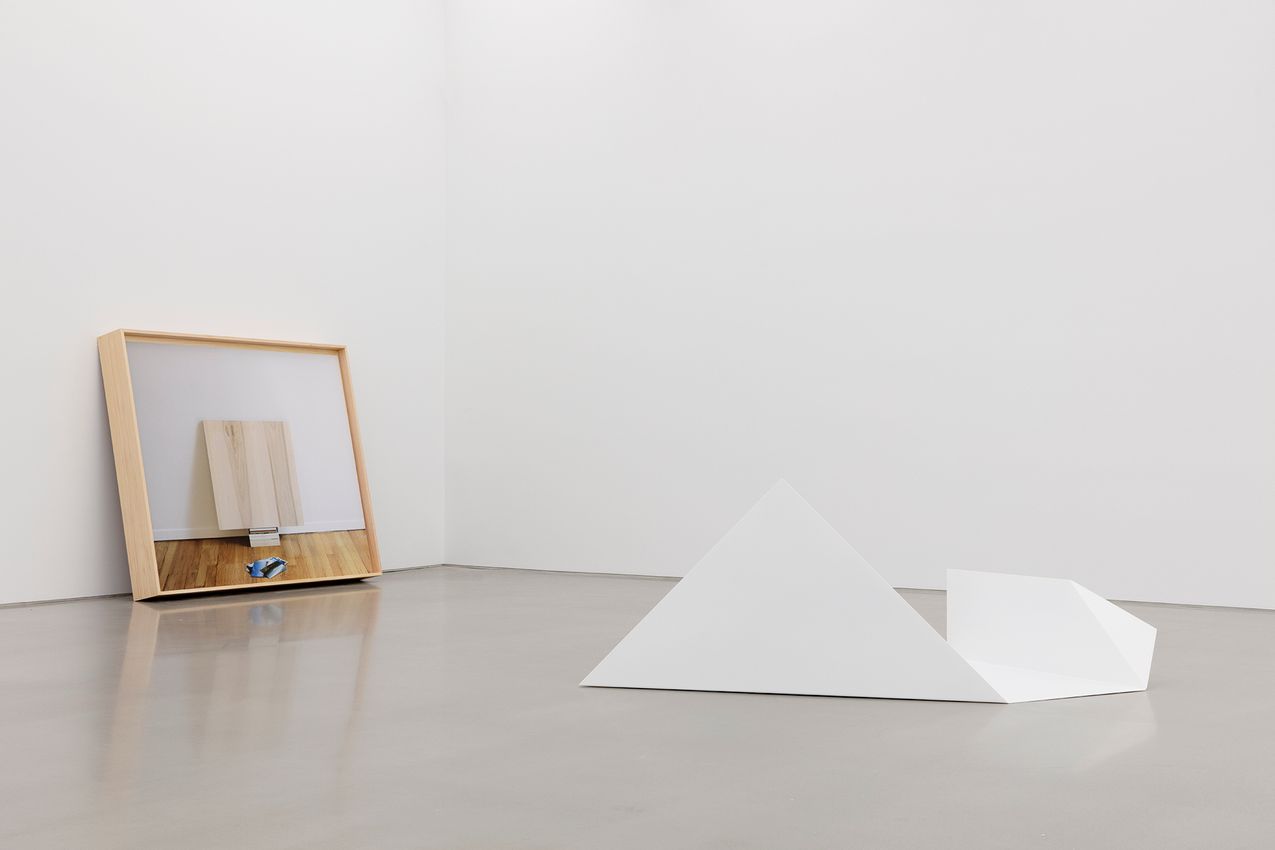
As part of her ongoing still life series, Hewitt will present a new set of photo-sculptures (photographs that rest in custom built wooden frames and lean against the wall), titled Spiral and Loop. Set in her studio and shot with a fixed camera angle in natural light conditions, each composition is punctuated by a variety of objects such as personal and found snapshots depicting everyday life, paper with abstract drawings by hand, a series of books, as well as a succession of raw materials such as wood, glass, metal, stone and shells. Her selection of books and materials are compressed within a liminal space and subjected to a chorographed geometry and the impression of her hand. Decentered and repositioned within the ‘democratized’ space the camera produces, each work is a quiet and subtle unfolding of compositional phrases: figuratively and concretely.
Juxtaposed to the leaning photographs, Hewitt introduces a new series of five steel sculptures. Industrially fabricated, the sheets of metal have been folded at 90 degree angles at various points of the same plane. These post-minimalist objects are placed in a scattered position across the gallery floor. Hewitt’s geometric forms mirror navigation, perspective and orientation within a built environment. Similarly, two site specific installations confirm her understanding of the importance of spatial awareness. These wall-like structures, through their dimensions, respond to the doors and windows of the first floor, adapting themselves to the architecture of the space.
Reading Room continues into Perrotin’s Lower East Side bookstore by repurposing its function and introducing a platform for a series of conversations. Hewitt has positioned a curated bibliography of titles significant to her practice as well as two other interventions: a single Riffs on Real Time photograph (which portrays the interior of Harlem’s landmark ‘National Memorial African Bookstore’) and a text-based html programmed video, exploring the intersection of concrete poetry and what Arjun Appadurai would call a technoscape. Throughout the duration of the exhibition, Hewitt will invite friends, colleagues, and thought partners to activate the space in a series of semi-public gestures in response to the notion of a collective archiving with curator/writer Omar Berrada, DJ/collagist Ayana Contreras, historian/writer Sharifa Rhodes Pitts, cinematographer Bradford Young, and musician Tariq Trotter/Black Thought.
Leslie Hewitt has held solo exhibitions at the Sculpture Center, New York; the Power Plant, Toronto, Canada; the Minneapolis Institute of Art; The Menil Collection, Houston; Contemporary Art Museum St. Louis; and the Institute of Contemporary Art/Boston, among others. She is the recipient of numerous awards and grants, including the Berlin Prize, the Joyce Alexander Wein Artist Prize, and was a Radcliffe Fellow for Advanced Studies at Harvard University. Hewitt’s work is in numerous public collections including the Museum of Modern Art, New York; the Solomon R. Guggenheim Museum, New York; the Whitney Museum of American Art, New York; the Los Angeles County Museum of Art, Los Angeles; the San Francisco Museum of Modern Art, San Francisco; The Walker Art Center, Minneapolis; and the Museum of Contemporary Art, Chicago; among others.
Working with photography, sculpture, and site-specific installations, Leslie Hewitt addresses fluid notions of time. Her work oscillates between the illusionary potential of photography and the physical weight of sculpture. In her photographed arrangements, she isolates personal effects and the residue of material culture to consider the fragile nature of everyday life. Her approach to photography and sculpture revisits the still life genre from a post-minimalist/civil-rights perspective. Her geometric compositions, which she frames and crystallizes through the spare assemblage of ordinary things, suggests the porosity between intimate and sociopolitical lives. Whether discreetly arranged in conceptually entangled layers or presented plainly, Hewitt often includes or is inspired by mementos such as family pictures, as well as books and vintage magazines that reference the Black literary and popular-cultures of her upbringing. Her practice as an artist points to the mechanisms of the construction of meaning and memory through decisively challenging both by unfolding formal, rather than didactic, connections in her contrapuntal compositions and distinctive take on spatiality.
Emmanuel Perrotin founded his first gallery in 1989 at the age of 21. He has opened since then over 17 different spaces, with the aim of continuing to offer increasingly vibrant and creative environments to experience artists work. He has worked closely with his roster of artists, some since more than 25 years, to help fulfil their ambitious dreams and projects.

A respected voice in contemporary art discourse.
Focusing on ambitious storytelling and insightful art-world commentary. Ocula Magazine publishes in-depth interviews, critical essays and timely analysis on the artists, exhibitions and ideas driving the global art world.
Learn more about Ocula Magazine
Showcasing the best of the art world.
Ocula partners with galleries from around the world to highlight their artists, artworks and exhibitions. Gallery membership is by application and invitation, with each member vetted by an independent panel.
Learn more about Ocula Membership

Specialises in the sale of major artworks.
Led by a team with deep ties to the world’s leading auction houses, galleries and collectors. Ocula’s advisory team offers bespoke services to high-net-worth clients from around the world who are looking to acquire the best of contemporary and modern art.
Learn more about our team and services