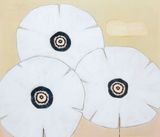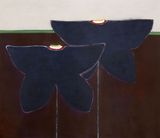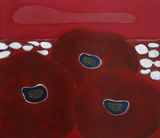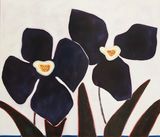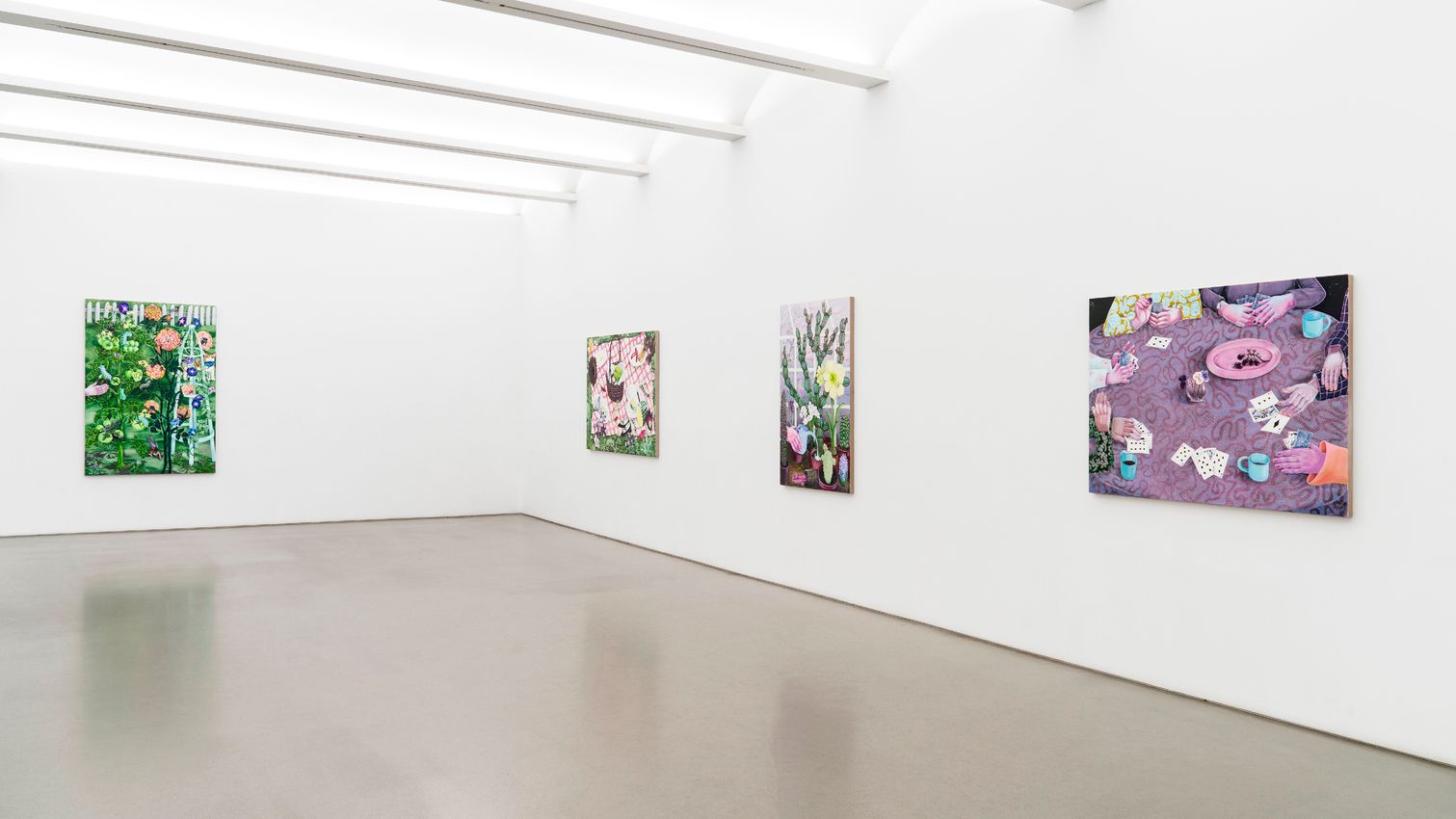
In Susumu Kamijo’s latest exhibition, Table for Us at Perrotin Hong Kong, the artist steps sideways into the realm of still life, only to transform the genre with a sleight of hand that feels at once candid and elusive. Known for his playful, abstract paintings of poodles and other sentient forms, Kamijo here shifts gears into a more intimate space, where florals and creatures coalesce in arrangements that hover between fantasy and familiarity. What appears to be a traditional still life at first blush—Morandi-esque vases, plates of food, large goldfish with petal-like fins bulging in their bowls—quickly dissolves into riddles of texture and composition, pulsating with a strange vitality, even a glint of poison in Summer Blossoms (2024).
It’s as if Kamijo is constructing scenes not from life around us, but from a place of suggestion, memory, and half-glimpsed reverie. Each piece becomes a chimera: an assemblage of everyday objects and animals that evoke a distant world. On a table beside a bird, feathery petals in the painting Red Flower and Pigeon (2024) spread their wings, reaching the eye into the negative space above. Kamijo’s previous devotion to the poodle now feels incidental; the animal itself served less as a focus than as a gateway for his experiments in form, colour, and design. That impulse spills over into the new work, reaching further to touch a more personal nerve. Behind these seemingly quotidian markers lies a fierce fidelity to composition as well as a longing for some summer idyll—a space where childhood remembrances mingle freely with the brine of the ocean and the heat of languorous afternoons.
Kamijo, in fact, grew up far from the warmth of the coast, in the mountainous region of Nagano, a landlocked enclave in Japan. His paintings bear no explicit landmarks, yet the flat horizon, contrasting with the rugged backdrop of his childhood, and the recurring sailor’s cap quietly hint at a deep-seated longing for the sea, a yearning that ripples through his work as persistently as it did through his early years.
The still lifes are steeped in nostalgia, conjuring summers spent with his grandparents, the taste of watermelon, and the fleeting joys of festival nights. The red and blue goldfish swimming in bowls nod to kingyo sukui, the beloved summer game of goldfish scooping, where children raced against the fragility of paper nets in hope of taking a fish home. These memories, as gossamer-thin as the nets themselves, linger beneath the surface, shaping Kamijo’s dreamlike arrangements.
In his application of colour, Kamijo alludes to the colour-field painters and the amorphous textures of Philip Guston. Broad arenas of blue, orange, and green acquire unexpected depth beneath a gauzy topcoat. At times, his stone-washed flower vases smoulder with a sensuous intensity, as seen in the densely packed bloomscape of Summer Blossoms (2024). Despite the simple forms and the more uniform palette of past works, Kamijo’s brilliance as a colourist shines throughout Table for Us. In Three Fishes and Cosmos (2024), he conjures an elusive hue for the placemat and vase, reminiscent of Van Gogh’s mineral-infused green.
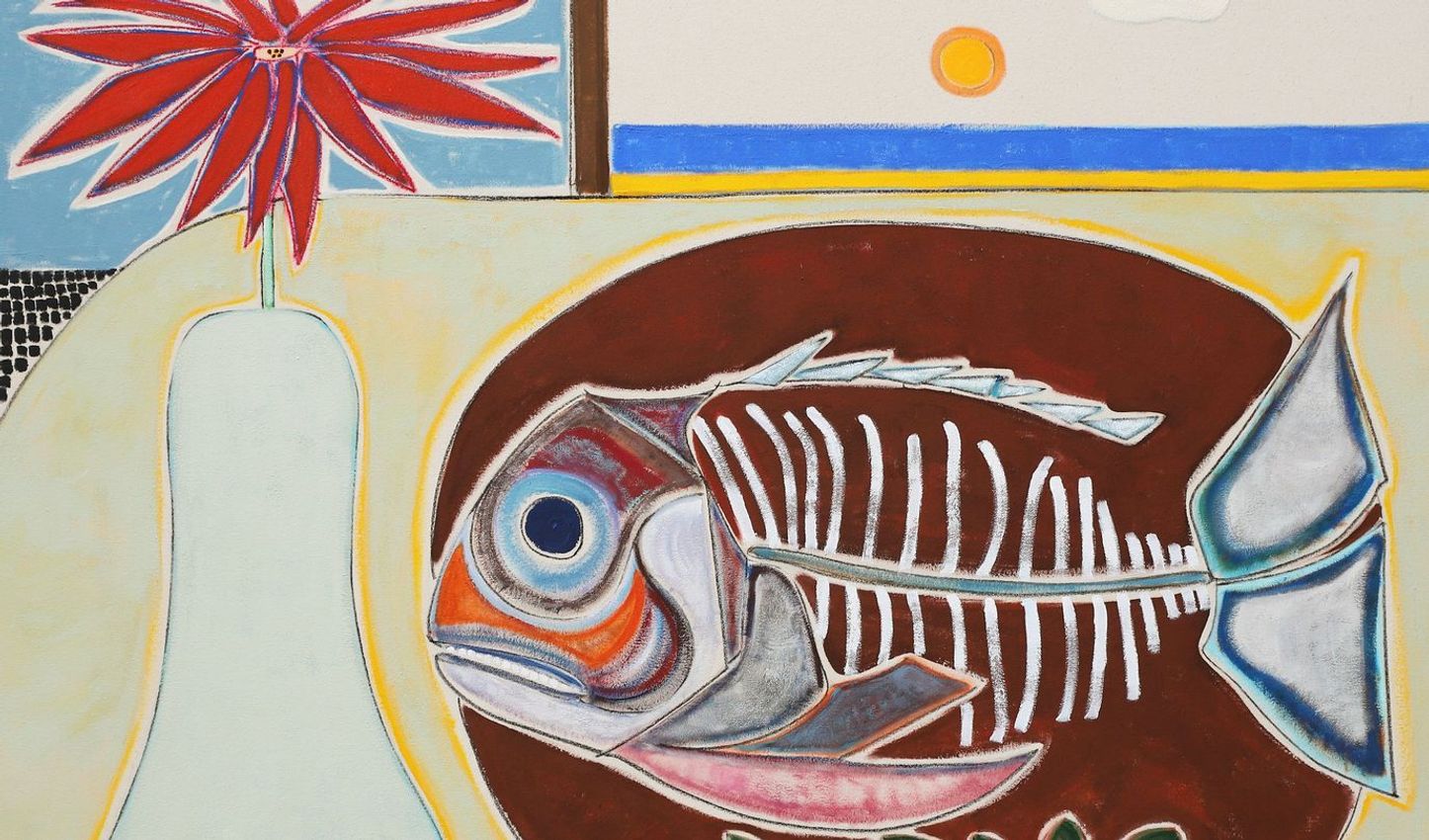
Three Fishes and Cosmos (2024) also delves into a theme threaded throughout the exhibition and the still life tradition: mortality and domesticity. The fish, their vividly coloured heads stark against exposed skeletons, volley between the delectable and the disconcerting—vibrant yet lifeless. Does stilling life in paint extinguish its wilderness?
The paintings on view at Perrotin Hong Kong draw the viewer in further: What do the containers that trace and hold each flower, fish, and meal signify? Are these haloed hard edges armour, portals, or prisons? There’s a sense of packaging in Kamijo’s work, as though each element were embalmed in a delicate protective film, suspended just before the point of decay. Echoing Matisse’s decorative cut-out strategies, the utensils are plotted out, almost plastic-wrapped, as separate entities, while the persimmons and pears look like fruit stickers. Each form is carefully outlined, its matte yet painterly tones crisply delineated, as if to hold the objects at a distance. Kamijo’s characteristic sharpness is also grounded in the aesthetic idiom of old Japanese masters such as Itō Jakuchū and Kiyokata Kaburagi. The contained patches of colour resemble Jakuchū‘s mid-Edo woodblock prints, where swallows and parrots are backlit in a red or white outline.
While Kamijo’s paintings assert cultural references and geography, time remains abstract and garbled. The sun could be setting or rising on the horizon line; objects could be contemporary or nostalgic. In John Ashbery’s 1991 poem The Improvement, he reminds us: “We never live long enough in our lives / to know what today is like.” This sentiment resonates within Table for Us. The works serve as pseudo still lifes—still frames imagined rather than simply observed. Yet, even the most quintessenial still lifes are, in a sense, counterfeit: an attempt to portray a present that forever eludes capture.
Prolific painter of poodles, Brooklyn-based contemporary artist Susumu Kamijo creates colourful, hard-edged compositions of voluminous shapes that form a figurative impression of these popular canine specimens.

A respected voice in contemporary art discourse.
Focusing on ambitious storytelling and insightful art-world commentary. Ocula Magazine publishes in-depth interviews, critical essays and timely analysis on the artists, exhibitions and ideas driving the global art world.
Learn more about Ocula Magazine
Showcasing the best of the art world.
Ocula partners with galleries from around the world to highlight their artists, artworks and exhibitions. Gallery membership is by application and invitation, with each member vetted by an independent panel.
Learn more about Ocula Membership

Specialises in the sale of major artworks.
Led by a team with deep ties to the world’s leading auction houses, galleries and collectors. Ocula’s advisory team offers bespoke services to high-net-worth clients from around the world who are looking to acquire the best of contemporary and modern art.
Learn more about our team and services