




MOHAMMED Z. RAHMAN
b. 1997, United KingdomFrom large-scale murals and installations to miniature pieces, Mohammed Z Rahman’s paintings and sculptures depict everyday memorabilia in a way that creates vivid stories of migration, family, queerness, labour patterns and class.
Early Years
Mohammed Z Rahman (b 1997, London) has written about their path to becoming an artist. They remember visiting London’s free galleries with their sisters and seeing Van Gogh’s Two Crabs (1889) at the National Gallery—“Van Gogh’s vivid impasto brushwork and ingenuous use of colour told me a secret in a language I hadn’t known I understood,” they wrote. They also discuss seeing their paternal grandfather’s corpse in hospital and wanting to paint the unexpected posthumous colours of his skin. Working in their uncle’s Essex curry house in 2017 while a student (“fulfilling a Bengali working-class rite of passage”), Rahman experienced the often explicit racism of the customers alongside the stories told by the older generation (as well as being aware of their own sexual identity). They realised that “painting was the best language to journal the experience”.
A self-taught painter, Rahman studied social anthropology at SOAS University of London, and their ethnographic research experience informs their artistic practice.
Mohammed Z Rahmann: Artworks
Mohammed Z Rahman’s artistic practice uses colour and symbolism—they describe it as a “carnivalesque and grave palette”—to weave stories of personal and shared emotion surrounding social mobility, human rights and community. They say that their paintings “disturb conventions of domestic space and custom in favour of dream logic and moments of magical realism”.
They painted the triptych Cook, Serve, Become a Man in 2018 following their stint in their uncle’s restaurant. The three paintings depict an uncle’s hairy paunch, the flash jewellery sometimes worn by men of their uncle’s generation, and finally a knife slicing up the karela (gourd), the phallic symbolism of which is undeniable.
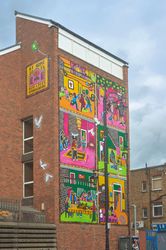
At Home (2025) is a permanent mural on the side of a block of flats in Hoxton, east London, featuring six vignettes in Rahman’s colourful, community-centric style, depicting family activities from eating together to playing music. Each space illustrates everyday life in a diverse London borough, yet enhances each scene with a dreamlike quality.
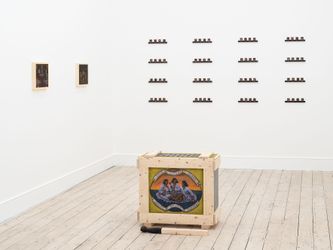
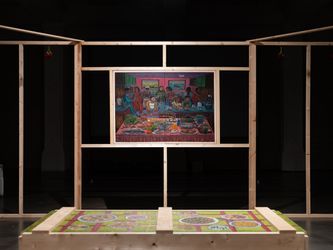
For In Minor Keys at the 2026 Venice Biennale, Rahman constructed Rolling Heart, bringing together selected sculptures and paintings in a wooden structure, including 2024’s Lovers’ Vigil, 64 matchbox paintings depicting objects typically associated with remembrance yet also acknowledging sexual freedom: candles, white flowers, pink fluffy handcuffs. Also featured were Memento Vivere (2024), a crate painted to look like condom packaging but memorialising social groups stepping up during the AIDS epidemic, and _Emergency Then (2024), a pair of paintings concerning fires, one seen by Rahman as a child as he was evacuated from his street, and another inspired by the Mostar unrest in 2014.
Mohammed Z Rahman: Select Exhibitions
Select Solo Exhibitions
- Art Now, Tate Britain, London (2026)
- Hearthside, Oitij-jo Programme, Whitechapel Gallery, London and Phillida Reid, Art Basel Miami Beach (2025)
- Remember to Live, Peer, London (2024)
- A Flame is a Petal, Phillida Reid, London (2024)
- City of Burrows, Phillida Reid, London (2023)
Select Group Exhibitions
- In Minor Keys, 61st Venice Biennale (2026)
- Love Will Come Back: Ann Craven with Robert Mapplethorpe and Mohammed Z Rahman, Phillida Reid, London (2024)
- Bidrohi, Old Spitalfields Market, London (2024)
- On Feeling, The Approach, London (2024)
- Come Closer, Indigo + Madder, London (2023)
- Atavism for the Future, Ehrlich Steinberg, Los Angeles (2023)
- Department of Unruly Histories, Cubitt, London (2023)
Further Reading
- Mohammed Z Rahman’s Instagram
- Artist profile page at Phillida Reid
- Mohammed Z Rahman’s official website
Mohammed Z. Rahman FAQs
Who are Mohammed Z Rahman’s influences?
Mohammed Z Rahman has been inspired by Salman Toor, Paula Rego, Toyin Ojih Odutola and Emory Douglas 4, and also cites William Morris, Noname, Zanele Muholi and Nan Goldin as creative role models.
What themes does Mohammed Z Rahman’s work explore?
With their background in anthropology, Rahman’s work considers elements of the British-Bengali identity, as well as themes of family, class, queerness and migration. Their university experience gave them the opportunity to learn more about the history of the Bangladeshi diaspora in London, but this also led to a stark realisation about the gatekeeping of history: they were able to read about their own parents’ history because they were at uni—their parents did not have access to papers written by white academics.
Is food important to Mohammed Z Rahman’s work?
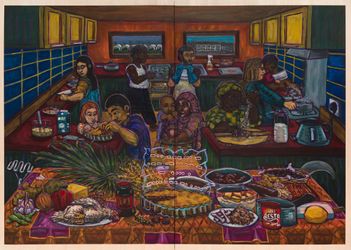
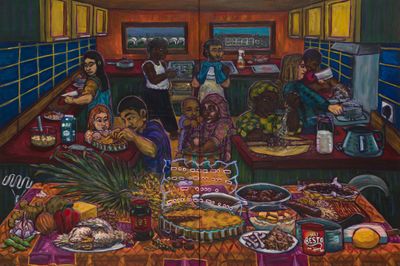
Yes, food is depicted in many of Rahman’s artworks, explicitly in Divali and Barbecue (2024), but also referenced through the act of eating together as a family or community activity. Their culinary vocabulary (inherited by Rahman via the Sylheti cuisine of their ancestors) translates into their artistic interpretations of life among the Bangladeshi diaspora, where food is a tool for kindness.
Ocula

Representative Artworks
View story
View story
View story
View story
View story

Explore and Follow Artists Shaping Contemporary Art
A respected voice in contemporary art discourse.
Focusing on ambitious storytelling and insightful art-world commentary. Ocula Magazine publishes in-depth interviews, critical essays and timely analysis on the artists, exhibitions and ideas driving the global art world.
Learn more about Ocula Magazine
Showcasing the best of the art world.
Ocula partners with galleries from around the world to highlight their artists, artworks and exhibitions. Gallery membership is by application and invitation, with each member vetted by an independent panel.
Learn more about Ocula Membership
Specialises in the sale of major artworks.
Led by a team with deep ties to the world’s leading auction houses, galleries and collectors. Ocula’s advisory team offers bespoke services to high-net-worth clients from around the world who are looking to acquire the best of contemporary and modern art.
Learn more about our team and services