




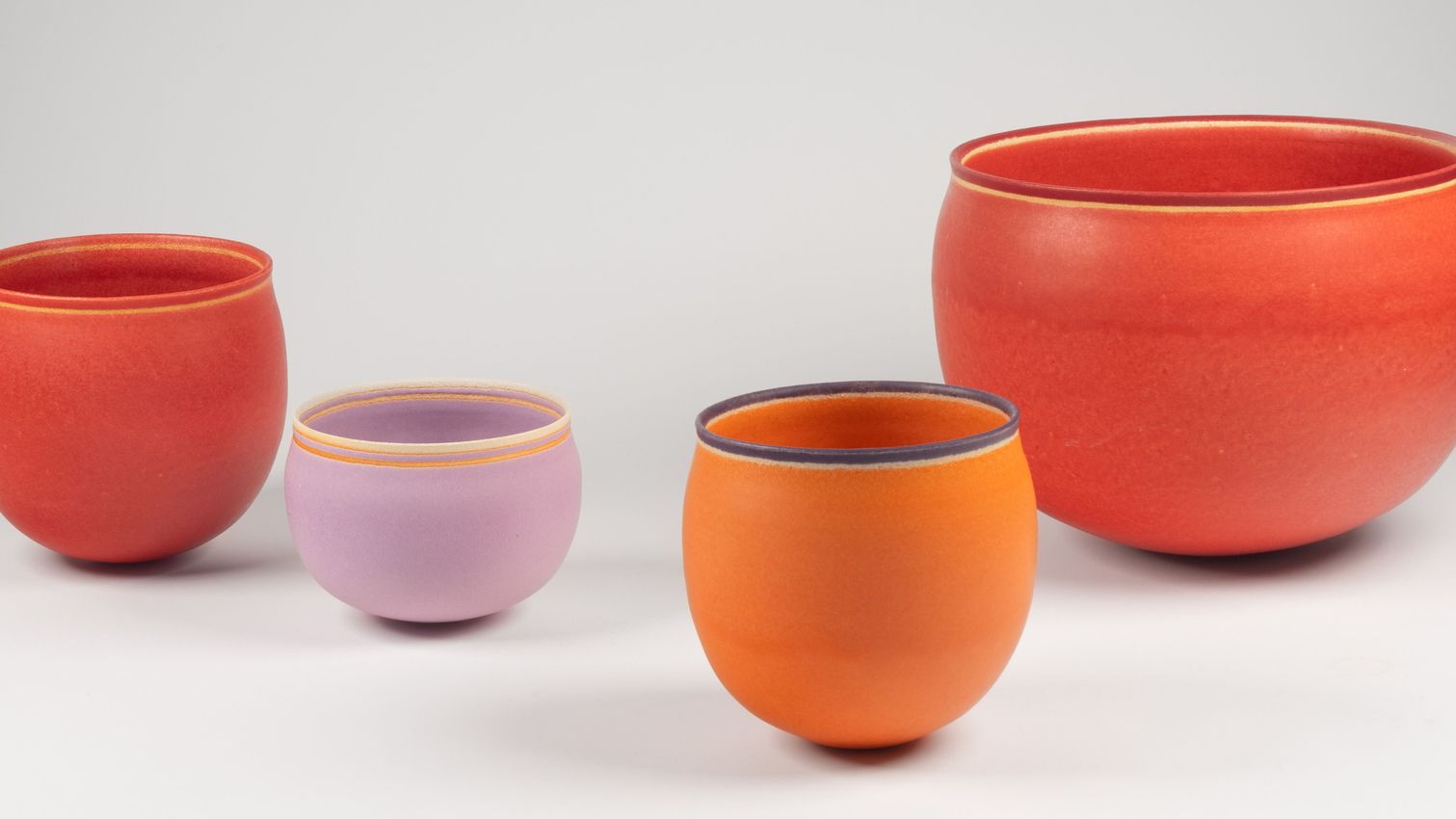
Alev Ebüzziya Siesbye makes bowls. She has been making them for decades now, through passages of life in Istanbul, in Copenhagen, in Paris. Being hand-coiled rather than thrown, they are slowly but steadily produced. Most are round at the bottom, with an extraordinarily satisfying weight to them, as if they were half-full with water. Others are poised upright, nearly jarlike; some lie low, at rest. She makes them in celestial blues, rigorous blacks and whites, life-affirming reds and yellows. But they are bowls, always bowls, and she has made them to the exclusion of all else.
One might think: so what? There is nothing so special in committing to a shape. Most painters make nothing but rectangles. Yet, in Ebüzziya Siesbye’s oeuvre, the recurrence of the open-mouthed container is charged with a special significance. Five years ago she made an exhibition called Repetition at the Arter contemporary art center in Istanbul, borrowing her title from Søren Kierkegaard. In that text, the philosopher (“the great Dane,” as she calls him) grasps for an elusive presentness, authentically connected to past and future. He finds his answer in repetition, which “has not the disquietude of hope, the anxious adventuresomeness of discoverers, nor the sadness of recollection; it has the blessed certainty of the instant.” To repeat is to echo that which has been and that which could yet be, and thus to anchor oneself in continuous time.
This is Ebüzziya Siesbye’s idea, too—except that each of her bowls is not temporal point, a tick of the clock, but a gorgeously held interval. They are to art what a monk’s chant is to belief. Line them all up, touching rim to rim in chronological order (what an artwork that would be!), and you would have Ebüzziya Siesbye herself before you. All to say: when she does do something radically new, you can be sure that it is consequential. The present exhibition at Salon 94 is one such dramatic moment in her long career. In one gallery, daylit, there are pieces that longtime admirers will find familiar, rendered in a warm and sensuous palette, blooming in mauves, pinks, and marigolds. The big surprise awaits in the next room: a group of bowls, fired to 1,280°F and surfaced with palladium and gold leaf. (The gilding was done by specialist artisan Marta Darowska, who restores works for museums and has also collaborated with the Indian architect Bijoy Jain.) They stage a glorious and wholly unexpected departure, as if a fanfare of trumpets had erupted amid a string quartet. And it is not just their bright, metallic surfaces that depart from precedent; the objects are also massive in both scale and proportion, their double walls concealing volumes of dark air within.
Ebüzziya Siesbye gladly acknowledges taking a risk with these works, explaining that she was partly responding to the strong exhibition space: an imposing and formal room, lined with an immaculately executed, quiltlike pattern of paneled wood. Against this backdrop the pieces strike a classical note, somewhat like gilt baroque furniture in a palatial interior. At the same time, they are austerely abstract, possessed of the forceful, absolute assurance that one encounters in, say, the work of Donald Judd (whose furniture has been shown in this very same gallery). And in spite of their startling glamour, there is also continuity beneath the surface—quite literally so, for as Ebüzziya Siesbye puts it, “the clay speaks through the metal.” In Kierkegaardian terms, they hold the now, resonating through time both forward and back, like gongs.
Another thing that Ebüzziya Siesbye likes to say: “there is nothing more complicated than simplicity.” She has loved Giorgio Morandi since she was about thirteen years old and had the chance to see a retrospective of his work at the Musée d’Art Moderne de Paris in 2001. It was then, she says, that ‘I understood what was happening beyond the frames. It was everything Morandi did not say in his paintings!’ The eloquence of his work, it struck her, was in how they activated the space around them (which is, of course, the viewer’s own). She compares the effect to that of ancient kouros figures, so still in their forward stride: ‘the very soil trembles.’
Now look at how Ebüzziya Siesbye’s pieces end, how they open themselves to the sky above. She often leaves an unglazed line just below the rim, demarcating its extent, at once stabilizing its relation to the ground and creating a dialogue with the infinite. The effect is similar to certain paintings of Mondrian’s, where he stops his stripes just short of the edge of canvas, implying that it is a core sample of an endless grid. This is more than coincidence, for Ebüzziya Siesbye does have a real affinity to that pure strain of modernist abstraction. The exhibition for Salon 94 includes vessel forms alluding to the works of El Lissitzky and Kazimir Malevich; there is also a connection to the work of her friend Nil Yalter, which draws inspiration from Byzantine priestly garments. Distorted across the curved surfaces, crosses infuse Ebüzziya Siesbye’s work with a strong directionality, in tension with the forms’ overall symmetry. There is none of the didactic stridency of Suprematism here, though: the motifs alight on her bowls like butterflies.
The understatement of Ebüzziya Siesbye’s work, though, only adds to its poetic depth. She recalls the observation of her former gallerist Garth Clark, who hosted her previous monographic exhibition in New York some years ago: “there is a hint of melancholy at the bottom of her bowls.” One cannot fully divine the source of that emotion—it has dimensions of the personal, the historical, and the spiritual, like everything that really matters. In any case, Ebüzziya Siesbye herself believes in letting her works keep their own counsel. (The Turkish word for a glaze formula, she points out, is sir, meaning ‘secret.’) Her pots have life precisely because they do not submit easily to her will. Their apparent repetition—perfection would be another word for it—is hard-won, and when we encounter them as viewers, we feel the nobility of that resistance. Even if you are so fortunate as to hold one in your hands, it will remain to some extent unreachable, wholly self-possessed. Is this the closest we can come to experiencing a piece of eternal heaven in this mortal life? Absolutely. But in the end, as she will be the first to tell you, it is the clay that decides.
Alev Ebüzziya Siesbye is known for her minimalist ceramic vessels glazed in saturated pigments with delicate detailing around the mouth. Her modernist works resemble ancient artefacts, whose simple design lends her pieces a unique, timeless quality. Siesbye’s works are the result of a life dedicated to kneading clay to the correct texture, adjusting enamel recipes to obtain the perfect colour, refining curves, bellies, and long lips, to harmoniously balance her artworks.

Salon 94 is an art gallery with three spaces in Manhattan, NYC. Since its creation in 2002, the mission of Salon 94 has grown from exhibiting special projects by emerging and renowned artists alike in the home of Jeanne Greenberg Rohatyn to representing artists such as Marilyn Minter, Lorna Simpson, Jon Kessler and Takeshi Murata.A satellite exhibition space debuted in September 2007 with sculptural work by Huma Bhabha. In 2010, a third exhibition space opened on the Bowery with a show of Richard Prince’s T-Shirt paintings. Located steps from The New Museum in New York’s Lower East Side, both galleries strive to provide more accessibility to visitors to the developing downtown art scene.Salon 94 is a member of the ADAA (Art Dealer’s Association of America).
A respected voice in contemporary art discourse.
Focusing on ambitious storytelling and insightful art-world commentary. Ocula Magazine publishes in-depth interviews, critical essays and timely analysis on the artists, exhibitions and ideas driving the global art world.
Learn more about Ocula Magazine
Showcasing the best of the art world.
Ocula partners with galleries from around the world to highlight their artists, artworks and exhibitions. Gallery membership is by application and invitation, with each member vetted by an independent panel.
Learn more about Ocula Membership

Specialises in the sale of major artworks.
Led by a team with deep ties to the world’s leading auction houses, galleries and collectors. Ocula’s advisory team offers bespoke services to high-net-worth clients from around the world who are looking to acquire the best of contemporary and modern art.
Learn more about our team and services