Press Release

The work of Analia Saban continually expands the definition of how paintings, sculptures and even everyday objects are made. Through tactile manipulations of material and composition, Saban transforms straightforward things—copper, linen thread, acrylic paint, paper, printing ink—into complex layered networks of information that consider the entwined relationship between art, culture and daily experience. Monika Sprüth and Philomene Magers are pleased to present Save As, an exhibition of new works by Saban at the Berlin gallery that delves into the increasingly porous line between our physical and virtual worlds—made ever more palpable by the further expansion of digital life in response to the coronavirus pandemic.

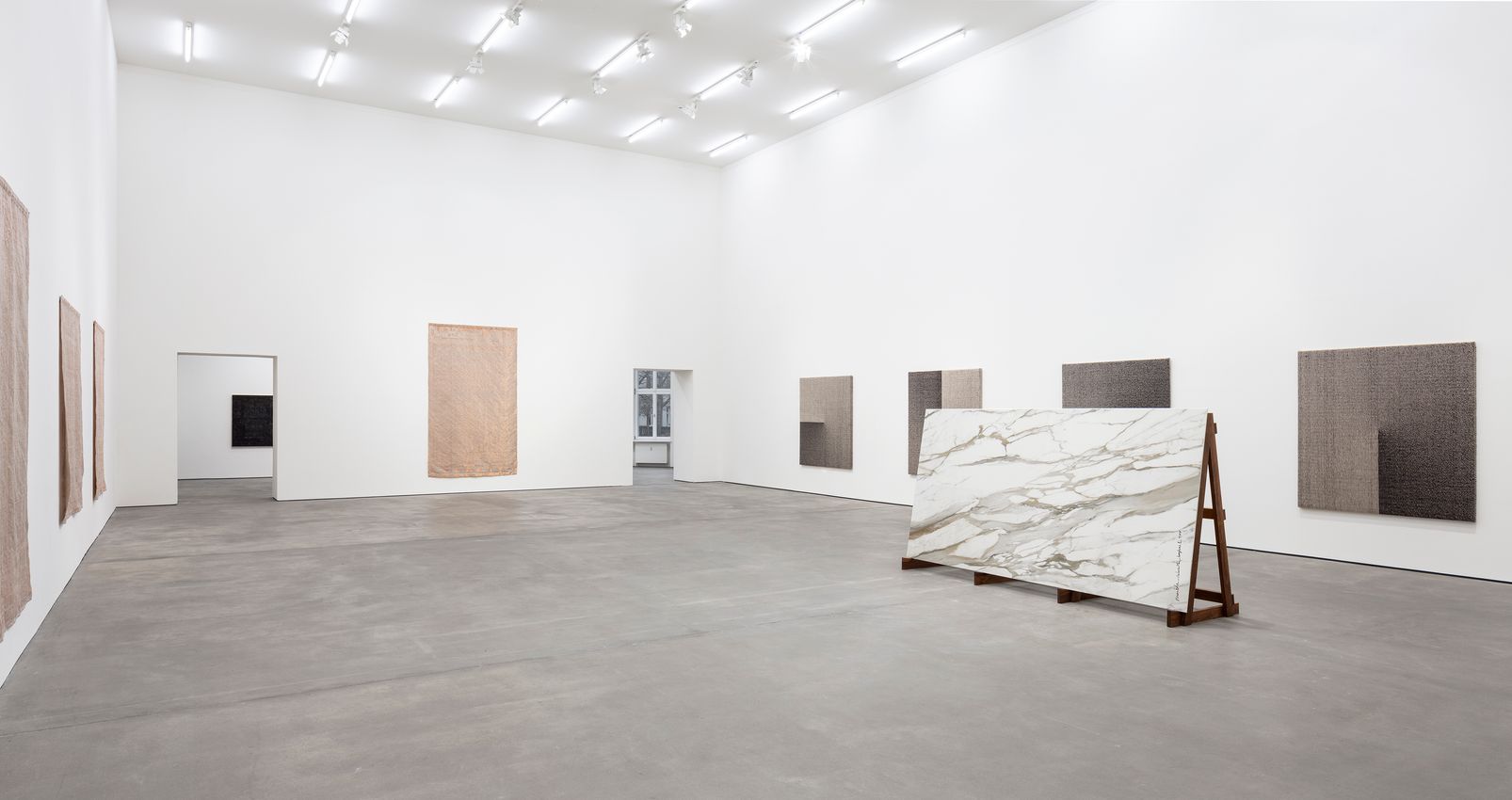
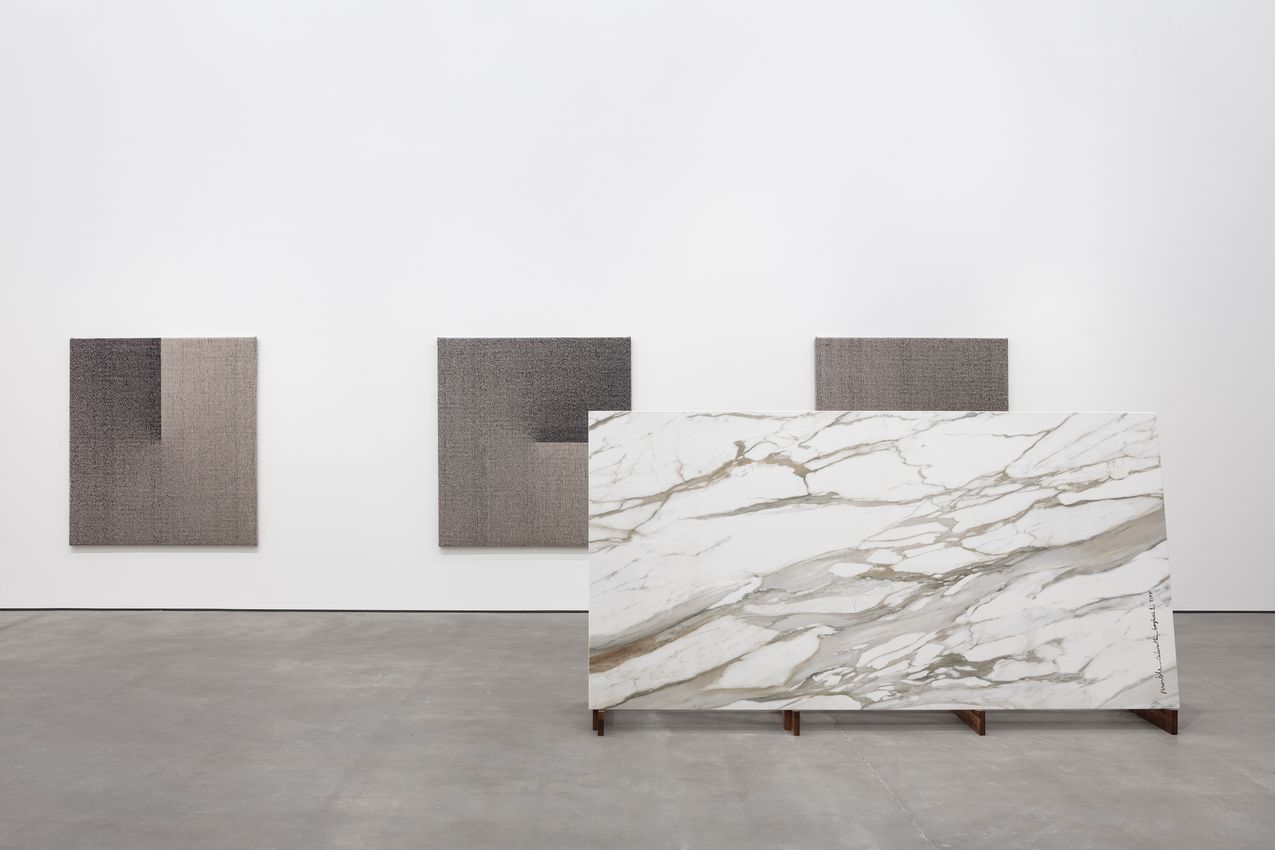
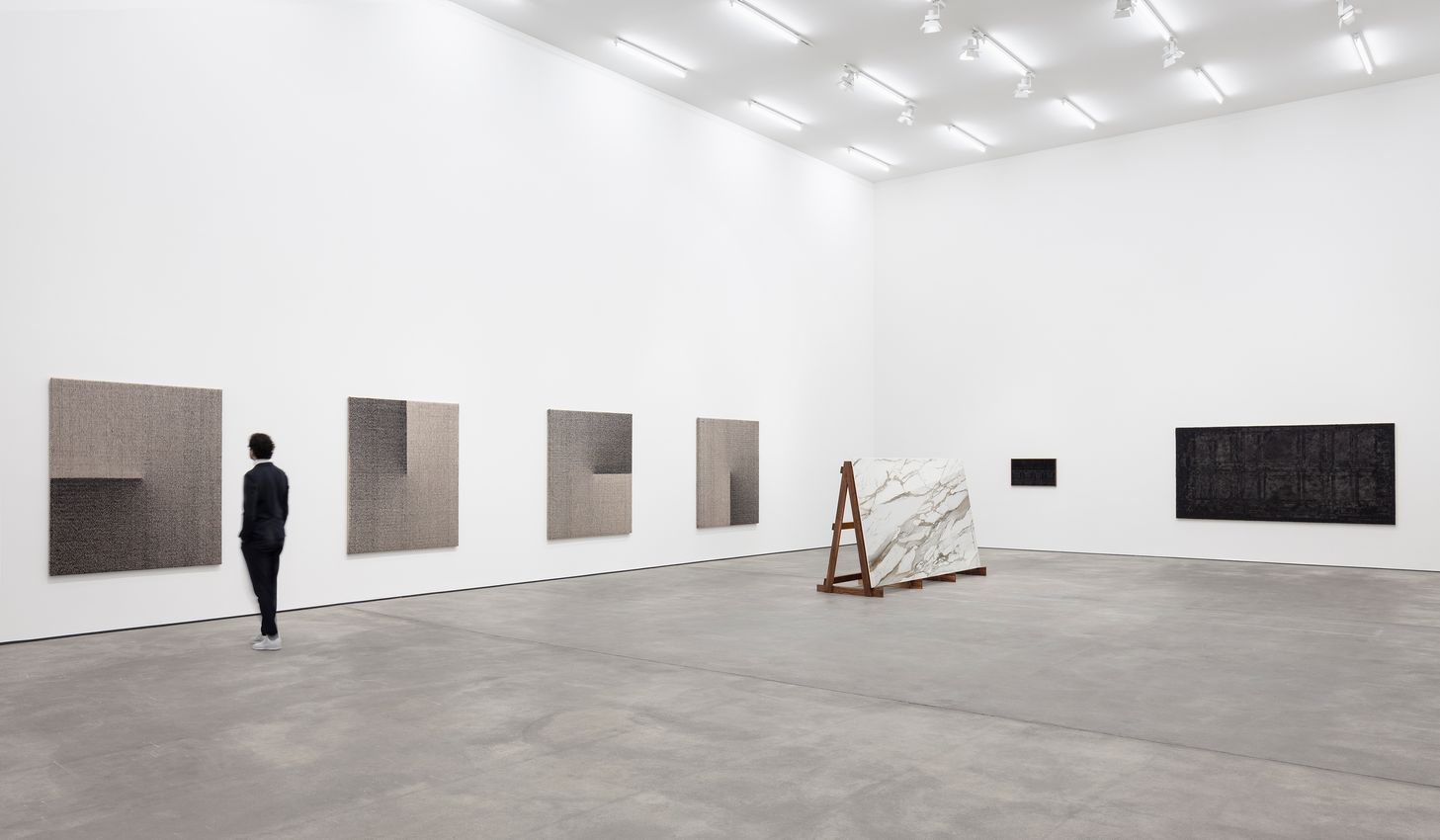
The title borrows from the basic computer function to ‘Save As,’ which prompts users to save a file as a new format—a small, albeit fundamental, alteration. Throughout the exhibition, similar transformative processes take place that illustrate Saban’s continued exploration of the analogue-digital divide and emphasize the extent to which computerization shapes our lives. The sculpture marble_calacatta_borghini1.TIFF (2020) presents what looks like a slab of marble leaning on an elegantly handcrafted walnut support. Stone from Italy’s Calacatta region is some of the most expensive on the market, prized for its pure-white background. Yet on closer inspection, the false nature of this work’s material reveals itself: It is in fact a digital image reproducing a veined marble surface, printed onto a sheet of porcelain. Surreal and unnerving, the sculpture encapsulates the themes at work in Save As: Where does the physical, tactile world end, and the world of technology and machines begin?

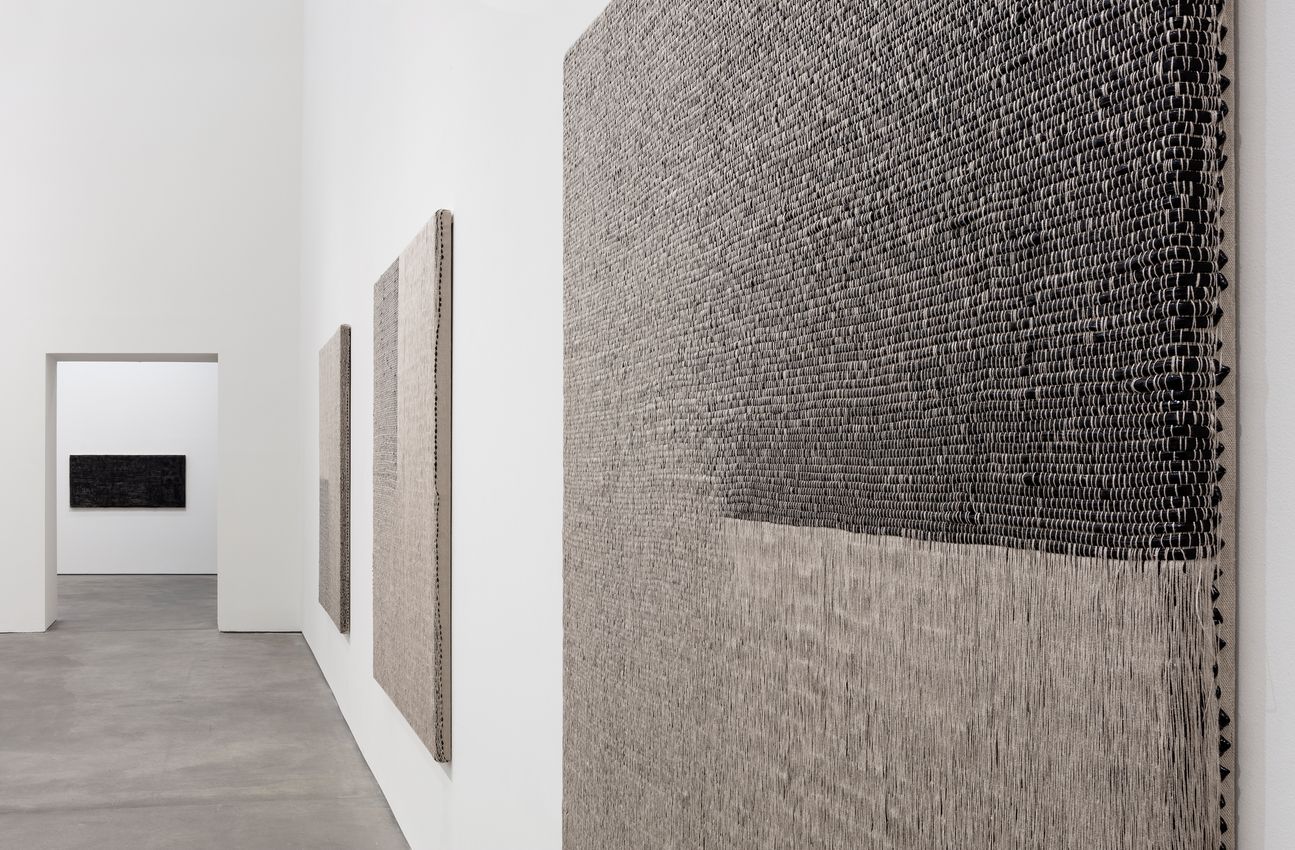
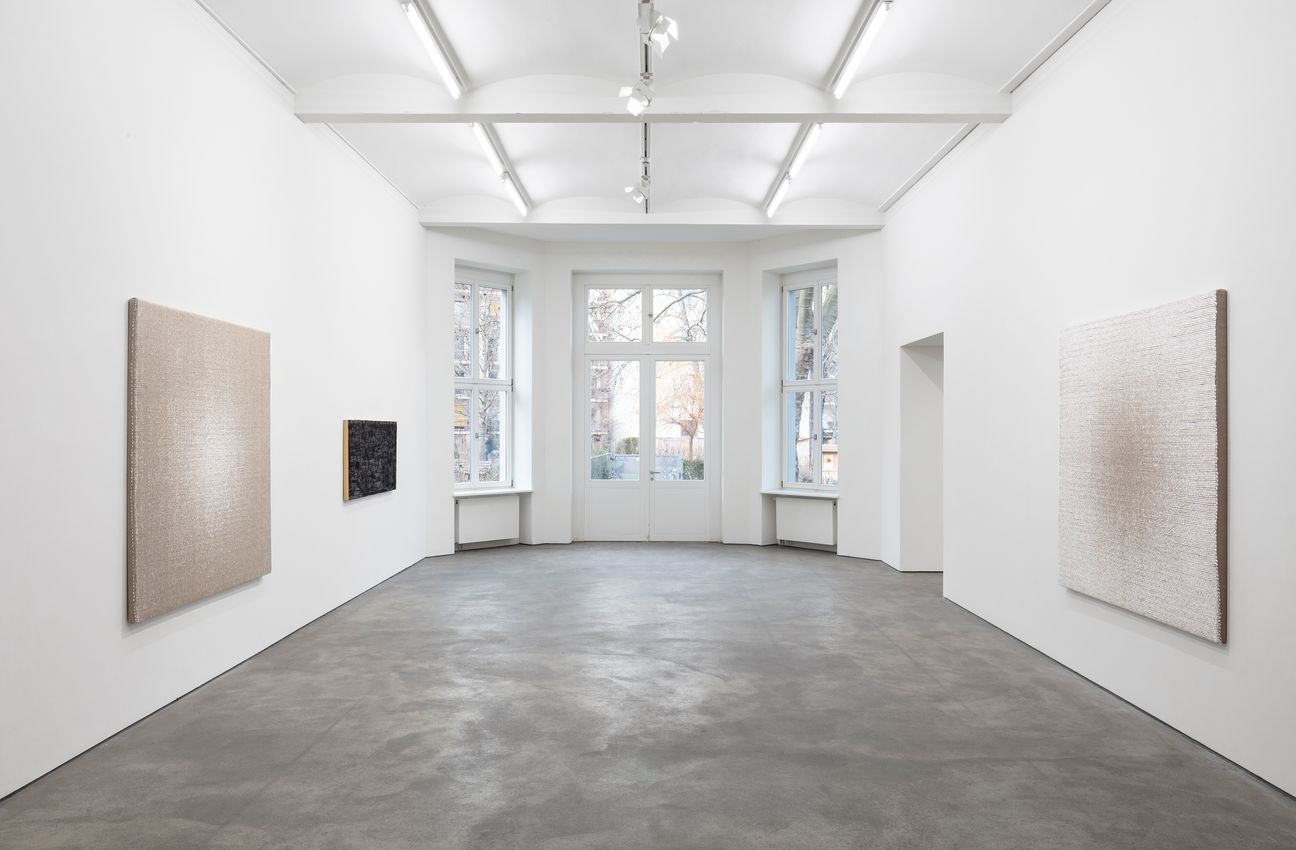
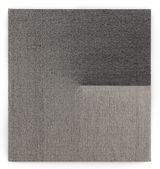
In 2016, Saban acquired her first loom and set to work reinventing how paintings are made: Rather than applying paint on canvas, she began to weave dried, pliable ‘threads’ of acrylic paint with linen threads, producing an object that hovers between painting and sculpture. She then got a Jacquard loom, which combines traditional, hands-on weaving with computerized mechanisms that allow for more intricate and larger-scaled designs. The compositions of these woven works, such as Woven Radial Gradient as Weft (Linen on White) (2020), are derived from Photoshop editing functions. At once purely abstract, they also suggest the inner workings of machines, like the ticking hands of a clock in Woven Angle Gradient as Weft, Black (Three O’Clock) (2020). Here we see time stopped: An invitation to pause and reflect on our ubiquitous digital tools, as well as on our current global predicament.

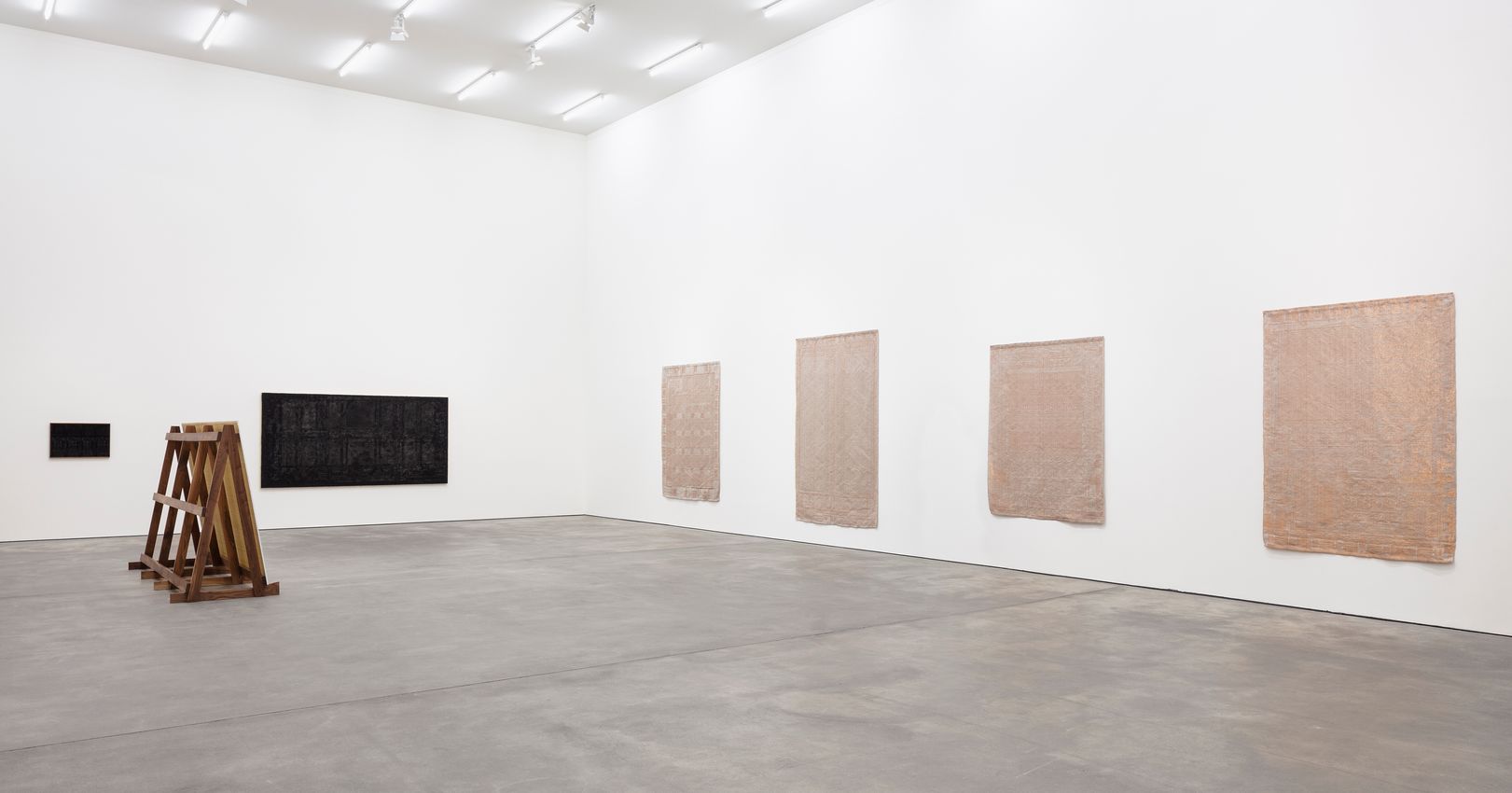
Computer circuitry is at the foundation of three further bodies of work included in the exhibition. Saban’s ‘Copper Tapestries’, also made with the Jacquard loom, interweave linen with metallic copper thread to create shimmering objects that hearken to the grandeur of centuries-old tapestries. Their compositions are modelled on the patterns of historical circuit boards that represent milestones in computer technology, which in turn have affected daily life. The circuit at the basis of Copper Tapestry (Computer Chip, TMS 1000, Texas Instruments, 1974) (2019), for example, paved the way for microcomputing and the eventual proliferation of handheld devices. Its surfaces gleam as light passes over them: Copper, here, represents not just an aesthetic medium, but an electrically conductive one that is often wound into circuit boards themselves.

Saban’s ‘Pleated Ink’ works likewise take circuit boards as the basis for their intricate, abstract-looking compositions, though to very different effect. To create these works, the artist developed a technique of applying thin, laser-cut patterns of paper over still-wet black printer’s ink; as the ink dries, it assumes elaborate patterns in and around the paper outlines, taking on a life of its own. Rather than ‘ink on paper,’ these objects are literally ‘paper on ink’ as they re-imagine drawing and printing techniques for the twenty-first century. Finally, a trio of intimately scaled panels incorporates actual computer motherboards that the artist salvaged from electronics yards. Saban overlays the same wet printer’s ink atop the circuitry, as in Motherboard #3 (2020), bringing its organic viscosity to bear upon the rigid, and now inert, computer components. These byproducts of mass digital culture usually go unseen, but now they appear as mysterious, portentous objects encased in the artist’s pristine walnut frames, and gleaming across the gallery walls.

Together, Saban’s recent series move between states of being, shifting in meaning as they bridge the zones of digital and analogue, fact and fiction, human and machine. Impossible to pin down, much like the streams of digital information that we encounter each day, they carry with them a distinct sense of inquiry and wonderment, even as they tackle fundamental questions about art, technology and its meaning within contemporary culture.

This exhibition is supported by Stiftung Kunstfonds as part of their NEUSTART KULTUR program.

Analia Saban (*1980, Buenos Aires) lives in Los Angeles. Solo exhibitions include Modern Art Museum Fort Worth (2019), Qiao Space, Shanghai (2017–2018), Blaffer Art Museum, Houston (2016), and Armory Center for the Arts, Pasadena (2014). Recent group exhibitions include those at Clark Art Institute, Williamstown, MA (2020), Hammer Museum, Los Angeles (2018), Los Angeles County Museum of Art and Aïshti Foundation, Beirut (both 2016–17), Rubell Museum, Miami (2015–16), The National Museum, Oslo (2014–2015), Palais de Tokyo, Paris (2013), Centre d’art Contemporain de Fribourg, Switzerland (2012–13), and MARCO Museum of Contemporary Art, Vigo, Spain (2012). Her work has also been featured at Art Safiental 2018: HorizontalVertical (2018); NGV Triennial at National Gallery of Victoria, Melbourne (2017–2018), and the first Made in LA biennial at the Hammer Museum, Los Angeles (2012).

Read More

Installation Views

About the Artist

Analia Saban was born in Buenos Aires, Argentina, in 1980 and lives in Los Angeles and New York City. She has exhibited widely in both solo and group shows. Recent group exhibitions include Variations: Conversations in and Around Abstract Painting, LACMA, CA, Vibrant Matter, Kiosk, Ghent, Belgium, both 2015, An Appetite for Painting, National Museum of Norway, Oslo, 2014, Expanding on an expansive subject, Part 2: Analia Saban, Is this a painting?, Armory Center for the Arts, Pasadena, CA, 2014, Le Club des Sous L’Eau / Nouvelles Vagues / Young Curator Season, Palais de Tokyo, Paris, 2013, the Hammer Museum’s first Los Angeles biennial exhibition, MADE IN LA 2012 and LA>La Ballena Negra, MARCO Museum of Contemporary Art, Vigo, Spain, 2012, Lost Line: Selections from the Permanent Collection, Los Angeles County Museum of Art, Los Angeles, 2012, and Pour une grammaire du hazard, FRI-ART, Centre d’art Contemporain de Fribourg, Switzerland, 2012/2013. She is the recipient of the Norton Museum’s Rudin Prize For Emerging Photographers Award, West Palm Beach, 2012, the Santa Monica Artist Fellowship, 2010, as well as grants from the Durfee Foundation, 2009 and the Fundacion Antorchas Fellowship, Buenos Aires, 2003 – 2005.

View Artist Profile

Also Exhibiting

About the Gallery

Sprüth Magers has expanded from its roots in Cologne (Germany) to become an international gallery dedicated to exhibiting the very best in groundbreaking modern and contemporary art. With galleries located in Berlin Mitte, London’s Mayfair and the Miracle Mile in Los Angeles–as well as an office in Cologne and an outpost in Hong Kong–Sprüth Magers retains close ties with the studios and communities of the German and American artists who form the core of its roster.

View Gallery Profile
Address
Oranienburger Straße 18
Berlin
Germany
Opening Hours
Tuesday - Saturday
11am - 6pm
(1)
Berlin Oranienburger Straße 18
Sprüth Magers
Oranienburger Straße 18, Berlin, Germany
+49 302 888 4030
http://www.spruethmagers.com

Opening hours
Tuesday - Saturday
11am - 6pm
The art world in focus