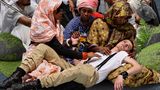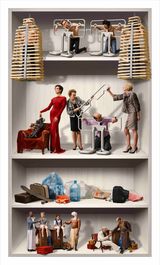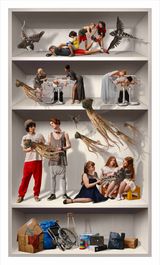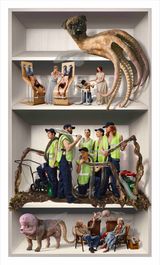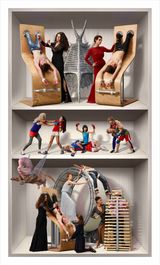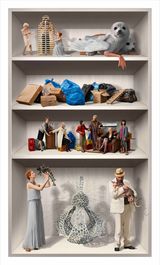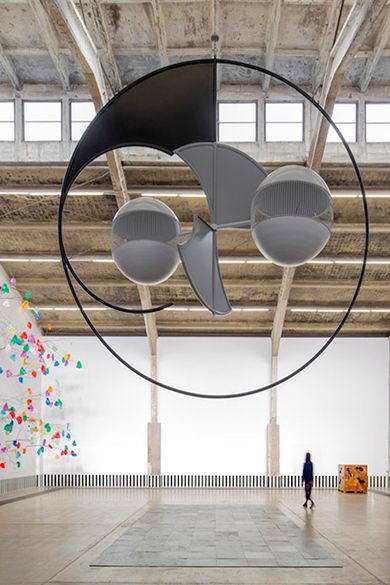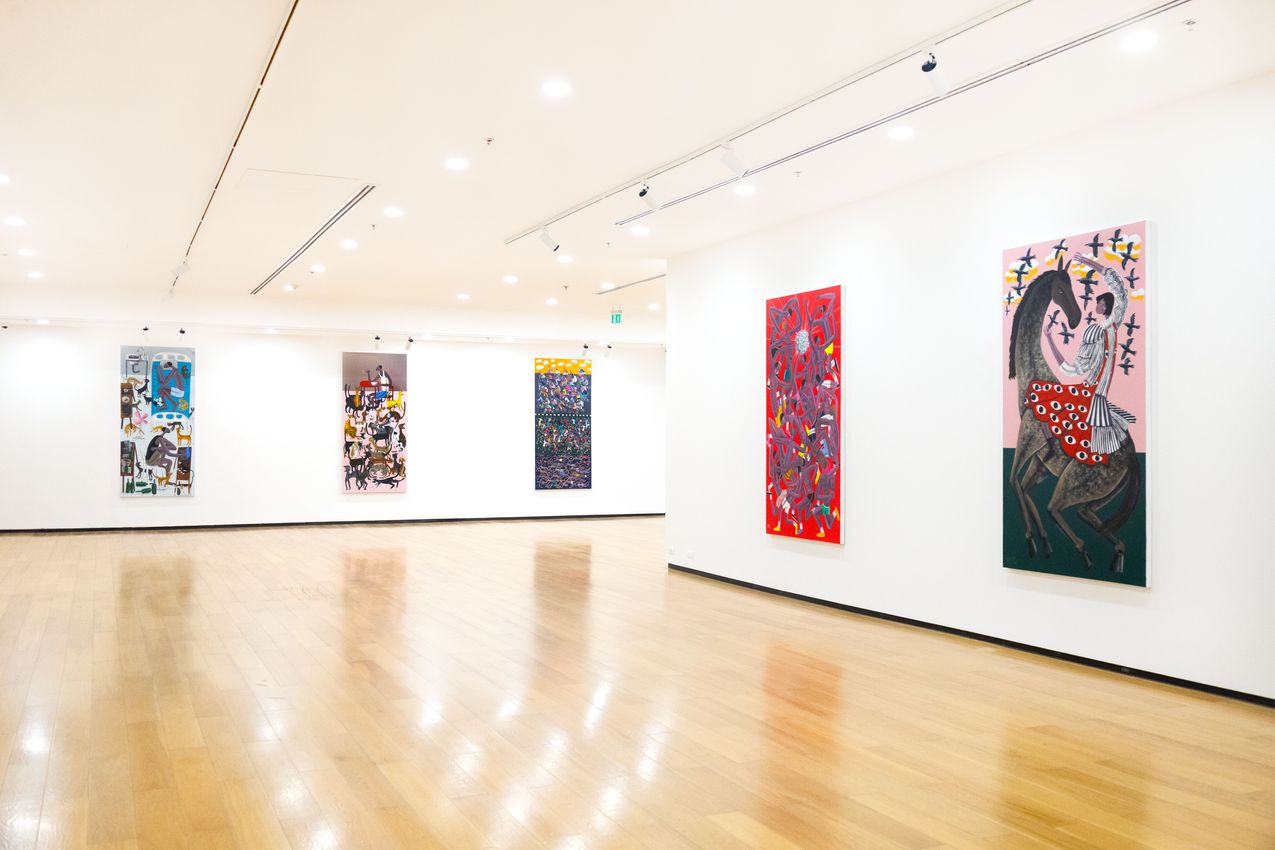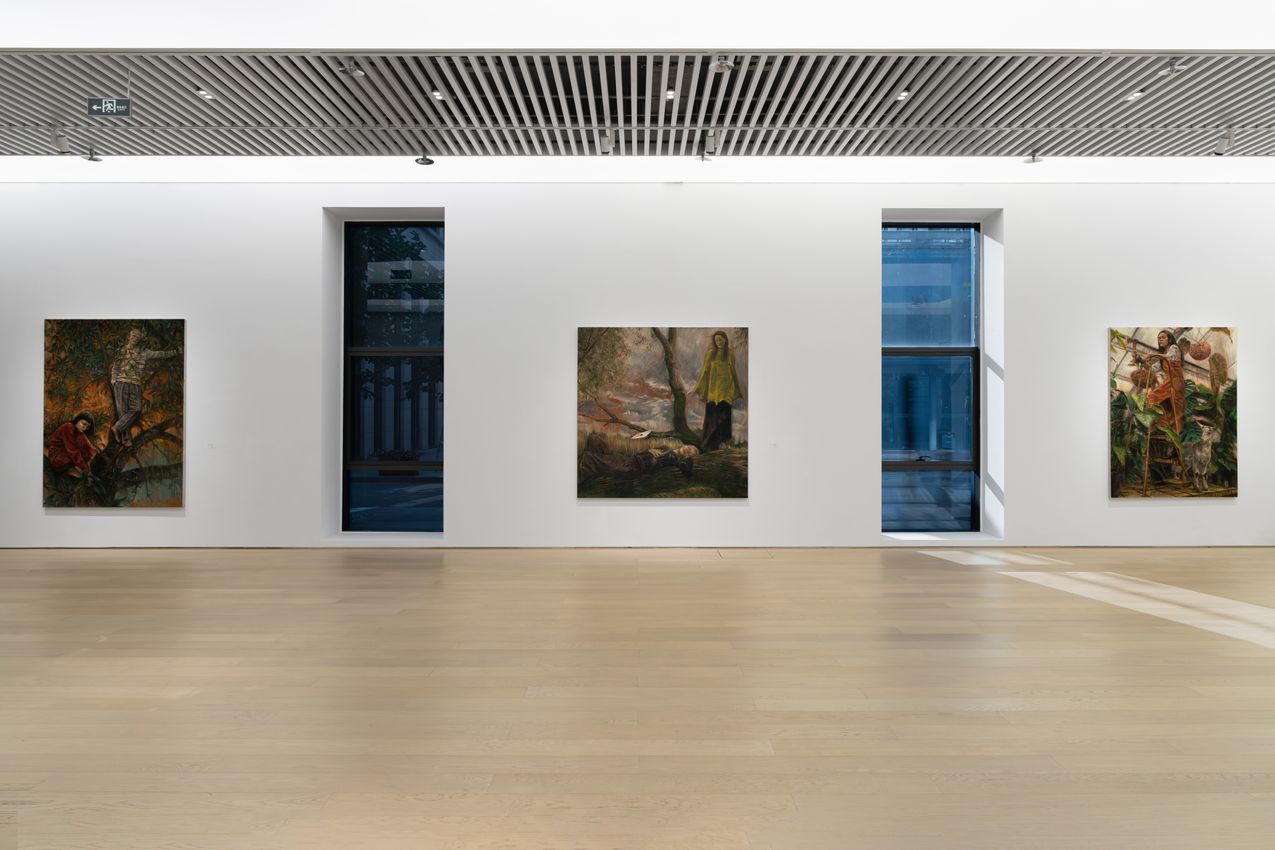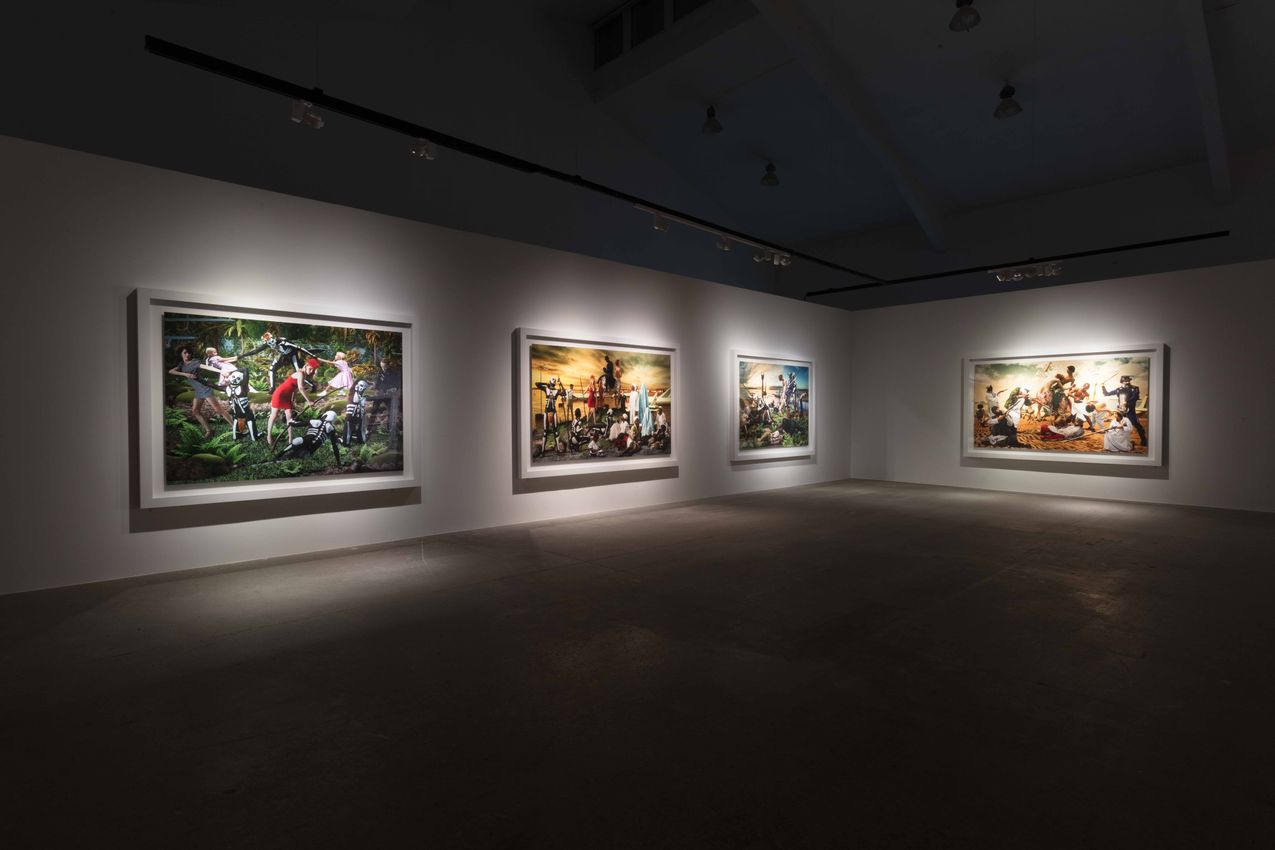
Tang Contemporary Art is pleased to present What Came to Pass, an exhibition for artists group AES+F, at Tang Contemporary Art’s 1st Gallery Space in Beijing on 20 May 2020. For their first solo exhibition in China in a decade, titled What Came to Pass, the artists present two projects consisting of large scale video installations and digital collages_Allegoria Sacra_ (2011-2013) and Inverso Mundus (2015-2017). The exhibition is a retrospective self-reflection on these two large bodies of work that psychoanalysed the state of humanity at the start and in the middle of the decade respectively.
AES+F is a collective of four Russian-born artists that work at the intersection of traditional media and new technologies. Their work is characterised by a highly conceptual and provocative style that reflects the contemporary media stream through the prism of the historical canon. Their signature approach is what they call ‘social psychoanalysis,’ which they employ to reveal the vices and conflicts of the post-globalised world.
AES+F is a collective of four Russian-born artists that work at the intersection of traditional media and new technologies. Their work is characterised by a highly conceptual and provocative style that reflects the contemporary media stream through the prism of the historical canon. Their signature approach is what they call ‘social psychoanalysis,’ which they employ to reveal the vices and conflicts of the post-globalised world. For their first solo exhibition in China in a decade, titled What Came to Pass, the artists present two projects consisting of large scale video installations and digital collages—Allegoria Sacra (2011-2013) and Inverso Mundus (2015-2017). The exhibition is a retrospective self-reflection on these two large bodies of work that psychoanalysed the state of humanity at the start and in the middle of the decade respectively.
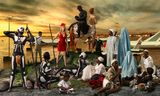
Allegoria Sacra, inspired by Giovanni Bellini’s mysterious painting of the same title, depicts a surreal world suspended in time, where passengers stuck in a futuristic airport drift into one another’s dreams. With a myriad of references to Bellini’s painting, as well as to global history and pop culture, the work allegorically uses the airport to refer to purgatory, where people from many walks of life congregate as they await their fate.
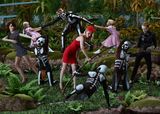
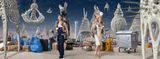
Inverso Mundus is based on the medieval engravings of a world upside-down, a comic strip from the middle ages depicting various social roles and norms reversed. AES+F’s epic video tableaux, like the medieval engravings, depicts a world where social conventions are inverted to highlight the underlying premises that we take for granted. In a whimsical reversal of the concept of the inquisition, women clad in cocktail dresses are sensually torturing men in cages and on devices styled after IKEA furniture. An international board of directors is usurped by their impoverished doppelgangers. The poor give alms to the rich. A pig guts a butcher. Virus-like objects loom over and settle on oblivious people who are taking selfies...
AES+F
First formed as AES Group in 1987 by Arzamasova, Evzovich, and Svyatsky, the collective became AES+F when Fridkes joined in 1995. AES+F work at the intersection of traditional media, photography, video and digital technologies. They define their practice as a kind of ‘social psychoanalysis’ through which they reveal and explore the values, vices and conflicts of contemporary global culture.
AES+F achieved worldwide recognition and acclaim in the Russian Pavilion at the 52nd Biennale di Venezia in 2007 with Last Riot (2007), their first multi-channel video installation. The following two projects, The Feast of Trimalchio (2009), and Allegoria Sacra (2011), were also shown at the biennales of Venice, Moscow, and others. AES+F presented their newest multi-channel video project, Inverso Mundus (2015), at the 56th Biennale di Venezia, 4th Kochi-Muziris Biennial, 1st Bangkok Biennial, and others.
The group had more than 100 solo exhibitions at museums, exhibition spaces, and commercial galleries worldwide. AES+F works have been shown in such venues as the ZKM (Karlsruhe), HAM (Helsinki), Moderna Museet (Stockholm), Tate Britain (London), MAXXI and MACRO Future (Rome), Centre Pompidou (Paris), Museo Thyssen-Bornemisza (Madrid), Mori Art Museum (Tokyo), Leeum Samsung Museum of Art (Seoul), The State Russian Museum (St. Petersburg), Garage Museum of Contemporary Art (Moscow), National Gallery of Australia (Canberra), Faena Art Center (Buenos Aires), and many others.
Their works appear in some of the world’s principal collections of contemporary art, such as the State Tretyakov Gallery, Moscow Museum of Modern Art, Multimedia Art Museum, National Center for Contemporary Art (Moscow), State Russian Museum (St. Petersburg), Moderna Museet (Stockholm), MOCAK (Krakow), CCA Ujazdowski Castle (Warsaw), ZKM (Karlsruhe), Art Gallery of South Australia (Adelaide), MONA (Hobart), Sammlung Goetz (Munich), Vanhaerents Art Collection (Brussels), Taguchi Art Collection (Tokyo), Museum of Fine Arts (Houston), Thoma Foundation (Chicago), Nomas Foundation (Rome), Pino Pascali Museum (Polignano-a-Mare), CA2M (Madrid), Wien Museum (Vienna), Art Museum of Northern Norway (Tromso), Les Abattoirs (Toulouse), Nam June Paik Art Center (Yongin), European Center of Photography, Centre Pompidou, Louis Vuitton Foundation (Paris), and many others.

AES+F achieved worldwide recognition and acclaim in the Russian Pavilion at the 52nd Biennale di Venezia in 2007 with their provocative, other-worldly Last Riot (2007), the first in a trio of large-scale, multichannel video installations of striking originality that have come to define both the AES+F aesthetic and the cutting edge of the medium’s capacities. The second of the series, The Feast of Trimalchio (2009), appeared in Venice in 2009, and the third, Allegoria Sacra (2011), debuted at the 4th Moscow Biennale in 2011. United as The Liminal Space Trilogy, this tour-de-force series was premiered in September 2012 at the Martin-Gropius-Bau, Berlin, and the Moscow Manege, the central exhibition hall of the artists’ home city. Most recently the Trilogy was shown in the Museum of Fine Arts in La Chaux-De-Fonds, Switzerland (June — September 2014). AES+F received the main award of the Kandinsky Prize 2012 and the main award of the NordArt Festival 2014 for the project Allegoria Sacra.


Tang Contemporary Art was established in 1997 in Bangkok, later establishing galleries in Beijing and most recently Hong Kong. Tang Contemporary Art is fully committed to producing critical projects and exhibitions to promote Contemporary Chinese art regionally and worldwide and encourage a dynamic exchange between Chinese artists and those abroad.
A respected voice in contemporary art discourse.
Focusing on ambitious storytelling and insightful art-world commentary. Ocula Magazine publishes in-depth interviews, critical essays and timely analysis on the artists, exhibitions and ideas driving the global art world.
Learn more about Ocula Magazine
Showcasing the best of the art world.
Ocula partners with galleries from around the world to highlight their artists, artworks and exhibitions. Gallery membership is by application and invitation, with each member vetted by an independent panel.
Learn more about Ocula Membership

Specialises in the sale of major artworks.
Led by a team with deep ties to the world’s leading auction houses, galleries and collectors. Ocula’s advisory team offers bespoke services to high-net-worth clients from around the world who are looking to acquire the best of contemporary and modern art.
Learn more about our team and services