



The swarm of spectators and the object of their gaze: two sides of an interdependent yet ambiguous relationship at the heart of Paul Pfeiffer‘s work and the focus of his forth-coming show at Thomas Dane Gallery, London. For the very first time in London, Pfeiffer (b. 1966, Honolulu) will present his seminal, pioneering works from the early 2000s alongside recent pieces revealing the artist’s exhaustive investigation in to themes of spectatorship and identity. Through careful editing of found video clips and still imagery Pfeiffer’s singular practice unpicks the mythology of the stadium to reveal disturbing aspects of the human condition and unexpected moments of extreme affect within the arena of mass entertainment. Race, gender, colonialism, camouflage, subjectivity, subjection and the quasi-religious experience of hero worship all feature prominently against the backdrop of popular sports culture.
Fragment of a Crucifixion (after Francis Bacon), 1999 depicts a seemingly familiar scene, a celebrating sports hero on a basketball court. However, we see only a single player and while camera flashes go off all around him we are aware that the court is not what it should be: no line markings, advertising, no referee or even a ball. The figure’s movements are wildly tormented as he moves back and forth, caught in an endless video loop, while the crowd around him are also perpetually hypnotised by their hero’s fate. Pfeiffer explicitly references the contorted crucifixion scene in Bacon’s painting of the same name, Bacon in turn inspired by the iconic screaming figure, shot in the eye, in the penultimate scene of Eisenstein’s Battleship Potempkin.
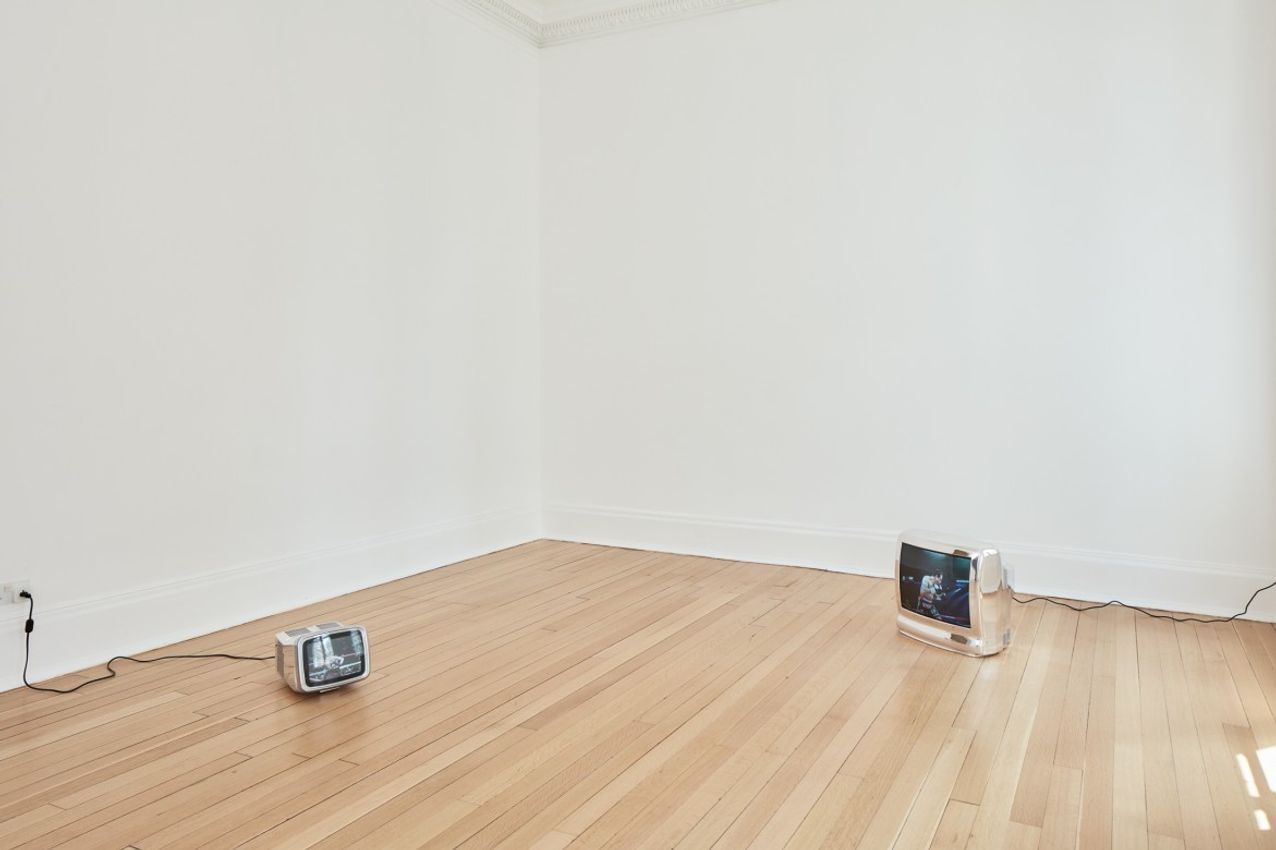
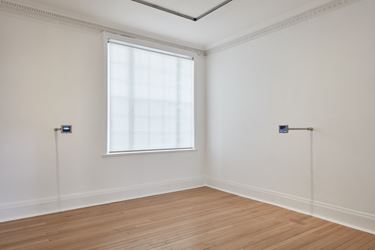
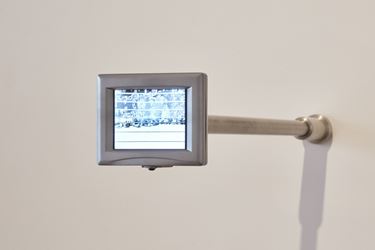
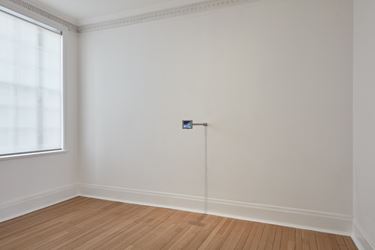
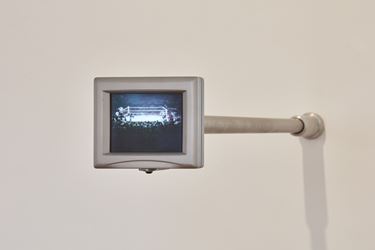
Pfeiffer’s Long Count series (Long Count (I shook up the World), 2000, Long Count (Thrilla in Manila), 2001 and Long Count (Rumble in the Jungle), 2001) commandeers excerpts from three Mohammed Ali fights, each fight the greatest live and televised spectacle of its time. From these works Pfeiffer has carefully removed the two fighters. Ghostly traces of the figures draw our attention to Pfeiffer’s intervention, not as pure absence but as an active process of erasure, forcing us to reassess the scene and shifting our gaze on to the surrounding arena. The apparatus of the works are emphasised; tiny four-inch screens protruding almost absurdly a metre from the wall towards the viewer’s eye line. Perhaps mimicking the thrust of Ali’s glove or more crucially foreseeing the invasive reach of this type of apparatus and spectacle into our daily lives.
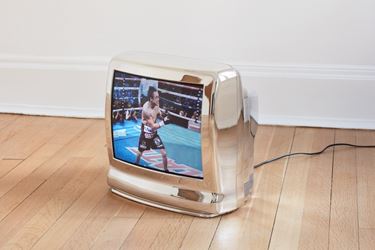
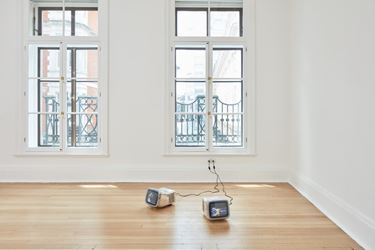
In a dedicated room Pfeiffer will show a constellation of his most recent works, continuing his series of Caryatids started in 2003. In these Pfeiffer again concentrates on boxing, perhaps the most singular, primeval and brutal of contact sports and certainly one the greatest television spectacles. In each work Pfeiffer has extracted a sequence of moments in which a fighter receives unrelenting heavy blows from his opponent, the opponent however, is virtually untraceably erased. In contrast to the Long Count works Caryatids fix our gaze squarely and unflinchingly on the body and suffering of the vanquished. The boxer becomes a martyr, a pilloried Saint Sebastian.
Four Horsemen of the Apocalypse (31), 2017 is a departure from Pfeiffer’s long-standing series of manipulated photographs of basketball players. In this work the player is now dwarfed by the giant arching roof of the arena, whose more traditional architecture suggests a type of theatrical drama rather than sporting contest. Pfeiffer’s Horsemen series are where we are most clearly focused of the role of the arena. These multi-tiered edifices, reminiscent of Dante’s description of a tiered decent into hell, place our heroes in a contradictory situation both as idol and slave of their circumstance.
The exhibition will run concurrently with Bruce Conner’s A MOVIE, 1959, on view at 3 Duke Street St James’s until 4th July.
Paul Pfeiffer lives and works in New York City, he is currently the artist in residence at University of Georgia, Athens.
Courtesy Thomas Dane Gallery


Whether depicting boxers fighting invisible opponents or a headless, ethereal Michael Jackson dancing, New York-based artist Paul Pfeiffer’s digital manipulations explore how media shapes perceptions of the world and ourselves. His installations presenting altered footage and imagery from sporting events, cinema, and television have been shown internationally.

Thomas Dane Gallery was established in 2004 and currently exists in two London gallery spaces at 3 and 11 Duke Street St. James’s, with a third space in Naples on Via Francesco Crispi which opened in 2018. A feature of the gallery is its commitment to the moving image, supporting the production and exhibition of works by Steve McQueen, John Gerrard, Akram Zaatari, Paul Pfeiffer and Bruce Conner.

A respected voice in contemporary art discourse.
Focusing on ambitious storytelling and insightful art-world commentary. Ocula Magazine publishes in-depth interviews, critical essays and timely analysis on the artists, exhibitions and ideas driving the global art world.
Learn more about Ocula Magazine
Showcasing the best of the art world.
Ocula partners with galleries from around the world to highlight their artists, artworks and exhibitions. Gallery membership is by application and invitation, with each member vetted by an independent panel.
Learn more about Ocula Membership

Specialises in the sale of major artworks.
Led by a team with deep ties to the world’s leading auction houses, galleries and collectors. Ocula’s advisory team offers bespoke services to high-net-worth clients from around the world who are looking to acquire the best of contemporary and modern art.
Learn more about our team and services
