





PAUL PFEIFFER
b. 1966, United StatesWhether depicting boxers fighting invisible opponents or a headless, ethereal Michael Jackson dancing, New York-based artist Paul Pfeiffer’s digital manipulations explore how media shapes perceptions of the world and ourselves. His installations presenting altered footage and imagery from sporting events, cinema, and television have been shown internationally.
Early Years
Born in Honolulu, Pfeiffer spent much of his early life in the Philippines, before moving back to the United States. After completing a BFA at the San Francisco Art Institute in 1987, Pfeiffer moved to New York, where he now lives and works. He completed an MFA at Hunter College in 1994, and later participated in the Whitney Museum of American Art Independent Study Programme from 1997 to 1998.
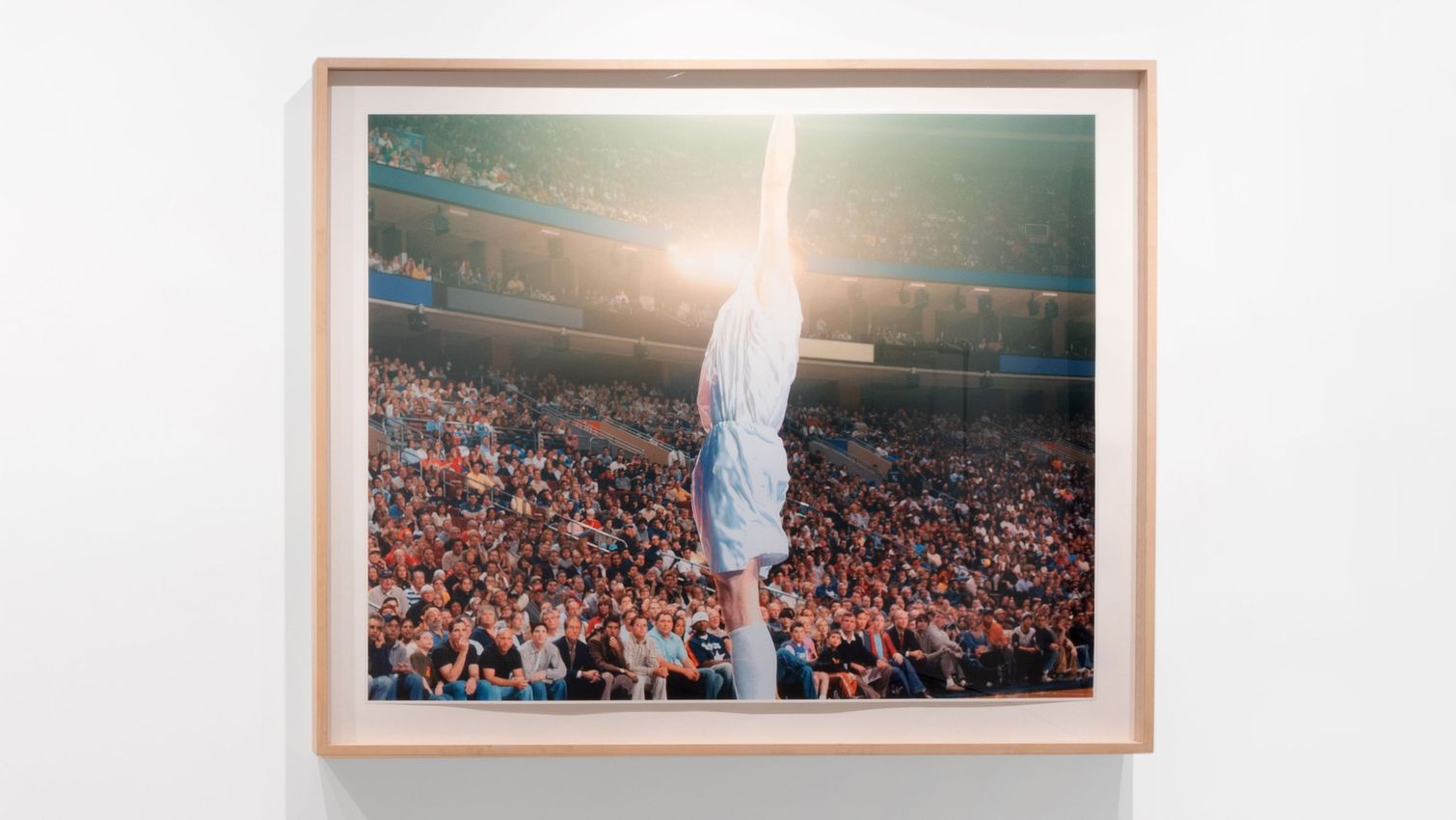
In 2000, Pfeiffer’s early work, Fragment of a Crucifixion (After Francis Bacon) (1999), won him the Whitney’s first Bucksbaum Award. Referencing Francis Bacon‘s 1944 crucifixion triptych, the work presented a scene from a televised basketball game, in which many of the players are rendered as ghostly figures.
Paul Pfeiffer Artworks
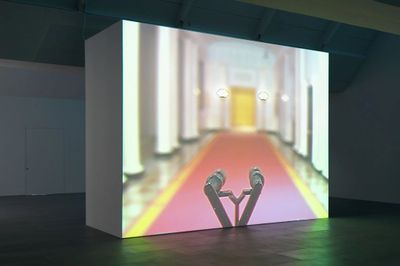
Paul Pfeiffer’s audiovisual installations combine video, photography, sculpture, and sound, using custom-modified screens and projectors built from outdated technology to present altered footage from sports, concerts, publicity images, and game shows, where he isolates and intensifies moments of mass media spectacle by digitally subtracting or “camouflaging” key visual information.
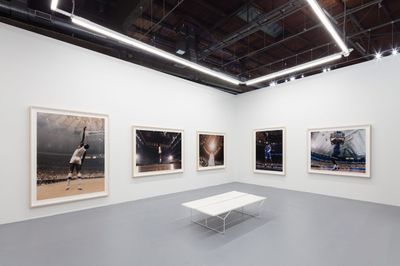
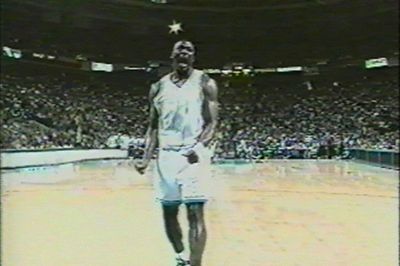
In his ongoing photographic series Four Horsemen of the Apocalypse (2000–2018), Pfeiffer reworks publicity and NBA images by masking out contextual details such as other players, jersey numbers, and branding, leaving a lone, often anonymous figure suspended within a seething crowd—a strategy he has described not as erasure but as camouflage. This approach extends to video pieces like John 3:16 (2000), where 5,000 frames of a televised basketball game are digitally edited so that only the ball and the players’ hands remain, forcing viewers to track its frantic movement on a miniature LCD screen. In the long-running video series Caryatid (2003–ongoing), sports footage is shown on modified retro televisions; in one work, Pfeiffer removes the hockey players from a Stanley Cup victory so the trophy appears to float above the crowd, while later works depict boxers staggering as if hit by invisible opponents. Beyond sport, he applies the same meticulous post-production to footage of Michael Jackson onstage or contestants on The Price Is Right, using digital alteration to push familiar figures and formats toward something uncanny and more-than-human.
Awards and Accolades
Pfeiffer’s art has earned him various accolades, including the Whitney Museum of American Art‘s Bucksbaum Award (2000), The Alpert Award in the Arts in Visual Arts (2009), and fellowship with the American Academy in Berlin in 2011. His work features in major public collections including the Museum of Modern Art, New York; the Guggenheim, New York; Museum of Contemporary Art Chicago; and MUSAC in León, Spain.
Exhibitions
Pfeiffer has been the subject of both solo exhibition and group exhibitions in important institutions.
Solo exhibitions include Desiderata, Perrotin, Paris (2018); Paul Pfeiffer: Screen Series, Museum of Contemporary Art Chicago (2017); Paul Pfeiffer: Caryatids, Honolulu Museum of Art (2016); Vitruvian Figure, Museum of Contemporary Art and Design, Manila (2015); Paul Pfeiffer: The Saints, Hamburger Bahnhof — Museum for Contemporary Art, Berlin (2009); and Morning after the Deluge, National Gallery of Victoria, Melbourne (2005).
Group exhibitions include Once Upon a Time Inconceivable, Protocinema, Istanbul (2021); Picture Industry: A Provisional History of the Technical Image, 1844—2018, LUMA, Arles (2018); The Beautiful Game, Los Angeles County Museum of Art (2014); The Luminous Interval, Guggenheim Museum Bilbao (2011); The Gold Standard, MoMA P.S.1, New York (2006); Bitstreams, The Whitney Museum of American Art, New York (2001); and Picturing Asia America: Communities, Culture, Difference, Houston Center for Photography, Houston, TX (1994).
Further Reading
In 2024, Ocula reviewed the artist’s extensive solo at MoCA’s Geffen building, Prologue to the Story of the Birth of Freedom, which brought together monumental installations, roaring soundscapes, large-format photography, and tiny flickering films.
Paul Pfeiffer FAQs
What is Paul Pfeiffer best known for?
Paul Pfeiffer is best known for digitally manipulating footage from sports, concerts, films, and television to create “video sculptures” that isolate moments of extreme emotion and spectacle. By erasing or “camouflaging” key figures and contexts, he exposes how mass media images shape desire, belief, and collective identity.
What themes does Paul Pfeiffer explore in his art?
Pfeiffer’s work explores the politics of spectatorship, the construction of celebrity, and the rituals of sport and religion in a media-saturated culture. His recurring interests include nationalism, race, masculinity, and the way images of athletic and pop-culture performance become modern forms of devotion and myth.
What are Paul Pfeiffer’s most important works and series?
Paul Pfeiffer’s key works and series include Fragment of a Crucifixion (After Francis Bacon) (1999), The Long Count (2001), the photographic series Four Horsemen of the Apocalypse (2000–ongoing), and the video series Caryatid (2003–ongoing). These works re-edit basketball, boxing, and other mass-media events to loop, magnify, or empty out familiar images, turning them into unsettling studies of power, faith, and spectatorship.
Where can I see Paul Pfeiffer’s work?
Paul Pfeiffer’s works are held in major museum collections, including the Whitney Museum of American Art, The Broad in Los Angeles, and other leading institutions in the United States and Europe. His touring survey exhibition Prologue to the Story of the Birth of Freedom has been presented at The Geffen Contemporary at MOCA Los Angeles, the Guggenheim Museum Bilbao, and the Museum of Contemporary Art Chicago.
Why is Paul Pfeiffer considered an important contemporary artist?
Paul Pfeiffer is widely regarded as a key figure in contemporary media art for the way he uses digital erasure and looping to reveal the hidden mechanics of spectacle and image worship. By dissecting familiar broadcasts frame by frame, he offers a precise, critical lens on how global audiences are produced and controlled through televised sport, celebrity culture, and mass entertainment.
Ocula | 2026
Recently Exhibited


Exhibiting Elsewhere








Paul Pfeiffer in Ocula Magazine









Explore and Follow Artists Shaping Contemporary Art
A respected voice in contemporary art discourse.
Focusing on ambitious storytelling and insightful art-world commentary. Ocula Magazine publishes in-depth interviews, critical essays and timely analysis on the artists, exhibitions and ideas driving the global art world.
Learn more about Ocula Magazine
Showcasing the best of the art world.
Ocula partners with galleries from around the world to highlight their artists, artworks and exhibitions. Gallery membership is by application and invitation, with each member vetted by an independent panel.
Learn more about Ocula Membership
Specialises in the sale of major artworks.
Led by a team with deep ties to the world’s leading auction houses, galleries and collectors. Ocula’s advisory team offers bespoke services to high-net-worth clients from around the world who are looking to acquire the best of contemporary and modern art.
Learn more about our team and services