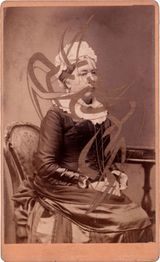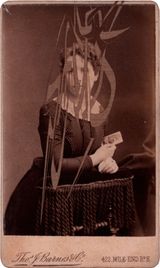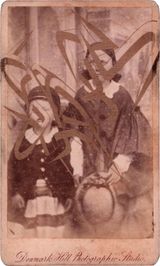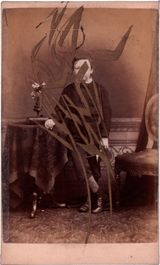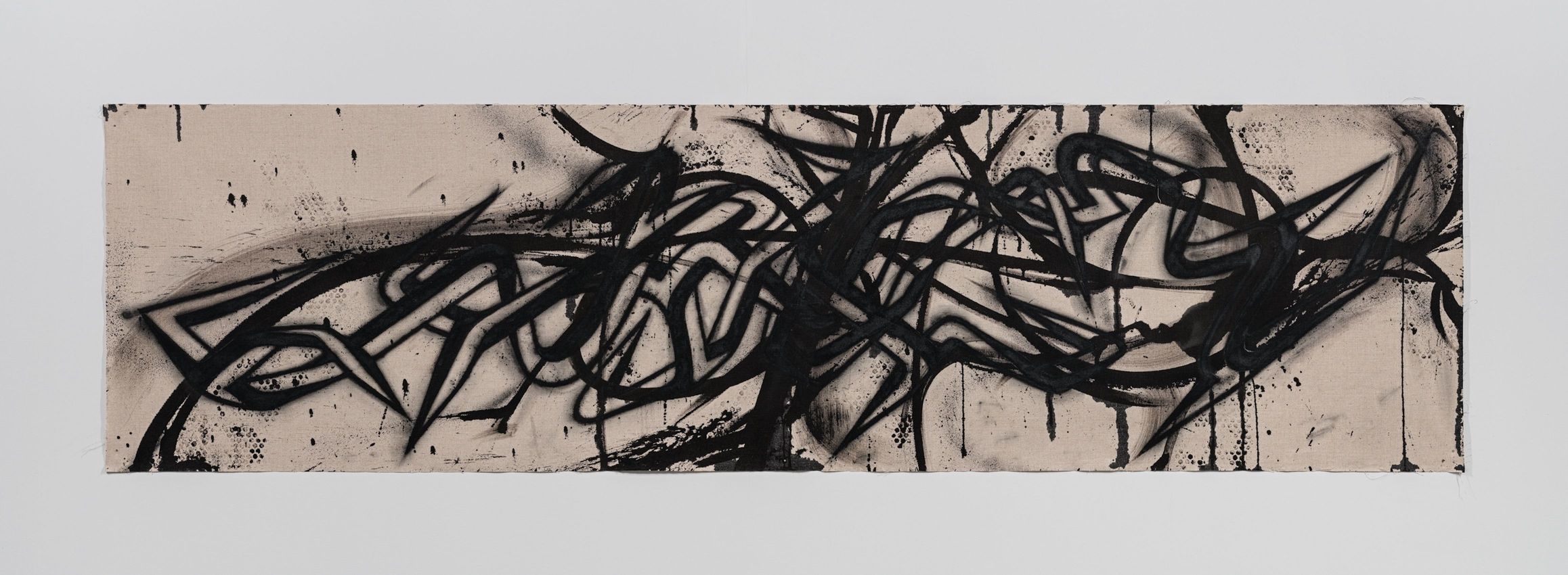
Grounded in the historical paradigm of Western painting, long structured around direct contact between tool and surface, contemporary painting has increasingly recognized that the evolution of formal vocabularies alone can no longer adequately address its present condition. Critical attention has therefore shifted toward the circumstances through which painting is constituted. In response, Japanese Italian artist Enrico Isamu Oyama draws upon his long-standing engagement with aerosol writing, translating it into a painterly methodology that reframes painting not as the product of a singular, fixed set of determinants, but as a process continuously examined through shifting material states and situational variables. Presented as Oyama’s first solo exhibition in Taiwan, Aerosolic Forms positions the works as points of entry, inviting viewers to encounter painting as an unfolding field of inquiry rather than a resolved image.
Born in Tokyo and working between New York and Tokyo, Oyama’s practice encompasses painting, sculptural installation, and site responsive works, and is rooted in a sustained investigation into the relationships between writing, line, and bodily action. Within this framework, aerosol paint has emerged as one of his primary media, not merely as a tool, but as a condition that fundamentally reconfigures how painting operates. Released through atomization, pigment no longer reaches the surface through liquid contact. Instead, it disperses into minute particles suspended in the air, gradually settling in response to airflow, distance, and environmental forces. Prior to deposition, pigment remains in continual flux, rendering time, atmosphere, and spatial conditions integral to the formation of the work. Painting thus shifts away from the primacy of manual control, unfolding through the modulation of multiple interdependent variables, while retaining an irreducible element of unpredictability shaped through ongoing negotiation between surface, medium, and environment.
This approach extends Oyama’s long standing engagement with aerosol writing, furthering his inquiry into how writing, once disentangled from semantic meaning and legibility, may persist as visual action. Aerosolic Forms do not prescribe a trajectory to be followed, but gestures toward indications that gradually come into visibility through process. The exhibition thereby advances a fundamental inquiry into the formation of painting itself. When line no longer arises from direct contact between brush and canvas, how can painting be constituted through the interplay of material, distance, and time?
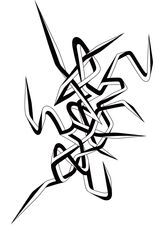
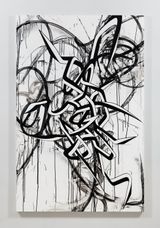
Within this trajectory of practice, Oyama has developed his core visual motif, Quick Turn Structure, as a response to the inherent indeterminacy of aerosol as a medium. Rather than originating from algorithmic form or fixed technique, this structure draws from the arcs, velocities, and abrupt directional shifts generated by bodily movement through space. As movement, distance, and material conditions shift, line unfolds accordingly, producing variations in direction, density, and rhythm. Through successive layers of spraying, accumulation, and reduction, these lines gradually build into thickened structures that articulate relationships between positive and negative space. Vision is correspondingly reoriented, moving between interior and exterior as it navigates overlaps, turns, and layered depth. Here, the canvas becomes a site for examining how painting itself takes shape.
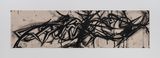
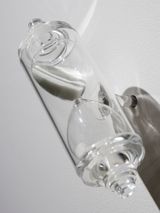
In Aerosolic Forms, Oyama juxtaposes aerosol, ink, laser inscription, and installation, allowing his methodology to articulate across differing material configurations. In FFIGURATI #655, a polished surface combined with aluminum paneling provides relatively stable conditions for aerosolized pigment to accumulate into clearly legible layers. By contrast, FFIGURATI #890 employ untreated canvas, where pigment oscillates between absorption, diffusion, and deposition, with density and texture emerging through the material’s responsiveness. FFIGURATI #777 further extends the logic of non-contact, as laser inscription allows form to emerge through energy modulation and the passage of time rather than physical imposition. Across these practices, particulate matter lingers in mist before settling, producing directional suggestions that remain provisional and unresolved. In this exhibition, painting no longer presents itself as a completed form, but as a condition continually in the making. Line gathers and disperses within the gaps between distance and time, guiding perception through shifts in density, rhythm, and direction without promising arrival. Released from the confines of the planar surface, painting unfolds alongside space, time, and the body, becoming a way of seeing suspended within mist.

A respected voice in contemporary art discourse.
Focusing on ambitious storytelling and insightful art-world commentary. Ocula Magazine publishes in-depth interviews, critical essays and timely analysis on the artists, exhibitions and ideas driving the global art world.
Learn more about Ocula Magazine
Showcasing the best of the art world.
Ocula partners with galleries from around the world to highlight their artists, artworks and exhibitions. Gallery membership is by application and invitation, with each member vetted by an independent panel.
Learn more about Ocula Membership

Specialises in the sale of major artworks.
Led by a team with deep ties to the world’s leading auction houses, galleries and collectors. Ocula’s advisory team offers bespoke services to high-net-worth clients from around the world who are looking to acquire the best of contemporary and modern art.
Learn more about our team and services