




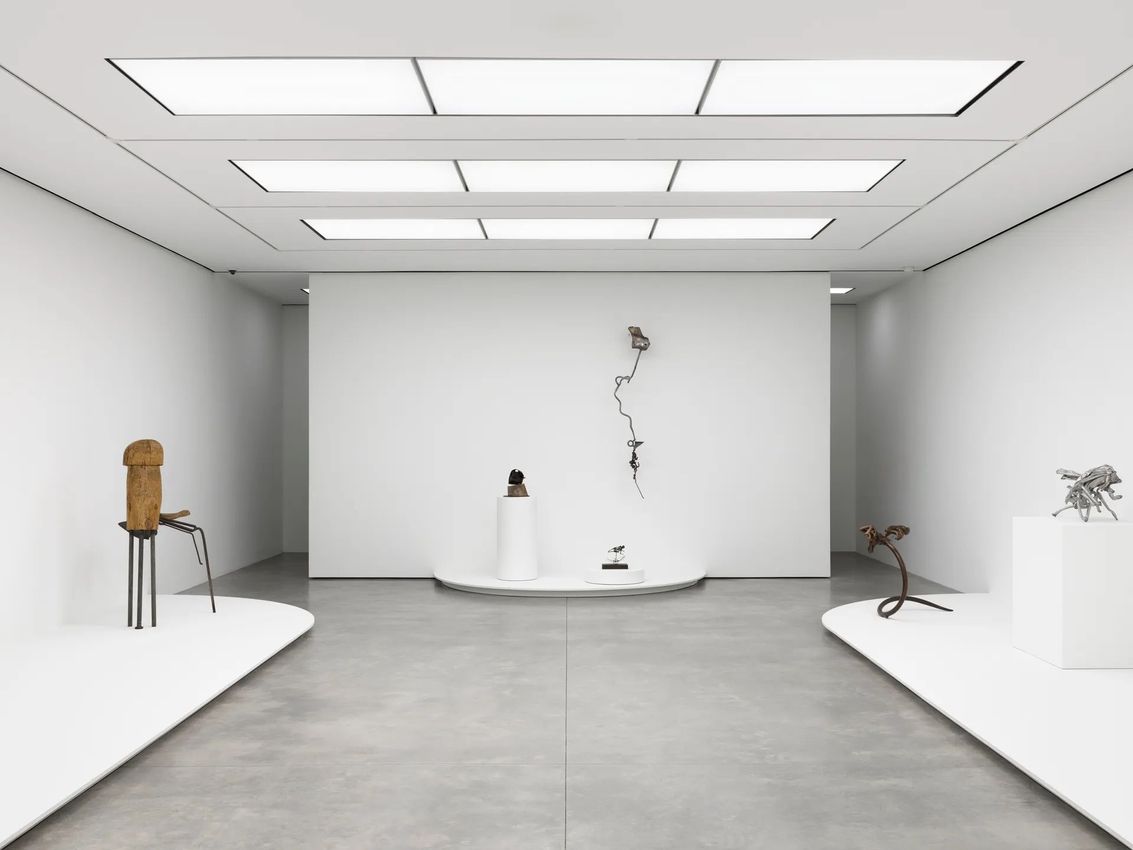
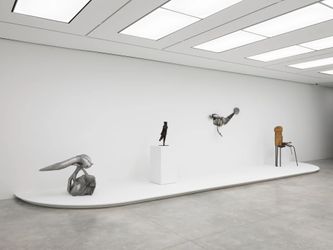
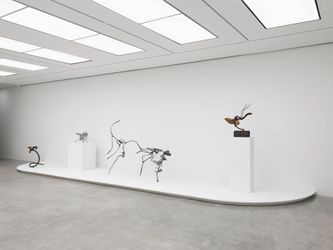
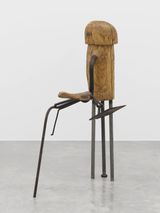
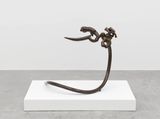
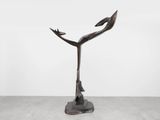
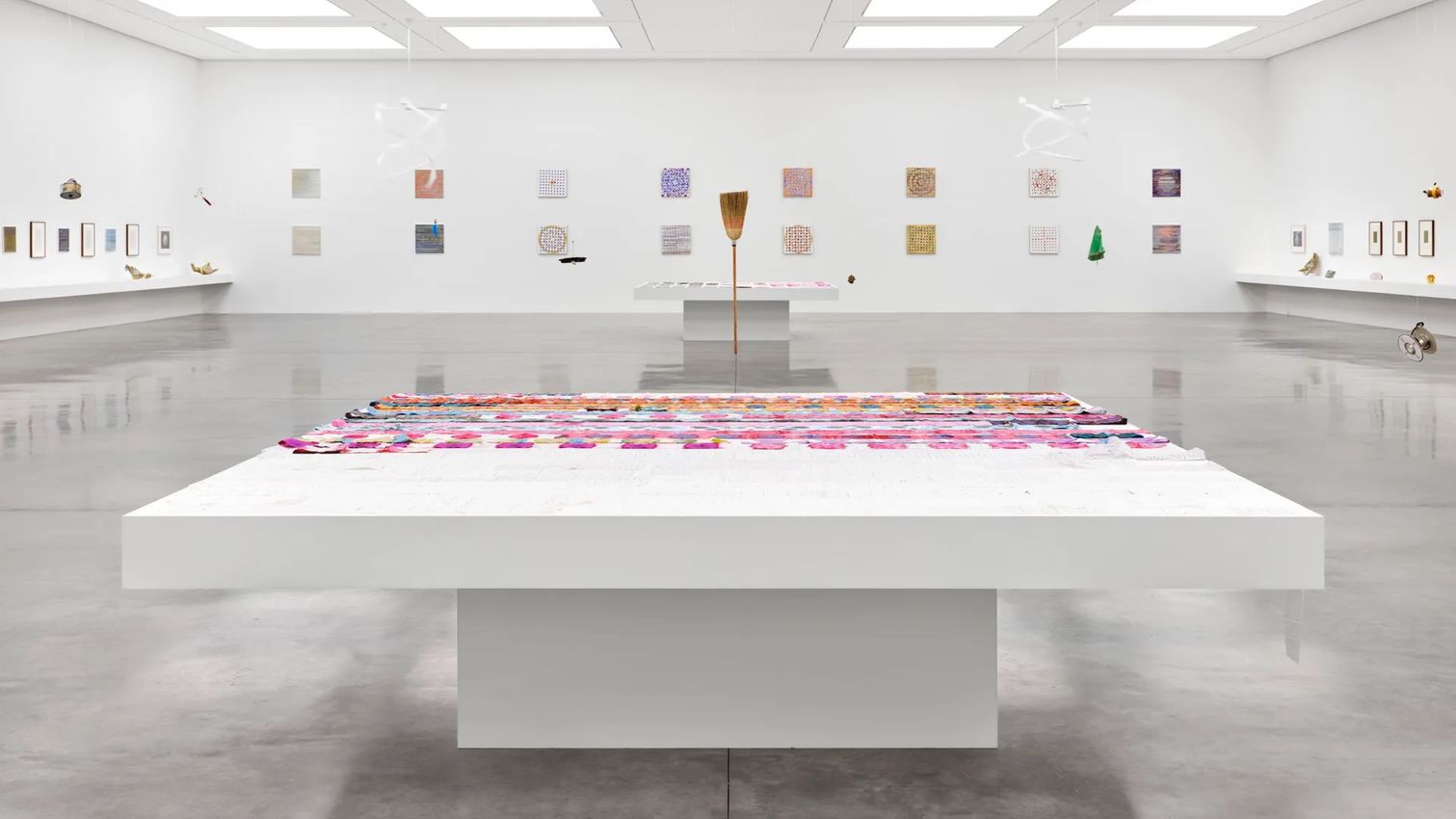
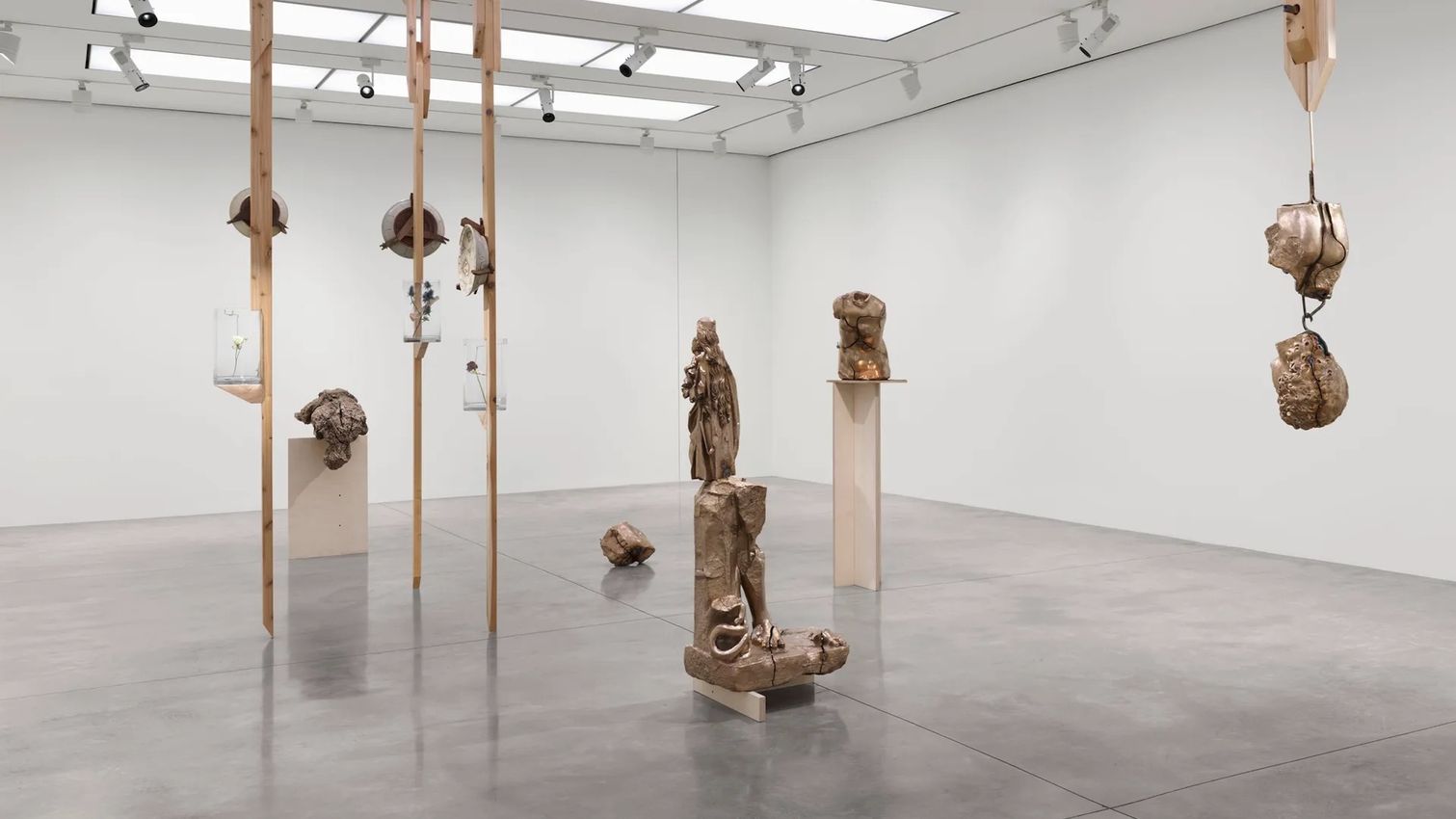
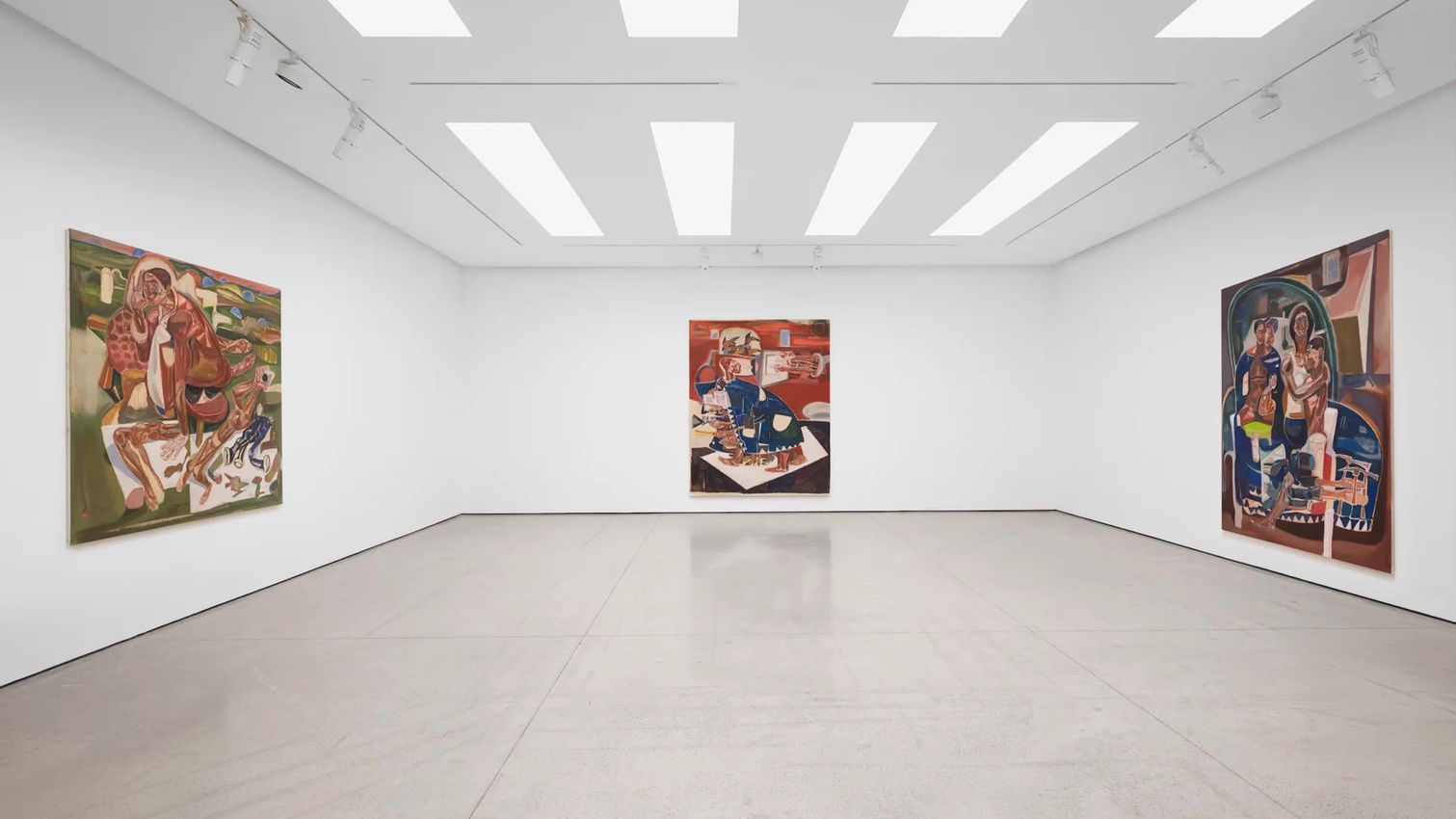
Honouring the life and legacy of American sculptor Richard Hunt (1935–2023), White Cube New York is pleased to present ‘Early Masterworks’, an exhibition bringing together 25 of the artist’s seminal sculptural works created between 1955 and 1969 – a fertile and critical period during which Hunt innovated the material techniques that would remain central to his prolific seven-decade-long career, immortalising him as one of the foremost sculptors of the 20th and 21st centuries. ‘Early Masterworks’ marks the largest gathering of Hunt’s works in New York since his landmark solo retrospective at the Museum of Modern Art in 1971.
In 1953, after receiving a scholarship at the prestigious School of the Art Institute of Chicago (SAIC), Hunt encountered the work of Spanish sculptor Jose González, whose metal welding techniques profoundly influenced the young artist, providing him with an innovative means to cultivate growth and renewal through the deft handling of unyielding metal. Utilising materials salvaged from alleys and local scrapyards in Chicago, Hunt began to apply his sculptural practice to reconciling the natural and the industrial, employing his self-taught welding technique to create fluid, organic forms suggestive of biomorphic growth. In a statement from 1957, the artist, at just 21 years old, expressed, ‘I hope the resultant constructions exhibit an organic presence of life which the use of vigorous technique is designed to create. [...] It is not possible to set down a clear outline for future work, for it seems that each new work suggests another either isolated in style and idea or as a developable series. I can only say that at present I wish to treat my materials (steel and space) in increasingly expansive terms.’[1]
Through metal, Hunt engaged in an iterative process – trialling, refining and rearticulating thematic threads, techniques of expansion and trajectories of metamorphosis. While early explorations included a fusion of metal and wood, as realised in works from his 1956 series such as Construction D, Construction N and Construction S, he later devoted himself exclusively to working with metal. These early masterworks are distinguished by characteristics located within distinct series, which equally overlap, build upon and engage in a dialogue with other works – from those rooted in classical and mythological themes and early 20th century Primitivism, to expressions of linear-spatial expansion, moving into the latter half of the 1960s towards more monolithic and enclosed forms, as exemplified by Figure Form (1966) and Stretch__(1969).
In 1955, at the age of 19, Hunt witnessed the open-casket funeral of Emmett Till – a young African American from Chicago whose brutal, racially-charged murder became an enduring symbol of the civil rights movement. Marking a critical turning point in Hunt’s artistic journey, he created two works in direct response to the event: Prometheus__(1956), where Till’s suffering is linked to the mythic narrative of the god of fire, who endured eternal condemnation at the hand of Zeus, and Hero’s Head (1956), immortalising the image of Till’s disfigured head through welded steel. Through the allegorical narratives of mythology – of indiscriminate punishment and metamorphic transformation – Hunt found a way to reconcile the darker realities of contemporary America. In his later career, Hunt reflected, ‘My own use of winged forms in the early ‘50s is based on mythological themes, like Icarus and Winged Victory. It’s about, on one hand trying to achieve victory or freedom internally. It’s also about investigating ideas of personal and collective freedom. My use of forms has roots and resonances in the African-American experience and is also a universal symbol.’[2]
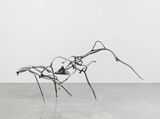
Hunt’s lifelong interest in mythology finds further expression in Linear Peregrination (1962), an expansive, open-form steelwork belonging to the artist’s ‘Metamorphosis’ series. Inscribing space through a meandering trinity of points, the sculpture’s chromed armature assumes the abstracted shape of a bovine, drawing dual inspiration from Picasso’s 1942 found-object sculpture, Bull’s Head, while referencing the Greek myth of Europa and the Bull. Representing the largest ‘drawing in space’ created by Hunt in the 1960s, Linear Peregrination‘s winding metal odyssey probes space in ways unattainable with other materials, subverting traditional sculptural modalities to expose its exterior parameters and voided spaces as an analogous interface.
Created in the same year, Organic Construction, Number 1 (1962) continues Hunt’s explorations with linear-spatial configuration, shaping a protracted, lateral form that extends through space, favouring horizontal expansion over vertical height. ‘I like the idea of creating this extension rather than having to grow up from the base more vertically’, Hunt noted. The sculpture’s central and sole point of vertical progression converges on two thick horns that create the composition’s balance. Demonstrating Hunt’s proclivity for disassembling and reassembling parts of old works, the horns are inherited from the artist’s earlier 1959 sculpture Longhorn__– created in San Antonio, Texas. The work was dismantled, and its parts reused and grafted to cultivate new, hybrid shapes, which became some of Hunt’s most notable sculptures. Elicited through the titular word ‘construction’, _Organic Construction___suggests a material and discursive life in constant evolution – fully realised yet maintaining an openness to further growth.
In the mid-1960s, Hunt began to explore more homogenised, enclosed forms, moving away from the calligraphic style of the linear-spatial sculptures. Produced within this transitional period, _Opposed Forms _(1965) embodies composite conditions, in which rounded, organic shapes cohere with constellations of axial geometry. A chrome-patinated bodily mass rests upon three attenuated legs of wrought steel, evoking a life form that appears almost otherworldly. Synthesising volumetric density and the delicacy of sculptural drawing in space, _Opposed Forms___tethers Hunt’s varying stylistic influences – from elements of the machine-made, to forms inspired by Surrealism, science fiction and biomorphic growth.
Exploring the possibilities of diverse metals, including copper and aluminium, as observed in Coil__(1965) and Tube Form (1966), as well as techniques of casting, showcased in Serpentine__(1969) – one of the first works the artist cast in America – Hunt’s progression into the 1970s laid the foundations for his later large-scale public installations. From his formative student years at the SAIC to the monumental, commissioned works exhibited in institutions across the United States, Hunt’s protean experimentations in scale, material, composition and subject matter collectively form the epic odyssey of an inimitable sculptor.


In the pantheon of 20th-century sculptors, Richard Hunt stands as one of the preeminent masters. Working predominantly in metal, the artist employs an alchemist’s touch to shape, cut, weld or cast his various materials, into sculptures whose fluid, biomorphic forms emerge as if shaped directly from nature. Hunt’s hybrid creations are characterised by a reconciliation and harmonisation of the vital tensions that exist between dualities – the natural and the industrial, the surreal and the abstract, the geometric and the organic. At the core of Hunt’s artistic and philosophical approach is a fundamental concern with freedom; of political and artistic freedom, as well as personal and universal freedom: ‘I am interested more than anything else in being a free person. To me, that means that I can make what I want to make, regardless of what anyone else thinks I should make.’
An international art powerhouse, White Cube was established in 1993 in London by art dealer Jay Jopling. In its space on Duke Street, it served as the early exhibition venue for many now internationally acclaimed British artists, including Tracey Emin, Gilbert & George, Rachel Kneebone and Antony Gormley, who still show with the gallery today.

A respected voice in contemporary art discourse.
Focusing on ambitious storytelling and insightful art-world commentary. Ocula Magazine publishes in-depth interviews, critical essays and timely analysis on the artists, exhibitions and ideas driving the global art world.
Learn more about Ocula Magazine
Showcasing the best of the art world.
Ocula partners with galleries from around the world to highlight their artists, artworks and exhibitions. Gallery membership is by application and invitation, with each member vetted by an independent panel.
Learn more about Ocula Membership

Specialises in the sale of major artworks.
Led by a team with deep ties to the world’s leading auction houses, galleries and collectors. Ocula’s advisory team offers bespoke services to high-net-worth clients from around the world who are looking to acquire the best of contemporary and modern art.
Learn more about our team and services