Press Release

When the people talk about Yukihisa Isobe, the best-known artwork is his ecological art Where has the river gone?. With the yellow flags floating on the still green filed, and the brown land becoming like a canvas, these bright, eye-catching colours lined out the winding road and marked out a history channel of the Shinano River. Where has the river gone? is one of Isobe’s iconic creations after his passionate devotions in Ecology whereas his early study was actually in fine art. Fram Kitagawa, the curator of the Echigo-Tsumari Art Triennale, once said: what Isobe currently does is exactly what I am longing for which art is a status quo between the relationship of the natural world and the human civilisation.

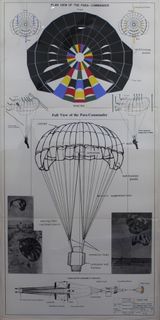
In 2018, the grand opening of ‘Yukihisa Isobe Memorial Echigo-Tsumari Kiyotsu Soko Museum of Art’ featured the artist’s works over the years, including not only his ecological arts but also his oil paintings, Wappen Series, and the plans of parachute project. Since his exceptional and outbreaking turning points, many audiences were astonished by his dynamic career paths. Yukihisa Isobe was born in 1935 Tokyo and later got accepted into Tokyo University of the Arts; therefore, he learned oil paintings under Ryohei Koiso and joined the Demokrato Artists Association [1] which is founded by Ei-Q, a mixed media artist. Then subsequently, Isobe participated in several times of the ‘Yomiuri Independent [2],’ which was an exhibition attracted to many Avant-Garde artists. He also set out an atelier in Aoyama and tried to make a lithograph there. Influenced by the European arts and Ei-Q, his oil painting style gradually became abstract and led to getting a rejection of his graduation project from the school committee, resulting in his delayed completion of degree works.

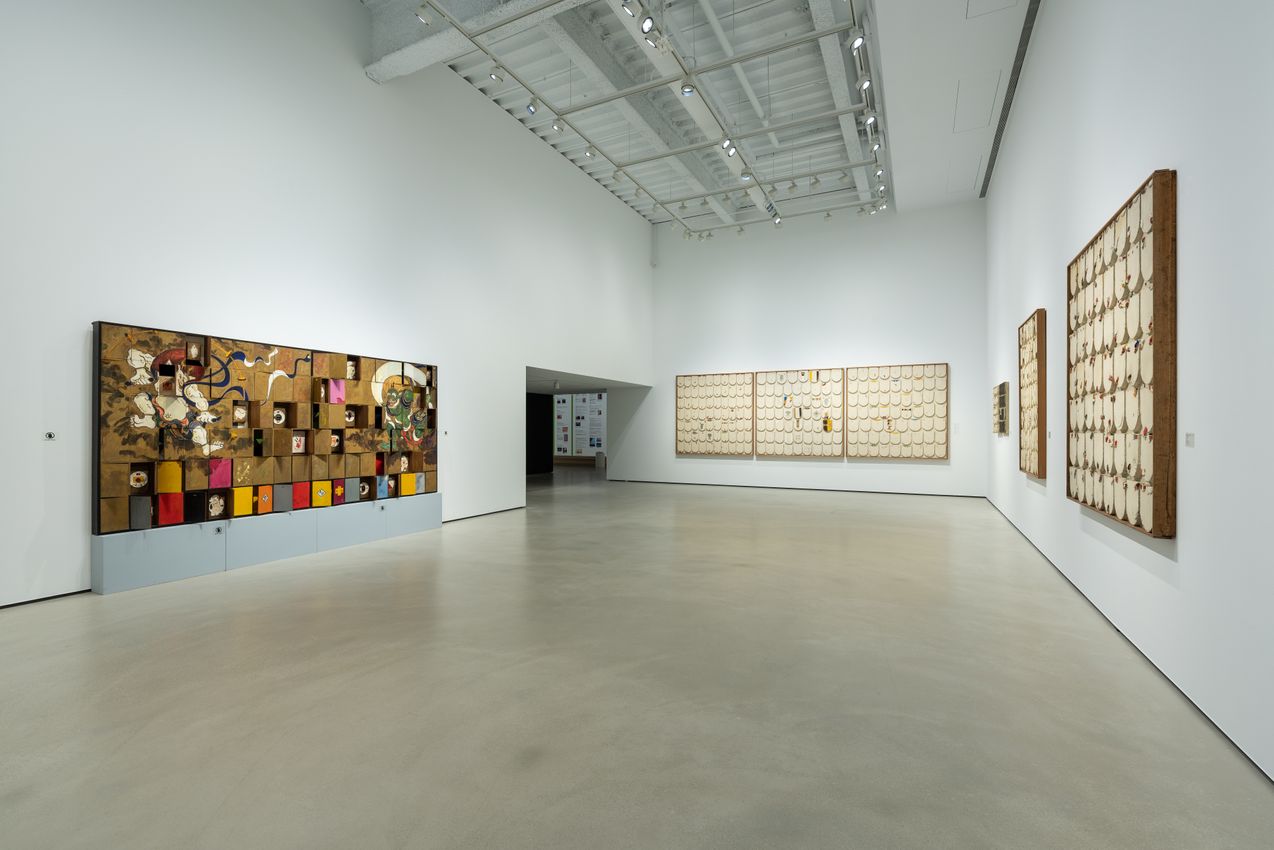
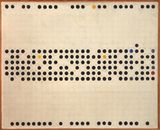
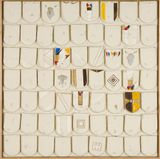
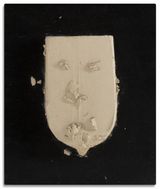
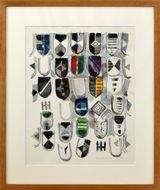
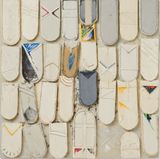
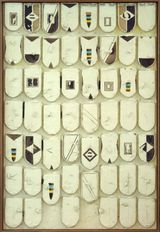
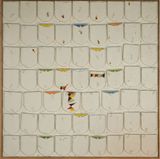
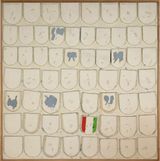
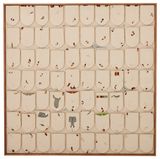
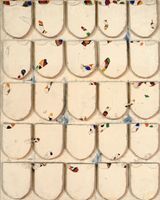
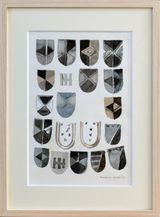
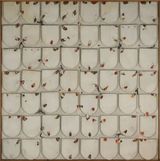
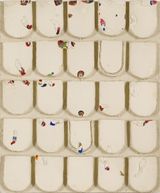
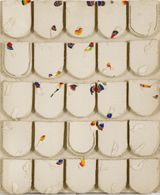
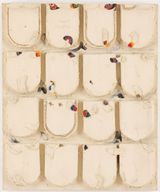
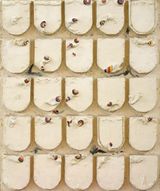
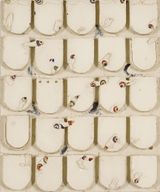
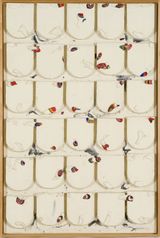
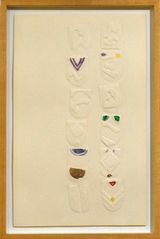
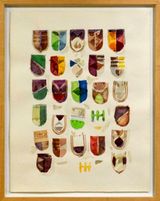
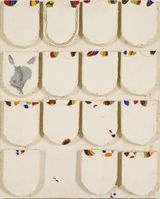
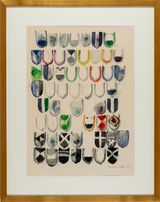
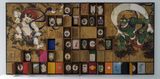
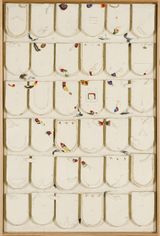
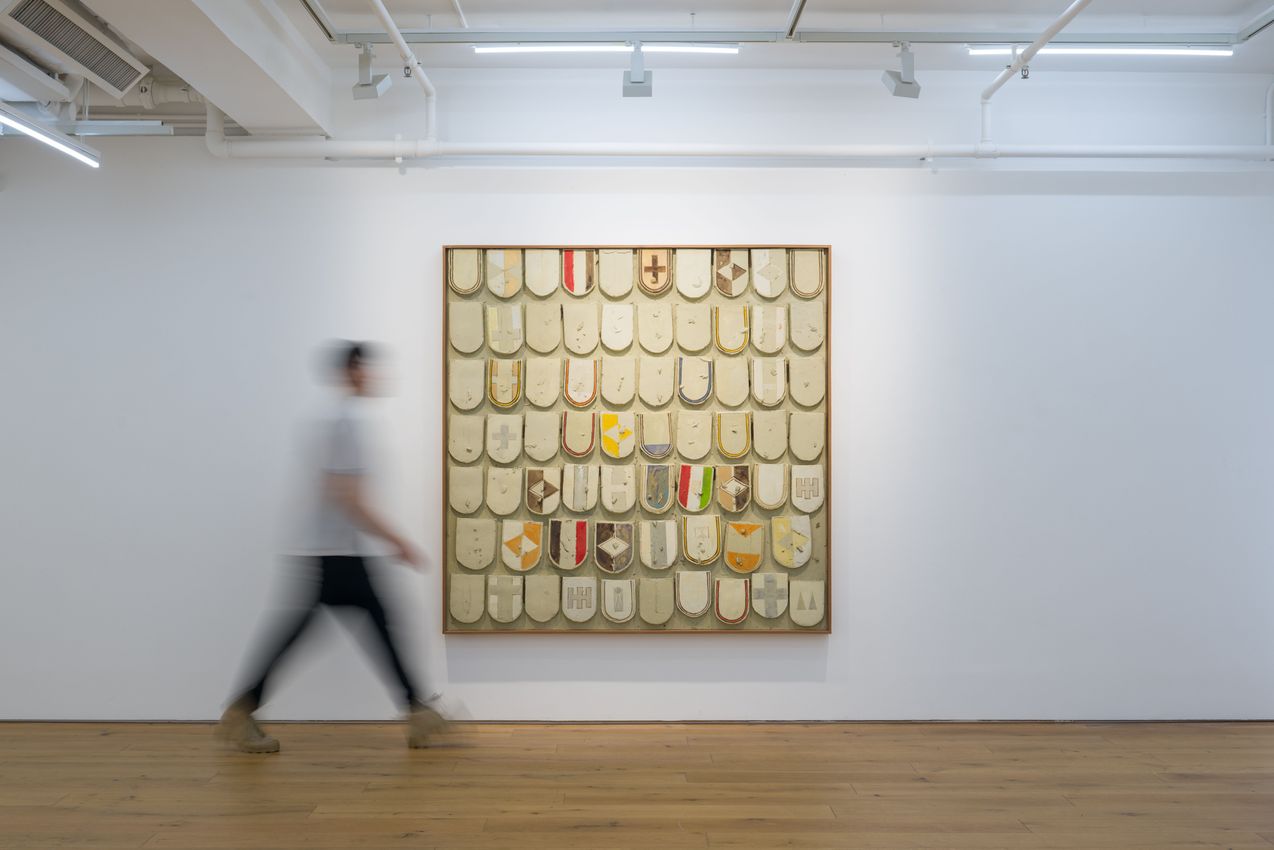
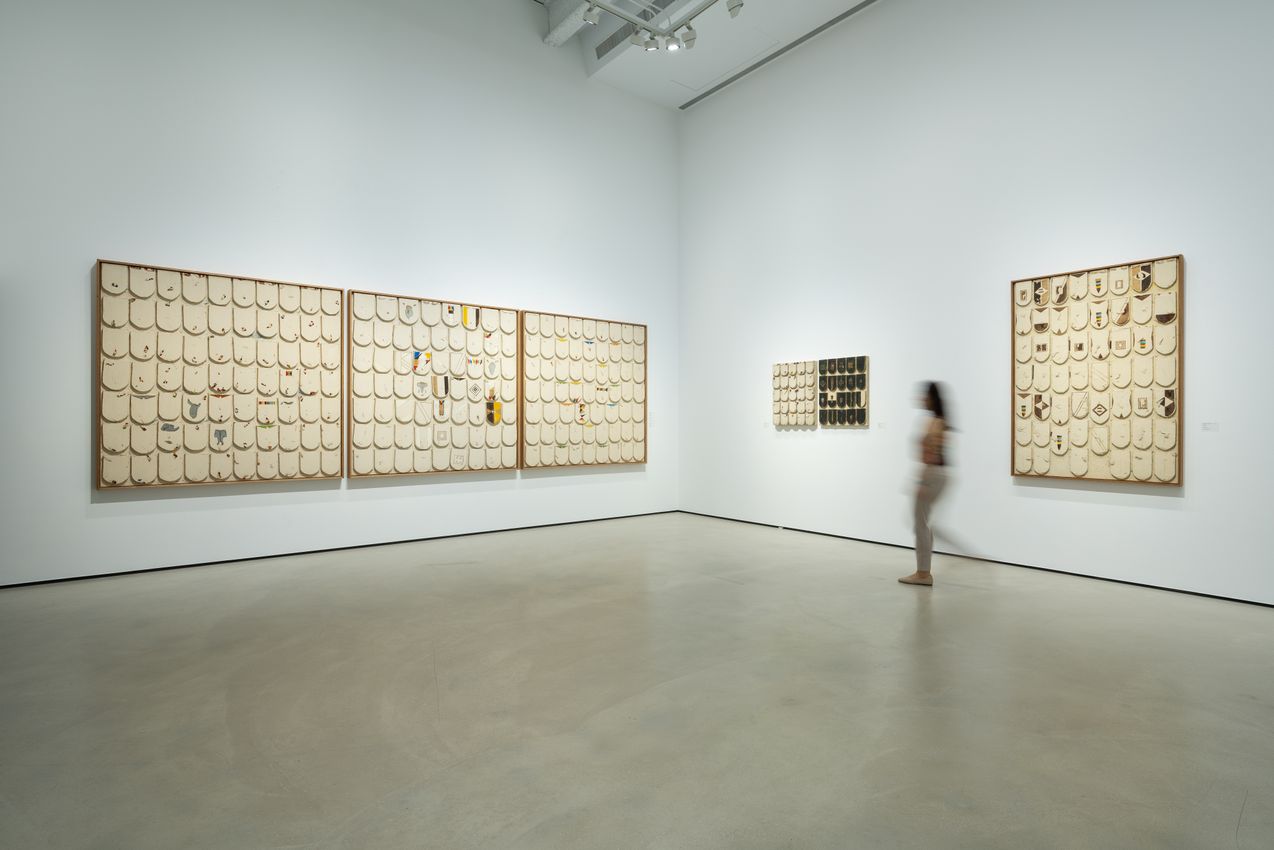
His representative works from 1961 to 1965 were made mostly from stone dust and decorated with repetitive Wappen elements. Having the opportunity to create a gigantic public works result from his unique Wappen characteristic which is easily associated with the style prevalent in the 50s, Ivy Style, repetitive of common literal symbols, fresco textures, and embossment structures. All these combinations echoed each other and successfully caught people’s eyes worldwide. Later, he created a giant wooden box which was functioned like a surprise box. He filled up spaces with daily collections of business logos, cards, prints, and wappens which were mass-produced from the modernisation. The front of the box was inspired by Sotatsu Tawaraya’s [3] Wind God and Thunder God and Modern Japanese Artists. There are two different time zones crossing and responding to each other: the modernisation period and the modern time of Japan. Since both of them could not be seen through on one surface, it triggers audiences’ curiosities and the desire to open and interact with the box. Even from nowadays, 2020, we still could peak the society back then through Yukihisa Isobe’s works.

Yukihisa Isobe moved to the United States for almost eight years, after his 1965 solo exhibition in Europe, and has a great impact on the rest of his career in art. For First Earth Day, he used air circulation concept and parachutes to make a ‘floating sculpture’, which opened a door for him to learn ecology. He later studied a master’s degree in Ecology from the University of Pennsylvania. Shifting his focus to the ecology, he intended to raise people’s awareness of environmental changes and visualise the issues. He returned to Japan in 1974, and still keep exhibiting his ecological arts while entrusted by the Japanese government to investigate the environment and teaches at the Tokyo Institute of Technology at the same time.

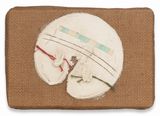
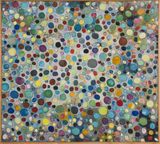
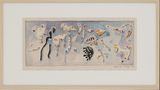
Whitestone Gallery Taipei is honoured to hold Yukihisa Isobe’s first solo exhibition, a retrospective, in Taiwan. It will feature almost forty artworks from the 1950s to 1960s, including oil paintings with his graduation project, Wappen Series, as well as a wooden box work. Artworks from his other stages are exhibited by showing early and recent photos presented by the artist.

  1. The Demokrato Artists Association founded by Ei-Q, as a leader, with Shigeru Izumi, Yoshio Hayakawa in 1951 and disbanded in 1957. The association rejected the authoritarianism of art and advocated the spirit of an independent. The association opened to art critics, designers and was not limited to artists. Sadashiro Kubo, Masuo Ikeda, Ay-O, and Yukihisa Isobe later entered the association.
  2. ‘Yomiuri Independent’ was hosted by the Yomiuri Shimbun and Tokyo Metropolitan Art Museum from 1949 to 1963 with a review free format, which provided opportunities for avant-garde artists to present their works.
  3. Sotatsu Tawaraya was active in the seventeenth century and was one of the most influenced artists, an iconic Rinpa School artist. His Wind God and Thunder God is chosen as a Japan national treasure.
Read More

Installation Views

Selected Works

Loading...
About the Artist

Yukihisa Isobe started his career as an artist, and shifted his interest to architecture and ecological planning. He is recently working as an environmental artist. He produced works that were composed of repeated emblem motifs in the early 1960s. These works consist of textures and three-dimensional structures like fresco paintings. The composition formed by irregularly repeated colors is very different from automatic repetition and multiplication that are typical in the pop art of the same generation; it is Isobe’s unique structure of repetition in abstract form. Isobe’s abstract expression incorporates symbolism of substance, repetition and mass productivity that are often seen in pop art, but reconstruct them beyond the boundary. With this, Isobe pioneered a new genre, a fusion of abstractionism and pop art. Isobe moved to New York in 1965. He produced Parachute Canopy Project (1969), in which parachutes were flown in the air to create various forms by wind directions, and installed Air Dome (1970) on the Earth Day. Since 1970 his interest gradually shifted to the environment and city planning. From 1990s when he restarted creating works to today, Isobe has been active as an environmental artist, producing land art works with themes of local communities and natural environment. He continues to create and exhibit works on the stage of Earth, literally.

View Artist Profile

Also Exhibiting

About the Gallery

Established in 1967, Whitestone Gallery is a leading Japanese gallery presenting a broad spectrum of Japanese art from the post-war to contemporary in spaces across East Asia.

View Gallery Profile
Address
1F, No. 1 Jihu Road
Neihu District
Taipei
Taiwan
Opening Hours
Tuesday – Saturday
11am – 7pm
(1)
Taipei 1F, No. 1 Jihu Road, Neihu District
Whitestone Gallery
1F, No. 1 Jihu Road, Neihu District, Taipei, Taiwan

Opening hours
Tuesday – Saturday
11am – 7pm
The art world in focus