

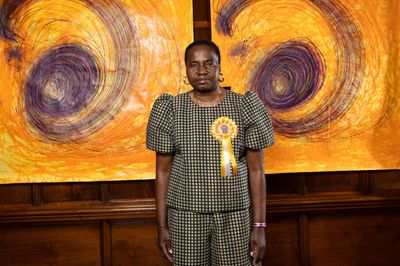
MOHAMMED SAMI
Mohammed Sami’s paintings explore the way time shapes memory. Inspired by his own lived experience of the trauma of conflict, yet eschewing stereotypical representations of turmoil, his unpeopled, seemingly ambiguous paintings of everyday scenes slowly, astutely reveal the emotional and physical impact of war.
Early Years
Mohammed Sami was born in Baghdad in 1984, growing up during the aftermath of the Iran-Iraq conflict. He studied drawing and painting at the Institute of Fine Arts in Baghdad, graduating in 2005. Sami worked for the Ministry of Culture, cataloguing artworks that had been stolen from the Centre for Contemporary Art in Baghdad after the US-led invasion of Iraq in 2003—a job that carried considerable risk, and gave Sami a minor stroke when he was aged only 22. The artist left Iraq in 2007, emigrating to Sweden. He then moved to Northern Ireland, graduating with a BA in fine art from the Belfast School of Art in 2016 and gaining his MFA in fine art from Goldsmiths in London in 2018.
Mohammed Sami: Artworks
Mohammed Sami’s paintings can be viewed as an allegorical representation of violence and conflict, examining the concept of belated memories—sparked by everyday scenes and familiar objects—of the wars through which he lived. Notably, his pictures do not contain people. Sami steers clear of clichéd depictions of trauma, instead using a semi-abstract style of painting to articulate a relationship between memory and reality. “The power of the painting lies in evoking the presence of what is not there,” he said]0 in 2025.
- Unedited still-life (2018) won the Hottinger Prize for Excellence at FBA Futures in 2019. Depicting a table, broken crockery and a spoon that seemingly hangs in the air, the flattened dimensions of the artwork add additional perspectives to the scene and ask the viewer to consider absence and what has been destroyed. Sami painted Unedited still-life following a phone call from his mother in which she told him she had witnessed the violent death of a neighbour he had known in childhood.
- 23 Years of Night (2022) brings the viewer into a domestic space: we see a mirror reflecting a drawn curtain, while a window is boarded up. The image suggests a safe place while conflict rages somewhere outside; a stark contrast between peace and the unknown.
- Sami’s 2026 exhibition Vicious Circles showcased a new collection of mixed-media pieces, displaying the power of light and colour to imbue domestic objects and scenes with underlying fear and disquietude and bringing the viewer into a space that exists somewhere between the present and the absent.
Mohammed Sami: Select Exhibitions
Select Solo Exhibitions
- Hostless, Fridericianum, Kassel (2026)
- Vicious Circles, Modern Art, Paris (2026)
- Mohammed Sami, KM21, The Hague (2025)
- Mohammed Sami: To Whom It May Concern, Douglas Hyde Gallery of Contemporary Art, Trinity College, Dublin
- After the Storm: Mohammed Sami at Blenheim Palace, Blenheim Art Foundation at Blenheim Palace (2024)
- Mohammed Sami: Isthmus, Fondazione Sandretto Re Rebaudengo, Turin (2024)
- Mohammed Sami: Muzzle of Time, Luhring Augustine, New York City (2023)
- Mohammed Sami: The Point 0, Camden Art Centre, London (2023) (and touring)
- Mohammed Sami, Modern Art, London (2022)
- Mohammed Sami, JAMM Art Gallery, Kuwait (2013)
- Mohammed Sami: Case of Emergency, Galleri Dag Andersson, Norrköping (2012)
- Mohammed Sami, Al Khanji Gallery, Aleppo (2006)
- Mohammed Sami, Alwasity Gallery, Iraqi Ministry of Culture, Baghdad
- Mohammed Sami, University of Baghdad (1999)
Select Group Exhibitions
- A History of the Carnegie International, Carnegie Museum of Art, Pittsburgh (2026)
- Masquerade, Ostillo Art Foundation, Austin (2026)
- Diary of Flowers: Artists and their Worlds, MOCA Grand Avenue, Los Angeles
- Turner Prize, Cartwright Hall Art Gallery, Bradford (2025)
- Astrup Fearnley Collection, Astrup Fearnley Museet, Oslo (2025)
- Ensemble, The Perimeter, London (2025)
- Le monde comme il va/ The World As It Goes, Bourse de Commerce – Pinault Collection, Paris (2024)
- Is it morning for you yet?, 58th Carnegie International, Carnegie Museum of Art, Pittsburgh (2022)
- The London Open 2022, Whitechapel Gallery, London (2022)
- Mixing It Up: Painting Today, Hayward Gallery, London (2021)
- Timeout, Patrick Heide Contemporary Gallery, London (2020)
- The Sea is the Limit, York Art Gallery, York (2018) (and touring)
- Salon d’Automne 2010, Paris (2010)
Further Reading
- Mohammed Sami’s website
- Artist profile at Modern Art
- 2019 interview in The Telegraph
- 2022 interview in The Guardian
Mohammed Sami FAQs
Was Mohammed Sami in Iraq during the US invasion?
Yes—speaking to The Telegraph in 2019, Sami recalled that he (then aged 19) and his family were at home during the “Shock and Awe” bombardment in March 2003 that signalled the start of the US military campaign. “We decided, if we die, let’s die in this house. It was impossible to think we were going to survive. We all prayed together, the last prayer before death, and we wished good luck for each other. I remember with each missile, you felt the ground rise up and fall down, it was like an earthquake,” he said in the Telegraph interview.
What techniques and materials does Mohammed Sami use?
Light and shadow are crucial elements of Mohammed Sami’s creation of atmosphere in his artworks. His visual language is evocative, sharp and touching, playing with traditional views of dimensions, revealing only parts of objects or blurring them to perhaps suggest muddied memories. Sami also mixes materials into his paint, including sand. He works on several canvases at once, without preliminary photographs or sketches.
Was Mohammed Sami a Turner Prize finalist?
Yes, Mohammed Sami was one of the finalists in 2025, nominated for his After the Storm exhibition at Blenheim Palace.
Does Mohammed Sami have any routines or rituals when preparing to work?
Yes—in a video made for Tate to coincide with the 2025 Turner Prize nominations, Sami explained that he rises early (around 4.30am) before going for a run or a long walk, and spending time in coffee shops to remove himself from the studio for a few hours and to digest ideas.
Ocula


Representative Artworks

View story

View story

View story

View story

View story
Mohammed Sami in Ocula Magazine




Explore and Follow Artists Shaping Contemporary Art
A respected voice in contemporary art discourse.
Focusing on ambitious storytelling and insightful art-world commentary. Ocula Magazine publishes in-depth interviews, critical essays and timely analysis on the artists, exhibitions and ideas driving the global art world.
Learn more about Ocula Magazine
Showcasing the best of the art world.
Ocula partners with galleries from around the world to highlight their artists, artworks and exhibitions. Gallery membership is by application and invitation, with each member vetted by an independent panel.
Learn more about Ocula Membership
Specialises in the sale of major artworks.
Led by a team with deep ties to the world’s leading auction houses, galleries and collectors. Ocula’s advisory team offers bespoke services to high-net-worth clients from around the world who are looking to acquire the best of contemporary and modern art.
Learn more about our team and services