Press Release

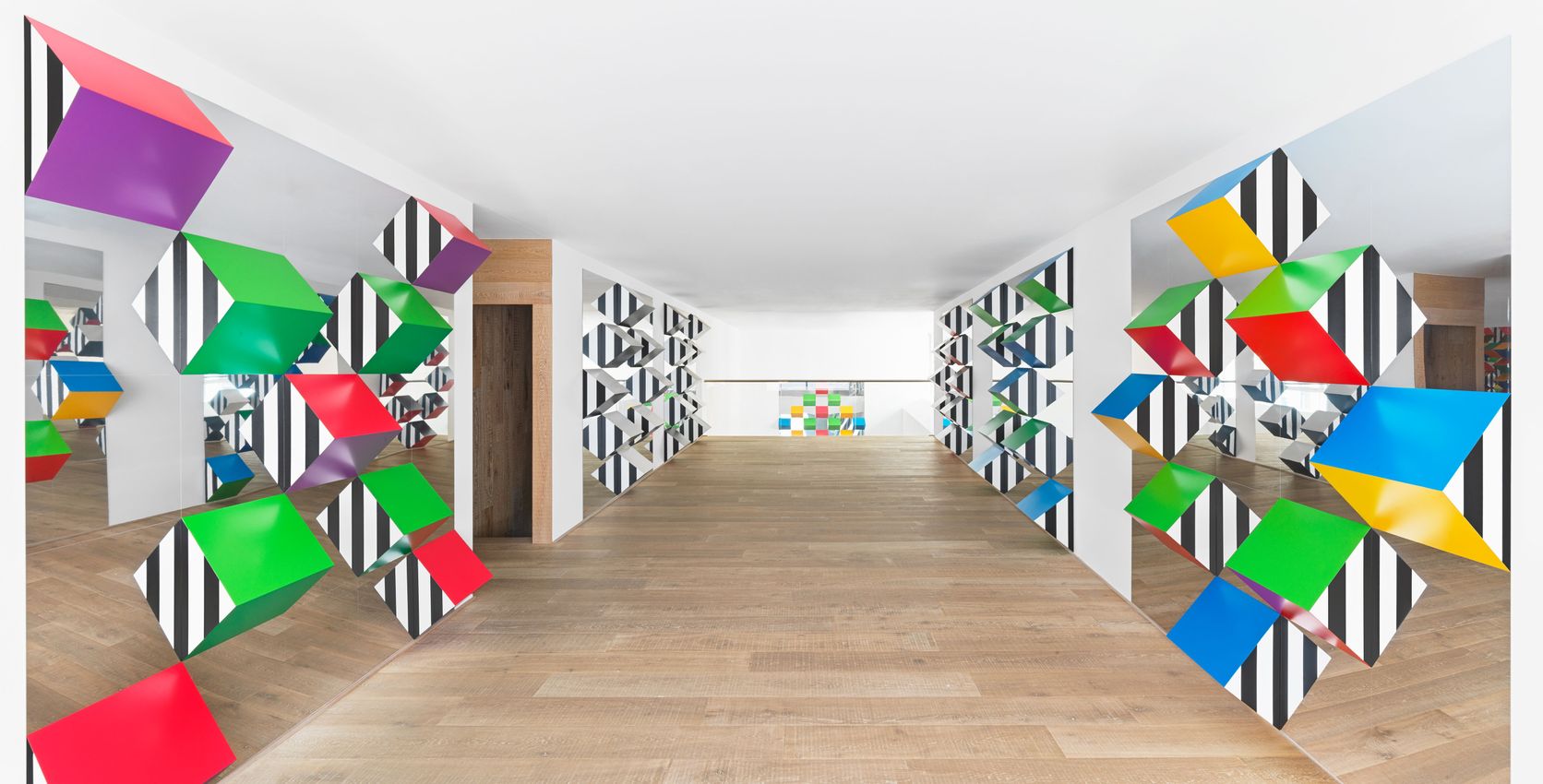
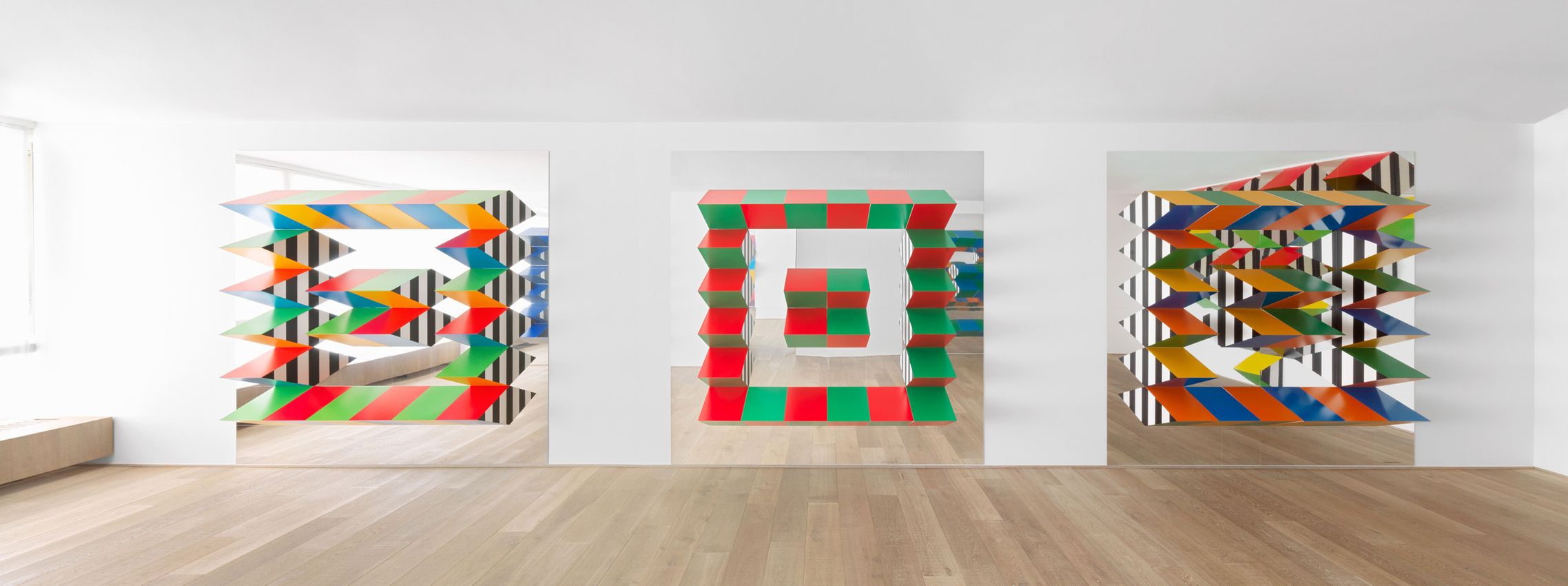
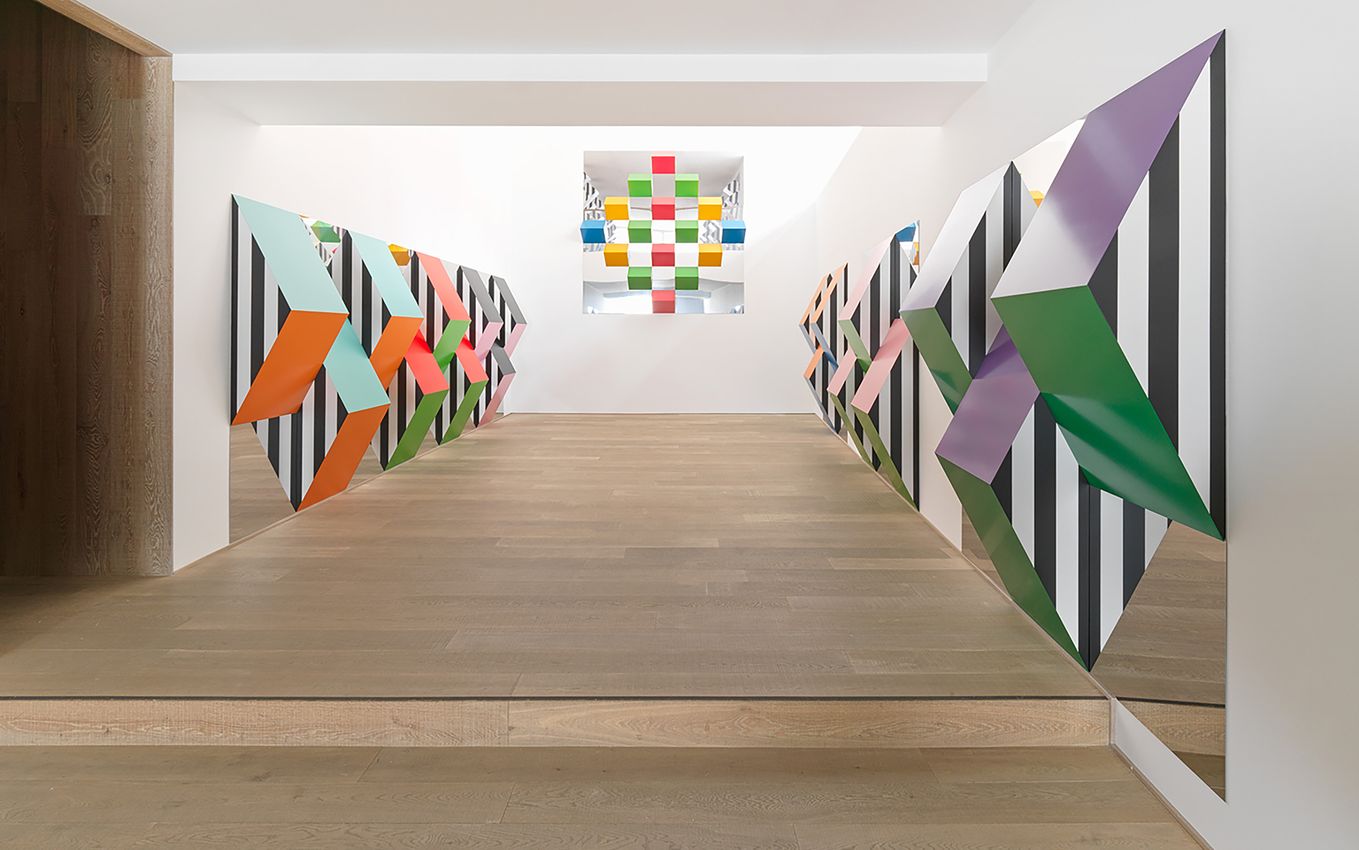
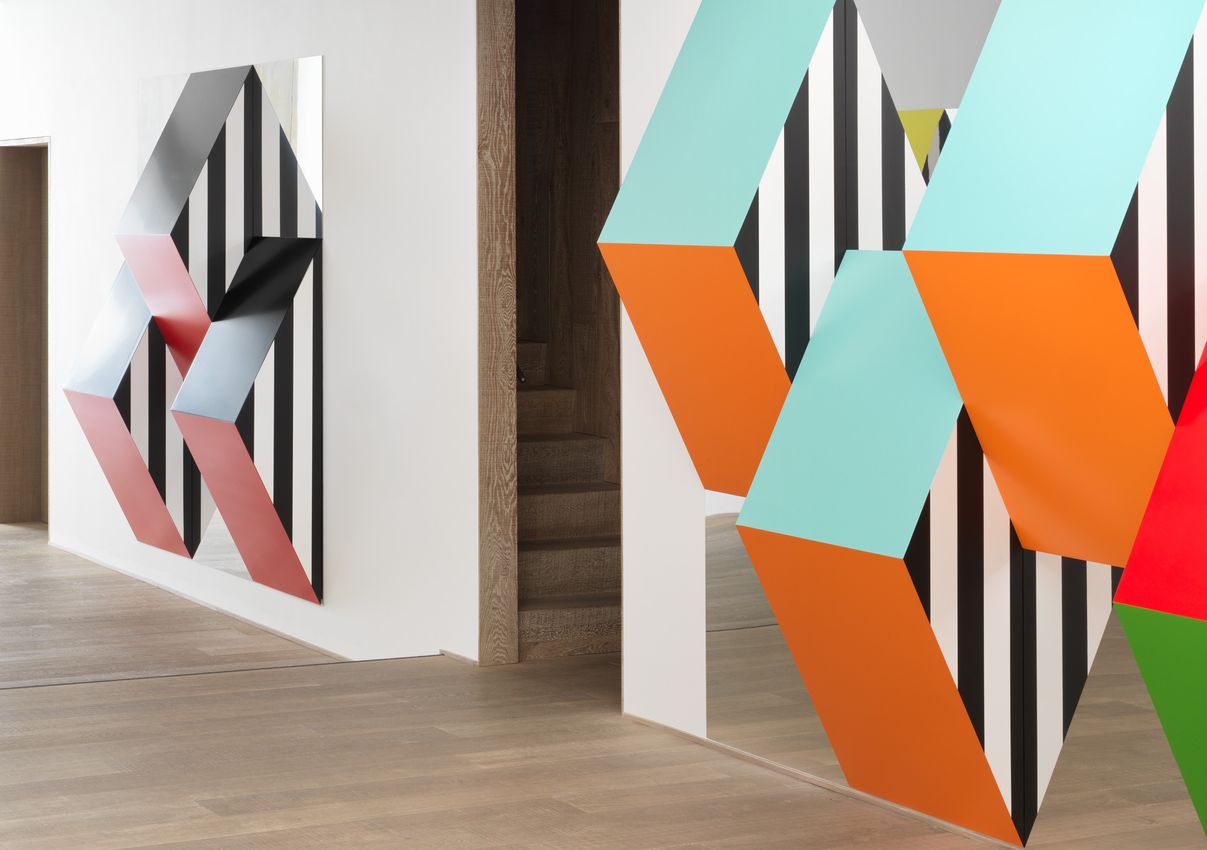
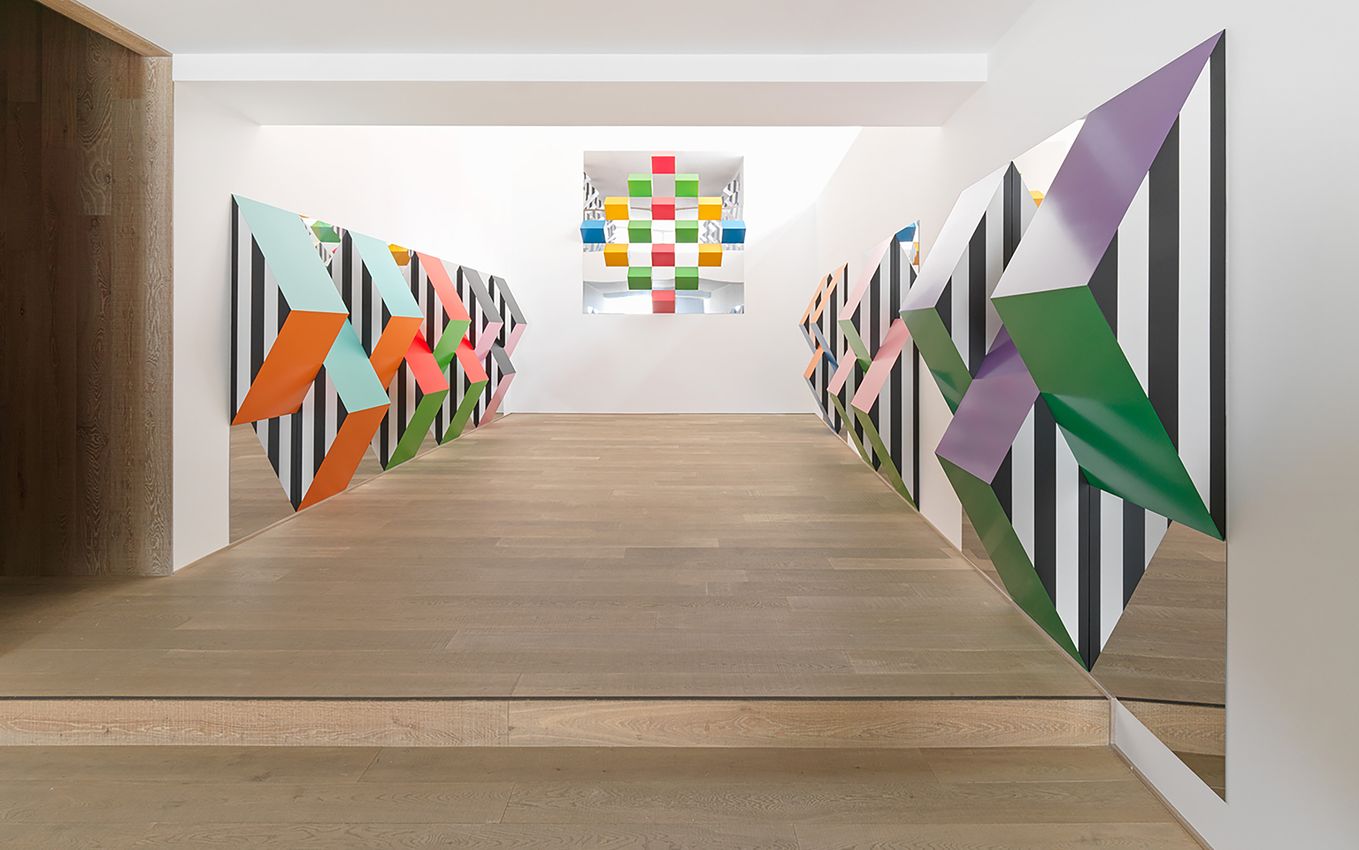
Xavier Hufkens is delighted to present an exhibition of new work by Daniel Buren. The exhibition comprises a series of high wall reliefs in which the artist combines his visual tool (the alternating stripes) with two other important elements in his work (colour and mirrors) to create works that enter into a dialogue with the space, with each other and with the viewer.

Géométries colorées [Coloured Geometries] is the first exhibition that Buren has conceived for the Rivoli space. This is important to note as it is not the artworks per se that are the subject of the exhibition but their relation with the space in which they are situated. And for the artist, this is both a physical reality i.e. the architecture (in this instance, the double-height void, clean contemporary lines and tight volumetrics) and a set of ever-changing conditions (light, atmosphere, people, even principles and ideologies). Buren’s high reliefs – dazzling three-dimensional assemblages of powder-coated coloured aluminium, mirrors and the artist’s trademark stripes – can be seen as devices that both challenge and reveal the physical and intangible qualities of the site. The mirrored surfaces not only capture the surrounding space, which then becomes part of the artwork, but also reflect it back and forth from work to work, thus creating a doubling and redoubling effect, ad infinitum. For all their rigid geometry, systematic construction and use of ‘hard’ industrial materials, the reliefs are far from static: they are responsive, mutable and constantly changing according to the circumstances presented.

The stripes in the reliefs are the only stable element that Buren has used in his work since 1965. This pattern, which the artist describes as his ‘visual tool’ [outil visuel], consists of a series of alternating white and coloured stripes that measure precisely 8.7 cm. The scale is derived from the width of the stripes on the first linen fabric he found as a young artist in Paris. Since then, they have been used in artworks and installations all over the world, both permanent and temporary. But like the mirrors, the stripes are not the overarching raison d’être of the work. Rather, they are a visual reference point, or touchstone, that allows space to be measured, especially by the artist, purely by eye. Here too, the aim is a form of spatial disclosure. In relation to this, the artist has said: ‘I don’t show stripes, they allow me to show things. What happens around them? How does the work influence its environment? ...If you see them as a painting, you’re on the wrong track. They are meant to challenge the idea of a frozen point of view.’

The notion of a ‘frozen point of view’ is a reference to the viewer’s physical position as well as their thought processes, both of which can be fixed or mobile. The shifting nature of the high reliefs is an encouragement to move around the space and to engage with works from various perspectives. The viewer’s reflected form also appears in the works and, in so doing, becomes a dynamic part of the visual experience. Here, colour plays a pivotal role and is used to potentially emotive effect. Colour has long fascinated Buren, who says: ‘Ever since I first started out, colour has been one of the things that have interested me the most and that I’ve tried to approach in a new way... colours carry thousands of implied meanings that escape the artist. If there’s one thing that’s hugely subjective, it’s colour. It affects each person in wholly different ways. I think it’s important to show that the effect of colour does not depend on an individual artist’s intention, but rather on the fact that it’s recreated by the eye of the observer.’

In Géométries colorées, Daniel Buren creates an optical experience that deals with different levels of perception: how we see the artworks themselves, how they make us view the surrounding space and, ultimately, since we behold ourselves in their surfaces, what they make us think.

Daniel Buren (b. 1938, Boulogne-Billancourt, Paris, France) lives and works in situ. He represented France at the Venice Biennale in 1986, for which he was awarded the Golden Lion. He was also honoured with the Praemium Imperiale for Painting in Tokyo (2007), among many other awards. Several volumes of his catalogue raisonné have already been published.

Read More

Installation Views

About the Artist

Daniel Buren is a world-renowned French conceptual artist whose work lies at the crossroads of sculpture, installation and painting, as well as action and intervention. He came to fame in Paris with the B.M.P.T. group (the initials of Buren, Mosset, Parmentier and Toroni) in 1966–1967 and continued to develop a critique of the art establishment. Buren appropriated a standard format fabric motif of 8.75 cm-wide vertical stripes (which alternate between white and a colour) as a visual instrument, or sign, to ‘expose’. He works on site, or in situ, in relation to the setting, a particular building and its story and context. Two examples that caused heated debate were Peinture-Sculpture at the Guggenheim Museum in New York, 1971 and the public commission Les Deux Plateaux (1986) at the Palais Royal in Paris. Throughout his career, he has documented all these events and grouped the images under the title Photo-souvenirs. Since the 1990s, his work has become increasingly architectural using fencing or grids, and stained glass window structures, such as his installation for Monumenta at the Grand Palais in Paris, 2012.

View Artist Profile

Also Exhibiting at Xavier Hufkens

About the Gallery
Xavier Hufkens is one of Europe’s leading galleries for contemporary art. Located in Brussels, the gallery maintains a diverse exhibition programme with solo exhibitions of the gallery artists as well as group exhibitions and special projects. The gallery deals in a distinctive combination of painting, drawing, sculpture, photography, video and installation-based work.

The origins of the gallery date back to 1987, when Xavier Hufkens opened a gallery space in an un-refurbished warehouse in the neighbourhood of the South Station (Midi) in Brussels. During the early years, the focus of the gallery was upon mid-career and emerging artists and the gallery is known for having introduced some of the most influential contemporary artists to Brussels at a time when they were still relatively unknown. British sculptor Antony Gormley, who is still affiliated with the gallery, Felix Gonzalez-Torres and Rosemarie Trockel all showed in Belgium for the first time with Xavier Hufkens (Gormley in 1987; Gonzalez-Torres in 1991 and Trockel in 1993).

In 1992, the gallery moved to a 19th-century townhouse at 6 rue Saint-Georges, close to the Avenue Louise. Completely renovated by Belgian architects Paul Robbrecht, Hilde Daem and Marie-José Van Hee, the house quickly gained a reputation for being not just one of the most beautiful contemporary art spaces in the Belgian capital, but also one of the most interesting. The expanded exhibition programme coincided with the additional representation of a number of established artists from Belgium and abroad, including Richard Artschwager, Thierry De Cordier and Jan Vercruysse. In 1997, Hufkens expanded the gallery further by annexing the adjacent building and a number of new artists joined the gallery, including Louise Bourgeois, Roni Horn and Thomas Houseago.

A second space in the same street, at 107 rue Saint-Georges, opened in spring 2013. Located in the Galerie Rivoli, a mixed-use commercial development from the 1970s, the new gallery space was designed by Swiss architect Harry Gugger, who was previously in partnership with Herzog and De Meuron. Slegten & Toegemann, Brussels, managed the project.

An eclectic but very clear vision underpins all of the gallery’s activities: ‘The definition of the gallery was established from the start. The common thread, then and now, is quality over and above everything else, which I find more intellectually challenging than a forced definition. From the early days I juxtaposed established artists such as Michelangelo Pistoletto with someone like Felix Gonzalez-Torres when he was totally unknown. Today I still mix my work: I have no problem showing Malcolm Morley … alongside Robert Ryman, or Willem de Kooning.’ [Xavier Hufkens in The Art Newspaper, Issue 220, January 2011, published online: 20 January 2011]

Xavier Hufkens represents some thirty artists from different generations. He was part of the six-member selection committee for Art Basel during seven years and also participates in up to five international Arts Fairs annually. The gallery has partnerships with the estates of Louise Bourgeois, Willem de Kooning, Robert Mapplethorpe and Alice Neel.
View Gallery Profile
Address
107 rue St-Georges
St-Jorisstraat
Brussels
Belgium
Opening Hours
Tuesday – Saturday
11am – 6pm
(1)
Brussels 107 rue St-Georges
Xavier Hufkens
107 rue St-Georges, St-Jorisstraat, Brussels, Belgium

Opening hours
Tuesday – Saturday
11am – 6pm
The art world in focus