Press Release
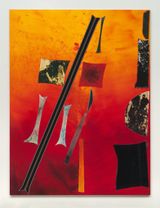
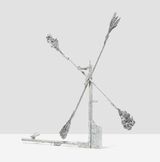
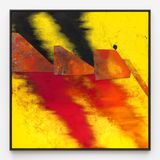
Xavier Hufkens is pleased to announce two exhibitions of new work by Sterling Ruby. Running concurrently in the two gallery spaces, ECLPSE (6 rue St-Georges) features the artist’s collages, while a series of recent sculptures are presented in SCALES (107 rue St-Georges).

Sterling Ruby is known for the multifaceted nature of his practice, which encompasses painting, ceramics, collage, video and photography, textiles, sculpture and installations. Working in a wide range of media, from the traditional to the unconventional, Ruby has created an oeuvre that, while remarkably diverse, is firmly rooted within a complex and coherent artistic strategy.

Often drawing upon autobiographical, art historical or sociological sources, Ruby’s work is frequently referred to as ‘post-humanist’ – a term that broadly describes a society which, thanks in part to technological advancement, has evolved beyond fixed categories of being (e.g. time/place), or predetermining classifications (e.g. animal/human). The seemingly ‘incomprehensible’ visual range of Ruby’s practice thus embodies a schizophrenic, ‘post-everything’ state of perpetual fragmentation and synthesis. A world in which, according to Ruby, ‘there is just too much information for anything to be coherent or whole.’ His practice involves a combination of philosophical enquiry and material investigation, the latter involving the seemingly endless repurposing, combining and recombining of different techniques and media. This too mirrors a shifting condition of constant deconstruction and reconfiguration, and the idea of a non-hierarchical, boundary-less universe.

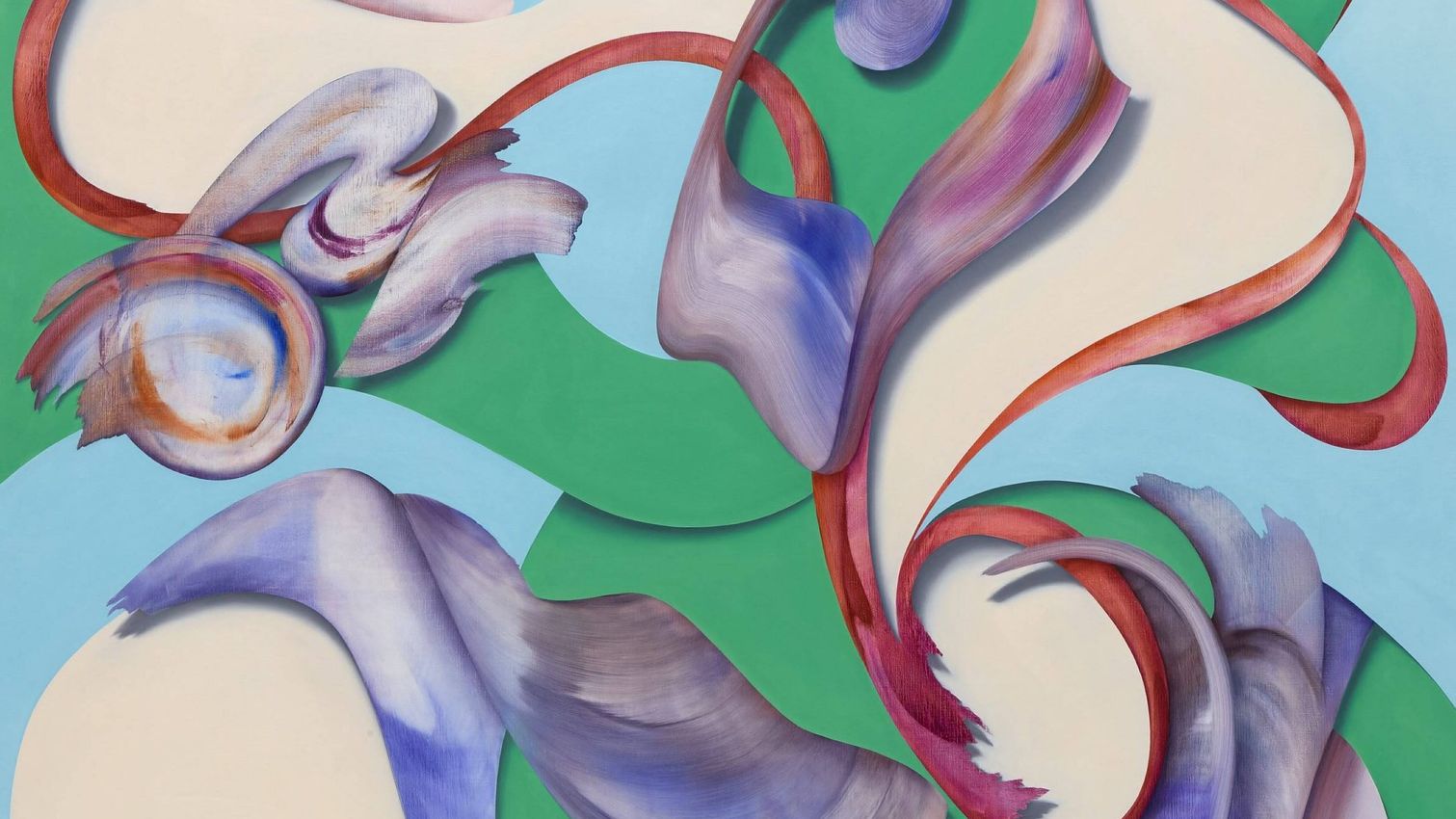
For this exhibition, Ruby has created a new series of collages entitled ECLPSE (the artist’s abbreviation for the word ‘eclipse’). Made from cardboard salvaged from the floor coverings in the artist’s studio, the collages reflect a newfound sense of simplicity and formality. The abstract shapes, which are reminiscent of suns, moons and overlapping landscapes, are painted in bright, primary colours. Ruby has said of these compositions: ‘They continue with themes, theories and concepts that have been central to my previous work, but I have been trying to make them abstract and formal, my attempt to connect to the historical lineage of Suprematism.’ The contrast between the reclaimed ‘artistic’ waste and the richness of the paint highlights a dynamic tension between Ruby’s contemporary practice and the early-modern belief in the supremacy of ‘pure artistic feeling’ over the visual depiction of objects.

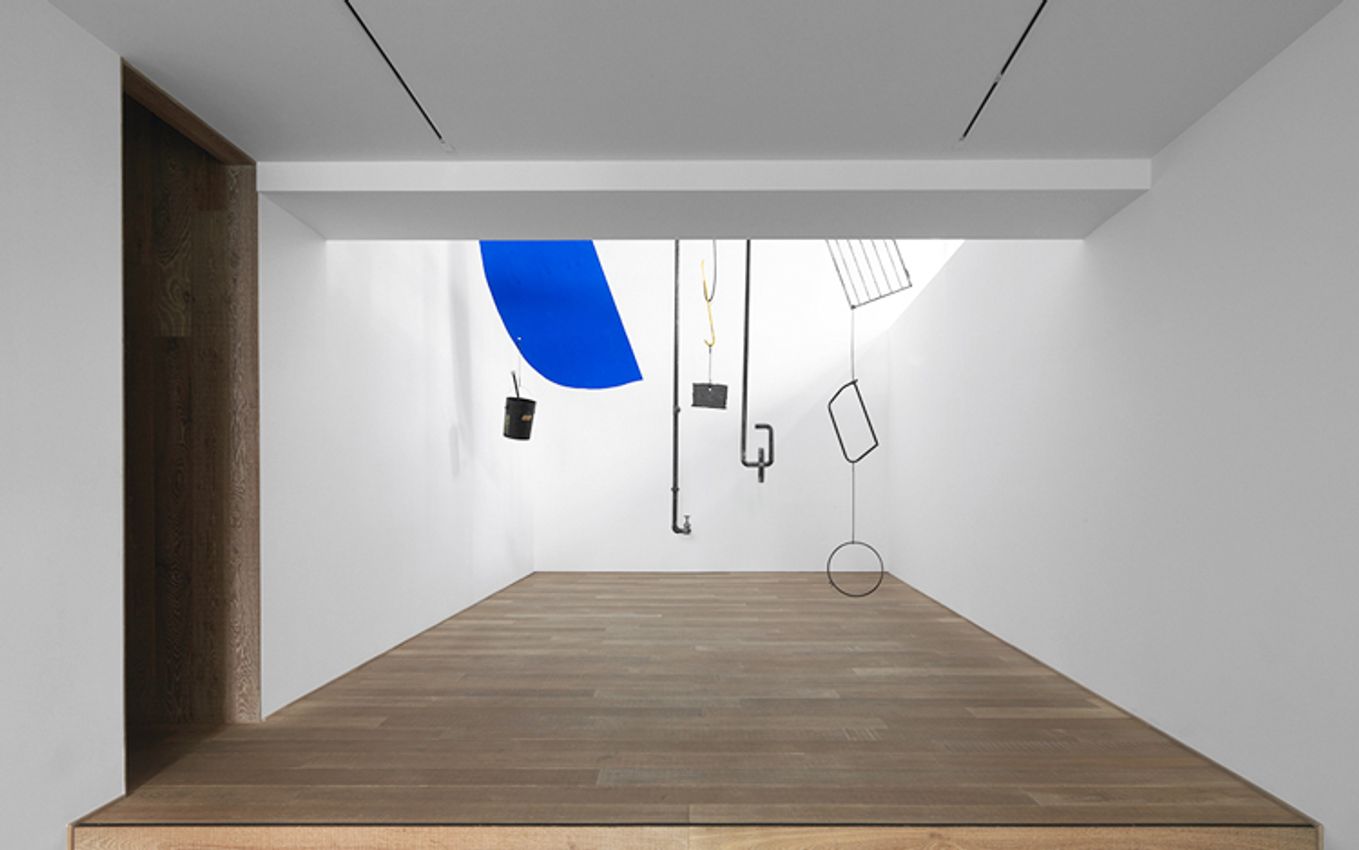
Ruby will also be exhibiting a new group of mobiles in the series known as SCALES. These monumental sculptures, which the artist views as three-dimensional manifestations of his collages, feature identical monochrome shapes to those evident in the ECLPSE series, but this time juxtaposed with identifiable scraps of materials and objects from his studio. These elements lend the works a more narrative aspect. Whilst Ruby is well known for his collages, and has also constructed mobiles in the past, the works presented in ECLPSE and SCALES bear witness to a shift in perspective. Says Ruby: ‘These works are pared down to their basic formal elements. In the past I’ve insisted on seeing the conceptual element, as opposed to feeling confident that it is there even when it is not evident at first glance. They are also playful, in a way, which feels new to me.’

Sterling Ruby (b. 1972) lives and works in Los Angeles. In 2014 his work was included in the Whitney Biennial, the 10th Gwangju Biennale and the 9th Taipei Biennial. Major solo exhibitions include: Sterling Ruby, Baltimore Museum of Art, USA (2014), Droppa Blocka, Museum Dhondt-Dhaenens, Ghent, Belgium (2013), Chron II, Kunsthalle Mainz, Germany (travelling exhibition, 2013), Soft Work, Centre d’Art Contemporain Genève, Switzerland (travelling exhibition, 2012-2014) and Supermax 2008, Museum of Contemporary Art, Los Angeles, USA (2008).
About the Artist

Sterling Ruby uses a wide range of aesthetic strategies in his practice, from saturated, glossy, poured polyurethane sculptures, to drawings, collages, richly glazed ceramics, graffiti inspired spray paint paintings, and video. In opposition to the minimalist artistic tradition and influenced by the ubiquity of urban graffiti, the artist’s works often appear scratched, defaced, camouflaged, dirty or splattered.

View Artist Profile

Also Exhibiting at Xavier Hufkens

About the Gallery
Xavier Hufkens is one of Europe’s leading galleries for contemporary art. Located in Brussels, the gallery maintains a diverse exhibition programme with solo exhibitions of the gallery artists as well as group exhibitions and special projects. The gallery deals in a distinctive combination of painting, drawing, sculpture, photography, video and installation-based work.

The origins of the gallery date back to 1987, when Xavier Hufkens opened a gallery space in an un-refurbished warehouse in the neighbourhood of the South Station (Midi) in Brussels. During the early years, the focus of the gallery was upon mid-career and emerging artists and the gallery is known for having introduced some of the most influential contemporary artists to Brussels at a time when they were still relatively unknown. British sculptor Antony Gormley, who is still affiliated with the gallery, Felix Gonzalez-Torres and Rosemarie Trockel all showed in Belgium for the first time with Xavier Hufkens (Gormley in 1987; Gonzalez-Torres in 1991 and Trockel in 1993).

In 1992, the gallery moved to a 19th-century townhouse at 6 rue Saint-Georges, close to the Avenue Louise. Completely renovated by Belgian architects Paul Robbrecht, Hilde Daem and Marie-José Van Hee, the house quickly gained a reputation for being not just one of the most beautiful contemporary art spaces in the Belgian capital, but also one of the most interesting. The expanded exhibition programme coincided with the additional representation of a number of established artists from Belgium and abroad, including Richard Artschwager, Thierry De Cordier and Jan Vercruysse. In 1997, Hufkens expanded the gallery further by annexing the adjacent building and a number of new artists joined the gallery, including Louise Bourgeois, Roni Horn and Thomas Houseago.

A second space in the same street, at 107 rue Saint-Georges, opened in spring 2013. Located in the Galerie Rivoli, a mixed-use commercial development from the 1970s, the new gallery space was designed by Swiss architect Harry Gugger, who was previously in partnership with Herzog and De Meuron. Slegten & Toegemann, Brussels, managed the project.

An eclectic but very clear vision underpins all of the gallery’s activities: ‘The definition of the gallery was established from the start. The common thread, then and now, is quality over and above everything else, which I find more intellectually challenging than a forced definition. From the early days I juxtaposed established artists such as Michelangelo Pistoletto with someone like Felix Gonzalez-Torres when he was totally unknown. Today I still mix my work: I have no problem showing Malcolm Morley … alongside Robert Ryman, or Willem de Kooning.’ [Xavier Hufkens in The Art Newspaper, Issue 220, January 2011, published online: 20 January 2011]

Xavier Hufkens represents some thirty artists from different generations. He was part of the six-member selection committee for Art Basel during seven years and also participates in up to five international Arts Fairs annually. The gallery has partnerships with the estates of Louise Bourgeois, Willem de Kooning, Robert Mapplethorpe and Alice Neel.
View Gallery Profile
Address
107 rue St-Georges
St-Jorisstraat
Brussels
Belgium
Opening Hours
Tuesday – Saturday
11am – 6pm
(1)
Brussels 107 rue St-Georges
Xavier Hufkens
107 rue St-Georges, St-Jorisstraat, Brussels, Belgium

Opening hours
Tuesday – Saturday
11am – 6pm
The art world in focus