






ADVÂNIO LESSA
b. 1981, Brazil1981, Lavras Novas, Minas Gerais, Brazil
Lives and works in Lavras Novas, Minas Gerais, Brazil
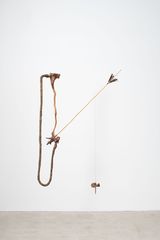
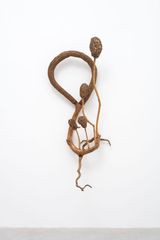
Advânio Lessa was born and currently resides in Lavras Novas, a district of Ouro Preto in the state of Minas Gerais, Brazil. His hometown, enriched by a quilombola1 heritage, and his parents’ occupations as a mule driver and a basket weaver, are integral elements of the universe that inspires his artistic practice. Crafting large-scale sculptures from logs of deceased trees, roots, and intertwined vines, the artist combines the wisdom of basketry and carpentry with the diverse range of wood and fibers found in the forests of the Ouro Preto region, including Cipó Alho, Cipó São João, Candeia, Jacarandá, Folha Miúda, and Rosemary. Lessa, who is also a farmer, engages in a close dialogue with this repertoire to create his pieces. In this sense, it is not misleading to assert that nature serves as a kind of co-author in his works.
The artist’s work enters the global stage armed with profound formal eloquence and meaningful discursive implications. His sculptures, whose scales mirror those of the human body, bear witness to a reciprocal relationship between humanity and the surrounding life forms. In this regard, they align with a significant contemporary trend: rather than adhering to epistemologies rooted in the Western perspective, which often place humans in a superior position, they embrace cosmologies where a non-hierarchical relationship among all living beings is observed.
Advânio Lessa’s work has been exhibited in solo and group shows at institutions such as Espaço Cultural CEFET - Ouro Preto (Ouro Preto, Brazil, 1998); Galeria Clélia Valadares (Belo Horizonte, Brazil, 2008); Galeria da FIEMG (Federação das Indústrias do Estado de Minas Gerais, Ouro Preto, Brazil, 2010); Graphos: Brasil (Rio de Janeiro, Brazil, 2013); Museu Afro Brasil (São Paulo, Brazil, 2013); Fundação Clóvis Salgado - Palácio das Artes (Belo Horizonte, Brazil, 2015); IA – Instituto de Arte Contemporânea de Ouro Preto and Museu da Inconfidência, curated by Valquíria Prates (Ouro Preto, Brazil, 2023), among others. His work is part of the collection of the Pinacoteca do Estado de São Paulo (São Paulo, Brazil). In 2024, also curated by Valquíria Prates, Advânio Lessa held Redemoinho não leva pilão [No whirlpool can wash away a pestle], his first solo show in São Paulo, at Gomide&Co.
—
1. In colonial Brazil, the quilombos were fortified settlements of black slaves who had escaped from slavery, endowedwith divisions and internal organization. After the end of slavery in the country in 1888, the concept of quilombo wasredefined, as they continued to exist outside the historical context in which they arose. In modern times, a quilombo isa space of resistance with the right to own its land and maintain its own culture. It is a type of organization of peoplewho occupy the land in the form of common use, with its use obeying environmental seasonality. The inhabitants of thequilombos are called quilombolas, who are currently the descendants of escaped slaves, recognized since 2007 by theBrazilian government as a traditional community - they carry out daily production practices with sustainabledevelopment - with a way of life linked to the environment and a culture that differs from the predominant local culture.
Text courtesy Gomide&Co.







Explore and Follow Artists Shaping Contemporary Art
A respected voice in contemporary art discourse.
Focusing on ambitious storytelling and insightful art-world commentary. Ocula Magazine publishes in-depth interviews, critical essays and timely analysis on the artists, exhibitions and ideas driving the global art world.
Learn more about Ocula Magazine
Showcasing the best of the art world.
Ocula partners with galleries from around the world to highlight their artists, artworks and exhibitions. Gallery membership is by application and invitation, with each member vetted by an independent panel.
Learn more about Ocula Membership
Specialises in the sale of major artworks.
Led by a team with deep ties to the world’s leading auction houses, galleries and collectors. Ocula’s advisory team offers bespoke services to high-net-worth clients from around the world who are looking to acquire the best of contemporary and modern art.
Learn more about our team and services