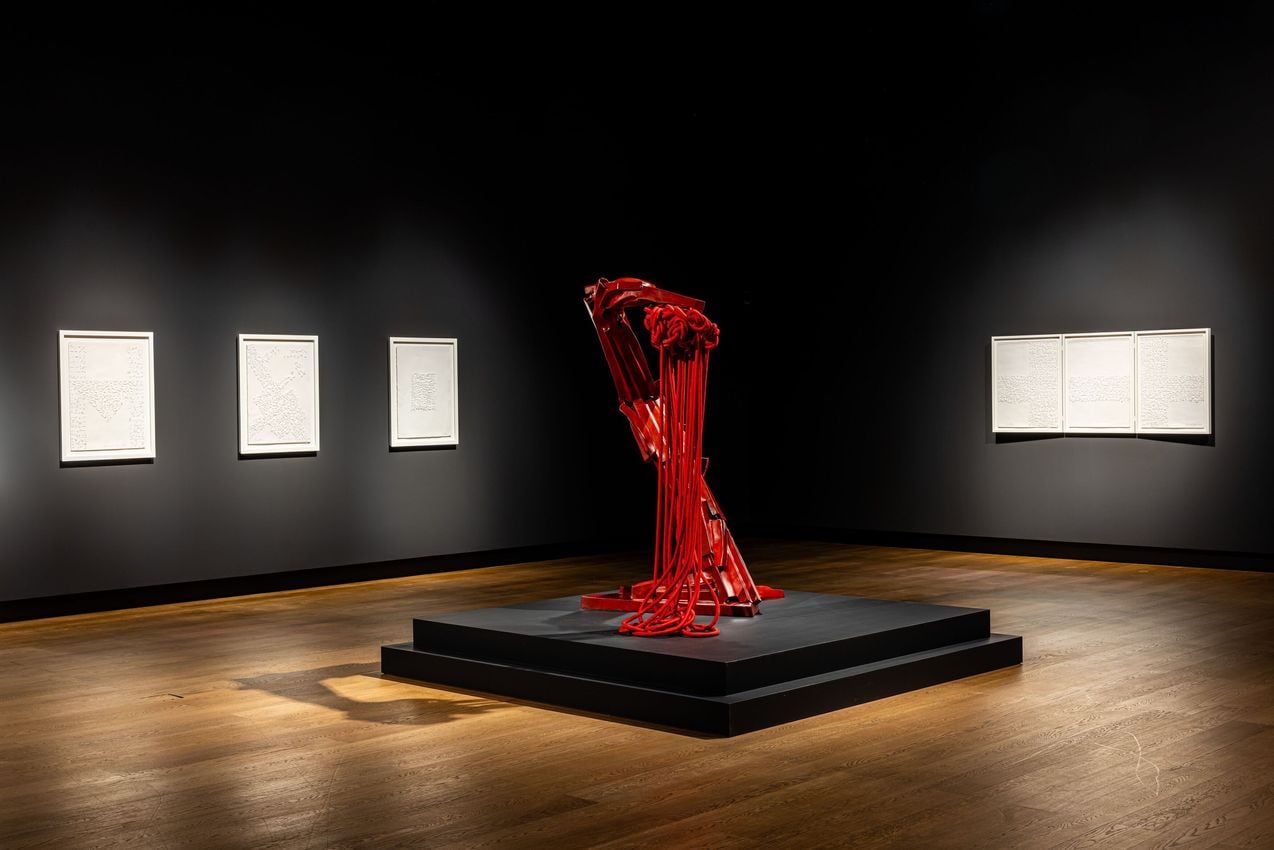
Barbara Chase-Riboud is renowned for creating abstract sculptures that combine the rigid forms of cast bronze or aluminium with the softness of fabric, generally silk or wool. Through their combination of formal elements, Chase-Riboud’s works toy with several central dichotomies, including hard and soft, masculine and feminine, and heavy and light.
Process
In 1958, Chase-Riboud developed her own method of the lost-wax casting method, innovating upon a centuries-old process. Chase-Riboud’s method involved creating thin sheets of wax that she could manipulate by bending, folding, and severing before taking them to a foundry to be cast, allowing her to create large-scale bronze or aluminium sculptures that appeared fluid or ribbon-like.
Chase-Riboud began to add fibres to her cast-metal sculptures in 1967, resulting in sculptures in which forms cast of bronze and aluminium rest on supports hidden by skeins of silk or wool, creating the impression of the metal being supported by the fabric.
Malcolm X Steles
In 1969, Chase-Riboud begun a series of works memorialising civil rights activist Malcolm X, who had been assassinated four years earlier. The ‘Malcolm X Steles’ are composed of 20 larger-than-life sculptures, each of which comprise a folded, bronze upper, with braids of knotted silk and wool cascading beneath, the patina and fibres ranging in colour between gold, red, and black.
Malcolm X #3 (1969) stands at eight-and-a-half feet, the folds of its bronze upper section recalling the perspectival fragmentation of Cubism, seemingly supported on a plinth of knotted fibres. Also fusing together elements of armour and textile, the work is informed by Chase-Riboud’s experiences in North Africa and China, while also embodying the potential of cultural integration represented by modern art, particularly within the context of the Civil Rights movement.
Literary Works
Chase-Riboud is also an accomplished author. Her first book of poetry, From Memphis & Peking, was published in 1974 to critical acclaim. This was followed by Chase-Riboud’s first novel, Sally Hemings (1979), for which she gained widespread recognition and was awarded the Janet Heidinger Kafka Prize in Fiction by an American Woman. She has published may other books, including several novels, collections of poetry, a travelogue, and a memoir.