





CALIDA RAWLES
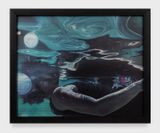
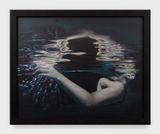
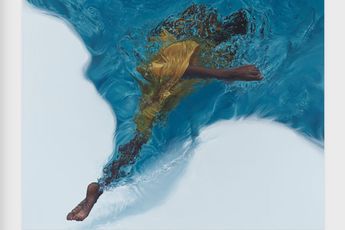
b. 1976, United StatesBlending hyperrealism and abstraction, Calida Rawles paints Black bodies floating in hypnotic waterscapes, surrounded by ripples, bubbles, refracted light, and expanses of dark and shadow. To Rawles, water holds a duality, representing both racial exclusion but also a space to heal.
Early Years
Calida Rawles was born in 1976 in Wilmington, Delaware and has always displayed artistic talent—she remembers being in kindergarten and a dinosaur she drew being singled out for praise from the teachers. She gained her BFA from Spelman College in Atlanta in 1998 and her MFA from New York University in 2000. When she was pregnant with her third daughter, Rawles learned to swim, and discovered both the tranquillity of being in water but also the way bodies moving through water became abstracted. “It was high noon, and I was doing the backstroke,” she recalls. “My eyes were adjusting in the sun, and I saw all these discs. It looked like a maze.”
Calida Rawles: Artworks
Water is a central element of Calida Rawles’ artworks. Water acts as solace and healer, but Rawles also considers its role in—and intergenerational impact on—Black American history: slave ships brought people to the USA across water; later, segregation laws prevented Black citizens from accessing public bodies of water. But Rawles’ hyperreal acrylic paintings take their subjects way beyond tropes of “Blackness”: they create a space for strength and serenity alongside discussions of serious sociopolitical topics.
- Lilith appears in some parts of Jewish folklore, although not the Bible—Lilith is Adam’s first wife, who refused to submit to him and fled the garden of Eden. In what’s been described as Rawles’ “breakthrough body of work”, A Dream For My Lilith (2020), she reimagined Lilith as a source of inspiration for rebellion, rising to the surface of unstable waters. Rawles has said of the show: “I knew I wanted the figures to be larger than life. I thought of Renaissance paintings, these large-scale, almost godly figures, and it was very important to put Black females in that light.”
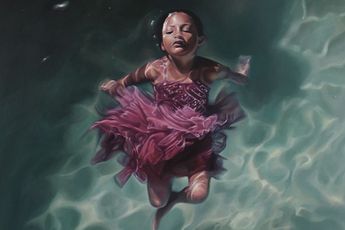
- Rawles often depicts her husband and children in her artworks. 2024’s With Wings of Infinity features her youngest daughter and a colour palette centring opulent purples and reds and dark watery shadows.
- Away With The Tides (2024 and touring) emerged from a collaboration between Rawles and the Overtown suburb of Miami. Overtown was a thriving suburb but the building of the interstate highway during the 1960s flattened the neighbourhood and its sense of community. Rawles, working with a team including her eldest daughter and a swimming instructor, photographed hundreds of images of Overtown citizens (from babies to seniors) in the water at the Virginia Key Beach and in the town swimming pool, producing works that considered generational shift, representation and the significance of water.
Calida Rawles: Select Exhibitions
Select Solo Exhibitions
- Away With The Tides, Spelman College Museum of Fine Art, Atlanta (2026)
- Away With The Tides, Cummer Museum of Art and Gardens, Jacksonville (2025) (and touring)
- This Time Before Tomorrow, Lehmann Maupin, London (2025)
- Calida Rawles, The Delaware Contemporary, Wilmington (2024)
- A Certain Oblivion, Lehmann Maupin, New York City (2023)
- On The Other Side of Everything, Lehmann Maupin, New York City (2021)
- A Dream For My Lilith, Various Small Fires, Los Angeles (2020)
- Calida Rawles, Standard Vision, Los Angeles (2020)
Select Group Exhibitions
- Giving You The Best That I Got, California African American Museum, Los Angeles (2025)
- Imagining Black Diasporas: 21st Century Art and Poetics, Los Angeles Museum of Contemporary Art (2024)
- LA Story, Hauser & Wirth_, West Hollywood (2024)
- A Superlative Palette, Harvey B Gantt Centre, Charlotte (2024)
- Generation, Kunsthalle Bremen (2023)
- Rose in the Concrete, San Francisco Museum of Modern Art (2023)
- Black American Portraits, Spelman College Museum of Fine Art, Atlanta (2023)
- 12th Berlin Biennale for Contemporary Art (2022)
- A Shared Body, Florida State University Museum of Fine Art (2021)
- Visions in Light, Windows on Wallis, Beverly Hills (2020)
- Presence, Fullerton College Art Gallery (2019)
- With Liberty and Justice For Some, Walter Maciel Gallery, Los Angeles (2017)
- From her, An exhibition by Women about Women, Pico House Gallery, Los Angeles (2014)
- Philadelphia International Art Expo (2003)
- Living Off Experience, Rush Arts Gallery, New York City (2002)
- Spirited and Free, Art Jaz Gallery, Philadelphia (2001)
Further Reading
- Calida Rawles’ official website
- Calida Rawles’ Instagram Artist profile page at Lehmann Maupin
- 2025 profile from Family Style Feature about Overtown from the New York Times (2024)
Calida Rawles FAQs
Does Calida Rawles still live in Wilmington?
No, Calida Rawles is now based in Los Angeles.
What materials and techniques does Calida Rawles use?
Calida Rawles is known for using small paintbrushes and thin strokes. Speaking in 2022, she explained that she liked canvases with texture because she grinds in paint as she works. “I use acrylic,” [she said], “but I probably paint it very much like watercolour.” She photographs her subjects (often many times) before creating her large-scale paintings.
Did Calida Rawles paint a book cover?
Yes, Calida Rawles painted the cover of The Water Dancer, the first novel from Ta-Nehisi Coates—Rawles and Coates had been friends since college. The image of a cosmic floating figure, with blurred face but realistic arms and hands, foretells Rawles’ later artistic oeuvre.
What are Calida Rawles’ literary influences?
Calida Rawles notably listens to audio books while she paints—she has cited Octavia Butler’s Parable of the Sower (1993) and Parable of the Talents (1998) as works she revisits, and also Roxane Gay’s Bad Feminist (2014) and Chimamanda Ngozi Adichie’s Americanah (2013). Before her 2025 exhibition This Time Before Tomorrow, she revisited books from Joseph Campbell, Paulo Coehlo and Albert Camus.
Ocula




Explore Calida Rawles' Exhibitions







Explore and Follow Artists Shaping Contemporary Art
A respected voice in contemporary art discourse.
Focusing on ambitious storytelling and insightful art-world commentary. Ocula Magazine publishes in-depth interviews, critical essays and timely analysis on the artists, exhibitions and ideas driving the global art world.
Learn more about Ocula Magazine
Showcasing the best of the art world.
Ocula partners with galleries from around the world to highlight their artists, artworks and exhibitions. Gallery membership is by application and invitation, with each member vetted by an independent panel.
Learn more about Ocula Membership
Specialises in the sale of major artworks.
Led by a team with deep ties to the world’s leading auction houses, galleries and collectors. Ocula’s advisory team offers bespoke services to high-net-worth clients from around the world who are looking to acquire the best of contemporary and modern art.
Learn more about our team and services