






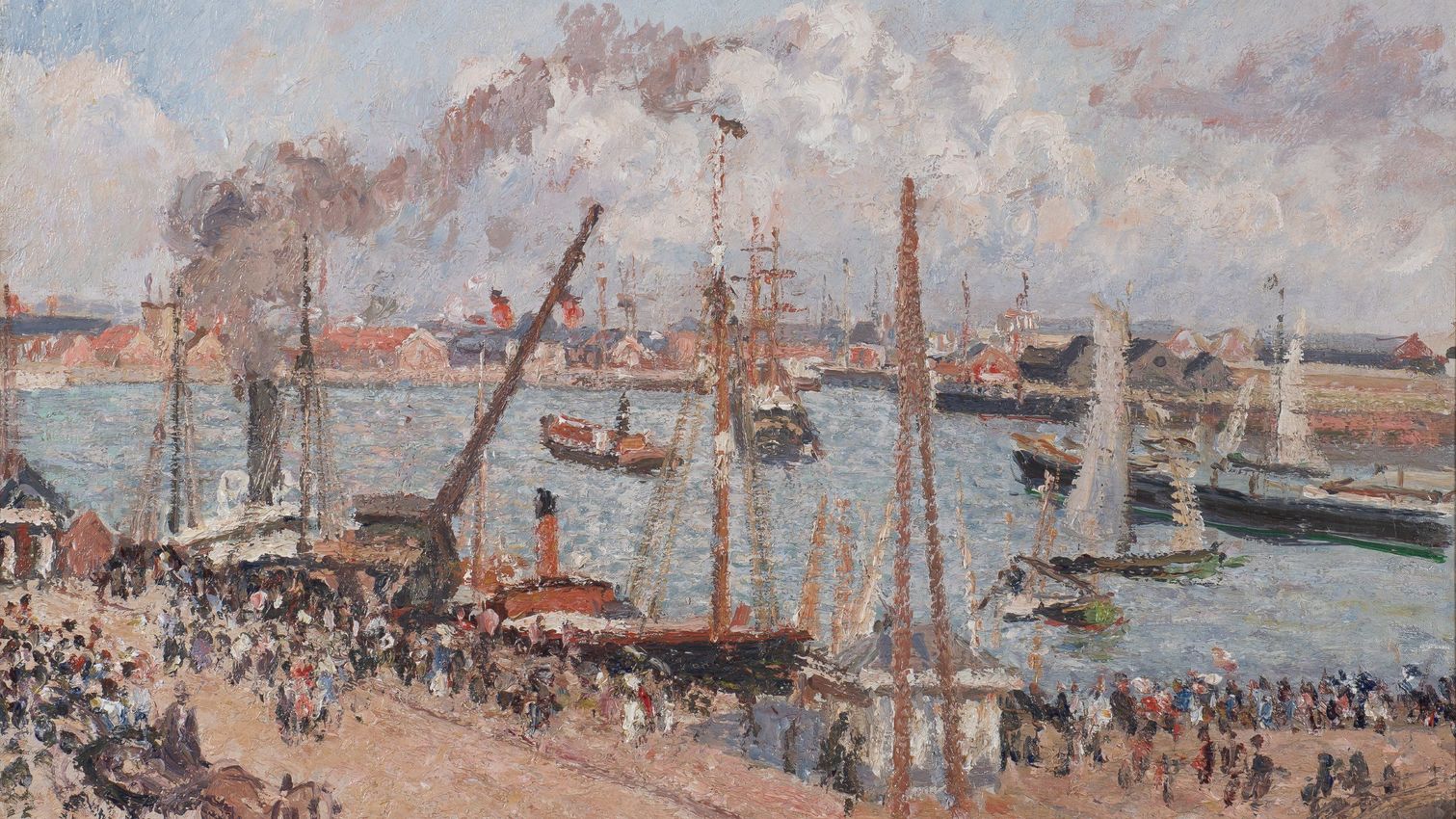
CAMILLE PISSARRO
1830-1903, Virgin Islands (U.S.)Camille Pissarro was a groundbreaking French painter and printmaker whose innovative approach to landscape and modern life helped define Impressionism and, later, Post-Impressionism.
Pissarro is the only artist to have exhibited in all eight Impressionist exhibitions in Paris between 1874 and 1886, underscoring his central role in the movement’s development and cohesion. His shimmering rural scenes, urban vistas, and commitment to painting en plein air (outdoors) cemented his reputation as a master observer of light, colour, and atmosphere.
Early Life and Influences
Born Jacob Abraham Camille Pissarro on the island of St. Thomas in the Danish West Indies, Pissarro was raised in a French Jewish family and sent to a boarding school in Paris at the age of 12. There, he developed a lifelong appreciation for French art and culture. After returning to St. Thomas, Pissarro soon chose to pursue painting seriously, moving permanently to Paris by 1855. Early influences included Gustave Courbet, Camille Corot, and Jean-François Millet, whose focus on rural life and realism shaped Pissarro’s artistic philosophy.
Realism and Rural Life (1850s–1860s)
Pissarro’s early paintings reflect his admiration for the Barbizon School and his commitment to depicting rural labour and village life with empathy and directness. He rejected academic traditions in favour of painting from direct observation, capturing the changing seasons and daily rhythms of the countryside around Louveciennes and Pontoise. Works such as The Banks of the Marne in Winter (1866) and The Harvest (c.1860) exemplify his dedication to tonal harmony and natural light.
Impressionist Innovations (1870s–1880s)
In the 1870s, Pissarro became a driving force among the Impressionists, working alongside Claude Monet, Pierre-Auguste Renoir, and Edgar Degas. His paintings from this period, including The Orchard, Côte Saint-Denis, at Pontoise (1877) and Path through the Woods (1876), are celebrated for their vibrant brushwork and ability to capture fleeting effects of light and atmosphere. Pissarro’s openness to experimentation and his collaborative spirit earned him the nickname “Father Pissarro” among peers like Paul Cézanne and Paul Gauguin, both of whom he mentored.
Neo-Impressionism and Urban Modernity (1880s–1900s)
In the 1880s, Pissarro explored Neo-Impressionism, adopting the pointillist techniques of Georges Seurat and Paul Signac. While only a portion of his works are strictly pointillist, paintings like The Garden of the Tuileries on a Winter Afternoon (1899) demonstrate his willingness to experiment with color theory and optical mixing. In his later years, Pissarro shifted focus to urban scenes, painting the bustling boulevards, markets, and gardens of Paris and other cities. Works such as Boulevard Montmartre, Spring (1897) and his series of the Grands Boulevards and Avenue de l’Opéra reflect his fascination with modernity and the changing face of the city.
Legacy and Influence
Pissarro’s influence extended far beyond his canvases. As a mentor to Cézanne, Gauguin, and Seurat, he helped shape the direction of modern painting. His democratic approach to subject matter—depicting peasants, workers, and everyday life with dignity—continues to resonate with contemporary artists exploring social realism and the poetics of daily experience. Pissarro’s practice of working in series to capture changing light and weather prefigures modern and contemporary interests in seriality and site-specificity.
Major Exhibitions
Solo Exhibitions
- Camille Pissarro: The Studio of Modernism, Albertina Museum, Vienna (2022)
- Pissarro: Father of Impressionism, Ashmolean Museum, Oxford (2022)
- Pissarro and the River, Musée Marmottan Monet, Paris (2017)
- Pissarro in Éragny: Nature Regained, Musée du Luxembourg, Paris (2017)
- Camille Pissarro: Impressions of City and Country, Jewish Museum, New York (2007)
- Homage to Camille Pissarro, Musée d’Orsay, Paris (2003)
- Camille Pissarro: Impressionist Innovator, National Gallery of Art, Washington, D.C. (1995)
Group Exhibitions
- Impressionism: Pathways to Modernity, Louvre Abu Dhabi (2022–2023)
- Impressionists on Paper: Degas to Toulouse-Lautrec, Royal Academy of Arts, London (2022–2023)
- Inventing Impressionism, National Gallery London (2015)
- Impressionism, Fashion, and Modernity, Musée d’Orsay, Paris; Metropolitan Museum of Art, New York (2012–2013)
- The Birth of Impressionism, de Young Museum, San Francisco (2010)
- Painters of Modern Life: The Impressionists, Hayward Gallery, London (1982)
Camille Pissarro FAQs
What is Camille Pissarro best known for?
Pissarro is celebrated as a founding figure of Impressionism and Post-Impressionism, known for his luminous landscapes, urban scenes, and his role as a mentor to Cézanne, Gauguin, and Seurat.
Why did Pissarro experiment with pointillism?
In the 1880s, Pissarro was influenced by Georges Seurat and Paul Signac, adopting pointillist techniques to explore new possibilities in colour and light. He later returned to a more intuitive Impressionist style.
How did Pissarro influence other artists?
He was a key mentor to several major artists, including Cézanne, Gauguin, and Seurat, and played a central role in the Impressionist group, encouraging collaboration and innovation.
Did Pissarro achieve recognition in his lifetime?
Although he struggled financially for much of his career, Pissarro achieved critical and commercial success in his later years, particularly after the success of exhibitions in London and Paris.
What subjects did Pissarro paint?
Pissarro’s subjects ranged from rural labourers and village life to bustling Parisian boulevards and gardens, reflecting his interest in both the countryside and the modern city.3
What is Pissarro’s legacy today?
Pissarro’s legacy endures through his pioneering techniques, his influence on modern art, and his democratic approach to subject matter. His works are held in the collections of major museums worldwide and continue to inspire artists and audiences alike.
Elaine YJ Zheng | Ocula | 2025


Recently Exhibited




Explore and Follow Artists Shaping Contemporary Art
A respected voice in contemporary art discourse.
Focusing on ambitious storytelling and insightful art-world commentary. Ocula Magazine publishes in-depth interviews, critical essays and timely analysis on the artists, exhibitions and ideas driving the global art world.
Learn more about Ocula Magazine
Showcasing the best of the art world.
Ocula partners with galleries from around the world to highlight their artists, artworks and exhibitions. Gallery membership is by application and invitation, with each member vetted by an independent panel.
Learn more about Ocula Membership
Specialises in the sale of major artworks.
Led by a team with deep ties to the world’s leading auction houses, galleries and collectors. Ocula’s advisory team offers bespoke services to high-net-worth clients from around the world who are looking to acquire the best of contemporary and modern art.
Learn more about our team and services