





CINGA SAMSON
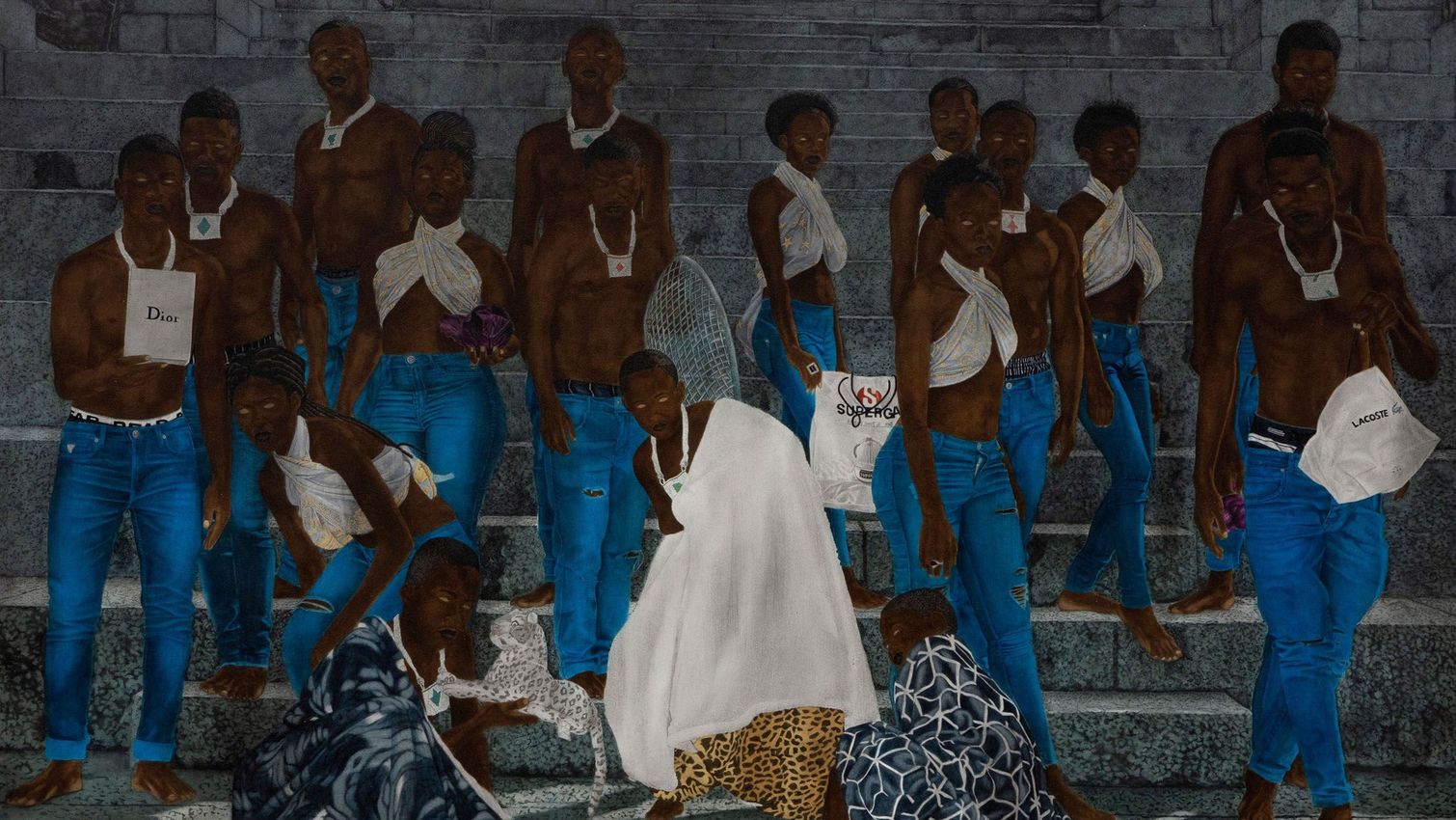
b. 1986, South AfricaCinga Samson (born 1986, Cape Town) is a South African painter known for figurative oil paintings that fuse contemporary realism with dreamlike, spiritual atmospheres. Working primarily with large-scale group scenes and heightened self-portraits, Samson is best known for his dark, velvety palettes, ceremonious compositions, and figures whose pupil-less eyes suggest a state of spiritual alertness rather than simple opacity. His paintings explore youth, blackness, masculinity, and spirituality in relation to globalisation and local traditions, often staging nocturnal or crepuscular encounters that feel suspended between the everyday and the mythic. Samson’s work has been shown at White Cube in London, at institutions including The FLAG Art Foundation in New York and Minneapolis Institute of Art, and in key group exhibitions such as Mapping Black Identities and Kubatana.
Early Life and Career Development
Samson was born in 1986 in Cape Town and grew up moving between the Eastern and Western Cape, an experience that later informed his sensitivity to landscape and social environment. He is largely self-taught: at 19 he encountered an artist’s studio for the first time and went on to share a workspace with painters Gerald Tabata, Xolile Mtakatya, and Luthando Laphuwano, who helped him develop his craft outside of formal art-school structures.
He first gained attention through exhibitions at Cape Town gallery blank projects, where a sequence of solo shows in 2015, 2016, 2017, and 2019 introduced his now-signature figures—young men posed with quiet intensity in tightly staged environments. Recognition accelerated with the prestigious Tollman Award for the Visual Arts in 2017 and his first solo exhibition in the Americas, Amadoda Akafani, Afana Ngeentshebe Zodwa (men are different, though they look alike), at Perrotin, New York in 2020. In 2023 White Cube announced exclusive global representation, cementing Samson’s position within an international network of contemporary painting.
Works, Series and Methods
Signature style: dark light and pupil-less eyes
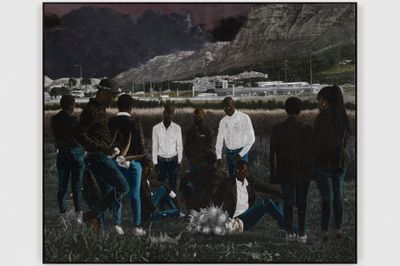
Samson’s paintings are immediately recognisable for their dense, dark tonalities and carefully controlled light, in which figures emerge from atmospheres that are closer to twilight than full night. Across large group scenes and more intimate portraits, his subjects often appear with blank, pupil-less eyes, a motif that complicates conventional ideas of visibility and recognition. Rather than signalling absence, these eyes evoke a heightened, almost visionary state linked to isiXhosa understandings of sleeplessness as spiritual vigilance, and invite viewers to consider alternative ways of seeing and being seen.
Compositionally, Samson draws from a long history of figurative painting—including religious scenes, portraiture, and history painting—while situating his characters in contemporary dress and settings. The result is a confident assertion of Black presence within canons of painting that have historically excluded it, while avoiding straightforward narrative or illustration.
Group scenes, self-portraits and constructed communities
Many of Samson’s best-known works present groups of young men whose gestures and subtle shifts of posture hint at unspoken social codes. In these large-scale compositions, bodies are arranged with choreographic care, often facing the viewer or each other in poised, almost ritualistic formations. The mood oscillates between camaraderie, menace, and introspection, echoing themes of masculinity, vulnerability, and power in post-apartheid South Africa and beyond.
Alongside these scenes, Samson’s self-portraits push the question of representation further, frequently staging the artist in ceremonious or elevated roles that complicate the line between individual identity and archetype. These images function as both personal and collective projections, folding ideals of success, spirituality, and social mobility into a single figure whose unreadable gaze resists easy decoding.
Landscapes, animals and recent developments
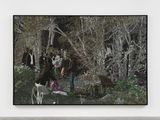
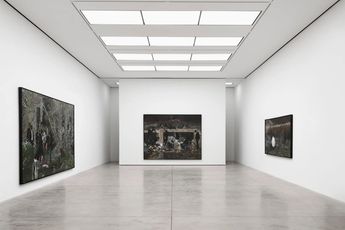
Recent exhibitions have extended Samson’s language into more stripped-back landscapes populated by a few enigmatic animal figures. In the White Cube exhibition Nzulu yemfihlakalo (2023) at Mason’s Yard, London, the upstairs space featured largely barren scenes inhabited by roaming dogs and other animals, their forms partially obscured in moody, deserted environments. This shift towards “landscape once removed”, developed further in the 2025 White Cube Bermondsey exhibition Alien Shores: landscape, once removed, opens his practice out to questions of migration, estrangement, and the psychological charge of place.
Across all these bodies of work, Samson paints exclusively in oil using a slow, layered technique that lends his surfaces a rich, almost lacquered finish. The meticulous handling of paint underscores the tension between the familiarity of his subject matter—friends, local scenes, everyday clothes—and the otherworldly, symbolic registers his compositions inhabit.
Themes and Context
Samson’s work addresses youth, blackness, masculinity, and spirituality against the backdrop of rapidly globalising contemporary life. His figures occupy liminal spaces—between day and night, village and city, tradition and aspiration—that mirror broader negotiations of identity in post-apartheid South Africa and the wider African diaspora. By combining elements of ceremonial dress, casual streetwear, and stylised gestures, his paintings stage a dialogue between inherited traditions and the visual codes of fashion, music, and social media.
Within contemporary art, Samson is often positioned within a wider resurgence of figurative painting, yet his work stands apart through its refusal of straightforward realism. His scenes drift between reality and fantasy, weaving spiritual symbolism into portraits that are also about class, aspiration, and belonging. In this sense his practice contributes to ongoing conversations around Black figuration, representation, and the politics of visibility, while insisting on ambiguity and interiority over didactic messaging.
Cinga Samson FAQs
What is Cinga Samson best known for?
Cinga Samson is best known for his figurative oil paintings of young Black men and self-portraits rendered in a dark, atmospheric palette, with figures often shown with pupil-less eyes and ritualistic poses. His paintings have become synonymous with a blend of spiritual symbolism, contemporary fashion, and psychologically charged group scenes.
What themes does Cinga Samson explore in his work?
Cinga Samson’s work explores youth, blackness, masculinity, spirituality, and the tensions between tradition and contemporary life. Through staged scenes that hover between realism and fantasy, he addresses how people negotiate identity, aspiration, and belonging in a globalised, post-apartheid society.
How does Cinga Samson’s painting relate to global figurative art?
Cinga Samson’s paintings inhabit and extend a long figurative tradition, drawing on historical portraiture and religious or ceremonial compositions while firmly locating his subjects in contemporary African contexts. His contribution to global figuration lies in how he asserts Black presence and spiritual complexity within that lineage, using ambiguity, darkness, and symbolic detail rather than straightforward narrative.
Ocula | 2026




Explore Cinga Samson's Exhibitions






Explore and Follow Artists Shaping Contemporary Art
A respected voice in contemporary art discourse.
Focusing on ambitious storytelling and insightful art-world commentary. Ocula Magazine publishes in-depth interviews, critical essays and timely analysis on the artists, exhibitions and ideas driving the global art world.
Learn more about Ocula Magazine
Showcasing the best of the art world.
Ocula partners with galleries from around the world to highlight their artists, artworks and exhibitions. Gallery membership is by application and invitation, with each member vetted by an independent panel.
Learn more about Ocula Membership
Specialises in the sale of major artworks.
Led by a team with deep ties to the world’s leading auction houses, galleries and collectors. Ocula’s advisory team offers bespoke services to high-net-worth clients from around the world who are looking to acquire the best of contemporary and modern art.
Learn more about our team and services