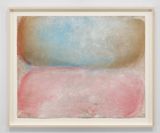
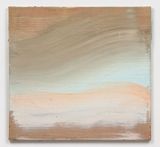
Over the course of 70 years, Ed Clarke’s explorations with pure color, abstract form, and the possibilities of paint yielded an output of remarkable originality, extending the language of American abstraction.
He experimented with numerous different ways of applying colour, including through his use of a broom, creating known horizontal bands of colours to undulating lines.
Russian influence
Clark initially painted in the figurative mode, as seen in his Self-portrait (1949—1951), which shows the young artist dressed in a gingham shirt and a blue coat against an abstracted background of black and yellow. Not long after moving to Paris during the 1950s, he was influenced by the Russian-born artist Nicolas de Staël to adopt brighter colours and abstraction, as seen in paintings such as The City or Portrait of Muriel (both 1952).
It was also in Paris that Clark began using the broom as his primary tool, having picked it up while looking for something that was wider than a paintbrush. With the canvas on the floor, the artist would use the broom to sweep blocks of pigment, creating the broad bands of colour imbued with movement and energy that came to characterise his paintings.
New York
In 1957, Clark returned to the United States, living between America and France over the following years. Settling in New York, he co-founded the artist-run Brata Gallery in the East Village, which went on to show the abstract works of Ronald Bladen, Al Held, John Krushenick, Sal Romano, and George Sugarman, among others.
Later that year, participating in the Christmas group show at Brata, Clark presented his first shaped painting. It is considered to be possibly the first use of a shaped canvas in America. The untitled work, depicting an abstract composition of green, blue, white, black, and grey, broke beyond the rectangular frame of the canvas through two pieces of paper that the artist had collaged onto it.
Elliptical Paintings
In 1968, then living in Vetheuil, France, Clark made his first oval-shaped painting—a shape he considered to be the closest to human vision. One such work, The Big Egg (1968), is composed of a sliver of pink at the very bottom, a middle-ground of bright blue and grey, and orange with a dash of white at the top. The largely horizontal bands of colours are not separated by hard edges or seamlessly integrated into one another but achieve harmony through Clark’s attention to their intensity. Clark also retains the rough marks left by the bristles of the broom, which add texture and a sense of depth to the painting.