





EDOUARD VUILLARD
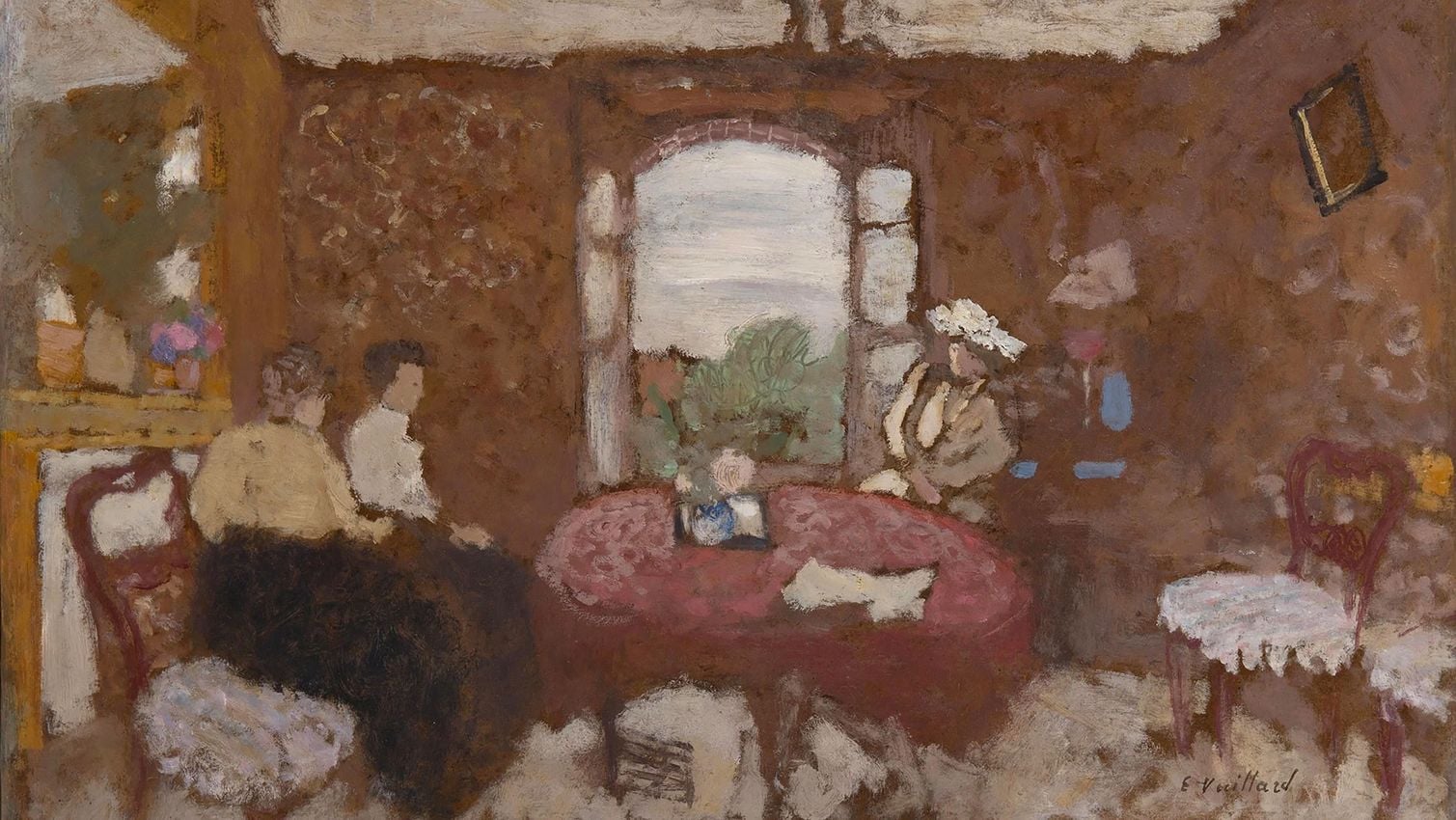
1868-1940, FranceÉdouard Vuillard was a French painter, printmaker, and decorative artist who painted intimate interior scenes. The artist was a prominent member of the Nabis group in the 1890s, and his works are characterised by rich patterns, flattened perspectives, and a focus on the private lives of his subjects.
When was Édouard Vuillard born?
Born on 11 November 1868 in Cuiseaux, France, Vuillard was the son of a retired army officer who died when the artist was only 15. His mother was a seamstress, a craft that would leave an enduring impression on the young painter’s work.
In 1877, the family relocated to Paris, where Vuillard attended the Lycée Condorcet. There, he met other artists like Pierre Bonnard. He later studied at the Académie Julian and the École des Beaux-Arts, immersing himself in the Parisian art scene.
When did Édouard Vuillard join the Nabis?
In 1889, Vuillard joined the Nabis (‘Nabi’, the word for ‘prophet’ in Arabic and Hebrew), a group of avant-garde artists committed to exploring symbolic and spiritual themes in art. Most of the group met whilst studying at Académie Julian, and they shared an admiration of the work of Cezanne, Gauguin, and Japanese Ukiyo-e (woodblock prints). Japanese art and objects were particularly popular in Paris from the 1860s following the lifting of a 250-year trade embargo between the two countries. Vuillard and the other Nabis artists were fascinated by the flattened planes of colour and intricate detailing.
What styles and themes are present in Édouard Vuillard’s work?
Vuillard’s paintings are celebrated for their depiction of intimate, domestic settings, reflecting his personal experiences and relationships. He frequently portrayed his mother and friends in their homes, capturing the essence of bourgeois life in late 19th—and early 20th-century France. His use of rich textiles and wallpapers, combined with a subtle colour palette, created a sense of warmth and familiarity.
Interior, Mother and Sister of the Artist (1893)
The artist’s close family members are depicted in their apartment. The artist’s mother commands a dominating presence within this small painting, the epicentre of perspectival lines, and her dress the largest expanse of unmodulated dark paint. In comparison, the figure of the artist’s sister in a tartan dress almost diffuses into the pointillist texture of the wallpaper behind. The work has been collected by the Museum of Modern Art in New York.
Girl in an Interior (c. 1910)
In this portrait, a young woman is seated on a red couch next to a tea set. The vibrancy of the red upholstery, the pink hues of the patterned background, and the highlights of the gold trim on the tea set—picked out in flickering yellow—exemplify the equal weight that Vuillard gives to his settings and sitters. The work is part of the Tate collection in the United Kingdom.
What were Édouard Vuillard’s most important exhibitions?
- Vuillard, The Museum of Modern Art, New York (6 April–6 June 1954).
- Intimate Interiors of Edouard Vuillard, Brooklyn Museum, New York (18 May–30 July 1990).
- Edouard Vuillard (1868-1940), Galeries nationales du Grand Palais, Paris (25 September 2003–4 January 2004). Organised by Musée d’Orsay.
What is Édouard Vuillard’s legacy?
After the disbandment of the Nabis around 1900, Vuillard’s style evolved towards a more naturalistic approach, though he maintained his focus on interior scenes. He also ventured into portraiture, capturing notable figures of French society. Vuillard continued to work prolifically until his death on 21 June 1940 in La Baule, France. Today, his works are held in major museums worldwide.
Hazel Ellis | Ocula | 2025










Explore and Follow Artists Shaping Contemporary Art
A respected voice in contemporary art discourse.
Focusing on ambitious storytelling and insightful art-world commentary. Ocula Magazine publishes in-depth interviews, critical essays and timely analysis on the artists, exhibitions and ideas driving the global art world.
Learn more about Ocula Magazine
Showcasing the best of the art world.
Ocula partners with galleries from around the world to highlight their artists, artworks and exhibitions. Gallery membership is by application and invitation, with each member vetted by an independent panel.
Learn more about Ocula Membership
Specialises in the sale of major artworks.
Led by a team with deep ties to the world’s leading auction houses, galleries and collectors. Ocula’s advisory team offers bespoke services to high-net-worth clients from around the world who are looking to acquire the best of contemporary and modern art.
Learn more about our team and services